Featured Articles
Popular Articles
-
 Dremio Blog: Open Data Insights
Governing Apache Ossie Semantic Models in Apache Polaris: APIs, Privileges, and Scope
-
Dremio Blog: Open Data Insights
Operating Apache Polaris with the Admin Tool: Bootstrap, Purge, and Metastore Maintenance
-
Dremio Blog: Open Data Insights
Running Apache Polaris with MongoDB: NoSQL Persistence, Bootstrap, and Maintenance
-
Dremio Blog: Open Data Insights
Atomic CTAS and RTAS with Apache Iceberg: Catalog Choice, Staging, and Rollback
Browse All Blog Articles
-

 Dremio Blog: Various Insights
How Dremio’s Agentic Lakehouse is Turning Data into Action
For decades, the traditional data experience has been defined by friction, with business teams frequently required to wait. Waiting for SQL experts to draft queries, waiting for ETL pipelines to refresh, and waiting for static dashboards to render. This reactive model has gone past being just a bottleneck and now represents an existential risk for […]
-
Engineering Blog
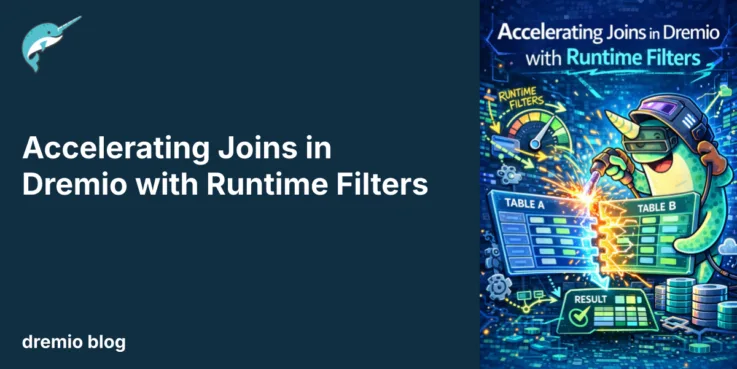
Accelerating Joins in Dremio with Runtime Filters
Runtime filters in Dremio are an opportunistic, runtime‑only optimization: they do not replace good data modeling, partitioning, or reflections, but they stack on top of those fundamentals to remove work that is provably useless for a specific query run.
-
Product Insights from the Dremio Blog
Customer 360: The complete guide
Learn how to build a customer 360 dashboard that unifies customer data and see how Dremio powers scalable, AI-ready analytics for enterprises.
-
Product Insights from the Dremio Blog
Best 9 agentic analytics tools to improve reporting
Explore the nine best agentic analytics tools for data analysis in 2026, and learn why Dremio is the top solution for enterprise users.
-
Product Insights from the Dremio Blog
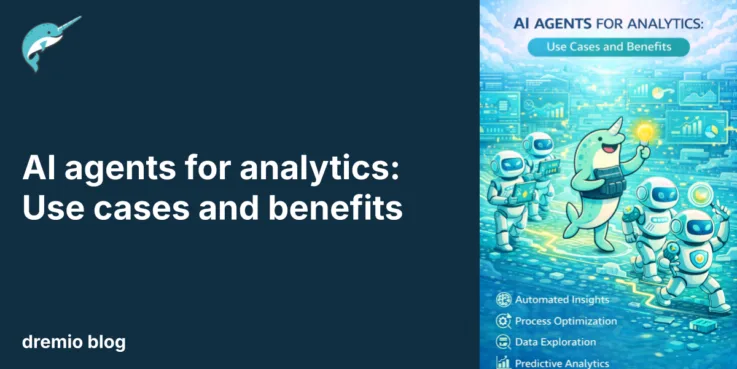
AI agents for analytics: Use cases and benefits
Discover how analytics AI agents drive faster decisions when powered by a governed, scalable lakehouse foundation built for enterprise data.
-
Dremio Blog: Various Insights
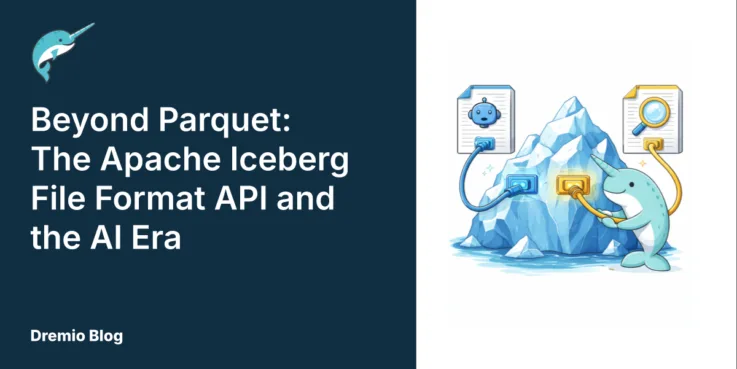
Beyond Parquet: The Apache Iceberg File Format API and the AI Era
The Apache Iceberg community recently finalised a new File Format API, scheduled for the upcoming 1.11.0 release. It is a strategic architectural shift that decouples the object model from the physical storage layout. The aim? To make file formats engine-agnostic, so Apache Iceberg can integrate with new formats without rewriting the core engine logic every […]
-
Dremio Blog: Various Insights
The Compounding Cost Advantage of the Agentic Lakehouse
How data architects can close the gap between the AI mandate and the infrastructure that actually delivers it If you are a data architect right now, you are likely operating under some version of the same executive mandate: implement AI, and do it fast. The pressure is real. So is the gap between what leadership […]
-
Engineering Blog
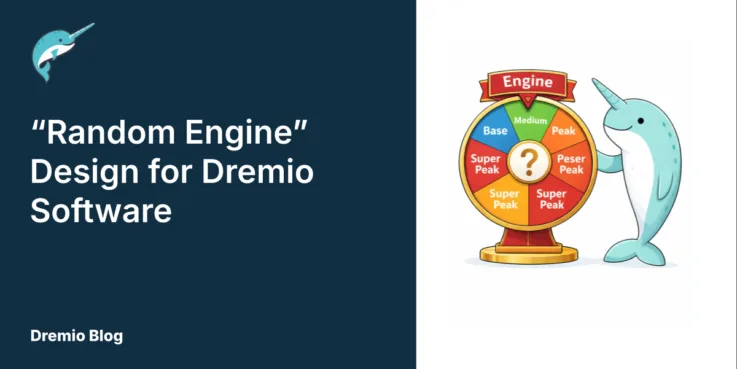
“Random Engine” Design for Dremio Software
Current Architecture (Conceptual) The current Dremio Software architecture often uses a fixed pool of executor engines. While this provides stability for baseline workloads, it struggles to handle predictable spikes in demand, leading to performance bottlenecks during peak periods, and overallocation of engines during quieter periods. Overallocation can have an impact on Cloud costs. This document’s […]
-
Product Insights from the Dremio Blog
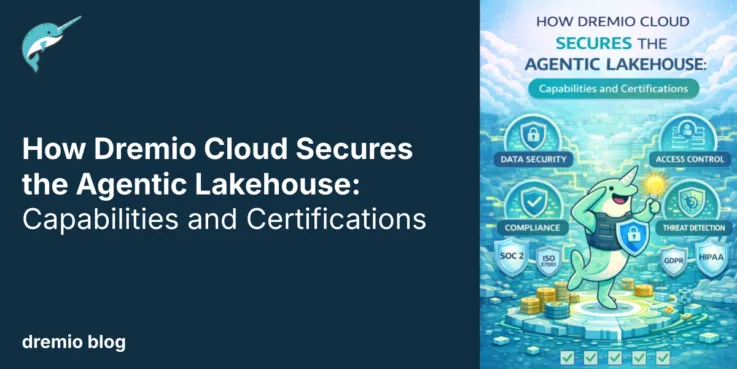
How Dremio Cloud Secures the Agentic Lakehouse: Capabilities and Certifications
The safest data architecture is one where data doesn't move, policies are unified in a central catalog, and every query is authenticated, authorized, and encrypted. By abstracting the complexity of data access and enforcing fine-grained controls at the catalog level, Dremio secures the data foundation so your teams—and your AI agents—can explore insights freely.
-
Product Insights from the Dremio Blog
Keep Databricks for ETL. Cut Analytics Costs.
Dremio's Agentic Lakehouse provides an alternative for the workloads that drive the highest Databricks spend: interactive analytics, BI dashboards, and ad-hoc queries. By offloading these queries to Dremio's engine with Autonomous Reflections, you eliminate the DBU consumption and the underlying cloud compute for 60-80% of your analytical workload. Meanwhile, Databricks stays in place for the heavy processing it does well: ETL pipelines, ML training, and Spark-based transformations.
-
Product Insights from the Dremio Blog
Shift Dashboards off Redshift and Cut Costs 40-60%
Dremio provides an alternative: keep Redshift for the workloads that need it, but offload the repetitive, expensive dashboard and reporting queries to Dremio's engine. Dremio's Autonomous Reflections serve those queries from Apache Iceberg tables on your own S3 storage, bypassing Redshift compute entirely. The result is a 40-60% reduction in Redshift compute costs in the first month, without migrating a single table.
-
Product Insights from the Dremio Blog
Offload Snowflake Dashboards. Lower Spend Fast
Dremio provides a different approach. Instead of replacing Snowflake entirely, you can layer Dremio on top of it, offloading the expensive, repetitive queries to Dremio's engine while keeping Snowflake for the workloads it handles best. Dremio's Autonomous Reflections, AI-powered analytics, and federated query engine reduce the compute Snowflake needs to process, often cutting the bill by 40-60% in the first month.
-
Product Insights from the Dremio Blog
One Click with Dremio’s Claude Connector Using MCP
If your team manages both a warehouse and a lake, give Claude the context it needs to actually help you. Using a dedicated MCP server bridges the gap between powerful language models and your complex data architecture.
-
Dremio Blog: Various Insights
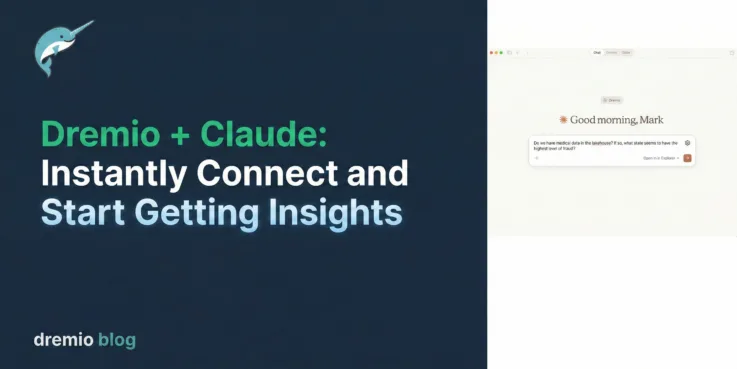
Claude + Dremio: Instantly Connect and Start Getting Insights
Today we're making it super simple to use Claude, Claude Cowork, and Claude Code with Dremio. The new Claude connector for Dremio Cloud lets anyone instantly connect Anthropic's Claude to their lakehouse.
-
Dremio Blog: Various Insights
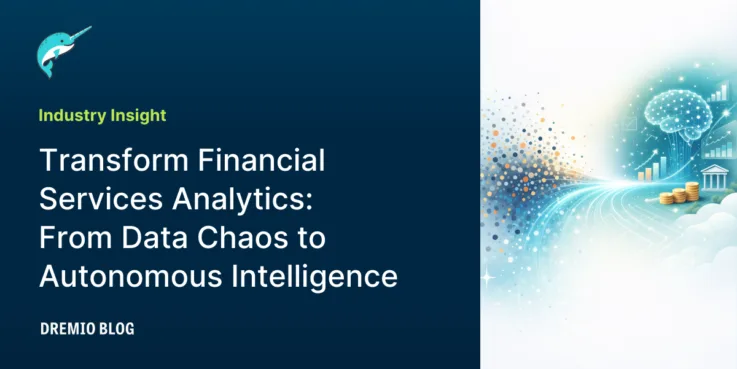
Transform Financial Services Analytics: From Data Chaos to Autonomous Intelligence
The Data Crisis Crippling Financial Services Most financial institutions today face the same bottleneck: fragmented, slow, and costly data systems that cripple the adoption of AI. Analysts wait hours for risk reports. Data engineers spend most of their time tuning queries instead of innovating. And autonomous AI agents hit performance walls and data inconsistencies that […]








- « Previous Page
- 1
- …
- 10
- 11
- 12
- 13
- 14
- …
- 50
- Next Page »