18 minute read · January 25, 2026
Why Agentic Analytics Requires Federation, Virtualization, and the Lakehouse: How Dremio Delivers

· Head of DevRel, Dremio

Agentic analytics is here. AI agents don’t wait for instructions. They take a question, explore the data, and find the next question before you ask it.
This changes everything.
It changes how people interact with data. It changes how quickly teams get answers. And it changes what the platform needs to do.
Traditional tools weren’t built for this. They expect users to know SQL, understand schemas, and move data into the right place. That breaks the agentic model.
Agentic analytics needs three things: federation, virtualization, and a lakehouse that works for both humans and machines. These features aren’t optional. Without them, natural language analytics stalls before it starts.
Dremio is the only platform that combines all three in one system. It gives agents the access, context, and speed they need, without ETL, without guesswork, and without delay.
This is what the Agentic Lakehouse looks like. Let’s break it down.
What Is Agentic Analytics?
Agentic analytics means AI does the work of an analyst, without needing one. A user starts with a goal. The agent takes it from there.
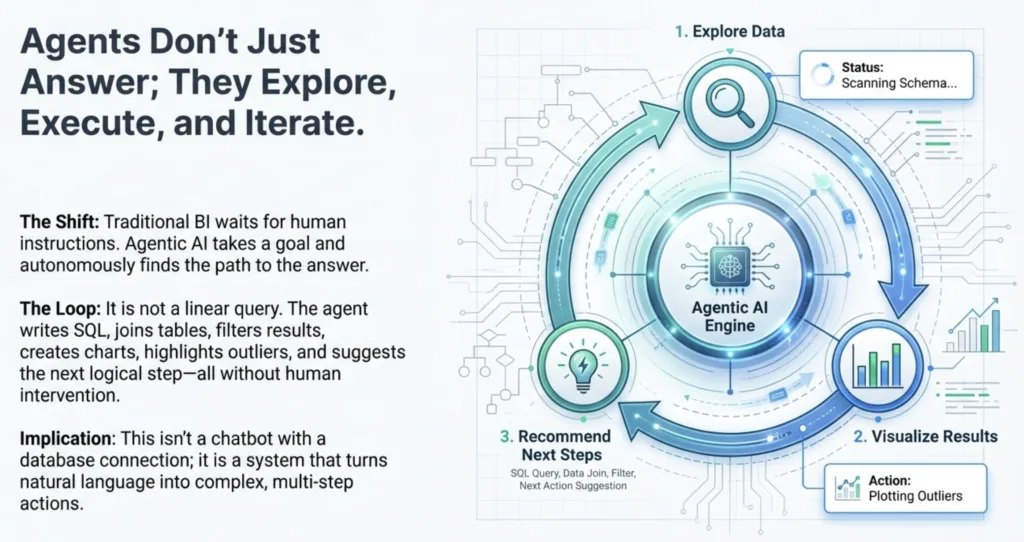
It writes SQL. It joins tables. It filters and tests results. It creates charts, highlights outliers, and suggests what to check next.
This isn’t a chatbot with a database. It’s a system that turns natural language into actions, and keeps going.
The agent works in a loop:
- First, it explores the data.
- Then, it visualizes the results.
- Finally, it recommends next steps.
That loop keeps the analysis moving. The user focuses on decisions. The agent handles execution.
This model makes analytics faster. It also makes it more accessible. Anyone can ask a question. The platform handles the rest.
But to make that possible, the architecture behind the agent must change. Let’s look at what that requires.
Why Agentic Analytics Needs a Different Stack
Agentic analytics sounds simple. Ask a question. Get answers. Ask the next one.
But to work at scale, it needs more than a fast database or a clever interface. It needs a stack that can support AI-driven analysis across all data, with no friction.
Here’s what that means.
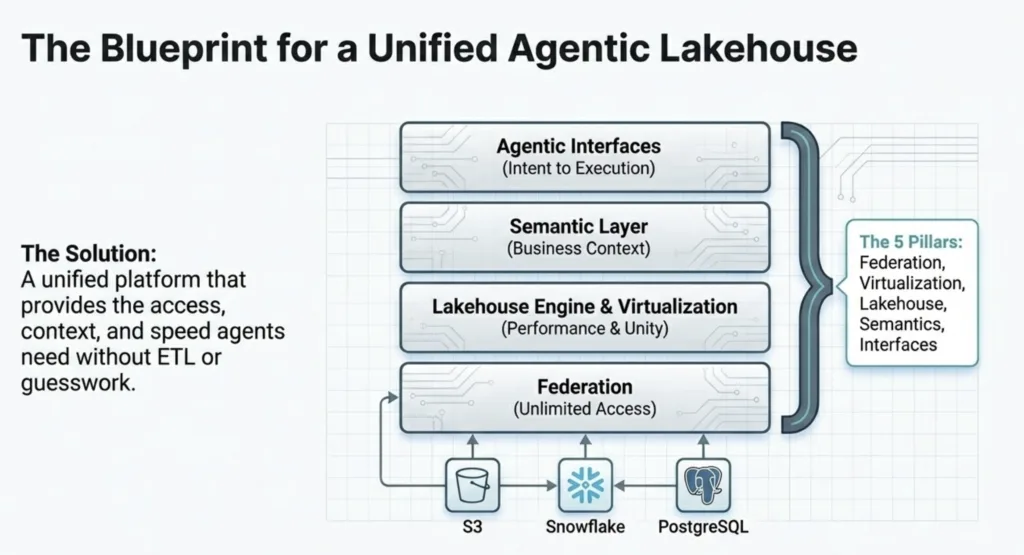
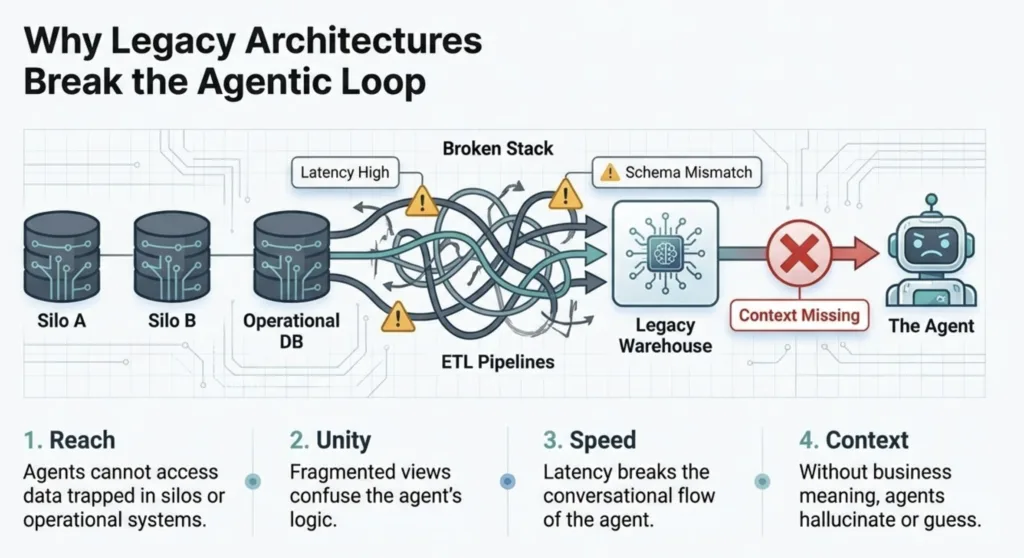
First, the agent needs to reach data wherever it lives. That includes data lakes, warehouses, and operational systems. Moving data into one place first breaks the flow.
Second, the agent needs to see a clean, unified view of the data. Tables from five systems must look like one. Agents can’t spend time decoding storage formats or connection settings.
Third, the agent needs performance. Fast answers matter. So does cost. A platform built for agentic analytics must deliver both.
Last, the agent needs context. It has to understand business terms, logic, and relationships to choose the right data and apply it correctly.
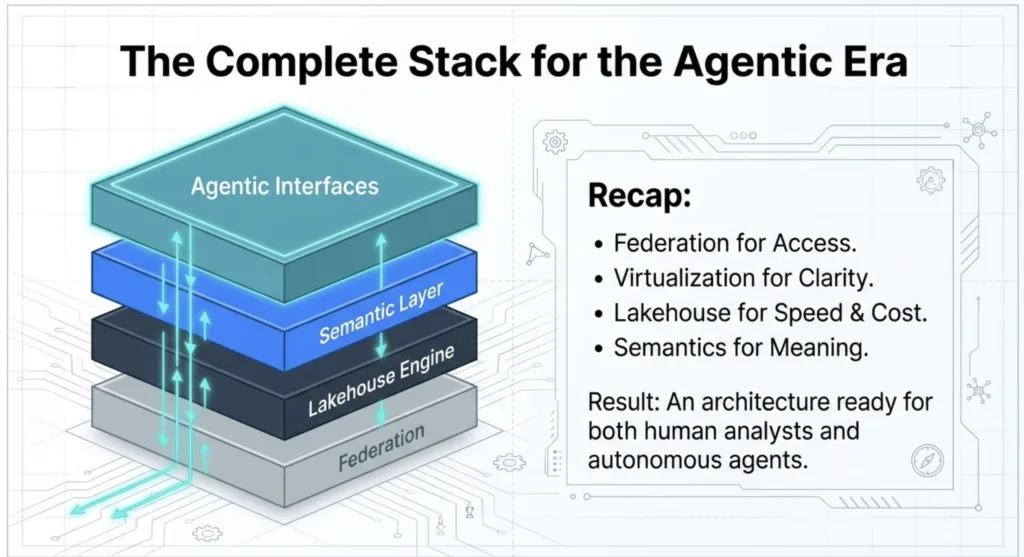
This is why federation, virtualization, and the lakehouse matter. Together, they give agents the access, structure, and speed they need. Without them, natural language analytics falls apart.
Now let’s look at each piece.
Try Dremio’s Interactive Demo
Explore this interactive demo and see how Dremio's Intelligent Lakehouse enables Agentic AI
Federation: Agents Need Access to Everything
Agentic analytics can’t stop at one system. The agent needs to ask questions that span multiple databases, data lakes, and warehouses. That only works if the platform supports federation.
Federation lets agents query across systems without copying data. Everything stays in place. There’s no ETL. No sync jobs. Just live access to live data.
This matters for natural language analytics. When a user asks a question, the agent might need customer data from a warehouse, event data from object storage, and product details from an operational system. With federation, it can query all three at once.
Dremio has this built in. Its engine runs federated queries across cloud storage, relational databases, and Apache Iceberg tables. It understands how to optimize joins across sources, so agents get results fast without moving data first.
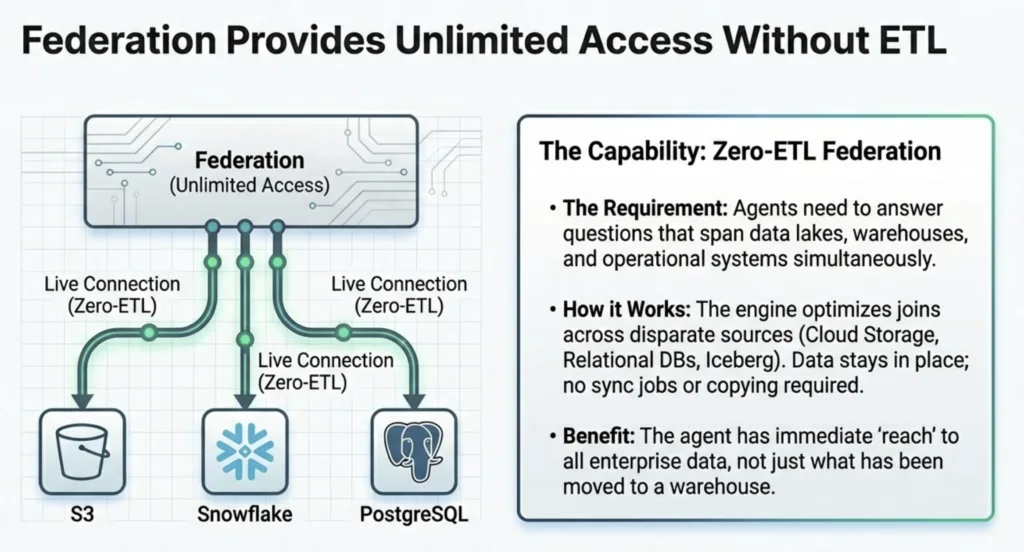
Federation is the first step toward a working Agentic Lakehouse. It gives the agent reach. Now it needs clarity. That’s where virtualization comes in.
Virtualization: One View for the Agent
Federation solves access. But access isn’t enough. The agent still needs to understand what it's looking at.
That’s the job of virtualization.
Data virtualization creates a single, logical view across all sources. Tables from different systems appear as one unified catalog. Connection details, file formats, and storage types stay hidden.
This is critical for agentic analytics. AI agents don’t reason like engineers. They don’t care where data lives or how it’s stored. They need a clean, consistent interface that reflects business logic, not infrastructure.
Dremio delivers that. It lets teams define virtual datasets using SQL. These views can combine fields from multiple sources, join them, filter them, and expose them under a shared namespace.
The result: Agents see one system. Not ten. They act faster. They make fewer mistakes. And they don’t need custom code for every source.
Virtualization is what makes the platform feel simple, even when the backend is complex.
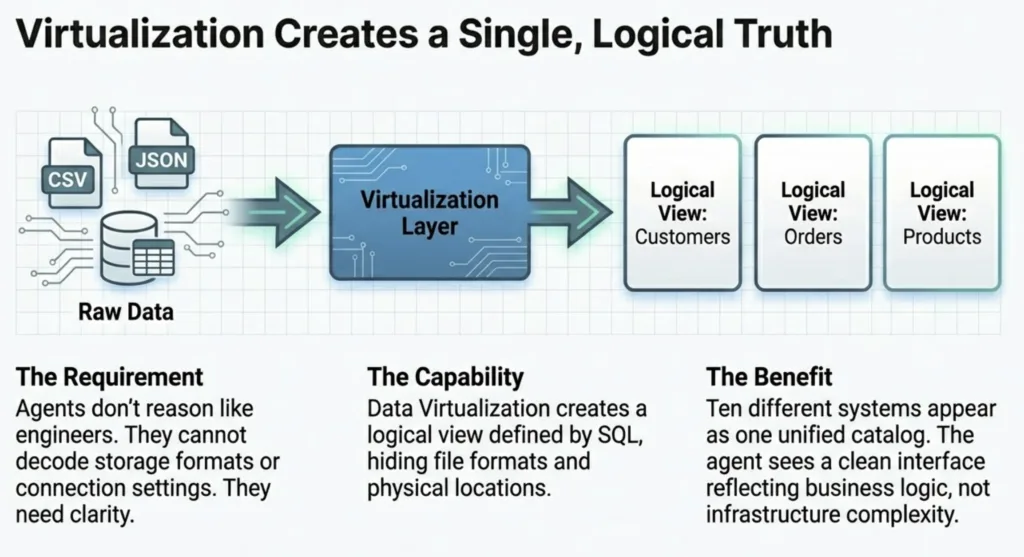
Next, we’ll look at the engine that brings it all together: the lakehouse.
The Lakehouse: One Engine, Lower Costs, Faster Results
Federation gives agents access. Virtualization gives them clarity. But performance and cost still depend on where the data lives and how it's stored.
That’s where the lakehouse comes in.
A lakehouse turns your object storage into an open, high-performance analytics system. It gives you the features of a warehouse; tables, schema enforcement, time travel, without locking you into a vendor. With Apache Iceberg, you get full table management on your data lake, built for interoperability.
This solves two problems.
First, it lowers costs. Traditional data warehouses charge for compute and storage, often at scale. Moving that data into Iceberg-based tables on your lake reduces those costs while keeping performance high.
Second, it simplifies architecture. Instead of copying data into a separate system for analytics, you run everything on the lake, directly on Iceberg.
Dremio takes this further.
Dremio uses the lakehouse not just for storage, but for acceleration. Its Reflections feature creates optimized physical layouts of virtual datasets, using Apache Iceberg under the hood. These accelerate queries without agents, or users, needing to know how Iceberg works.
As you migrate data from existing warehouses to an Iceberg lakehouse, Dremio adapts. You start by querying warehouse data directly. As you move data into the lake, Dremio applies autonomous performance features, like caching and intelligent optimization.
The result: Better speed, lower cost, and a single system for agentic analytics, through every stage of your migration.

Next, let’s talk about meaning, and how the semantic layer gives agents the context they need.
The Semantic Layer: Context That Guides the Agent
Agents can access data. They can query it. But can they understand it?
Not without context.
The semantic layer gives AI agents the business meaning behind your data. It defines key metrics, joins, filters, and labels in one place, so the agent doesn’t guess.
Instead of raw column names, agents see tags like “Revenue” or “Customer Region.” Instead of hunting through table schemas, they follow lineage and documentation. This reduces mistakes and builds trust in the answers.
Dremio includes a unified semantic layer by design. Teams can define SQL-based views that span any connected source. They can add metadata, tags, and descriptions that guide both users and AI agents. And they can expose these definitions consistently across tools and teams.
Natural language analytics depends on this layer. It’s what lets a question like “What were sales by product category last quarter?” return the right results, every time.
The semantic layer turns data into something agents can reason about. It shortens the path from question to answer, and makes the answer easier to trust.

Now let’s look at how that answer actually gets delivered.
Agentic Interfaces: From Intent to Execution
Once the agent understands the data, it needs a way to act.
Agentic interfaces connect user intent to platform execution. They let people ask questions in natural language, and let agents translate that intent into queries, visualizations, or deeper exploration.
Dremio offers this in two ways.
First, there’s a built-in assistant. Users can type a plain-language question, and Dremio turns it into a query using the semantic layer. It returns results with charts and follow-up suggestions, without writing SQL.
Second, Dremio supports integration through the MCP server. This lets teams connect external agents, apps, and clients directly to the platform. The interface is consistent, so every agent works the same way, whether it’s embedded in a dashboard or deployed as a custom solution.
This consistency matters. It means users don’t need to learn five tools. And AI agents can interact with data reliably, without rewriting logic for every workflow.
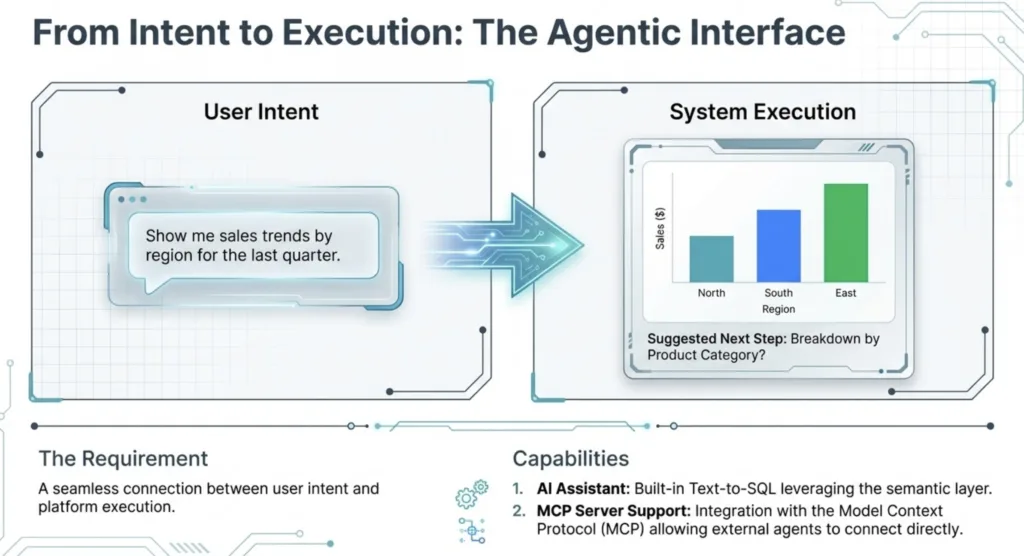
Agentic interfaces are where people, agents, and the lakehouse meet. They complete the loop; from intent to insight, without adding friction.
Why the Agentic Lakehouse Must Be Unified
You can try to stitch this together, federation from one vendor, semantics from another, and a warehouse on top. But every extra piece adds complexity. And complexity breaks agentic analytics.
Agents need consistency. They need fast access, clear meaning, and predictable performance. A fragmented stack can’t deliver that.
Dremio is built as one system. Federation, virtualization, the semantic layer, and lakehouse acceleration all work together. Metadata stays aligned. Business logic is shared. Queries run faster because the platform understands how each layer connects.
This unified design also reduces cost and overhead. There’s no need for separate ETL pipelines, query engines, or semantic services. Everything happens in one place.
And it scales. As more users adopt natural language analytics, and more agents drive analysis, the system holds up, because it was designed for this.

The Agentic Lakehouse isn’t a marketing label. It’s an architecture that works. Dremio is where it comes together.
Start Where You Are. Evolve at Your Pace.
Most teams aren’t starting from scratch. They already use data warehouses, lakes, and BI tools. The shift to agentic analytics doesn’t mean replacing everything on day one.
Dremio fits into your current stack. It can query warehouse data directly, join it with files from cloud storage, and expose it all through a single interface. AI agents can work with this data right away, no migration needed.
Then, as you move more data into Apache Iceberg tables, Dremio gives you even more. Reflections accelerate query speed without any manual tuning. Caching and autonomous performance management reduce costs behind the scenes.
You don’t need to choose between flexibility and performance. With Dremio, you get both.
And as your data estate evolves, the agent doesn’t have to change how it works. It always sees one catalog. One set of definitions. One path from question to answer.
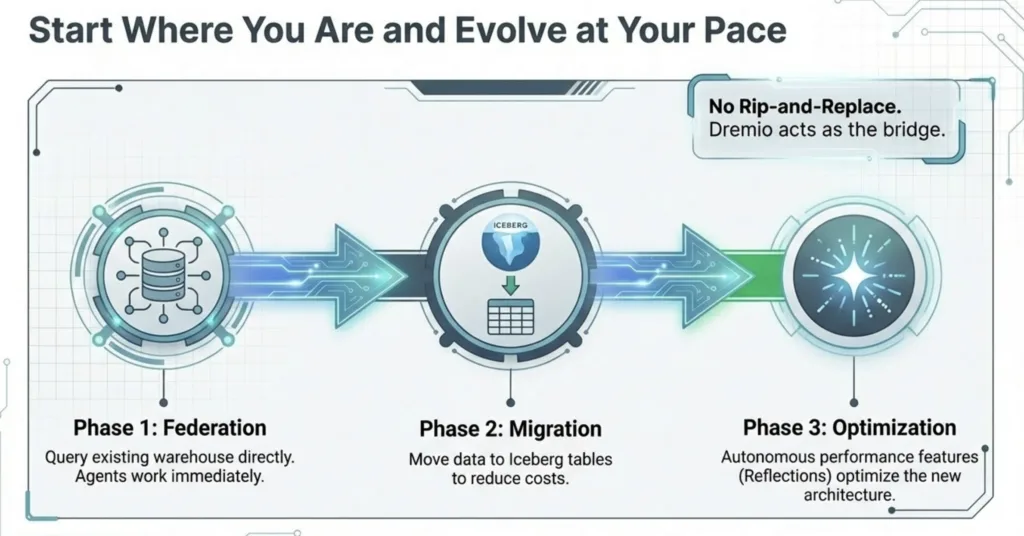
Dremio gives you agentic analytics today, and a clear path to the Agentic Lakehouse of tomorrow.
Experience Agentic Analytics with Dremio Cloud
Agentic analytics isn’t a trend. It’s the next phase of how organizations work with data. AI agents need access, speed, and context, across every system your business relies on.
Dremio is the only platform that delivers this in a unified, open architecture. It combines zero-ETL federation, real-time virtualization, a context-rich semantic layer, and lakehouse acceleration—ready for both humans and machines.
Whether you're exploring natural language analytics, building with AI agents, or scaling your Iceberg lakehouse, Dremio is built for you.
Start now. Experience agentic analytics in action with a free trial of Dremio Cloud.
FAQ: Agentic Analytics, Agentic Lakehouse, and Natural Language Analytics
What is agentic analytics?
Agentic analytics is a model where AI agents perform analysis based on user intent. They don’t stop at one query. They explore data, create visualizations, and suggest follow-up actions automatically.
What makes a lakehouse “agentic”?
An Agentic Lakehouse supports the needs of AI agents from end to end. It combines open data storage (like Apache Iceberg), fast federated access, and a unified semantic layer. It enables autonomous analytics without data movement or manual setup.
Why do AI agents need federation and virtualization?
Agents must reach all enterprise data without waiting on ETL jobs. Federation gives them live access. Virtualization simplifies that access into one consistent view. Together, they reduce friction and boost accuracy.How does Dremio support natural language analytics?
Dremio includes an AI assistant that turns natural language into queries. It also supports agent connections through MCP. Its semantic layer ensures that answers are accurate and aligned with business terms.
Additional Resources
BLOG
Intro to Dremio, Nessie, and Apache Iceberg on Your Laptop
Dremio Blog: Open Data Insights,
Learn More ->
BLOG
5 Use Cases for the Dremio Lakehouse
With its capabilities in on-prem to cloud migration, data warehouse offload, data virtualization, upgrading data lakes and lakehouses, and building customer-facing analytics applications, Dremio provides the tools and functionalities to streamline operations and unlock the full potential of data assets.
Dremio Blog: News Highlights, Dremio Blog: Open Data Insights,
Learn More ->
BLOG
Dremio Arctic is Now Your Data Lakehouse Catalog in Dremio Cloud
Dremio Arctic bring new features to Dremio Cloud, including Apache Iceberg table optimization and Data as Code.
Dremio Blog: News Highlights, Dremio Blog: Open Data Insights, Product Insights from the Dremio Blog,
Learn More ->