Featured Articles
Popular Articles
-

 Product Insights from the Dremio Blog
The AI Foundation of the Agentic Lakehouse
-
Dremio Blog: Open Data Insights
Why Agentic Analytics Requires Federation, Virtualization, and the Lakehouse: How Dremio Delivers
-
Dremio Blog: Various Insights
Data Warehouse Cost: Pricing & Optimization Tips
-
Dremio Blog: Various Insights
Top 13 Data Lakehouse Tools for 2026



Browse All Blog Articles
-
 Product Insights from the Dremio Blog
3 Python Libraries for Working with Dremio’s Agentic Lakehouse Platform
Dremio's power can be fully leveraged within the Python ecosystem thanks to these versatile community-driven libraries.
-
Product Insights from the Dremio Blog
5 Powerful Dremio AI Features You Should Be Using
Dremio's approach reveals a clear vision for the future of the data stack: AI is not a bolt-on feature but a foundational capability woven throughout the entire data lakehouse platform.
-
Product Insights from the Dremio Blog
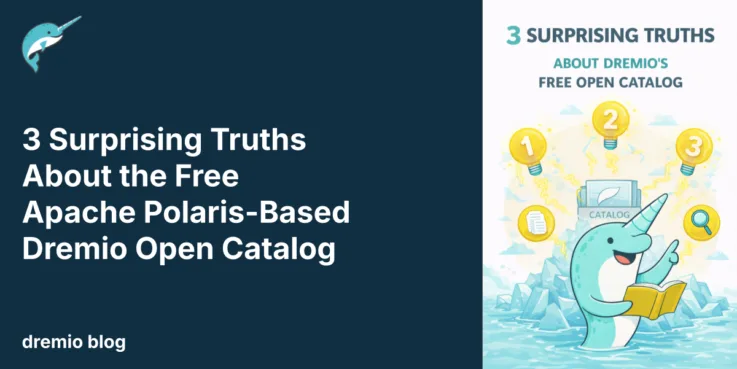
3 Surprising Truths About the Free Apache Polaris-Based Dremio Open Catalog
Dremio’s Open Catalog delivers a free, interoperable, and flexible foundation for the modern data lakehouse. By embracing open standards and a "bring your own" philosophy for compute, storage, and AI, Dremio provides a platform that prioritizes user choice and cost control over vendor lock-in. This commitment to openness gives you the flexibility to select the best tools to achieve your data analytics goals.
-
Product Insights from the Dremio Blog
5 Counter-Intuitive Dremio Performance Tips for Lightning-Fast Iceberg Queries
Achieving elite Dremio performance is a blend of smart architecture, understanding the platform's autonomous capabilities, and applying targeted, tool-assisted tuning. By moving beyond the basics, you can create a truly interactive experience for your data consumers.
-
Product Insights from the Dremio Blog
Beyond the Warehouse: How Dremio Dismantles the ETL Tax for High-Performance BI
Dremio is the engine that finally transforms the lakehouse into a high-performance BI reality. By unifying namespaces, automating acceleration via Reflections, and utilizing the power of Apache Iceberg, it moves the organization away from the "data moving" era.
-
Product Insights from the Dremio Blog
7 Ways Dremio’s Vectorized Architecture Redefines Lakehouse Performance
The Dremio performance story is a narrative of engineering excellence meeting operational simplicity. By combining the efficiency of Apache Arrow, the "magic" of Iceberg-backed Reflections, and the intelligence of an AI-driven optimizer, Dremio has built a system where performance is an automated byproduct of the architecture.
-
Product Insights from the Dremio Blog
Data Ingestion Patterns Using Dremio: From Raw Data to Apache Iceberg
By combining open standards, autonomous lakehouse operations, and agentic interaction, Dremio turns the journey from raw data to trusted insight into an incremental, flexible process, not a long, disruptive platform migration.
-
Dremio Blog: Various Insights
How LLMs Work: Tokens, Embeddings, and Transformers
Large Language Models (LLMs) are capable of understanding and generating language. However, they do not understand or process language in the same way that a person like you or I does. When reading text, humans construct meaning by processing the syntax of each sentence as it unfolds. This involves combining word definitions, using context from […]
-
Product Insights from the Dremio Blog
5 Steps to Supercharge Your Analytics with Dremio’s AI Agent and Apache Iceberg
The traditional barriers between complex, distributed data and clear, actionable answers have been removed. With an intelligent, AI-native data lakehouse, you no longer need to be a data engineer to explore your data; you just need to be curious.
-
Dremio Blog: Various Insights
11 Best AI Tools for Data Engineering
Discover the top AI tools for data engineers. Compare leading platforms and see how Dremio automates pipelines and boosts performance at scale.
-
Dremio Blog: Various Insights
SQL Query Optimization: 18 Proven Techniques and Tips
Explore 18 strategies for optimizing SQL queries and learn how enterprises improve speed, reduce compute costs, and maintain efficient workloads with Dremio.
-
Product Insights from the Dremio Blog
5 Ways Dremio Reflections Outsmart Traditional Materialized Views
Dremio Reflections don't just accelerate queries; they accelerate the entire analytics lifecycle by removing performance tuning from the critical path. By reclaiming the time and cognitive overhead traditionally spent on manual materialization management, Reflections empower data teams to shift their focus from infrastructure management to insight delivery.
-
Product Insights from the Dremio Blog
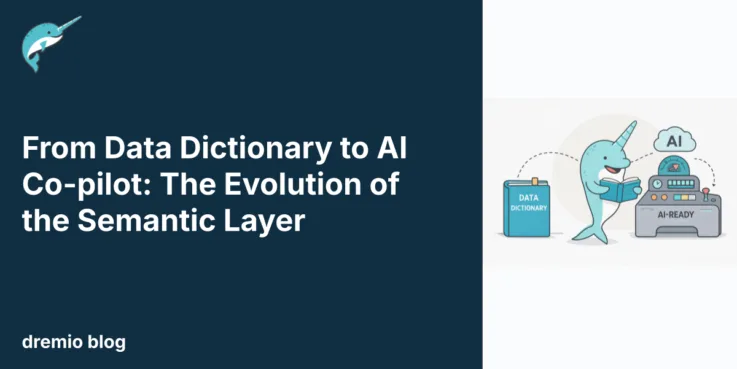
From Data Dictionary to AI Co-pilot: The Evolution of the Semantic Layer
The semantic layer has evolved far beyond its origins as a simple data dictionary. This evolution is marked by five critical shifts: a scalable layered architecture, a focus on serving AI as a primary consumer, a hybrid virtual-physical model for performance, universal federation into a single pane of glass, and governance that is built-in, not bolted-on. It now serves as the critical interface not just for human analysts using BI tools, but for a new generation of AI agents that rely on its rich semantic context to explore, analyze, and generate insights from data.
-
Dremio Blog: Various Insights
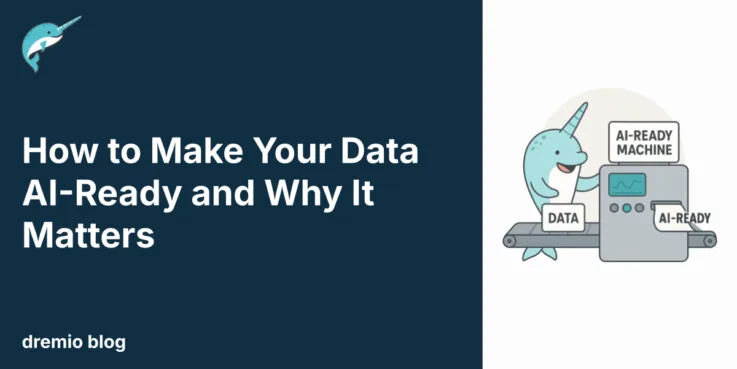
How to Make Your Data AI-Ready and Why It Matters
Discover how AI-ready data drives accuracy, scalability, and efficiency—and how Dremio’s Intelligent Lakehouse simplifies the entire process.
-
Product Insights from the Dremio Blog
Beyond Text-to-SQL: 4 Surprising Truths About the Modern Data Lakehouse
A truly modern data lakehouse is defined by more than just its use of open formats. Its value is measured by its intelligence and completeness. It is a platform where AI can take action, where openness extends to other compute engines, where the semantic layer is a structured and programmable asset, and where performance management is autonomous. These integrated capabilities are shifting the baseline for what organizations should expect from a data platform. The focus is no longer just on storing and querying data, but on creating a self-managing, intelligent, and truly unified ecosystem. As you evaluate your data strategy, ask yourself a forward-looking question: As AI becomes a more active participant in our data ecosystems, how will you leverage it to not just analyze your business, but to help run it?















- « Previous Page
- 1
- 2
- 3
- 4
- …
- 37
- Next Page »