52 minute read · November 29, 2022
What Is a Semantic Layer?

· Senior Product Marketing Manager, Dremio
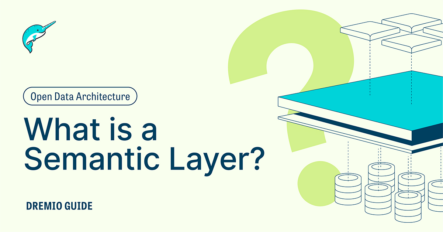
The semantic layer is a business representation of corporate data for end users. In most data architectures, it sits between your data store (like data warehouse and data lake) and consumption tools for your end users. By representing data in a business-friendly format, data analysts can create meaningful dashboards and derive actionable insights from data without needing to understand the underlying physical data structure.
This guide explores what semantic layers are, their benefits and how they’re implemented within your enterprise data stack.
Key highlights:
- A semantic layer is a business representation of data that translates complex technical structures into accessible, analytics-ready insights for end users.
- Semantic access layers sit between data storage and consumption layers, providing consistent logic, governance and simplified access across the enterprise data stack.
- Implementing semantic layers improves collaboration, data consistency and self-service analytics through a unified semantic data model.
- Dremio delivers a unified semantic layer within its open data lakehouse, enabling faster queries, stronger governance and true self-service analytics without data duplication.
Why use a semantic layer?
Companies use data warehouses or data lakes to store data from multiple sources. End users need a way to access this data in a way that is meaningful to them. The problem is, the data there only makes sense to data engineers. Many teams try to solve this challenge with existing tools — but those solutions only go so far.
A semantic layer is not:
- A replacement for a data lakehouse or data warehouse
- An alternative to a data transformation or ETL tool
- A BI or visualization platform
- An OLAP cube or aggregation engine
Each of these plays a role in the modern data stack, but none are designed to translate technical data into business-ready insights.
Data engineers create ETL pipelines from source datasets into data lakes and data warehouses. They physically organize the data into schemas and tables. The table names are complex and reflect the physical data model.
This is where business-ready data layers are needed.
As the logical layer for data access, semantic data layers provide a way for teams to collaborate and share data products. It gives data consistency and simplicity across different domains. A unified semantic model standardizes business logic and makes data more useful to everyone. A well-architected solution empowers end users to become decision-makers with self-service analytics.
Key semantic layer benefits
A semantic data model provides a unified, business-friendly abstraction layer over complex data environments, unlocking significant value for organizations by making data more accessible, consistent, and actionable. By bridging the gap between technical data platforms and business users, it enables teams to collaborate effectively, trust their data, and independently generate insights.
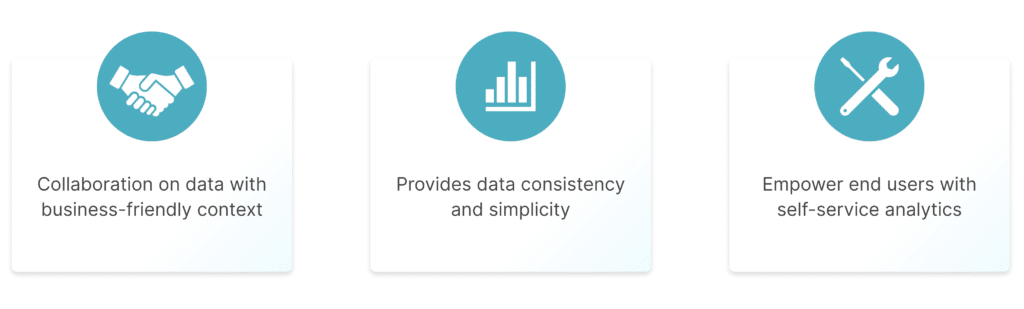
Collaboration on data
A semantic layer fosters cross-team collaboration by providing a shared understanding of metrics, definitions, and relationships across domains. Teams can work together on analysis, reporting, and AI initiatives without confusion or duplication.
- Standardize business definitions across departments.
- Enable shared dashboards and reports with trusted metrics.
- Facilitate cross-domain projects by providing a common data vocabulary.
Data consistency
By centralizing definitions and metrics, a semantic layer ensures data consistency across all tools, platforms, and business processes. This reduces errors, improves trust in analytics, and supports better decision-making.
- Maintain a single source of truth for metrics and dimensions.
- Reduce reconciliation work between disparate data sources.
- Ensure consistent reporting and analysis across all domains.
Self-service analytics
A semantic layer empowers business users to explore and analyze data independently, enabling ad hoc insights without relying on IT or complex technical knowledge. This accelerates decision-making and increases agility.
- Provide business-friendly interfaces for querying and reporting.
- Allow users to generate insights using standardized metrics.
- Reduce reliance on technical teams for routine analytics tasks.
How a semantic layer architecture fits into the modern data stack
A semantic layer is most valuable when treated as part of the broader data architecture, not as a standalone analytics feature. In the modern data stack, it sits between storage systems, data processing pipelines, and consumption tools, giving teams a consistent way to define, govern, and access business-ready data.
The table below explains where the semantic layer fits, what it does, how it connects with other parts of the stack, and why it matters for enterprise analytics and AI workflows.
| How semantic layers fit into data stacks | How it works |
| Position in the stack | A semantic data layer sits between data storage and analytics tools, providing a business-friendly abstraction that translates complex, heterogeneous data into consistent, accessible metrics and dimensions for end users. |
| Core functions | It standardizes metrics, enforces governance, and enables self-service analytics, transforming disparate data sources into a unified, trusted layer that supports ad hoc exploration, reporting, and AI/ML workflows. |
| Integration with other layers | The semantic access layer connects data platforms, ETL pipelines, BI tools, and AI systems, ensuring consistent definitions, streamlined queries, and seamless interoperability across the modern data stack ecosystem. |
| Enterprise impact | By providing trusted, consistent data, the semantic architecture accelerates insights, enhances collaboration, reduces errors, and supports scalable, governed analytics and AI initiatives across the organization. |
Methods of implementing semantic layers
Now that we’ve set a baseline for what a semantic layer is, we’ll review common ways organizations implement them.
Data Marts
Data warehouses often aggregate data from many sources, and some may be irrelevant to business users.
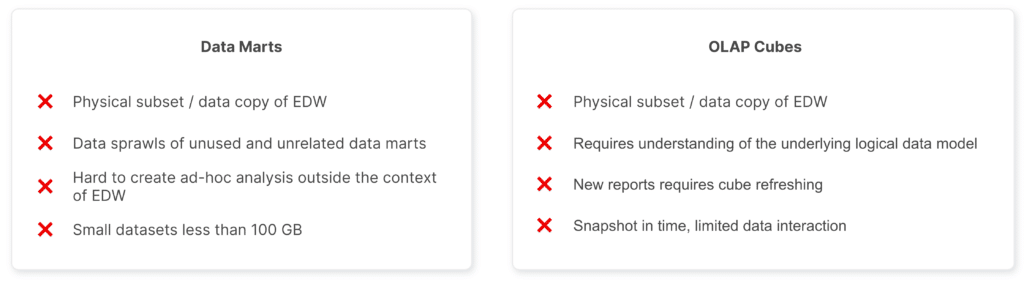
To avoid redundancy and to give data analysts access to just the datasets they need, data engineers will create data marts, a curated subset of the data warehouse that provides a domain-specific view of data for various departments. When creating data marts, data engineers will often represent this data in business-friendly language for end users.
Data marts are one way to implement a semantic layer, but they do come with their own set of challenges.
Challenges with Data Marts:
A limitation of data marts is their dependency on the data warehouse. Slow and bombarded data warehouses are often the reason for creating data marts. The size of a data warehouse is typically larger than 100 GB and often more than a terabyte. Data marts are designed to be less than 100 GB for optimal query performance.
If a line of business requires frequent refreshes on large data marts, then that introduces another layer of complexity. Data engineers will need more ETL pipelines to create processes ensuring the data marts are performant.
Now that your data mart is less than 100 GB, what happens if end users request data outside the context of the data warehouse?
Many organizations have data sources that must stay on-premises. Others may store data in another proprietary data warehouse, sometimes across different cloud providers. This makes it hard for end users to do ad-hoc analysis outside the context of their data warehouse. Business units create their own data marts, resulting in data sprawl across the enterprise, which is a data governance nightmare.
Learn more: how to create a no-code data mart with a unified semantic layer
OLAP Cubes
In addition to planned queries and data maintenance activities, data warehouses also support ad hoc queries and online analytical processing (OLAP). An OLAP cube is a multidimensional database for analytical workloads. It performs analysis of business data, providing aggregation capabilities and data modeling for efficient reporting.
Challenges with OLAP Cubes:
OLAP cubes for self-service analytics can be unpredictable because the nature of business queries is not known in advance. Organizations cannot afford to have analysts running queries that interfere with business-critical reporting and data maintenance activities. Because of this, datasets required to support OLAP workloads are extracted from the data warehouse, and analysts run queries against these data extracts.
OLAP cubes’ dependency on the data warehouse poses many challenges. As extracted datasets from the data warehouse, cubes require an understanding of the underlying logical data model. In many cases, massive amounts of data are ingested into memory for analytical queries, incurring expensive computing bills.
Because the data extracts are a snapshot in time of the data warehouse, they offer limited interaction with the data until the OLAP cubes are refreshed. Depending on the workload, it’s not uncommon for cubes to take hours for data refresh.
Why enterprises prefer a unified semantic layer
Most organizations prefer to have a single source of enterprise data rather than replicating data across data marts, OLAP cubes or BI extracts. Data lakehouses solve some of the problems with a monolithic data warehouse, but they’re only part of the equation. A unified semantics layer is just as important.
A unified layer is mandatory for any data management solution, such as the data lakehouse. Some benefits include:
- A universal abstraction layer: Technical fields from facts and dimensions tables are transposed into business-friendly terms like Last Purchase or Sales.
- Prioritizing data governance: An enterprise semantic foundation makes it easy for teams to share views of datasets in a consistent and accurate manner, meaning only users with provisioned access can see the data.
- All your data: Your end users need self-service access to new data. You don’t want to spend more time creating ETL pipelines with dependencies on proprietary systems. Consume data where it lives.
How semantic layers enable trusted AI and autonomous analytics
Semantic layers play a critical role in making AI and autonomous analytics more reliable. AI systems need more than raw access to data. They need consistent definitions, governed access, and business context that explains what the data means. Without that layer of meaning, AI tools can misinterpret fields, apply the wrong metric logic, or generate answers that conflict with trusted reporting.
By standardizing how data is modeled and accessed, a semantic layer gives AI systems a governed foundation for analysis. It helps reduce model risk, supports consistent outputs, and makes it easier for teams to use AI across BI, data science, and operational workflows. This is especially important as enterprises adopt AI agents that can query data, generate insights, and recommend actions with less manual oversight.
Standardized metrics for AI model reliability
AI models and agents depend on consistent inputs. If revenue, churn, customer lifetime value, or active users are defined differently across tools or teams, AI-generated outputs can become unreliable. A semantic layer solves this problem by centralizing metric definitions and calculation logic, so AI systems use the same trusted business logic as analysts and dashboards.
This consistency improves confidence in AI-driven recommendations. When metrics are defined once and governed centrally, teams can reduce conflicting outputs and make it easier to validate AI responses against approved enterprise definitions.
- Define business metrics once and reuse them across BI, AI, and data science tools.
- Reduce conflicting answers caused by inconsistent metric logic.
- Improve model reliability with governed, approved data definitions.
- Support better validation of AI-generated insights against trusted analytics.
Semantic context for enterprise AI agents
Enterprise AI agents need context to answer business questions accurately. A raw table name or column name rarely explains the business meaning of the data. A semantic layer adds that context by mapping technical data structures to business-friendly terms, relationships, hierarchies, and governed datasets that agents can understand and use.
This context helps AI agents produce more relevant and explainable answers. Instead of guessing which table, field, or calculation to use, agents can rely on the semantic model to understand business meaning, access rules, and relationships across domains.
- Translate technical schemas into business-friendly concepts.
- Help AI agents understand relationships between metrics, dimensions, and entities.
- Provide governed access to approved datasets and definitions.
- Improve explainability by grounding AI outputs in trusted business context.
Bridging BI, data science and AI consumption
Most enterprises use many tools to consume data, including BI dashboards, notebooks, spreadsheets, applications, and AI agents. Without a shared semantic layer, each tool may recreate logic in its own way, which leads to metric drift and inconsistent analysis. A semantic layer creates a common foundation that supports multiple consumption patterns without forcing every team into the same interface.
This shared foundation helps BI teams, data scientists, and AI systems work from the same trusted data model. Analysts can build dashboards, data scientists can create features, and AI agents can answer questions using consistent definitions, permissions, and business logic.
- Serve consistent metrics to BI dashboards, notebooks, applications, and AI tools.
- Reduce duplicated logic across analytics and data science workflows.
- Support governed self-service access for both human users and AI systems.
- Create a shared data foundation for reporting, predictive analytics, and autonomous insights.
Cost and performance impact of a unified semantic layer data model
A unified semantic layer does more than make data easier to understand. It can also reduce cost, improve performance, and simplify how teams manage analytics across the modern data stack. When organizations rely on duplicated data marts, BI extracts, and tool-specific models, they often create extra storage, repeated compute jobs, and more pipelines to maintain.
By centralizing business logic and enabling governed access to data where it lives, a semantic layer helps teams avoid unnecessary movement and duplication. It also creates a stronger foundation for query acceleration, self-service analytics, and operational efficiency across BI, AI, and data science workflows. This aligns with the brief’s emphasis on avoiding repeated data movement and supporting unified, governed analytics.
Reducing data duplication across marts and extracts
Many organizations create data marts, OLAP cubes, and BI extracts to make enterprise data easier to access. While these copies can improve performance for specific use cases, they also create duplicated datasets across departments, tools, and business domains. Over time, this increases storage costs and makes it harder to know which version of the data is correct.
A unified semantic layer reduces the need for these copies by providing a shared business model over existing data. Teams can access consistent metrics, dimensions, and definitions without creating a new extract for every dashboard, department, or analytics workflow.
- Reduce the number of duplicated data marts and BI extracts.
- Lower storage costs by minimizing unnecessary data copies.
- Maintain consistent business definitions across teams and tools.
- Give users governed access to data without moving it into separate systems.
Lowering compute costs through query acceleration
Query performance directly impacts analytics costs. When users run repeated queries across large datasets, compute usage can grow quickly, especially when teams rely on brute-force processing or repeated transformations. A unified semantic layer can help control these costs by standardizing common access patterns and making it easier to optimize high-value queries.
With query acceleration, caching, reflections, or other optimization techniques, organizations can serve frequent analytics workloads more efficiently. Instead of reprocessing the same logic across multiple tools, the semantic layer can help route users to optimized datasets and precomputed results while preserving consistent business logic.
- Accelerate common queries used in dashboards and reports.
- Reduce repeated processing of the same metric calculations.
- Improve performance for self-service analytics workloads.
- Help control compute spend by optimizing frequent access patterns.
Minimizing operational overhead and pipeline complexity
When every team creates its own data model, extract, or transformation pipeline, operational complexity grows. Data engineers must maintain more jobs, monitor more dependencies, and troubleshoot more points of failure. This slows delivery and makes it harder to scale analytics across the enterprise.
A unified semantic layer simplifies this environment by centralizing business logic and reducing the need for tool-specific modeling. Data teams can manage definitions, access rules, and relationships in one shared layer, while business users consume trusted data through the tools they already use.
- Reduce the number of pipelines required for analytics delivery.
- Simplify maintenance by centralizing business logic.
- Lower the risk of errors from duplicated transformations.
- Free data teams to focus on higher-value data products and governance.
Top platforms for business-friendly data access semantic layers
A semantic layer simplifies access to complex enterprise data by providing a business-friendly abstraction that standardizes metrics, definitions, and relationships across tools and platforms. The following table highlights some of the leading platforms that enable consistent, governed, and self-service analytics, making data accessible for BI, AI, and cross-team collaboration.
| Top platforms for business-friendly data access semantic layers | Key features |
| Dremio |
|
| AtScale |
|
| Looker |
|
| Snowflake Semantic Views |
|
| dbt Semantic Layer |
|
| Cube Cloud |
|
| Graphwise |
|
| Google Cloud Data Catalog with Vertex AI |
|
| PoolParty |
|
1. Dremio
Dremio is a leading data lake engine and semantic layer platform designed to simplify, accelerate, and unify data access across your modern data stack. It eliminates the need for complex ETL pipelines by allowing users to query data directly where it lives, whether in a lakehouse, warehouse, or cloud storage.
With Dremio’s Universal Semantic Layer, organizations can define metrics, relationships, and hierarchies once and make them available across BI, AI, and data science tools, ensuring data consistency, governance, and trust. This capability empowers both technical and non-technical users to perform self-service analytics with confidence, without sacrificing control or performance.
At the core of Dremio’s value is its ability to deliver high-performance analytics at scale while maintaining flexibility and openness. Features like Dremio Reflections automatically accelerate queries for sub-second response times, while its self-service data access model gives users the ability to explore and analyze data without IT bottlenecks.
Role-based access control, data lineage tracking, and integration with major BI tools (like Tableau, Power BI, and Looker) make it a complete platform for governed, enterprise-grade analytics. In essence, Dremio’s semantic model transforms your data lake into a high-speed, business-ready environment, bridging the gap between raw data and actionable insight.
Key features of Dremio:
- Universal Semantic Layer for consistent business logic and metrics
- Dremio Reflections for automated query acceleration
- Self-Service Analytics for business and data teams
- No Data Movement with direct querying across data sources
- Advanced Governance with role-based access and lineage tracking
- Native Integration with BI, AI, and ML tools across the data ecosystem
2. AtScale
AtScale provides a universal semantic model designed to bridge business logic with cloud‑data platforms and BI/AI tools, offering a consistent metric layer consumed by humans and agents alike. It supports multi‑platform connectivity (Snowflake, Databricks, BigQuery) and emphasizes semantic models that serve dashboards, notebooks, and even AI agents.
AtScale pros:
- One semantic layer for multiple clouds/data platforms.
- Models built for both human BI consumption and autonomous workflows
- Business definitions are declared once and reused everywhere
Cons of AtScale:
- Higher cost or licensing complexity given its enterprise orientation
- Complexity in setup and modelling might require experienced analytics engineers
- Dependency on integration maturity for all consuming platforms; some tools may have less mature connectors
3. Looker (Google Cloud)
Looker uses its LookML modeling language to create a semantic layer within the BI tool, allowing organizations to define dimensions, metrics, and relationships once and reuse across dashboards and instances of “Looker Agents” and newer AI‑enabled interfaces. It emphasizes central definitions and AI‑trustworthiness of analytics.
Looker pros:
- Strong semantic modeling with LookML, with reusable definitions and business logic
- Tight integration with BI workflows and visualizations, enabling self‑service for business users
- Enhanced AI/LLM trust via a governed semantic data layer, reducing errors in generative analytics
Cons of Looker:
- Tied to the Looker ecosystem, so the semantic model may be less portable if using multiple BI tools
- Visualization and customization capabilities have received criticism for being limited
- Complexity in scaling large semantic models or enabling them outside of the Looker tool stack
4. Snowflake Semantic Views
Snowflake’s Semantic Views allow organisations to create semantic modelling objects natively inside the Snowflake platform, defining business metrics and dimensions referenced by downstream BI and AI systems. These views sit within the data platform itself.
Snowflake Semantic Views pros:
- Native integration in Snowflake: simpler architecture if your data platform is already Snowflake
- Direct support for business definitions (metrics, dimensions, relationships) inside the warehouse
- Reduces fragmentation between BI models and data platform models
Cons of Snowflake Semantic Views:
- As a newer feature, third‑party tool support and ecosystem maturity may be less developed
- Semantic definitions tied to Snowflake may limit portability across platforms
- Semantic modelling flexibility may be less comprehensive than specialised semantic‑layer platforms
5. dbt Semantic Layer
dbt’s Semantic Layer (built on MetricFlow) enables data teams to define business metrics and semantic definitions centrally in the dbt project, then expose those metrics to downstream tools (BI, spreadsheets, notebooks). It focuses on metric consistency and tool‑agnostic consumption.
dbt Semantic Layer pros:
- Define once, use everywhere, avoid drift
- Tool‑agnostic consumption: supports analytics tools beyond one vendor
- Governance and version control are built into analytics engineering workflows
Cons of dbt Semantic Layer:
- Still maturing compared to some full packaged semantic‑layer platforms, meaning fewer features may be available initially
- BI tool integrations vary, so they may require extra effort to connect downstream
- Focus is more on metric definition than on query performance optimizations or virtualization features
6. Cube Cloud
Cube Cloud offers a universal semantic layer for modern data stacks, supporting BI, spreadsheets, embedded apps and AI. It emphasises performance optimization (caching, pre‑aggregation), broad integration (Power BI, Excel, custom APIs) and a reusable single source of truth for metrics.
Cube Cloud pros:
- SQL, GraphQL, REST endpoints for analytics and apps
- Caching and pre‑aggregation to improve query speeds and reduce compute load
- Broad ecosystem compatibility (including Power BI/Excel) and central governance
Cons of Cube Cloud:
- Learning curve and evolving product may present onboarding challenges
- Cost and complexity may increase as models and use cases grow across domains
- Some users report occasional performance unpredictability or complexity in model setup
7. Graphwise
Graphwise combines knowledge graph and semantic layer capabilities to help organizations model relationships across structured and unstructured data. It focuses on adding context to enterprise data so teams can support search, analytics, and AI use cases.
Graphwise may be useful for organizations that need ontology management, relationship mapping, and semantic reasoning. It is less focused on traditional BI metric management than some semantic layer platforms.
Graphwise pros:
- Combines knowledge graph and semantic modeling capabilities
- Helps model relationships across structured and unstructured data
- Supports semantic context for AI and LLM use cases
- Provides tools for reasoning, explainability, and relationship mapping
Cons of Graphwise:
- Requires expertise in ontology and knowledge graph modeling
- Can be complex to implement without existing graph infrastructure
- Has a smaller ecosystem than more common BI-focused semantic tools
- May require additional tools for standard BI workflows
8. Google Cloud Data Catalog with Vertex AI
Google Cloud Data Catalog and Vertex AI can support semantic metadata, data discovery, and AI feature management within Google Cloud. Data Catalog helps teams manage metadata, governance, and lineage. Vertex AI supports feature reuse and machine learning workflows.
This combination is most relevant for organizations already using Google Cloud for analytics and AI. It can help connect metadata management with machine learning, but it may require more setup for teams using data platforms outside the Google Cloud ecosystem.
Google Cloud Data Catalog pros:
- Integrates with Google Cloud analytics and AI services
- Supports metadata management, discovery, and lineage tracking
- Connects data governance with Vertex AI workflows
- Helps teams organize and reuse features for machine learning
Cons of Google Cloud Data Catalog:
- Best suited for organizations already using Google Cloud
- Has limited out-of-the-box support for non-Google data platforms
- Requires technical expertise to configure metadata and semantic models
- May not provide a full business-facing semantic layer on its own
9. PoolParty
PoolParty is a semantic middleware and knowledge graph platform. It helps organizations manage ontologies, taxonomies, metadata, and semantic relationships across data and content systems.
PoolParty is often a fit for organizations that manage large volumes of documents, metadata, or domain-specific terminology. It is more focused on semantic web, taxonomy, and knowledge graph use cases than on BI metrics or dashboard-oriented analytics.
PoolParty pros:
- Supports ontology and taxonomy management
- Helps align semantics across data and content silos
- Provides tools for metadata tagging, text mining, and semantic search
- Integrates with content management and knowledge management systems
Cons of PoolParty:
- Has a steeper learning curve for teams without semantic modeling experience
- Focuses more on semantic web and content use cases than BI metrics
- May require additional tools for advanced analytics and visualization
- May be less familiar to teams focused on traditional BI workflows
Common use cases and semantic layer examples
A semantic layer in data analytics provides a business-friendly abstraction over complex data environments, making it easier for organizations to extract insights, maintain consistency, and accelerate decision-making. By mapping data into meaningful metrics and dimensions, it enables analysts, BI tools, and AI agents to interact with data in terms they understand, rather than struggling with multiple schemas or fragmented platforms.
Here are some common use cases and examples of how semantic layers are applied in practice:
Cross-Departmental Reporting
Organizations often struggle to reconcile data from sales, marketing, finance, and operations due to inconsistent definitions and siloed systems. Unified data abstraction standardizes key business metrics and dimensions, enabling teams to generate consistent, accurate reports without manually reconciling data from multiple sources.
For example, a company can define “monthly active users” or “revenue per customer” centrally in the semantic model, ensuring that every department uses the same definition, which reduces errors and improves confidence in shared dashboards. This accelerates reporting cycles and enhances strategic decision-making across the organization.
Self-Service Analytics
Analysts and business users frequently need to perform ad hoc analysis, but may lack the deep technical skills to query raw data directly. A unified semantic model provides a business-friendly interface, allowing users to explore and analyze data without writing complex SQL or understanding underlying data models.
For instance, marketing teams can quickly examine campaign performance or segment customers based on behavior using BI tools connected to the semantic layer. This empowers teams to generate insights independently while maintaining consistency and governance across the organization.
AI and Machine Learning Enablement
AI and ML initiatives require clean, consistent, and semantically enriched data to ensure accurate predictions and actionable outcomes. A semantic model standardizes metrics and relationships across multiple data platforms, providing a reliable foundation for model training and feature engineering.
For example, a financial services firm can leverage this structure to create consistent customer risk scores or transaction patterns that feed directly into AI models. This reduces data preparation time, improves model accuracy, and enables AI agents to make intelligent, context-aware recommendations.
Data Governance and Compliance
Ensuring proper data governance and compliance is critical for regulated industries, but disparate systems and inconsistent definitions make enforcement difficult. A semantic data layer centralizes data definitions, access controls, and lineage tracking, allowing organizations to enforce policies consistently.
For example, healthcare organizations can use semantic architecture to control who can access sensitive patient data while maintaining a consistent view of clinical metrics across reporting and analytics tools. This simplifies audits, ensures compliance, and builds trust in the data being used across the enterprise.
Best practices for managing a semantic data layer
Effectively managing a semantic data layer is critical for turning raw data into trusted, actionable insights across the enterprise. By following proven best practices, organizations can ensure consistent metrics, enforce governance, accelerate analytics, and create a scalable foundation for AI and self-service initiatives. The following practices highlight key strategies to maximize the value and impact of your governed data layer while maintaining agility and reliability.
Start with high-value business domains
Focusing on high-value business domains first ensures that your semantic data layer delivers immediate impact and demonstrates tangible ROI. By prioritizing domains like sales, finance, or customer analytics, teams can quickly establish trust in their semantic data and show how standardized definitions and accessible metrics improve decision-making.
- Identify domains with the greatest business impact
- Map key stakeholders and data sources for each domain
- Pilot the unified layer with a small, high-value dataset before scaling
Starting with high-value domains also allows teams to uncover potential challenges early, such as complex data transformations or inconsistent metrics, and address them in a controlled environment. Lessons learned from these initial domains provide a blueprint for scaling unified semantic architecture across other business areas efficiently.
Standardize metrics and definitions early
Defining metrics and business terms early in the semantic layer prevents misalignment and ensures that all teams interpret data consistently. Standardization creates a single source of truth, reducing confusion, reconciliation work, and errors across reports and analytics dashboards.
- Define key business metrics (e.g., revenue, churn, active users)
- Establish consistent dimensions and hierarchies (e.g., region, product category)
- Document metric definitions and calculation logic centrally
Early standardization also accelerates self-service analytics by giving business users confidence that their insights are based on accurate, trusted definitions. This practice helps maintain governance while supporting agile analytics across multiple teams and platforms.
Adopt open standards to avoid lock-in
Using open standards in your semantic layer prevents dependency on a single vendor and ensures interoperability across tools and platforms. This flexibility allows your organization to adapt to new technologies, integrate diverse data sources, and switch tools without losing semantic consistency.
- Ensure compatibility with multiple BI, AI, and analytics platforms
- Maintain portability of semantic definitions across data platforms
- Use open data modeling standards (e.g., RDF, SQL-based semantic models)
Open standards also facilitate collaboration with external partners or across domains, as the definitions and relationships in the semantic layer can be easily shared and understood. This ensures long-term agility and protects investments in the semantic architecture.
Automate governance and access control
Automating governance ensures that policies, permissions, and compliance rules are consistently applied across all users and platforms. It reduces manual errors, accelerates onboarding, and provides visibility into who can access which data.
- Implement role-based access controls (RBAC)
- Enforce data masking or anonymization rules automatically
- Track data lineage and usage to support audits and compliance
Automation also allows your semantic layer to scale without increasing administrative overhead. By embedding governance into the layer itself, organizations can maintain trust in data while empowering self-service analytics and AI initiatives.
Continuously monitor performance and iterate
A semantic data layer is not a “set it and forget it” solution; it requires ongoing monitoring and optimization. Tracking performance ensures that queries remain fast, models are accurate, and business users can reliably access the data they need.
- Monitor query performance and optimize transformations
- Track usage patterns to identify high-demand metrics and domains
- Collect feedback from users and iterate on semantic models regularly
Continuous monitoring and iteration also help the organization adapt to changing business needs, incorporate new data sources, and improve the usability and reliability of the semantic layer over time. This ensures that the layer remains a valuable, evolving asset for analytics, AI, and decision-making.
Get started with a data lake semantic layer from Dremio
Dremio offers a modern, high-performance approach to building a data lake semantic layer, enabling organizations to unlock insights directly from their data lakes without the complexity of moving or reshaping data. By providing a business-friendly abstraction over datasets, Dremio ensures consistent metrics, trusted definitions, and seamless access for analysts, BI tools, and AI agents. Dremio’s architecture supports scalability, high concurrency, and optimized query performance, making it an ideal choice for enterprises looking to unify analytics across multiple domains.
With Dremio, business users can explore data independently while IT maintains governance and control, empowering self-service analytics at scale. Autonomous performance features like Dremio Reflections accelerate queries automatically, reducing wait times and improving productivity. By combining semantic modeling with performance optimization and user-friendly access, Dremio positions itself as a superior solution for organizations seeking a reliable, scalable, and fully governed data access model.
Frequently asked questions
Semantic data is data that includes business meaning, context, and relationships. Instead of exposing only technical table names and column names, semantic data helps users understand what the data represents and how it should be used.
In analytics, semantic data often appears through a semantic dataset, which gives users a curated, business-friendly view of underlying data. This helps analysts, BI tools, and AI systems work with trusted definitions rather than raw schemas.
- A semantic data model defines business concepts, metrics, dimensions, and relationships in a consistent way. It maps technical data structures to terms users understand, such as customer, revenue, churn, product, or region.
This model supports self-service analytics by giving business users a simpler way to explore data without needing to understand every table, join, or transformation behind the scenes.
A semantic layer should provide consistent business definitions, governed access, reusable metrics, and integration with downstream tools. It should also support performance, documentation, lineage, and collaboration across teams.
When building a semantic layer, teams should start by identifying core business metrics, defining dimensions and relationships, applying governance, and connecting the layer to BI, AI, and analytics tools.
A data fabric is an architecture for connecting, governing, and managing data across distributed systems. It focuses on integration, metadata, policy enforcement, and access across the enterprise data estate.
A semantic layer focuses on business meaning. It translates technical data into shared metrics, definitions, and relationships that users and tools can understand. In many architectures, a semantic layer can work within a data fabric by making governed data easier to consume.
No. Semantic layers and dbt serve different but complementary purposes. dbt helps teams transform, test, and version data models. A semantic layer helps expose governed business definitions, metrics, and relationships to users and tools.
Many teams use dbt to prepare and manage trusted data models, then use a semantic layer to make those models easier to access. Teams can also use dbt as part of managing your semantic layer with dbt when they want version control and repeatable development workflows.
Yes. A semantic layer can provide a business-friendly view over data without requiring teams to copy it into a new system. This approach helps reduce duplicated marts, extracts, and pipelines.
This is useful during data migration because teams can create governed access to existing data while they modernize systems over time. It lets users keep working with consistent definitions while the underlying architecture evolves.
A semantic layer supports data mesh by helping domain teams publish data products with clear definitions, governed access, and business context. Each domain can manage its own data while still exposing it through shared standards.
In a data mesh, domain ownership is important, but consistency still matters. A semantic layer helps balance those needs by giving teams autonomy while maintaining common metrics, documentation, and access controls across the organization.
Try Dremio’s Interactive Demo
Explore this interactive demo and see how Dremio's Intelligent Lakehouse enables Agentic AI