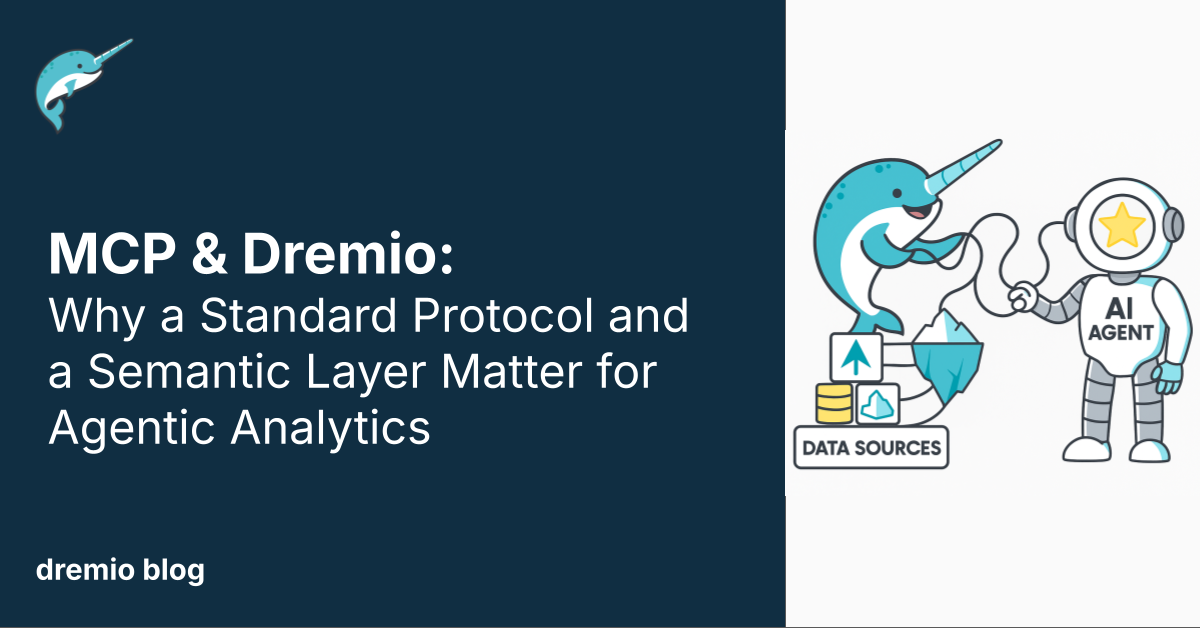
Most large-language‑model assistants still live in walled gardens: they can reason about natural language but they can’t readily fetch data or execute actions in enterprise systems without brittle custom integrations. The Model Context Protocol (MCP) and Dremio’s MCP Server are trying to change that by creating a universal, governed way for AI agents to plug into analytical data. Below is a research‑driven look at what MCP is, why it matters, and how Dremio’s combination of an MCP server and an integrated semantic layer makes it uniquely powerful for agentic analytics.
What Is the Model Context Protocol (MCP)?
MCP is an open standard designed to connect AI models with external tools and data sources. MCP is built on JSON‑RPC and acts like a “universal adapter” or “USB‑C” for AI: it defines a single, standardized protocol for large‑language models to invoke functions, fetch data or use predefined prompts from external services. Instead of writing custom integration code for every API or database, a developer can deploy an MCP server that exposes capabilities (tools, data resources and prompts), and an MCP client in the AI application can discover and invoke them.
This client‑server architecture decouples the AI model from the underlying systems. The AI sends JSON‑RPC calls to the MCP server to list tools, get schema information or run queries, and receives structured results in a uniform JSON format. MCP also supports “resources” (documents or other data context) and “prompts,” enabling richer, multi‑step interactions beyond simple function calls.
Try Dremio’s Interactive Demo
Explore this interactive demo and see how Dremio's Intelligent Lakehouse enables Agentic AI
Why MCP Matters
MCP addresses several pain points that have limited the adoption of agentic AI:
Rapid tool integration: Because MCP exposes external capabilities through a standard interface, any MCP‑compatible AI app can connect to new services (e.g., Google Drive or a SQL database) by adding the appropriate server, no bespoke integration code required.
Enabling autonomous agents: MCP allows agents to perform multi‑step workflows by retrieving data, executing functions and maintaining context across calls. This turns the AI from a passive “brain” into an active “doer”.
Reduced friction & consistency: Once an application supports MCP, it can connect to many services through a single mechanism. All requests and responses follow the same JSON‑RPC format, reducing the need to handle diverse auth flows and data formats.
Two‑way context: MCP servers can supply prompts and data resources so that models aren’t starting from scratch for each call; they can ingest context and participate in dialogues rather than issuing one‑off queries.
Dremio’s MCP Server: Bringing Agents to the Lakehouse
Dremio, the intelligent lakehouse platform, built one of the first enterprise‑grade MCP servers. The MCP server is open‑source project that enables AI agents to dynamically explore datasets, generate SQL queries and retrieve governed data from its lakehouse in real time. The server provides a single interface over all data sources and eliminates the bottleneck of data fragmentation by exposing Dremio’s unified data access layer to agents.
Capabilities and Tools
Dremio’s MCP server offers several tools that agents can invoke:
Run SQL Query – Accepts natural language or SQL, generates SQL using Dremio’s query engine and returns results.
Get Schema Of Table – Allows agents to browse table schemas to understand available fields before composing queries.
Run Semantic Search – Supports searching across Dremio’s semantic layer, retrieving relevant datasets and metadata.
Because the server implements the MCP standard, agents can automatically discover these tools via a “list tools” call, understand their input/output schemas and invoke them without custom glue code.
Integration with the Lakehouse
Dremio’s MCP server sits atop its Unified Semantic Layer, a business‑friendly representation of the lakehouse that organizes data into virtual datasets and data marts without copying data. The semantic layer lets data teams define consistent business metrics and relationships (e.g., “Active Customer,” “ARR”) and enforce role‑based access controls across sources. This layer abstracts the complexity of underlying files and tables so that non‑experts can query data using familiar business terms.
By exposing the semantic layer through MCP, agents can browse curated datasets, interpret field meanings and generate governed SQL queries. Combining MCP with Dremio’s rich metadata allows agents to discover datasets, translate natural language to SQL and return insights securely. A Medium article further notes that Dremio’s semantic layer gives agents a vocabulary to operate within, enabling them to interpret, navigate and reason about data using shared business definitions.
Autonomous Performance via Reflections
Latency and cost matter for AI agents that generate multi‑step plans. Dremio addresses this with Autonomous Reflections, which automatically create and maintain physical materializations (like aggregated or raw copies) based on observed query patterns. These reflections act like always‑fresh caches: the query engine transparently rewrites SQL to hit these optimized representations, providing sub‑second response times and reducing compute costs. Dremio’s page highlights that as workloads become more dynamic (e.g., with agentic queries), manual performance tuning breaks down, so the system analyzes query patterns and manages reflections without human intervention. Real‑world deployments showed that 80 % of workloads were accelerated without manual tuning and some query times dropped from 13 seconds to 1 second.
Because Dremio’s MCP server runs on top of this engine, agent queries automatically benefit from these reflections, no special configuration needed. The combination of fast query rewriting and the semantic layer means agents can interact with large lakehouse datasets quickly and cheaply.
Built on Open Standards
Dremio’s lakehouse platform is built on Apache Iceberg, Apache Arrow and its Apache Polaris based catalog service. Using Iceberg’s REST catalog and open formats means data remains portable; an organization can keep or swap catalogs without breaking the MCP endpoint. This open‑standards stance aligns with MCP’s goal of avoiding vendor lock‑in and easing cross‑engine interoperability.
Why Dremio’s Approach Is Uniquely Powerful for Agentic Analytics
Bringing these elements together, the MCP standard, Dremio’s semantic layer and autonomous reflections, creates a powerful foundation for agentic analytics:
Universal connectivity with governance – MCP standardizes tool discovery and invocation, while Dremio’s MCP server embeds enterprise‑grade role and object‑level permissions. Agents can query and retrieve data without circumventing governance policies.
Business‑aware agents – The semantic layer gives agents a curated, business‑friendly view of the lakehouse so they understand the meaning of “ARR,” “customer churn” or “late shipment” without seeing raw tables. This reduces hallucination risks and ensures consistent metrics across analyses.
Automatic performance optimization – Autonomous reflections deliver sub‑second query times and adapt to changing workloads. Agent workflows that involve iterative querying (e.g., refine a cohort then compute metrics) benefit from faster loops and lower costs.
Open and interoperable – By adopting open standards (JSON‑RPC, Iceberg REST and Arrow), Dremio’s MCP server fits into a broader ecosystem. Agents built with OpenAI’s Agents SDK or LangChain can connect without proprietary dependencies.
Two‑way context and richer workflows – MCP’s support for resources and prompts allows Dremio to supply agents with additional context (e.g., sample rows, schema docs or prompts for common analyses) so that interactions go beyond simple query execution.
Conclusion
As of September 2025, MCP has matured into a key building block for connecting AI agents to external systems. However, a protocol alone isn’t enough; it needs to be paired with a data platform that provides meaning, performance and governance. Dremio’s MCP server, integrated semantic layer and autonomous reflections deliver this combination. They turn natural‑language intent into secure, performant and semantically rich analytics, enabling agents to act not just as chatbots but as trustworthy decision‑makers.
Ingesting Data Into Apache Iceberg Tables with Dremio: A Unified Path to Iceberg
By unifying data from diverse sources, simplifying data operations, and providing powerful tools for data management, Dremio stands out as a comprehensive solution for modern data needs. Whether you are a data engineer, business analyst, or data scientist, harnessing the combined power of Dremio and Apache Iceberg will undoubtedly be a valuable asset in your data management toolkit.
Oct 12, 2023·Product Insights from the Dremio Blog
Table-Driven Access Policies Using Subqueries
This blog helps you learn about table-driven access policies in Dremio Cloud and Dremio Software v24.1+.
Aug 31, 2023·Dremio Blog: News Highlights
Dremio Arctic is Now Your Data Lakehouse Catalog in Dremio Cloud
Dremio Arctic bring new features to Dremio Cloud, including Apache Iceberg table optimization and Data as Code.