Data chaos arises from inconsistent definitions among teams, leading to mistrust in reports.
The semantic layer evolves from a static data dictionary to an active, AI-focused data ecosystem.
A modern semantic layer features a layered architecture, improving performance and management of data complexity.
Dremio's hybrid model combines virtual views with physical data for optimal speed and flexibility.
Governance is now integral in the semantic layer, ensuring consistent security and access controls for self-service analytics.
Data chaos is a common challenge. The marketing team uses one business intelligence (BI) tool, finance uses another, and sales has their own set of dashboards. Each team defines "active user" or "monthly revenue" slightly differently, leading to conflicting reports, endless reconciliation meetings, and a pervasive mistrust in the data.
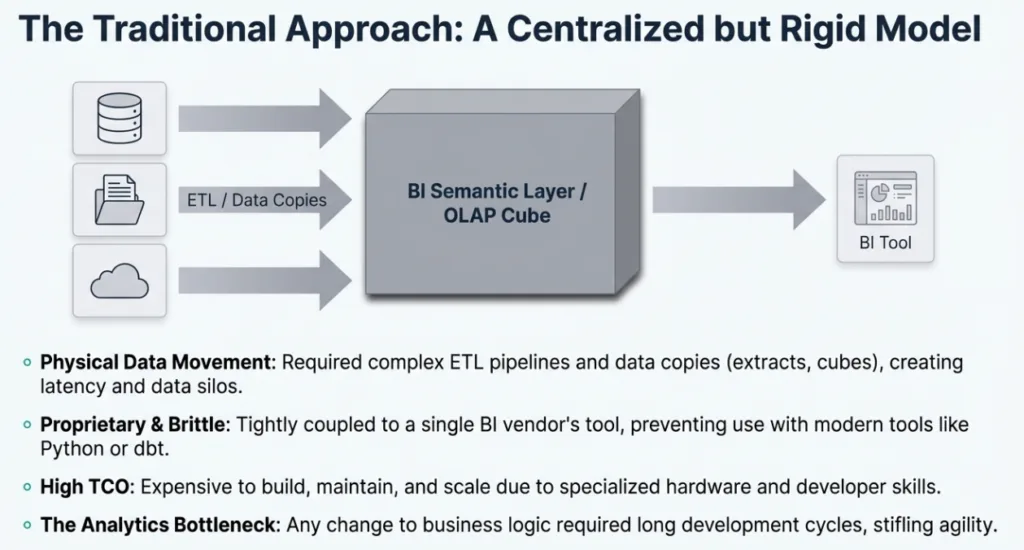
The traditional solution to this problem has been the semantic layer, a business-friendly map of an organization's data that translates complex table and column names into understandable business terms. It promised a single source of truth by creating a consistent set of metrics for everyone.
But in the era of AI, the traditional concept of a semantic layer is no longer enough. This evolution is not incremental; the semantic layer is transforming from a passive data dictionary into the active, intelligent co-pilot for your entire data ecosystem.
Build for Scale, Not Just for Today: The Power of a Layered Architecture
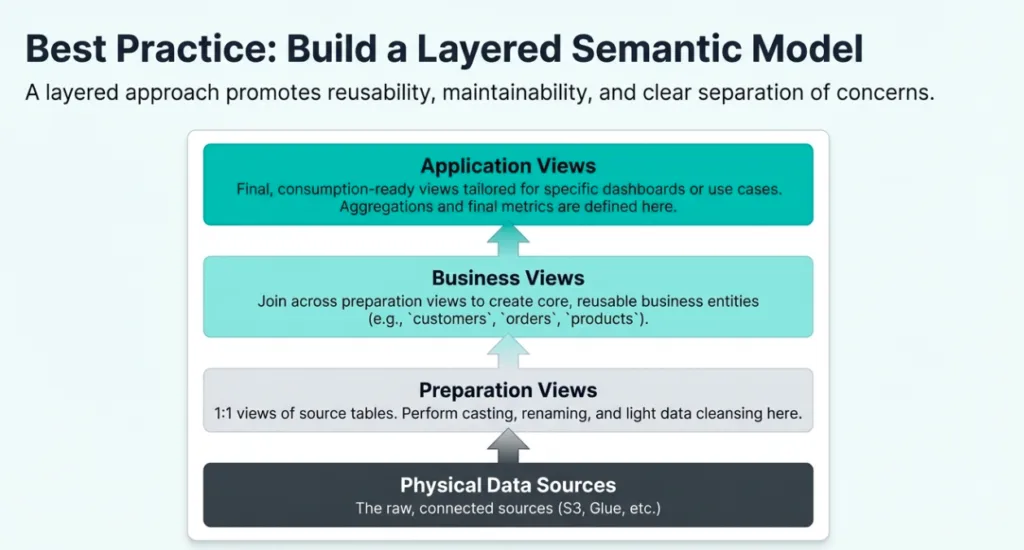
A modern semantic layer is not a flat list of business terms mapped to physical tables. To manage complexity, security, and performance effectively, the best practice is to build a layered architecture of views, where each layer serves a distinct purpose.
Preparation Layer: This foundational layer organizes and exposes only the required datasets from the source. Views in this layer map 1-to-1 with physical source tables. Their job is to clean up raw data, renaming cryptic columns, casting data types, without performing any complex joins.
Business Layer: This is where business logic lives, and it’s where a data modeler works with business experts to define views that represent key business entities. Views in this layer combine the foundational views from the preparation layer to create holistic, logical representations of entities such as "customer," "product," or "order."
Application Layer: This is the final, consumption-ready layer tailored for specific use cases. Views here are built on top of the business layer and are designed for a particular BI dashboard, data science project, or report. This is where final filters, selections, and aggregations are applied to meet the specific needs of the end-user or application.
Adopting this layered architecture enables data leaders to systematically manage security, guarantee usability, and optimize performance, transforming the semantic layer from a bottleneck into a scalable asset. This approach improves productivity for analytics initiatives, reduces the cost of service delivery, and provides an accurate self-service model for data consumers.
Your Next Power User is an AI: Teaching Your Data to Speak
The most significant evolution of the semantic layer is its new primary consumer: AI. While documentation has always been necessary for human analysts, it is now critical context for AI agents.
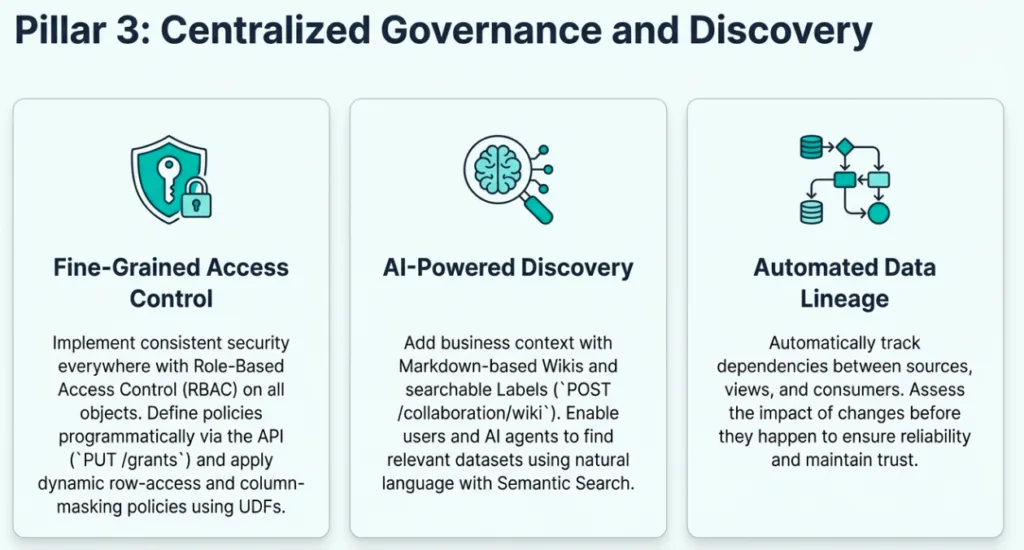
In Dremio, metadata features like Wikis and Labels are not just passive documentation. A Wiki can provide a detailed, Markdown-formatted description of a dataset, while Labels can be used to categorize data (e.g., PII, Finance). This rich context is fed directly to Dremio's AI Agent, enabling it to understand the data's meaning, structure, and business relevance.
This semantic context powers features like natural language querying, where a user can ask a question in plain English, and the AI Agent generates the correct SQL to answer it. It also drives semantic search, which looks beyond table names to search wikis, labels, and other metadata to find the most relevant datasets.
These definitions and classifications are stored with the data, guiding both natural language queries, SQL generation, and manual exploration.
This shift transforms a well-annotated semantic layer from a static catalog into a dynamic engine for AI-driven data discovery and analysis.
Achieve Agility Without Sacrificing Speed: The Hybrid Virtual-Physical Model
A common and valid concern with semantic layers built entirely on virtual views is performance. Chaining multiple layers of views can add complexity to queries and slow them down, creating a frustrating experience for users.
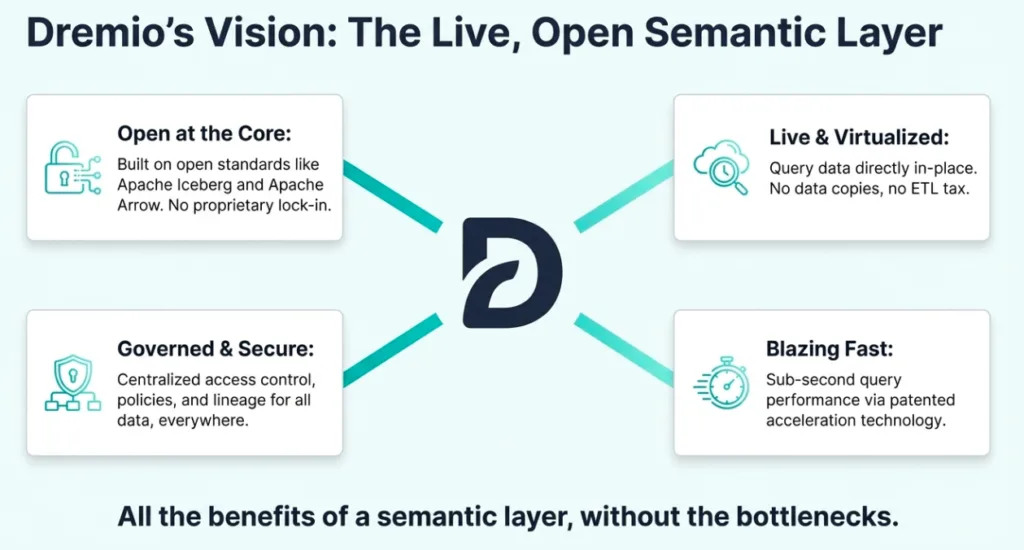
The solution is a hybrid approach that combines the flexibility of virtual views with the speed of physically optimized data. Dremio achieves this with a feature called Reflections, query-rewriting materializations that physically accelerate the virtual semantic layer. End-users and BI tools continue to query the simple, logical views, but Dremio’s query planner automatically rewrites the query to use the optimized physical Reflection behind the scenes.
Furthermore, with Autonomous Reflections, Dremio can automatically learn an organization's query patterns and create, manage, and refresh these materializations without manual intervention from data teams. This hybrid model delivers the best of both worlds: the simplicity and agility of a virtual semantic layer with the raw performance of physically optimized data.
Unify Your Data Universe: A Single Pane of Glass for a Distributed World
A modern semantic layer cannot be confined to a single database or data warehouse. To provide a true single source of truth, it must federate data from across an organization's entire, often fragmented data landscape.
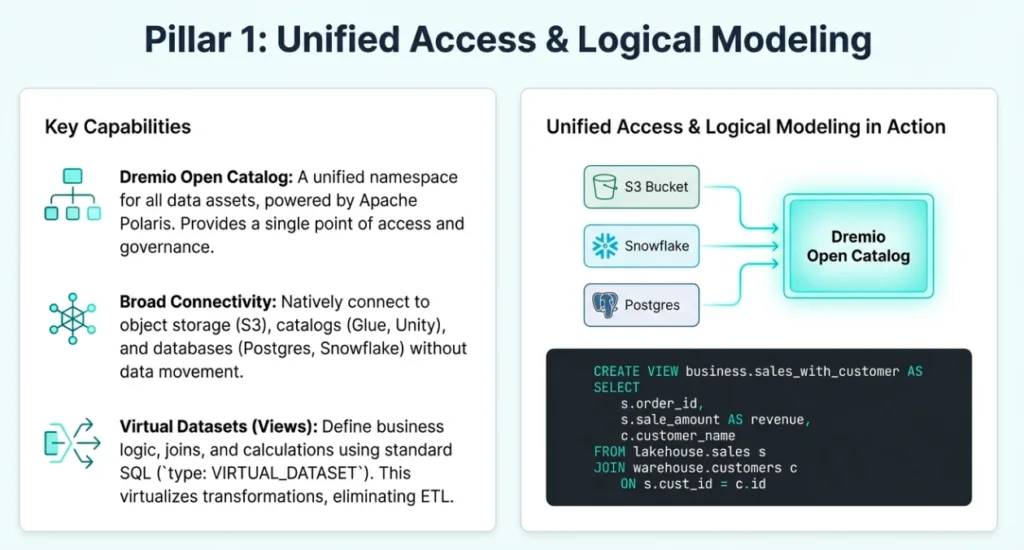
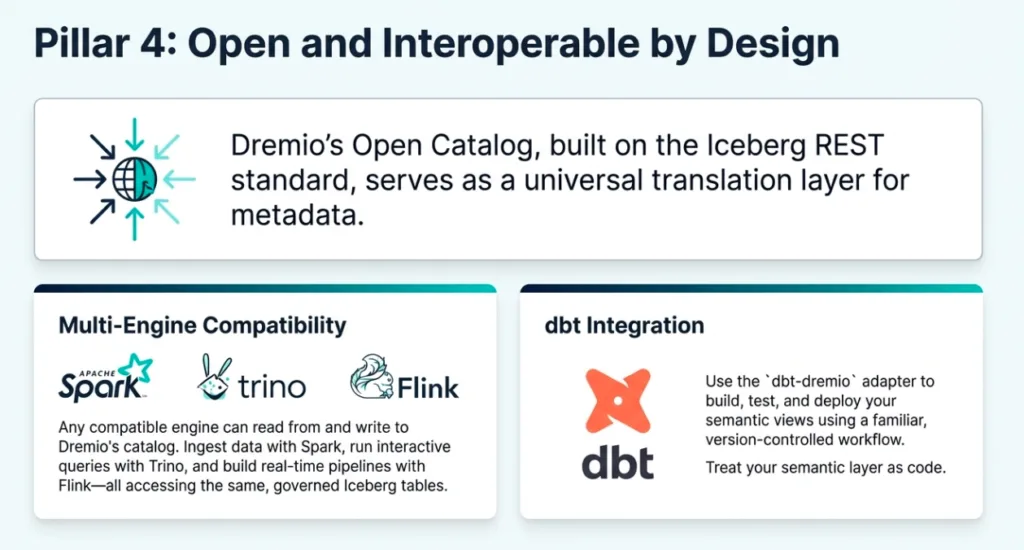
Dremio creates a unified semantic layer by connecting to a diverse set of sources where the raw data lives, the "bronze layer." Its massively parallel processing (MPP) model can federate across relational sources, object stores such as Amazon S3 and Azure Storage, databases such as PostgreSQL and Snowflake, and other data catalogs such as AWS Glue.
By connecting directly to these distributed sources, Dremio allows you to build a single, consistent, and centralized semantic layer on top of a physically decentralized data ecosystem. This isn't just about connecting to sources; it's about creating a single logical hub for business logic that breaks down data silos and ensures consistency, regardless of where the underlying data is stored.
Enable Self-Service with Confidence: Weaving Governance into the Fabric
For a semantic layer to be the bedrock of a data-driven enterprise, governance cannot be an afterthought. It must be woven into the fabric of the layer itself. Applying security policies in downstream tools creates security gaps and administrative headaches; in a modern architecture, governance is integral to the semantic layer.
In Dremio, governance policies are applied directly to the objects, the tables and views, within the semantic layer. This ensures that rules are enforced consistently for every user and every tool that accesses the data. Key governance capabilities include:
Role-Based Access Control (RBAC): Managing permissions by granting privileges to roles rather than to individual users, simplifying administration and ensuring consistency.
Fine-Grained Access Controls: Implementing row-access and column-masking policies, often through flexible SQL-based functions, to protect sensitive data. This allows you to control which users can see specific records or to obscure sensitive fields based on user roles.
Data Lineage: Visualizing the complete flow of data from its source to the point of consumption. This provides essential transparency for auditing, impact analysis, and troubleshooting.
By integrating governance directly into the semantic layer, organizations eliminate the security gaps and administrative chaos that arise from managing policies in downstream tools, thereby enabling truly secure, self-service analytics at scale.
Is Your Semantic Layer Ready for the Future?
The semantic layer has evolved far beyond its origins as a simple data dictionary. This evolution is marked by five critical shifts: a scalable layered architecture, a focus on serving AI as a primary consumer, a hybrid virtual-physical model for performance, universal federation into a single pane of glass, and governance that is built-in, not bolted-on. It now serves as the critical interface not just for human analysts using BI tools, but for a new generation of AI agents that rely on its rich semantic context to explore, analyze, and generate insights from data.
As your organization increasingly relies on data to make decisions and on AI to augment that process, the capabilities of your semantic layer will become a key competitive differentiator. This leads to a final, thought-provoking question: As AI becomes a primary consumer of your data, is your semantic layer ready to speak its language?
Ingesting Data Into Apache Iceberg Tables with Dremio: A Unified Path to Iceberg
By unifying data from diverse sources, simplifying data operations, and providing powerful tools for data management, Dremio stands out as a comprehensive solution for modern data needs. Whether you are a data engineer, business analyst, or data scientist, harnessing the combined power of Dremio and Apache Iceberg will undoubtedly be a valuable asset in your data management toolkit.
Oct 12, 2023·Product Insights from the Dremio Blog
Table-Driven Access Policies Using Subqueries
This blog helps you learn about table-driven access policies in Dremio Cloud and Dremio Software v24.1+.
Aug 31, 2023·Dremio Blog: News Highlights
Dremio Arctic is Now Your Data Lakehouse Catalog in Dremio Cloud
Dremio Arctic bring new features to Dremio Cloud, including Apache Iceberg table optimization and Data as Code.