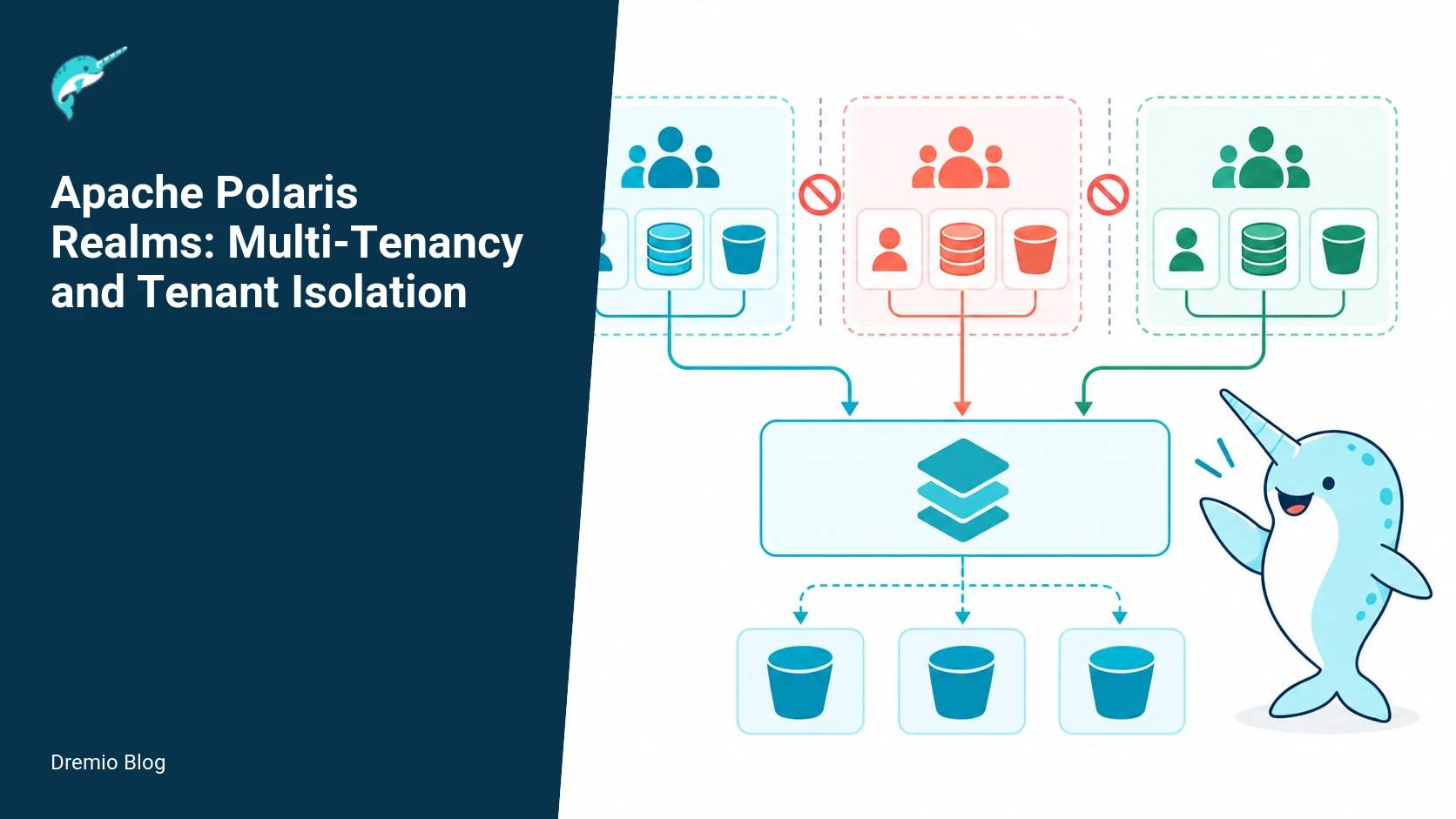
A Polaris realm is a top level administrative boundary that lets a single Polaris service host separate sets of principals, roles, catalogs, and configuration. Realms reduce accidental cross tenant visibility at the catalog layer, they do not replace network isolation, separate encryption keys, storage policies, database controls, or resource quotas. Production tenancy requires those other boundaries to be aligned with realms. The Polaris realm feature is documented as unreleased at the time of writing, so verify behavior against the linked primary documentation and test upgrades with realm routing enabled.
Why realms exist, and what they actually cover
Polaris realms introduce a logical multi tenant organization inside the Polaris control plane. Realms provide independent catalogs, identity mappings, role definitions, and configuration overrides per realm. Practically, a realm lets you run multiple independent tenant catalogs on one Polaris cluster without those catalogs sharing catalog objects, role names, or principal assignments by default.
That said, realms are not a complete tenancy boundary. They operate at the Polaris control plane and catalog level. They do not, by themselves, guarantee isolation of the following:
Network boundaries, such as tenant VPCs, firewalls, or private links.
Disk and storage encryption keys or separate KMS scopes.
Compute quotas and scheduling limits on engines that access data.
Underlying object storage bucket policies and access control.
For production tenancy you must combine realms with network, storage, and compute isolation. The Polaris documentation marks the realms guide as unreleased, so confirm exactly which resources are scoped to realms in the version you run. I checked the official realm documentation, the production configuration guide, and the Polaris 1.7.0 release notes while preparing this article. See the Sources section for links and verification statements, checked on September 22, 2026 where freshness matters.
Realm object boundaries. Each stage has a result that can be checked before the next stage begins.
Architecture: how realms map to Polaris objects and requests
The simplest mental model is this: a realm is an umbrella for named collections of control plane artifacts. That includes catalogs, principal stores, role definitions, and realm scoped configuration. Realm scoping changes how Polaris resolves principals and catalogs from incoming requests. The control plane holds many realms and routes an API request into the appropriate realm based on routing keys described in configuration.
Key decision points you must make when adopting realms:
Routing strategy, for example host header mapping, path prefix, or token claim. Each has operational trade offs for TLS certificates and gateway complexity.
Catalog lifecycle per realm, including shared versus isolated storage locations for table metadata.
Authentication method support, and whether identity providers can emit realm-identifying claims.
Cross realm administrative roles, if any, and the audit requirements around them.
Polaris resolves request context before applying catalog or role logic. The usual flow is: incoming request arrives, an ingress or Polaris front end extracts a realm routing key, Polaris loads realm specific catalogs and configuration, and Polaris enforces RBAC using the realm principal and role mappings. This means a misrouted request may be evaluated against the wrong realm, so routing correctness is critical. Upgrade testing must include realm routing, because routing behavior can change across versions. This caution comes directly from the current unreleased realm documentation and the production configuration guide, which advise testing realms across upgrades.
Request routing by realm. Each technical risk needs a matching test, boundary, or operating signal.
Control plane versus data plane isolation
Polaris governs metadata and access decisions, it does not move or host your data. Realms partition the control plane, but they do not, by default, create separate data paths. Engines or query runners continue to read data from the storage locations that catalogs point to. That separation creates four possible relationships between realm and data plane:
Control plane isolated, data isolated. Realms point at storage locations that are also separated by network and ACLs.
Control plane isolated, data shared. Different realms reference the same bucket or database with separate catalog prefixes or filters.
Control plane shared, data isolated. No realms used, but storage is split per tenant.
Neither isolated. This is the least safe option, do not run production like this.
You must decide which model you need. If you need cryptographic separation, assign unique KMS keys and storage credentials per tenant. If you need network separation, use VPC, private link, or separate storage accounts. Polaris realms are one ingredient; you still need storage-side policies and compute-side quotas to achieve a full tenancy posture. The Polaris production configuration guide lists recommended production hardening steps that are complementary to realms. See Sources for that link, and review it for details before rolling realms into production.
Control-plane versus data-plane isolation. The loop turns table or catalog signals into controlled operational changes.
Routing, tokens, and authentication patterns
How requests get assigned to a realm matters. Polaris can accept an explicit realm identifier in API requests if your clients provide it. More common in production is to use an ingress or identity provider that sets a header or adds a realm claim to an authentication token. Choose one and standardize it across your ecosystem.
Common patterns:
Host header routing. Use DNS and TLS to give each tenant a distinct hostname. Pros: simple routing, TLS per tenant. Cons: managing certificates at scale can be work intensive.
Path prefix routing. Single hostname, path indicates realm. Pros: fewer certificates. Cons: reverse proxies must rewrite and maintain path mappings, clients must be realm-aware.
Token claim routing. Identity provider emits a realm claim (for example an OIDC group or custom claim). Polaris uses that claim to resolve a realm. Pros: simpler for single sign on. Cons: requires tight identity provider coordination and careful token validation.
Example: realm aware request pattern
POST /api/v1/catalogs HTTP/1.1
Host: tenant-a.polaris.example.com
Authorization: Bearer eyJhbGciOi... (JWT includes iss and realm claim)
Content-Type: application/json

{"name":"tenant_a_sales","storageConfig":{...}}
In this pattern the ingress routes traffic by hostname. The JWT includes a realm claim. Polaris checks that the incoming hostname maps to realm tenant-a and it validates the token issuer and realm claim match. After that Polaris creates or updates the catalog inside the tenant-a realm. If the ingress or token were misconfigured and the request lands in tenant-b realm, the API will either fail a realm validation check or create a catalog in the wrong realm, depending on configuration. That is why routing tests are part of any upgrade or deploy checklist.
For how engines discover the catalog and interact with the catalog API, the Polaris REST API documentation explains the typical engine to catalog flows and may help when you design how clients obtain realm scoped endpoints.
Tenant configuration checklist
Below is a practical checklist you can use when onboarding a tenant into a Polaris realm. Each step maps to a decision or test you should run. Do not treat realms as sufficient by themselves, add these items to your standard tenancy onboarding.
Create the realm entry in Polaris and verify the realm ID and name. Confirm the cluster runs the Polaris version that includes the realm features you intend to use. The realm documentation is marked unreleased, so confirm exact behavior for your Polaris release. See Sources.
Decide routing strategy, update ingress and DNS, and obtain certificates if you choose host header routing. Test route to correct realm with a smoke API call that includes authentication.
Provision identity provider mappings. Configure token claims or headers to include the realm identifier. Verify token validation and claim extraction inside Polaris using representative tokens.
Set up tenant specific catalogs. Prefer separate storage prefixes or buckets for tenant metadata and data. If you must share storage, apply strong ACLs and object prefixes that are enforced by storage policies.
Provision storage credentials and KMS keys per tenant where cryptographic separation is required. Confirm credentials are rotated and access is scoped to tenant resources.
Configure RBAC inside the realm. Create least privilege roles and test them thoroughly. Use the Dremio explainer on Polaris access control as a reference for designing role patterns and credential vending behavior.
Apply compute quotas and engine scheduling limits to prevent noisy neighbor problems. If your compute layer cannot enforce per-realm quotas, consider separate engine pools per tenant.
Set up logging, audit trails, and alerting. Capture realm identifiers in audit logs and ensure retention satisfies compliance.
Run a staged access test: service account, user account with least privilege, and user with elevated role. Validate each can only access their realm resources.
For a deeper discussion of Polaris role patterns and credential vending, the Dremio article on Polaris access control outlines operational patterns and is a good companion to the checklist.
Practical isolation test cases
Testing isolation is the most important operational task. Test the control plane and the data plane independently and together. Include tests in CI that run on every upgrade candidate. Here are focused test cases you can automate.
Realm routing smoke test, positive: request with correct host header and token reaches intended realm and performs a catalog read. Expected: 200 and realm id in response metadata.
Realm routing smoke test, negative: request with mismatched host header and token should fail with a realm mismatch error or unauthorized result. Expected: 401 or 403 depending on configuration.
Cross realm role name collision: create identical role names in two realms, assign different permissions, and verify the role in one realm does not grant permissions in the other. Expected: role scope remains per realm.
Shared storage exposure: create an object in a shared bucket that one realm should not list, then attempt to read from the other realm using its catalog definition. Expected: storage ACLs prevent the read if storage is isolated; if not isolated, the control plane should still prevent the catalog mapping from exposing it.
Credential theft simulation: rotate storage credentials and verify that stale credentials used by an engine cannot access tenant data. Expected: failed storage auth, and audit entries showing the failed access with realm id.
Upgrade routing regression test: perform a rolling upgrade in a staging cluster with realms enabled and run the full routing smoke test suite during and after the upgrade. Expected: no change in routing behavior across versions. The realm documentation marks upgrades and routing as an area to test.
Automate these tests in a CI pipeline and gate releases on them. Include ephemeral tenants and quotas so test runs do not consume production resources.
Tenant threat model. A reversible canary keeps an unsupported client or unsafe policy from becoming a fleet-wide incident.
Failure modes and operating consequences
Here are practical failure modes I have seen in similar multi tenant control planes and how they map to Polaris realms.
Misrouted requests. Symptom: operations occur in the wrong tenant catalog. Cause: incorrect ingress, DNS, or token claims. Mitigation: strict ingress configuration, validation of incoming claims, and route smoke tests. For host header routing, monitor TLS certificate and SNI mismatches.
Shared storage accidental exposure. Symptom: tenant A can read data belonging to tenant B because catalogs point to the same storage and ACLs are permissive. Cause: weak storage policies or shared credentials. Mitigation: per tenant credentials, KMS separation, and storage ACL audits.
Upgrade regressions. Symptom: realm resolution behavior changes after Polaris upgrade. Cause: changes in default routing or realm lookup logic. Mitigation: include realm routing in upgrade testing, follow the unreleased realm documentation and verify expected behavior before rolling to production.
Noisy neighbor compute abuse. Symptom: tenant consumes excessive query resources and degrades performance for others. Cause: no per-realm quotas. Mitigation: enforce engine pools, query concurrency limits, and per-tenant quotas.
Cross realm admin leakage. Symptom: an admin granted cluster wide privileges can alter other tenants. Cause: ambiguous admin scopes. Mitigation: clearly document and test super admin roles, use break glass controls, and audit sensitive operations.
Monitoring and alerting should include realm identifiers in logs and metrics. Track error rate and unauthorized access attempts per realm. Track catalog creation rate and unusual spikes in cross realm activity, because rapid unexpected catalog changes are often an indicator of routing misconfiguration or an automated script gone wrong.
Rollout checklist
Stage 0: Read the unreleased realm documentation and production configuration guide, and confirm the Polaris version you will run. The work here is to identify any breaking behavior or changed defaults. (Documentation links are in Sources.)
Stage 1: Deploy realms to a staging cluster. Configure ingress, DNS, and identity provider claims. Run the routing smoke tests and test cases above.
Stage 2: Onboard a low risk tenant. Assign separate storage prefixes and unique KMS keys if possible. Monitor logs and metrics for two weeks.
Stage 3: Run a controlled upgrade test with realms enabled. Validate routing behavior during the upgrade window and post upgrade. This is crucial because current realm documentation advises upgrade testing.
Stage 4: Incrementally onboard additional tenants, apply per realm quotas and alerts, and ensure audit trails contain realm identifiers. Iterate on RBAC configurations.
Stage 5: Define an incident runbook for misrouted requests and cross realm access. Include steps to immediately revoke tokens, disable routes, and rollback changes.
Each stage should have an explicit rollback plan and a measured success criteria. Success criteria include zero unauthorized accesses in audit logs, passing isolation test cases, and acceptable performance under representative load.
What to measure after deployment
Observability matters. Add these measurements to your dashboards and SLOs after enabling realms.
Per realm request rate and error rate. Track 4xx and 5xx by realm and by endpoint.
Unauthorized and authentication failures by realm and token issuer. Spikes here often indicate misconfiguration or attack attempts.
Catalog churn rate per realm. Sudden increases in catalog operations can indicate scripting errors or misrouted automation.
Storage access failures and latency per tenant. Correlate with storage ACL changes and credential rotations.
Compute usage per realm, including query concurrency, average query time, and resource consumption. Use these to tune quotas and engine pools.
Audit trail completeness, including whether every sensitive operation records the realm id and principal. Periodically replay or spot check audit trails to verify integrity.
Include alerts for behavioral anomalies, not only hard failures. Examples: a sudden rise in catalog creation in one realm, or repeated 401s for a realm, which can indicate either credential expiration or an attempted attack.
Worked example: end to end tenant onboarding
This worked example walks through onboarding tenant "acme" into a Polaris cluster using host header routing, per tenant storage prefixes, and per tenant KMS keys. It is intentionally concrete but does not invent commands. Where commands or keys would appear in a real runbook I specify the parameters to verify instead.
1) Confirm Polaris version and realm documentation behavior for that version. Verify whether realm routing supports host header, path prefix, and token claims in your release. The realm docs are marked unreleased; check them first.
2) DNS: create tenant-acme.polaris.example.com and provision TLS certificate. Ensure ingress will map that hostname to the Polaris front end.
3) Identity provider: configure an OIDC client to emit a realm claim with value acme. Create a service account and user accounts for the tenant. Provide a token that includes realm=acme for testing.
4) Storage: create a storage prefix acme/ in your object storage, provision a tenant specific service principal or IAM role, and create or assign a KMS key dedicated to the tenant metadata and data if you require cryptographic separation.
Call the Polaris API via the tenant hostname with the service account token. Create the catalog for acme pointing to the acme/ prefix and the tenant specific credentials. Verify the API response includes the catalog id and the realm id matches acme.
In the tenant realm, create minimal roles for data analyst and admin. Grant the analyst read and list permissions on tenant catalogs only. Grant the admin higher privileges but scoped to the realm.
Run the positive routing smoke test: using a user token that includes realm=acme and host tenant-acme.polaris.example.com, list catalogs and verify you only see acme catalogs. Record the response metadata including realm id for future comparisons.
Run the negative routing test: attempt the same token against tenant-b host or create a token with realm=b against acme host, verify that the API rejects the request or fails realm validation.
Post onboarding, monitor the metrics listed earlier for at least two weeks before raising the tenant to full SLA status. If you need more detailed patterns for engine to catalog interactions, consult the Dremio post on the Polaris REST API, which explains how engines discover and authenticate to the catalog. That helps you design how clients should obtain realm aware endpoints.
Limits and things to verify in your environment
Do not assume behaviors that the documentation does not state. Verify the following in your Polaris release during testing:
Which Polaris objects are strictly realm scoped: catalogs, roles, principals, configuration keys. If the docs are silent for your version, test by creating identical names in two realms and observing visibility.
Whether internal admin APIs can bypass realm scoping. Test that super admin operations are audited and that you can put break glass controls around them.
Routing precedence rules. If multiple routing signals are present, determine which one Polaris honors, and validate against ingress configuration.
Upgrade behavior for realms. Verify the version change does not alter routing semantics or realm metadata layout.
If the documentation does not specify one of the above, add a test case for it and file a verification ticket with the Polaris maintainers if you find ambiguous behavior.
Cross-link: Polaris features that matter for realms
These Dremio resources are useful when you plan and operate realms. I include each once in the article where it helps the reader.
This section gives a concrete sequence you can follow to add realm-aware request handling to an existing Polaris deployment, using the realm-aware request pattern and the tenant configuration checklist you already have. The steps assume Polaris 1.7.0 or later, with the realm feature present in the unreleased documentation. Verify your Polaris binary and documentation for realm feature flags before you begin, since the documentation is marked unreleased and behavior may change.
Summary, before you touch production: add a realm header parser near the API edge, validate realms against your tenant configuration store, issue realm-scoped tokens, and route to a realm-aware control plane or enforcement proxy. Test routing and token handling end to end in a staging cluster where you can break components deliberately.
Step by step implementation
1) Record current state. Export Polaris control plane and data plane configs, and save current routing rules for API gateways. Keep copies of tenant configuration artifacts referenced in your tenant configuration checklist.
2) Add realm detection at the API gateway. If you use Envoy, add a vhost or listener filter that extracts the realm from a header such as X-Polaris-Realm or from the first path segment. Decide on a canonical source. Document that in your internal API contract. For example, choose header extraction if you will send requests through browser clients that cannot alter path prefixes.
3) Implement validation against tenant configuration. The gateway should call your tenant registry service or a cached copy to validate the realm string and fetch tenant-specific limits, default project IDs, and allowed storage buckets. This is the place to enforce the tenant configuration checklist items such as allowed external storage and request quotas.
4) Issue realm-scoped tokens. When your authentication flow issues Polaris access tokens, include realm claims. Polaris routing and enforcement components will need to read that claim. Use short lived tokens for interactive flows, and a rotation scheme for machine tokens. The unreleased realms docs describe expected token behavior, so verify claim names and formats when you test.
5) Route requests using realm. Update your service mesh or load balancer to forward the realm header to the Polaris API server and any enforcement proxies. Ensure the header is immutable after the gateway, for example by stripping it from external requests and re-inserting a gateway-signed header. This prevents spoofing by clients.
6) Make Polaris control plane realm-aware. Configure Polaris using the documented production configuration guide, mapping realm identifiers to Polaris tenant objects. Because realms docs are currently unreleased, verify that the Polaris version you have exposes the realm mapping keys, and test that operations like project creation and query execution resolve to the expected tenant context.
7) Enforce data plane boundaries. Polaris will route metadata and planning through the control plane, but storage access often happens via connectors configured per tenant. Ensure connectors are configured only with tenant-authorized credentials, and validate that the connector config respects the tenant configuration checklist item about storage bucket isolation.
8) Gradually roll traffic. Start with a small percentage of tenant requests or a single noncritical tenant, then increase after verifying metrics listed below. Include upgrade routing tests as part of this ramp, since realm routing behavior may change across Polaris releases.
Quick config verification checks
Confirm realm header survives gateway to Polaris control plane, and is absent from external logs where it could be spoofed.
Verify token contains realm claim and that Polaris rejects tokens without a valid realm for realm-scoped endpoints.
Check that default project and storage bindings for a realm are applied when creating new resources.
Run a sample query and trace it to ensure the planner and executor were provided the same realm context.
Do these checks in a reproducible script so you can run them after upgrades. If the realm feature changes between releases, your script will highlight the change quickly.
Failure injection tests for realm isolation
Realms reduce a large class of misrouting and configuration errors, but they do not eliminate all risks. Use targeted failure injection to validate real-world resilience. Below are five focused tests that exercise routing, tokens, control plane mapping, and storage enforcement. Run these in staging with realistic data volumes.
1. Header tampering and replay
What to do: Send requests that set the realm header to another tenant, and requests that omit the header entirely. Also replay a previously captured request with a valid header but expired token.
What to expect: The gateway must reject external headers or overwrite them with a gateway-signed header. Polaris should reject requests with invalid or missing realm claims when the endpoint requires them.
Why it matters: Attackers or buggy clients may attempt to change realm identifiers. If the header is mutable downstream, cross-tenant access is possible.
2. Token claim mismatch
What to do: Issue tokens whose realm claim differs from the header, and tokens with no realm claim. Test both interactive tokens and machine tokens used by connectors.
What to expect: Your authentication layer and Polaris should agree on which claim source is authoritative. One side should reject the request, or the gateway should canonicalize the realm before token verification.
Why it matters: Tokens are the canonical auth signal. If gateway and control plane disagree, you get silent misattribution and potential data leaks.
3. Control plane mapping drift
What to do: Simulate a configuration sync failure where Polaris control plane sees stale tenant mappings. Create a new tenant in the gateway registry but not in Polaris, then run tenant operations.
What to expect: Operations should fail fast with a clear error indicating missing tenant mapping. If they do not fail, you need stronger validation at the gateway or deployment automation to prevent drift.
Why it matters: Drift between the gateway registry and Polaris mapping will cause unexpected resource creation or silent routing to a default tenant.
4. Connector credential isolation
What to do: Replace a tenant connector credential with a credential that has broader access, then attempt to read another tenant's storage. Also revoke a tenant credential while a long-running query is active.
What to expect: Reads must fail if the connector credential lacks permission. Long-running queries should either complete using existing credentials cached by the executor, or fail predictably if credential revocation is immediate. Observe which behavior your connector and execution stack follow and document it.
Why it matters: Data plane isolation depends on connector configuration and cloud IAM. Polaris realms cannot replace per-connector credential controls.
5. Upgrade and routing regression
What to do: Perform a canary upgrade of Polaris or the gateway that handles realm headers. During the canary window, run a mix of realm-scoped and non-realm requests, including requests that exercise default project bindings and storage access.
What to expect: Any change in routing or realm interpretation must be observable in your test harness. If behavior differs, rollback. Because realm documentation is unreleased, be particularly careful with upgrades across minor or major Polaris releases.
Why it matters: Upgrades are when implicit assumptions break. If your deployment relies on the unreleased realm behavior, test it explicitly before broad rollout.
Decision table: when to use realms, and what additional controls to add
This decision table helps you choose whether realms are sufficient, and lists additional controls you should add depending on tenant risk profile. Think of realms as a logical scoping mechanism that simplifies routing and configuration. They do not replace network segmentation, cloud IAM, or billing isolation.
Low risk tenants, such as internal analytics teams, where data sensitivity is low:
Use realms to separate default project and query limits.
Enforce connector credential scoping, but you can reuse shared read-only credentials if acceptable to your policy.
Monitor query latency and concurrency per realm, add alert at modest thresholds.
Medium risk tenants, multi-team environments with mixed sensitivity:
Use realms plus per-tenant connector credentials. Do not share storage credentials across realms.
Enable gateway header signing and token realm claims, reject mismatches.
Limit cross-tenant visibility by restricting default project creation to tenant admins.
High risk tenants, external customers or regulated workloads:
Combine realms with separate cloud accounts or projects for storage, and with network isolation for executors when possible.
Use short-lived, auditable tokens and add real-time audit tooling that surfaces cross-realm attempts.
Perform frequent failure injection tests, and require a canary window for all upgrades that might impact routing or token validation.
When deciding, also consider operational cost. The stricter the controls, the higher the runbook overhead. Realms simplify policy mapping, but strict isolation requires per-tenant configuration and verification tasks from the tenant configuration checklist.
Label of fact check: I checked the Polaris realm documentation links and the Polaris 1.7.0 release notes on September 22, 2026 for feature presence and recommended production configuration behavior. Because the realm documentation is marked unreleased, you must verify specific configuration keys and token claim names in your deployed Polaris version.
FAQ
Are realms sufficient for tenant isolation in production?
No. Realms isolate control plane artifacts but do not substitute for network, storage, KMS, or compute boundaries. You must combine realms with those controls for production tenancy.
Is the realms feature stable across Polaris releases?
At the time of writing, the realms documentation is marked unreleased. Behavior can change across Polaris versions. Verify behavior in your target release and include realm routing in upgrade tests. Facts checked on September 22, 2026 where freshness matters.
What routing methods are supported for realms?
Common patterns are host header routing, path prefix routing, and token claim routing. Which ones Polaris honors may vary by release. Validate ingress and token claim extraction in your environment.
Can two realms share the same storage bucket?
They can, technically, if you design catalogs to use prefixes and storage access is correctly scoped. Sharing storage increases complexity and risk, so prefer separate buckets or strong ACLs and KMS separation if you need strict isolation.
How should I test upgrades when using realms?
Include routing smoke tests and full isolation test cases in staged upgrades. Verify that realm routing, catalog resolution, and RBAC work identically before and after upgrade. The unreleased realm docs specifically call out upgrade testing as necessary.
What operational metrics should I add after enabling realms?
Track per realm request rate, error rate, unauthorized attempts, catalog churn, storage access failures, compute usage, and audit trail completeness. Use these to detect misrouting, attacks, and noisy neighbor issues.
Related Dremio guides
These guides cover adjacent implementation details that are outside this article's main scope.
Intro to Dremio, Nessie, and Apache Iceberg on Your Laptop
Editor’s note, September 2026. This post was published in September 2023 and some product details have changed since. Nessie is still available and self-deployable under the Apache-2.0 licence, and it remains the clearest implementation of catalog-level branching. It is not an Apache Software Foundation project, and its development has slowed considerably. For how the current […]
Aug 16, 2023·Dremio Blog: News Highlights
5 Use Cases for the Dremio Lakehouse
With its capabilities in on-prem to cloud migration, data warehouse offload, data virtualization, upgrading data lakes and lakehouses, and building customer-facing analytics applications, Dremio provides the tools and functionalities to streamline operations and unlock the full potential of data assets.
Sep 30, 2026·Dremio Blog: Open Data Insights
Apache Iceberg 1.12.0: What’s New, Breaking Changes, and Upgrade Guide
Apache Iceberg 1.12.0 expands v3 engine support, REST catalog operations, streaming reliability, and v4 groundwork. Learn how to upgrade safely.