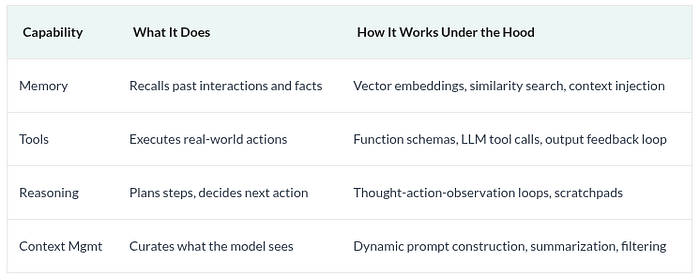
Our last post explored what makes an AI agent different from a traditional LLM — memory, tools, reasoning, and autonomy. These agents are the foundation of a new generation of intelligent applications.
But how are these agents built today?
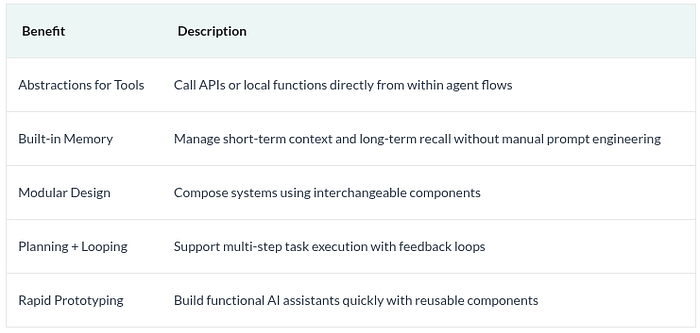
Enter agent frameworks — open-source libraries and developer toolkits that let you create goal-driven AI systems by wiring together models, memory, tools, and logic. These frameworks enable some of the most exciting innovations in the AI space… but they also come with trade-offs.
In this post, we’ll dive into:
What AI agent frameworks are
The most popular frameworks available today
The benefits they offer
Where they fall short
Why we need something more modular and flexible (spoiler: MCP)
What Is an AI Agent Framework?
An AI agent framework is a development toolkit that simplifies the process of building LLM-powered systems capable of reasoning, acting, and learning in real time. These frameworks abstract away much of the complexity involved in working with large language models (LLMs) by bundling together key components like memory, tools, task planning, and context management.
Agent frameworks shift the focus from “generating text” to “completing goals.” They let developers orchestrate multi-step workflows where an LLM isn’t just answering questions but taking action, executing logic, and retrieving relevant data.
Memory
Memory in AI agents refers to how information from past interactions is stored, retrieved, and reused. This can be split into two primary types:
Short-term memory: Keeps track of the current conversation or task state. Usually implemented as a conversation history buffer or rolling context window.
Long-term memory: Stores past interactions, facts, or discoveries for reuse across sessions. Typically backed by:
A vector database (e.g., Pinecone, FAISS, Weaviate)
Embedding models that turn text into numerical vectors
A retrieval layer that finds the most relevant memories using similarity search
Under the hood:
Text is embedded into a vector representation (via models like OpenAI’s text-embedding-ada-002)
These vectors are stored in a database
When new input arrives, it’s embedded and compared to stored vectors
Top matches are fetched and injected into the LLM prompt as background context
Tools
Tools are external functions that the agent can invoke to perform actions or retrieve live information. These can include:
Calling an API (e.g., weather, GitHub, SQL query)
Executing a shell command or script
Reading a file or database
Sending a message or triggering an automation
Frameworks like LangChain, AutoGPT, and Semantic Kernel often use JSON schemas to define tool inputs and outputs. LLMs “see” tool descriptions and decide when and how to invoke them.
Under the hood:
Each tool is registered with a name, description, and parameter schema
The LLM is given a list of available tools and their specs
When the LLM “decides” to use a tool, it returns a structured tool call (e.g., {"name": "search_docs", "args": {"query": "sales trends"}})
The framework intercepts the call, executes the corresponding function, and feeds the result back to the model
This allows the agent to “act” on the world, not just describe it.
Intro to Dremio, Nessie, and Apache Iceberg on Your Laptop
We're always looking for ways to better handle and save money on our data. That's why the "data lakehouse" is becoming so popular. It offers a mix of the flexibility of data lakes and the ease of use and performance of data warehouses. The goal? Make data handling easier and cheaper. So, how do we […]
Aug 16, 2023·Dremio Blog: News Highlights
5 Use Cases for the Dremio Lakehouse
With its capabilities in on-prem to cloud migration, data warehouse offload, data virtualization, upgrading data lakes and lakehouses, and building customer-facing analytics applications, Dremio provides the tools and functionalities to streamline operations and unlock the full potential of data assets.
Aug 31, 2023·Dremio Blog: News Highlights
Dremio Arctic is Now Your Data Lakehouse Catalog in Dremio Cloud
Dremio Arctic bring new features to Dremio Cloud, including Apache Iceberg table optimization and Data as Code.