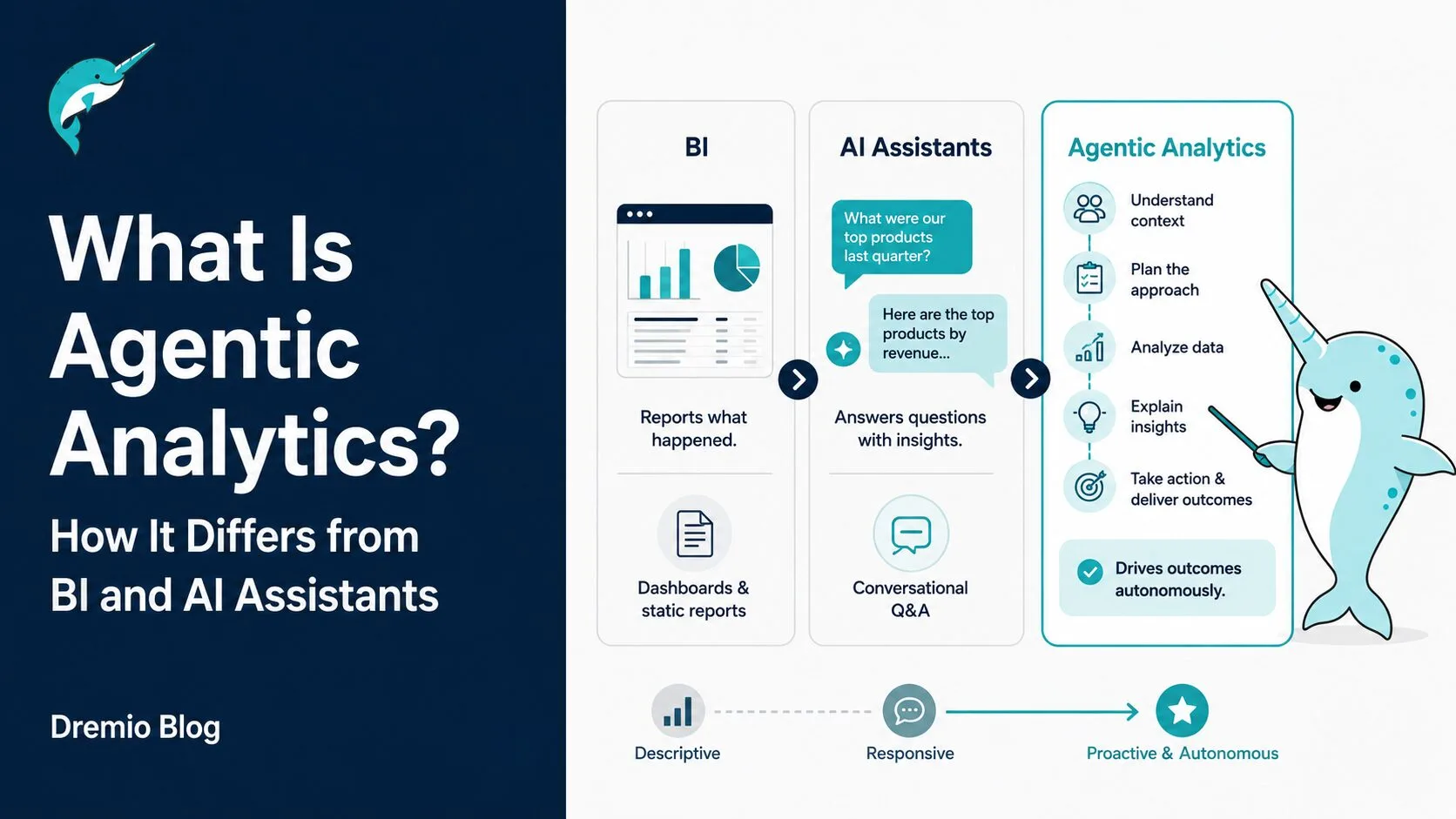
business analyst gets a question from the CMO on Monday morning: "Why did customer churn spike last month?" Under a traditional BI model, that question enters a backlog, a report gets built over two days, and the answer lands on the CMO's desk on Wednesday reflecting data from three weeks ago. By that point, the business has already made decisions without the analysis.
Agentic analytics changes that equation entirely. The same question triggers an autonomous AI agent that queries live data, joins the right tables across multiple systems, interprets the results, and delivers a full analysis in seconds, with no analyst in the loop.
That gap is what this post unpacks. We will define what is agentic analytics, explore how it differs from traditional BI, augmented analytics, and text-to-SQL, and explain why the data foundation underneath the agent matters more than the AI model on top.
The Problem With How Analytics Has Always Worked
Traditional BI was built around a model where data analysts act as intermediaries between business questions and data answers. A business user asks a question. The analyst translates it into a query, builds a report, and delivers a visualization.
The model works when questions are predictable and cadences are stable. It breaks down when questions are urgent, unpredictable, or require combining data from multiple sources.
Self-service BI was supposed to fix this. Give business users drag-and-drop tools and pre-built dashboards, and they won't need analysts for routine questions. In practice, self-service BI shifted the bottleneck rather than eliminating it. Business users could answer the questions the dashboards were built for, but anything outside those pre-built views still required analyst time.
Augmented analytics came next: embed AI into BI tools to help analysts work faster. Auto-generated insights, natural language querying, and anomaly flags baked into dashboards. These tools genuinely help, but they keep the human in the loop at every step.
An AI co-pilot suggests the next query. The analyst then decides whether to run it. The latency drops from days to hours, but the model is still fundamentally human-guided.
The core problem is not the tools. The problem is that insight generation has been a sequential, human-dependent process. Sequential human-dependent processes do not scale with the volume, velocity, or variety of questions modern businesses generate.
Defining Agentic Analytics: What the Term Actually Means
Agentic analytics is the use of autonomous AI agents to perform multi-step analytical workflows with goal-directed behavior. The agent receives a business question, plans a sequence of steps to answer it, executes those steps using available tools (SQL queries, metadata lookups, external APIs, visualization engines), interprets the results at each step, and delivers a complete analysis, all without requiring human approval between steps.
This definition excludes a few things that get incorrectly lumped in:
It is not text-to-SQL. Text-to-SQL translates a natural language question into a single SQL query. That is a single-shot transformation. The human still runs the query, inspects the result, and decides what to ask next. There is no reasoning chain, and no synthesis across multiple results.
It is not a chatbot. A chatbot is stateless and reactive. It answers one question at a time with no memory of prior exchanges and no ability to take action. An agentic system retains context, plans across multiple steps, and can trigger downstream workflows.
It is not RPA. Robotic Process Automation executes rule-based workflows. The steps are predefined. An agentic system decides its own steps based on the goal and intermediate results. It adapts.
It is not a dashboard. Dashboards are passive views of pre-aggregated data. They answer the questions they were built to answer, nothing more.
The word "agentic" comes from AI agent research. A foundational framing is the ReAct framework (Yao et al., 2022), which showed that language models improve dramatically when they alternate between reasoning (what do I think is happening?) and acting (what tool should I call?). Every time the agent acts, it observes the result and reasons again. This loop continues until the agent has enough information to answer the original goal.
In analytics, the tools available to the agent are SQL execution, schema and metadata lookup, visualization generation, API calls, and calls to other specialized agents. The goal is a business question. The environment is a data platform.
Dremio's analysis of agentic analytics captures the critical insight: the limiting factor for agentic analytics is not the AI model. It is the data foundation the agent operates on.
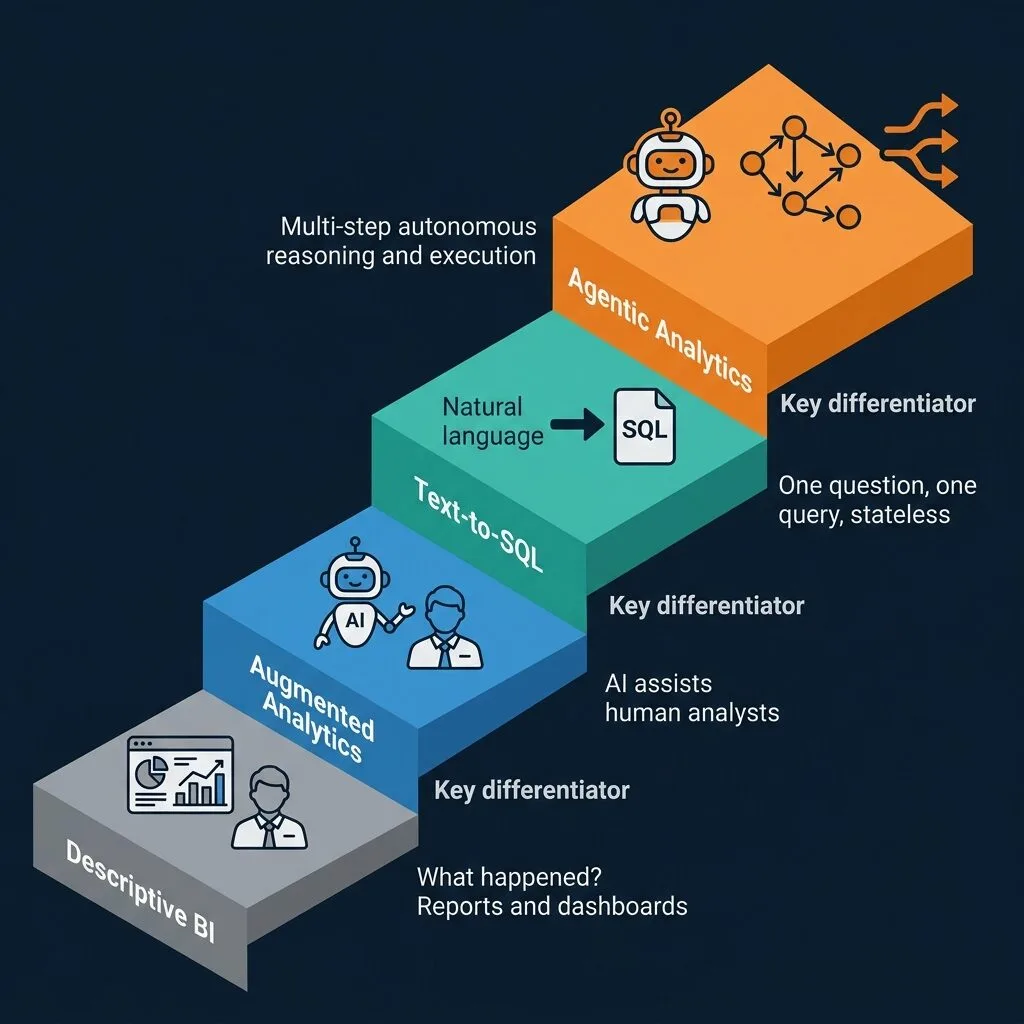
The Analytics Evolution Ladder
To understand where agentic analytics fits, it helps to trace the progression of how businesses have used data to make decisions. Each level changed one thing about the prior model.
Level 1: Descriptive BI answers the question "what happened?" Reports, dashboards, and charts built by analysts or BI developers show historical data in visual form. The human builds the view, another human reads it. Answer latency: days to weeks. The model is entirely human-driven.
Level 2: Augmented Analytics brings AI in as a co-pilot for the human analyst. The AI generates suggestions, flags anomalies, and translates some natural language questions into SQL. But the human decides which suggestions to act on. Answer latency: hours to a day. The model is human-guided with AI assistance.
Level 3: Text-to-SQL enables a business user to type a question and receive a SQL query (or the query result). This eliminates the analyst for simple, single-question lookups. But it is still single-shot: one question maps to one query.
There is no planning, no synthesis, and no multi-step reasoning. Answer latency: minutes. The model is human-initiated, AI-executed for one step.
Level 4: Agentic Analytics removes the human from the per-step loop entirely. The agent receives a goal, plans the steps to achieve it, executes each step, uses results to inform the next step, and delivers a complete analysis. Answer latency: seconds. The model is autonomous.
Level
Name
Who's In Control
Answer Latency
What Changed
1
Descriptive BI
Human
Days to weeks
Structured data visualization
2
Augmented Analytics
Human + AI assist
Hours
AI enters the loop
3
Text-to-SQL
Human initiates, AI executes one step
Minutes
Natural language queries
4
Agentic Analytics
Autonomous AI agent
Seconds
Multi-step autonomous reasoning
The jump from Level 3 to Level 4 is not incremental. It is the difference between a tool that responds to inputs and a system that pursues goals.
Agentic BI vs. Agentic Analytics: Understanding the Boundaries
Many data leaders search for agentic BI and agentic analytics interchangeably. However, they describe different scopes of automation.
Agentic BI represents the automation of existing business intelligence workflows. It focuses on generating dashboards, scheduling reports, updating charts, and responding to single-turn queries. The agent essentially acts as a virtual BI operator, replacing the manual clicks of a report builder.
Agentic analytics represents the automation of the entire analytical pipeline. It goes beyond BI to handle raw data ingestion, programmatic data preparation, advanced machine learning or statistical modeling, and narrative report synthesis. The agent functions as a virtual analyst, translating a high-level business goal into a series of investigations and presenting a finalized narrative.
This shift changes how users interact with data. You no longer request a dashboard to look for answers. You state your business objective, and the agent delivers the final analysis.
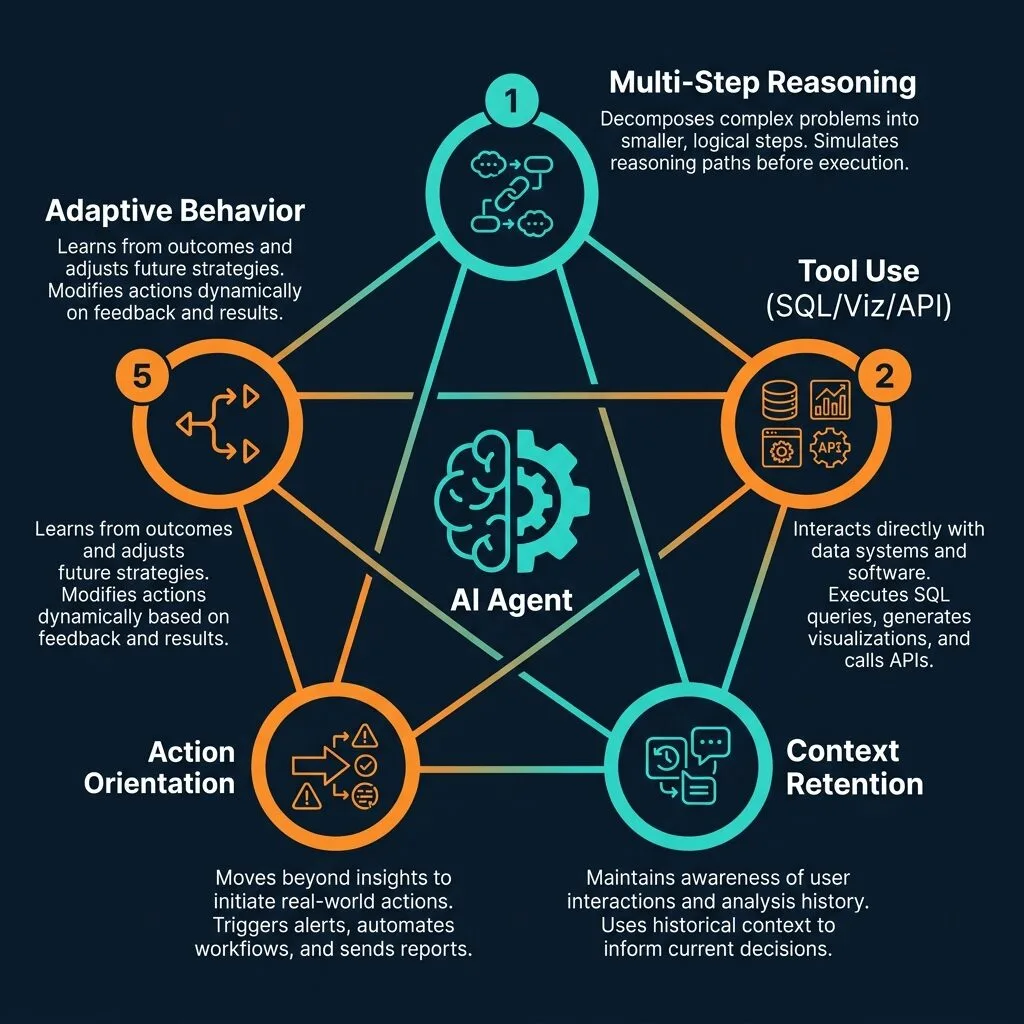
What Makes Analytics "Agentic": Five Core Capabilities
Not every AI analytics tool qualifies as agentic. The term has specific meaning rooted in these five capabilities. A system that lacks any one of them is a capable tool, but not an agentic analytics system.
1. Multi-Step Reasoning
The defining capability. When a business user asks "why did churn spike last month?", an agentic system does not generate one SQL query and return the result. It breaks the question into sub-questions:
What is the overall churn rate trend over the past six months?
Which customer segments are driving the spike?
What product usage patterns differ between churned and retained customers?
Does support ticket volume correlate with churn in the affected segments?
What changed in pricing or product in the relevant time window?
Each sub-question becomes a query or a tool call. The results of each step inform the framing of the next. The final output synthesizes all intermediate results into a coherent answer.
This is the core of what separates agentic analytics from text-to-SQL. The agent plans, not just translates.
2. Tool Use
An agentic analytics system is not limited to SQL. It has access to a defined set of tools it can call at any step:
SQL execution against the data platform
Schema and metadata discovery to find the right tables before querying
Visualization generation to produce charts from query results
External API calls to enrich data (Salesforce, Stripe, weather APIs)
Calls to other specialized agents for domain-specific analysis
Tool use is what gives the agent reach across the full data environment. An agent limited to SQL can only analyze what is already in the warehouse. An agent with API access can bring in external context. An agent that can call other agents can coordinate parallel analysis streams.
3. Context Retention
A stateless system forgets everything between questions. An agentic system retains the results of prior steps in its working context. This serves two purposes.
Within a single analytical task, context retention lets the agent use the result of step 3 to frame step 4 correctly. The agent does not need to re-execute earlier steps because it already has the results.
Across a user session, context retention lets the user ask follow-up questions without restating everything. "Now break that down by region" is a valid follow-up because the agent remembers what "that" refers to.
This is what makes the interaction feel like working with an analyst rather than filling out a query form.
4. Action Orientation
A chatbot produces text. An agentic analytics system can trigger actions. This is the capability that moves agentic analytics from insight generation to business process automation.
Examples of actions an analytics agent can take:
Send a Slack alert when a KPI drops below threshold
Create a Jira ticket for the team responsible for the affected area
Kick off a data pipeline to refresh a downstream model
Schedule a recurring report to be delivered every Monday
Update a metric in a monitoring dashboard
Action orientation is what makes agentic analytics a platform capability, not just a query interface. The analysis is not the end of the workflow. Instead, it can trigger the next phase of your operations.
5. Adaptive Behavior
When a query returns null results, or when the data contradicts the agent's initial hypothesis, an agentic system adjusts. It does not fail or return an empty result and stop. It reasons about why the result was unexpected and tries a different approach.
For example: if the agent queries a customer segmentation table and finds no records for the time period in question, it might check whether the table has a different partitioning scheme, expand the time window, or look for an equivalent table in a different schema.
Adaptive behavior is what makes the agent genuinely autonomous rather than just pre-scripted. It can operate in real-world data environments where not everything is clean, complete, or where the agent expected it to be.
The Grounding Challenge: Why AI Analytics Agents Hallucinate Math
The most common failure mode of early AI analytics systems is producing incorrect figures with high confidence. This is the grounding challenge. When an AI analytics agent makes calculations locally or writes raw SQL against a database without constraints, it operates on statistical guesswork.
Generative models do not perform arithmetic natively. They predict the next token based on training weights. If an agent runs Python code to calculate metrics in a sandbox, it easily makes errors like summing pre-averaged ratios or joining tables on incorrect columns.
To produce reliable analysis, the system must use deterministic execution. The agent should compile its analytical steps into logical query intentions, then pass those intentions to a governed database engine. The query engine, not the language model, executes the math.
A governed semantic layer acts as the compiler constraint for the agent. It enforces pre-defined joins, metric calculations, and security policies. The agent cannot write incorrect SQL because it queries views that contain the correct logic. This architecture guarantees that every metric is calculated consistently across runs.
The Technical Components of an Agentic Analytics Stack
Building a production-ready agentic analytics system requires coordinating five distinct layers of technology.
First is the Reasoning Engine. This is the planner, typically an LLM running an orchestration loop like the ReAct framework. It receives the high-level business goal, decides which steps to take, evaluates intermediate data, and determines when the goal is met.
Second is the Tool Interface. This is the protocol that allows the reasoning engine to interact with external systems. Standards like the Model Context Protocol (MCP) define how agents read schemas, execute queries, and access metadata safely.
Third is the Grounding Engine. This is the semantic layer. It maps raw tables to business concepts, curating metric definitions and relationships. It teaches the agent the vocabulary of the business so the agent writes correct queries.
Fourth is the Compute Engine. This is the high-performance SQL query engine. Because agents issue many complex, unpredictable queries in a single session, the query engine must return results in seconds. Slow query execution causes the agent's reasoning loop to time out.
Fifth is the Integration Layer. This is the action-oriented interface. It translates the agent's findings into downstream business processes, such as sending Slack messages, creating Jira tickets, or launching orchestrators.
How Agentic Analytics Differs From What You're Already Using
If you are evaluating whether to invest in agentic analytics, this comparison matters. The table below clarifies the specific differences between the approaches your organization may already have in place.
Capability
Traditional BI
Augmented Analytics
Text-to-SQL
Agentic Analytics
Who drives the analysis?
Human analyst
Human + AI suggestions
Human question, AI SQL
Autonomous agent
Multi-step reasoning?
No
No
No
Yes
Context across steps?
No
Partial
No
Yes
Can trigger actions?
No
No
No
Yes
Handles unpredictable queries?
No (requires pre-built)
Partial
Limited
Yes
Answer latency
Days
Hours
Minutes
Seconds
Scales with question volume?
No
Partial
Partial
Yes
The pattern is clear: each prior level adds one capability, but none of them achieve what agentic analytics achieves at Level 4. The question for your organization is not "should we replace BI?" It is "what class of analytical work should we apply agentic capabilities to first?"
Routine analytical tasks with predictable structure may still be served well by existing BI. High-volume, high-variability, time-sensitive analytical tasks are where agentic analytics delivers the most distinct value.
Why the Data Foundation Matters More Than the AI Model
This is the part of the agentic analytics conversation that gets the least attention and matters the most. Organizations evaluating agentic analytics often focus on which LLM to use, which agent framework to adopt, or which orchestration tool to connect. The LLM is not the bottleneck. The data foundation is.
There are three specific ways a weak data foundation causes agentic analytics to fail.
Failure Mode 1: Incomplete Data Access
An agent can only analyze the data it can reach. If your data is distributed across a cloud data warehouse, an S3 data lake, several SaaS APIs, and a PostgreSQL operational database, an agent that can only query the warehouse is blind to 80% of the relevant context.
Query federation addresses this. When the agent can issue a single query that spans data across cloud storage, databases, and SaaS sources, it gets a complete picture. Without federation, the agent either gives a partial answer or requires complex custom plumbing to aggregate data into one place before analysis.
Dremio's Agentic Lakehouse provides this federated access layer, so agents can reach all relevant data regardless of where it lives.
Failure Mode 2: Wrong Business Context
LLMs are excellent at generating plausible-looking SQL. They are not inherently aware of your business definitions. "Revenue" might mean different things in three different tables. "Active customer" might be defined differently in the CRM versus the product database. Without a governed semantic layer, the agent confidently writes SQL that produces wrong answers.
The AI semantic layer solves this by providing the agent with curated business definitions, governed joins, and standardized metric definitions. When the agent queries "revenue," it goes through a view that enforces the correct definition. The semantic layer is not just a performance optimization. It is a correctness mechanism that guarantees accurate results.
You can read more about why this layer is critical in Dremio's guide to what a semantic layer is and how it shapes query accuracy.
Failure Mode 3: Performance Timeouts
Human analysts write queries they've thought through and tested. Agentic systems issue queries on the fly, covering patterns no human anticipated. If your data platform requires manual query tuning or relies on pre-built materialized views to be fast, it will not keep up with an agent that issues hundreds of varied queries per day.
Autonomous performance addresses this by automatically accelerating any query pattern without requiring manual intervention. Dremio's Autonomous Reflections observe query patterns and build the right acceleration structures automatically. The agent never has to wait for a DBA to tune a query that wasn't anticipated.
Dremio's Autonomous Performance blog explains how this works in practice and why it's a prerequisite for real-world agentic workloads.
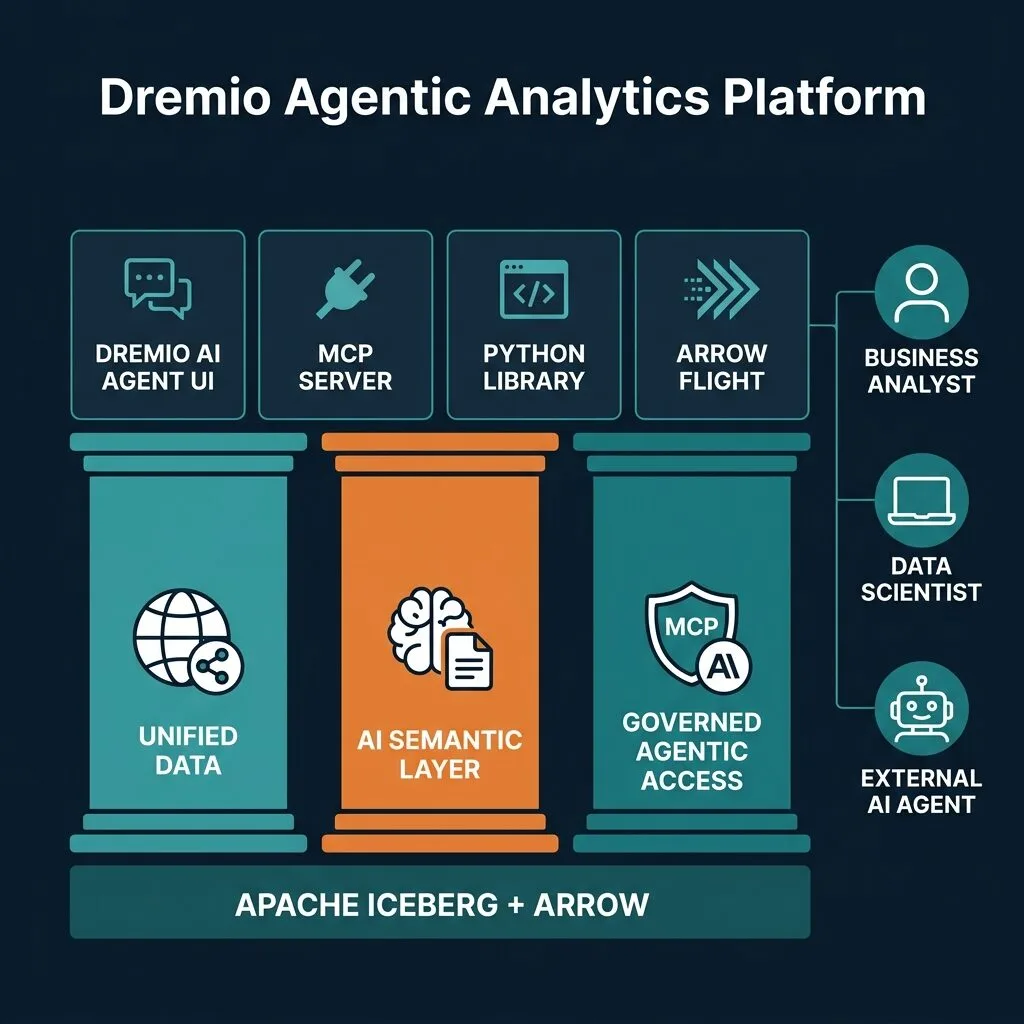
How Dremio Implements Agentic Analytics
Dremio exposes agentic analytics through multiple interfaces, designed to meet different users where they are.
The Built-in AI Agent
Dremio's AI Agent in the platform UI operates across five modes:
Discover: Explore what datasets, schemas, and tables are available. The agent inventories the data environment so users don't have to.
Explore: Profile data distributions, check data quality, understand what's in a dataset before building analysis on it.
Analyze: The core agentic mode. Pose a business question. The agent then plans and executes a multi-step analysis.
Visualize: Auto-generate appropriate charts and visualizations from query results without manual chart configuration.
Explain SQL: Translate existing SQL queries into plain-language explanations. Useful for teams inheriting legacy query logic.
These five modes cover the full analytical lifecycle from data discovery through insight delivery.
The MCP Server for External Agents
Dremio exposes an MCP (Model Context Protocol) Server that allows external AI agents to connect to Dremio as a governed data tool. An agent running in Claude, ChatGPT, or a custom LLM framework can call Dremio tools via MCP: list available tables, retrieve schema metadata, execute SQL, fetch semantic context.
This means any LLM-based agent can use Dremio as its data backbone without needing Dremio's own UI. For organizations building custom analytical agents for specific business domains, this is how you get governed, semantically-aware data access without rebuilding the governance infrastructure from scratch.
Python Integration: DremioAgent
For data teams building custom analytical workflows in Python, the dremioframe library includes a DremioAgent class that wraps SQL execution, metadata access, and semantic layer context into a Python-native interface. Teams can build domain-specific agents, integrate with workflow orchestration tools, and compose multi-agent pipelines using Dremio as the data execution layer.
AI SQL Functions
Dremio also brings AI into the SQL layer itself through AI SQL Functions. These are SQL functions that call LLM capabilities inline:
SELECT
  customer_id,
  ai_summarize(support_notes) AS issue_summary,
  ai_classify(support_notes, 'billing,technical,feature_request') AS category
FROM support_tickets
WHERE ticket_date >= CURRENT_DATE - INTERVAL 30 DAYS;
This approach embeds AI processing into the data pipeline rather than layering it on top, which means AI-enriched results can flow directly into downstream dashboards, models, and reports.
Real-World Use Cases for Agentic Analytics
The value of agentic analytics becomes concrete when you look at specific operational contexts where the traditional model creates measurable delays or gaps.
Anomaly Detection and Ops Monitoring
Operations teams monitor dozens of KPIs. When something spikes or drops, the current model is: alert fires, analyst investigates, report goes to leadership. The investigation step takes hours.
An agentic analytics system can be the investigation step. When a KPI deviates from baseline, the agent automatically analyzes contributing factors, segments the deviation by dimension (region, product, channel), and delivers a root cause summary alongside the alert. Ops leaders receive not just the alert but the analysis.
Customer Churn and Retention Analysis
Marketing and customer success teams consistently cite churn analysis as one of the most time-consuming analytical tasks. The question "which customers are most at risk this quarter and why?" requires joining transaction history, product usage logs, support ticket data, and NPS scores.
An agentic system executes this join automatically, applies segmentation, computes churn probability by segment, and produces recommended interventions. A task that took an analyst two days takes the agent two minutes.
Supply Chain Optimization
Supply chain data spans inventory systems, demand forecasting models, and supplier databases, often across multiple platforms. When inventory levels drop or demand signals change, an agentic system can analyze the full context: current inventory, projected demand, supplier lead times, cost options. It can recommend the optimal reorder decision with supporting data, rather than waiting for a human to pull together the same information manually.
Financial Close and Reconciliation
Month-end close involves running hundreds of reconciliation checks against financial data. Most of these checks are routine. A small number surface actual discrepancies. An agentic system can run the full set of checks, triage the results, generate explanations for each flagged discrepancy, and present the finance team with a prioritized list of items requiring human review.
The analyst's role shifts from running checks to reviewing exceptions. The same analytical work that took a team a week now surfaces in hours.
Trust, Governance, and Why Autonomy Does Not Mean Unchecked
The most common concern with autonomous analytics agents is the trust question. If a human isn't approving each step, how do you know the agent isn't accessing data it shouldn't, producing analysis based on the wrong definitions, or making decisions that should require human review?
These are legitimate questions. The answers come from the governance architecture underneath the agent, not from limiting what the agent can do.
The Semantic Layer as a Correctness Constraint
When the agent queries data through a governed semantic layer, every query is constrained by the business logic encoded in that layer. The agent cannot accidentally use the wrong join or the wrong definition of a metric because the semantic layer enforces the correct one. The semantic layer is not just for human analysts. It is the core mechanism that makes agent-generated analysis trustworthy.
Fine-Grained Access Control
Dremio's Fine-Grained Access Control (FGAC) enforces row-level and column-level permissions at query execution time. When an agent runs a query on behalf of a user, it operates under that user's permissions. The agent cannot access rows or columns the user is not authorized to see.
Governance is not a policy statement. It is enforced at the query engine level.
Full Audit Trails
Every tool call the agent makes, every SQL query it executes, and every result it retrieves is captured in an audit log. This gives security and compliance teams full visibility into what the agent did, when it did it, and what data it accessed. The autonomous nature of the agent does not create a black box. Instead, it creates a detailed audit log.
Trust in agentic analytics is not a matter of limiting autonomy. It is a matter of ensuring the autonomy operates within a governed, observable, access-controlled environment.
What to Look for in an Agentic Analytics Platform
If you are evaluating platforms that claim agentic analytics capabilities, the following checklist separates genuine capability from marketing.
Capability
Why It Matters
Warning Sign
Governed data access (FGAC)
Agents must respect row/column permissions
Governance is a post-query filter, not enforced at execution
AI semantic layer
Consistent business definitions prevent wrong answers
Agent queries raw tables directly with no business context
Autonomous performance
Agents issue unpredictable query patterns
Platform requires manual tuning or pre-built views to be fast
Query federation
Agents need all relevant data, not just the warehouse
Single-source access only
Multi-interface access (UI + API + MCP)
Different user types need different access patterns
UI-only agent access
Full audit logging
Autonomous actions must be traceable
No visibility into agent query history
Semantic lineage
Know what data informed the agent's analysis
Black-box result with no lineage
The platforms that score well on this checklist are not just the ones with the best LLM integration. They are the ones with the strongest data foundation. The AI model is the top layer. The data platform is the infrastructure that determines whether that top layer produces trustworthy results.
Frequently Asked Questions
How does agentic analytics differ from a traditional natural language query (NLQ) interface?
Traditional natural language query interfaces are stateless and reactive translation tools. They convert a single natural language question into a single SQL statement. The user must inspect the resulting data table and formulate the next question by hand. There is no planning, context preservation, or multi-step analysis.
Agentic analytics uses goal-directed AI agents to execute multi-step investigations autonomously. The agent receives a high-level goal and creates a plan containing multiple sub-questions. It queries database metadata, executes SQL statements, reads the results, and adjusts its plan based on those findings.
It then runs statistical checks and compiles the entire sequence into a finished narrative report. You can explore how this workflow operates in the platform interface by reviewing Dremio's AI Agent overview.
Why do AI agents need a governed semantic layer instead of querying raw database tables directly?
AI models do not possess inherent knowledge of your business definitions or database layouts. If you allow an agent to query raw tables directly, it will write incorrect SQL. It will join columns incorrectly, double-count pre-aggregated fields, or fail to account for schema changes. These errors lead to confidently presented wrong numbers.
A governed semantic layer acts as an essential compiler constraint for the agent. It maps complex database tables to clear business concepts. When the agent queries a metric like quarterly revenue, it accesses a virtual view that enforces standard formulas and joins.
The semantic layer guarantees that the agent calculates metrics consistently across runs. You can learn more about configuring this logic in Dremio's AI Semantic Layer guide.
What is the Model Context Protocol (MCP) and how does it connect AI agents to data catalogs?
The Model Context Protocol is an open standard that allows large language models to interact with external tools and data sources. In traditional architectures, developers had to write custom API clients and custom SQL wrappers for every new model version. This created massive integration overhead and security risks.
MCP replaces this custom work with a unified client-server interface. A data platform exposes an MCP server that lists schemas, executes queries, and retrieves metadata safely. Any MCP-compliant client can connect to this server and use the catalog as a tool.
How does Dremio solve query timeout issues in agentic analytics sessions?
AI agents operate in iterative reasoning loops. In a typical session, the agent runs a query, inspects the result, and decides what query to run next. If each query takes minutes to execute, the agent will exceed the session timeout limits of the LLM. The reasoning loop will break, and the analysis will fail.
Dremio resolves this issue by automating query acceleration. The platform monitors incoming queries and automatically builds Reflections to pre-aggregate and index data in the background. The agent receives query results in milliseconds instead of minutes.
This interactive speed keeps the agent's reasoning loop active and allows it to complete complex analysis quickly. You can read about this technology in Dremio's Autonomous Reflections architecture.
Can analytics agents run secure queries on sensitive data, and how are permissions enforced?
Security is a major concern when deploying autonomous agents. If an agent has root access to all data, it may expose sensitive information like customer credit cards or employee records. Limiting the agent to pre-aggregated data lists, however, destroys its ability to run ad-hoc investigations.
Dremio solves this through Fine-Grained Access Control. The agent runs queries using the specific credentials and permissions of the requesting user. Dremio enforces row-level security and column-level masking at the query engine level.
The data is restricted before the agent receives it, ensuring that the agent never sees data the user is not allowed to see. Learn more about these policies in Dremio's Agentic Lakehouse security solutions.
What is the difference between custom python-based agent frameworks and built-in UI analytics agents?
Built-in UI agents are designed for business analysts and operations leaders. These agents run inside the data platform console, allowing users to type questions and receive charts without writing code. They are optimized for ad-hoc questioning and reporting.
Python-based frameworks are designed for data teams who build custom pipelines. By using Python libraries, engineers can embed analytical agents into orchestrations. The agent can monitor inventory, run statistical checks, and write custom narratives.
It can then trigger automated actions like sending Slack messages or updating dashboard cards. You can register to explore both interfaces on the Dremio Cloud registration page.
How does query federation benefit agentic analytics in multi-cloud environments?
In most organizations, data is scattered across multiple cloud platforms, object stores, and local relational databases. If an AI agent can only query a single data warehouse, it remains blind to most of your operational context. If you must build pipeline scripts to copy all that data into one warehouse, the delay destroys the real-time speed of agentic analytics.
Query federation allows the agent to issue a single query that joins data across multiple physical locations without data copying. The query engine handles the translation and pushes filtering work down to the source systems. The agent receives a complete view of the data lakehouse instantly. You can read about this execution model in Dremio's Query Federation guide.
Final Thoughts: Agentic Analytics Is a Paradigm Shift, Not a Feature
The framing that matters here: agentic analytics is not a feature you add to your existing BI stack. It is a different approach to how analytical work gets done, who does it, and at what speed.
Traditional BI built a model where insight is expensive to produce and therefore rationed. Agentic analytics makes insight cheap to produce, which means it can be democratized. Every business question, whether from a CMO or a front-line manager, can trigger a full analysis rather than entering a queue.
That shift has implications beyond the analytics team. When analysis is available on demand, businesses can run faster. Decisions that used to wait for the next weekly report can be made the same day. Hypotheses can be tested in minutes rather than weeks.
The practical recommendation: identify one analytical bottleneck in your organization right now. This could be a recurring report that takes two days, a root cause analysis that runs late, or a manual quarterly churn assessment. Map that bottleneck to the five capabilities of agentic analytics and evaluate whether an agent with proper data access could close it.
As AI models continue to improve, the differentiating factor in agentic analytics will not be which model you use. It will be the quality, governance, and breadth of the data foundation the agent operates on. That foundation is worth investing in now.
Try Dremio Cloud free for 30 days and explore how the Agentic Lakehouse gives autonomous agents the governed, federated, high-performance data foundation they need to produce analysis you can actually trust.
Try Dremio Cloud free for 30 days
Deploy agentic analytics directly on Apache Iceberg data with no pipelines and no added overhead.
Intro to Dremio, Nessie, and Apache Iceberg on Your Laptop
Editor’s note, September 2026. This post was published in September 2023 and some product details have changed since. Nessie is still available and self-deployable under the Apache-2.0 licence, and it remains the clearest implementation of catalog-level branching. It is not an Apache Software Foundation project, and its development has slowed considerably. For how the current […]
Aug 16, 2023·Dremio Blog: News Highlights
5 Use Cases for the Dremio Lakehouse
With its capabilities in on-prem to cloud migration, data warehouse offload, data virtualization, upgrading data lakes and lakehouses, and building customer-facing analytics applications, Dremio provides the tools and functionalities to streamline operations and unlock the full potential of data assets.
Sep 30, 2026·Dremio Blog: Open Data Insights
Apache Iceberg 1.12.0: What’s New, Breaking Changes, and Upgrade Guide
Apache Iceberg 1.12.0 expands v3 engine support, REST catalog operations, streaming reliability, and v4 groundwork. Learn how to upgrade safely.