Business intelligence aims to answer data questions in plain English, but AI often struggles due to data fragmentation and lack of context.
A robust data foundation includes a semantic layer for context, live data federation for access, and high performance for speed.
Dremio's platform integrates everything needed for agentic analytics, eliminating the need for a complex, DIY solution.
True agentic systems should manage both structured and unstructured data, enabling insights from all data assets.
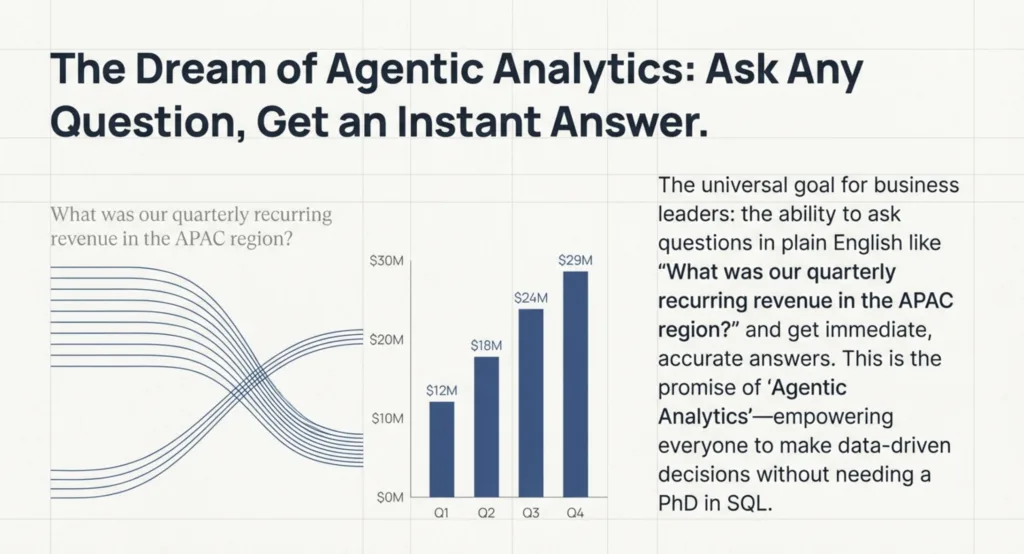
Every business leader shares a common dream: to ask simple questions about their company's data in plain English and get instant, accurate answers. "What was our quarterly recurring revenue in the APAC region?" or "Show me the top 10 most active customers last month." This is the holy grail of business intelligence, the promise of "Agentic Analytics" that companies are pouring their AI budgets into. The idea is simple: empower everyone to make data-driven decisions without needing a PhD in SQL.
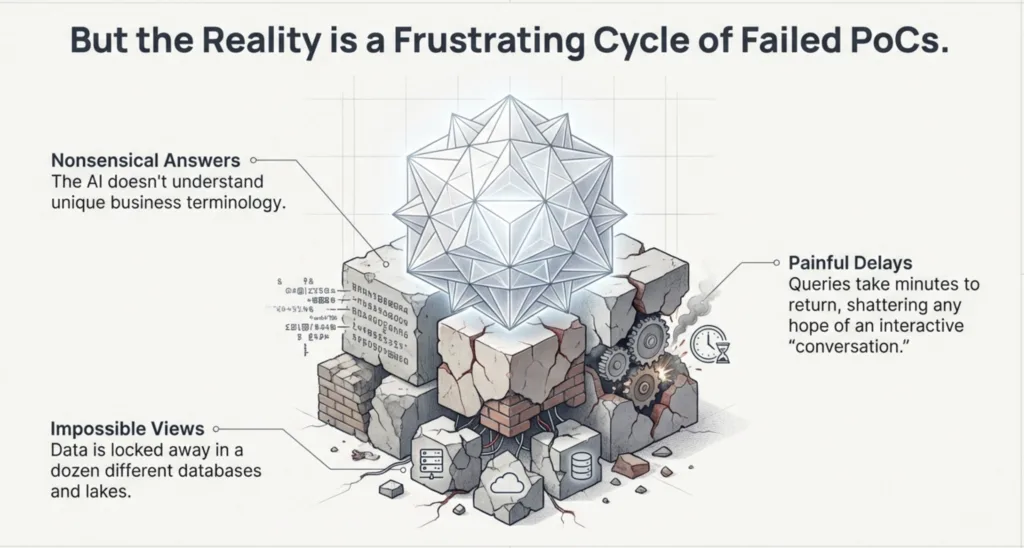
But the reality is often a frustrating cycle of failed proofs-of-concept. The conversational AI assistant doesn't understand the business's unique terminology, giving generic or nonsensical answers. The data it needs is locked away in a dozen different databases and data lakes, making a unified view impossible without a massive data engineering project. And when a query finally does run, it takes minutes to return, shattering any hope of an interactive "conversation."
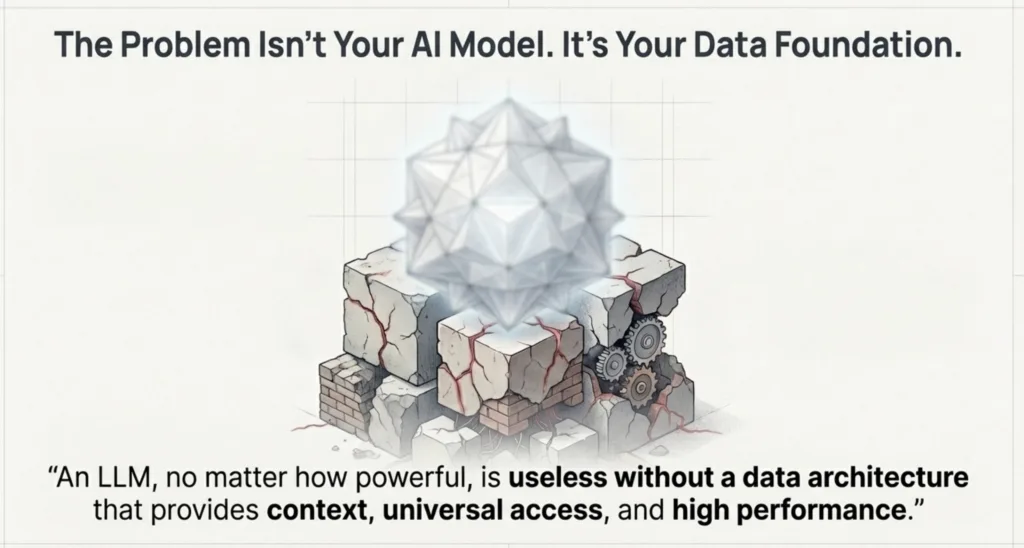
The common reaction is to blame the AI model. But the problem isn't the AI; it's the data foundation it's built upon. An LLM, no matter how powerful, is useless without a data architecture that provides context, universal access, and high performance. This article reveals the key components of a data foundation that provides the three missing ingredients: deep business context, universal data access, and interactive speed.
Takeaway 1: Your AI Lacks Context, Making It Unhelpful
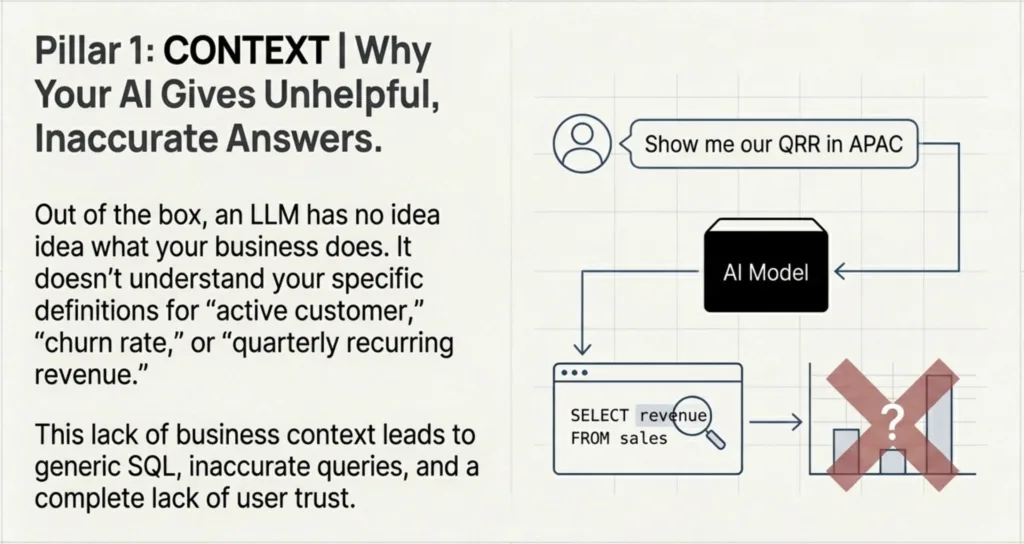
Out of the box, a large language model has no idea what your business does. It doesn't understand your specific definitions for "active customer," "churn rate," or "quarterly recurring revenue." This fundamental lack of business context is why so many AI data assistants fail. They can translate a generic question into generic SQL, but they can't answer a specific business question because they don't speak your company's language. The result is inaccurate queries and a complete lack of trust from users.
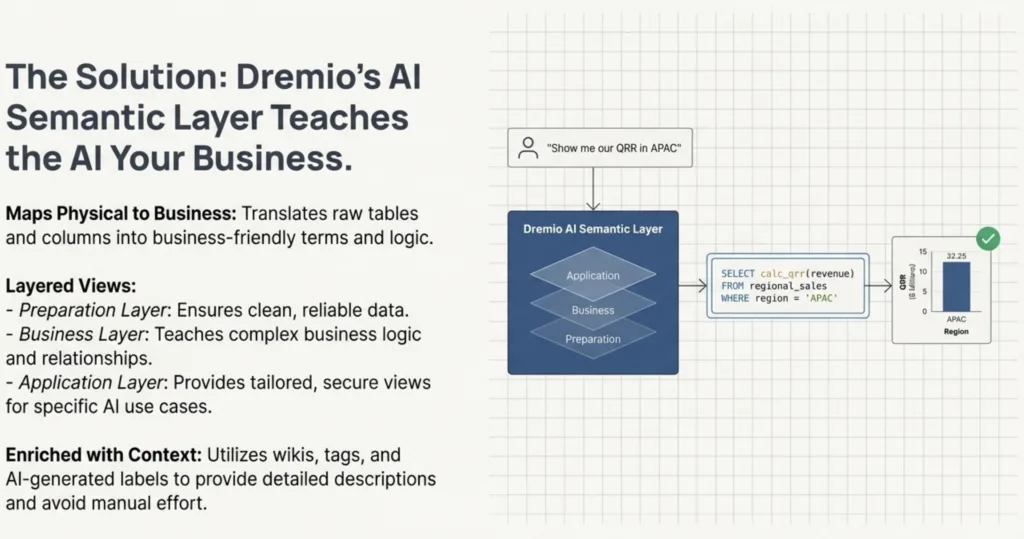
The solution is a semantic layer that teaches the AI your business. Dremio’s AI Semantic Layer maps the physical data structures, the raw tables and columns, to business-friendly terms and logic.
Layered Views: The semantic layer is built to teach the AI your business from the ground up. The preparation layer ensures the AI works with clean, reliable data. The business layer teaches the AI complex business logic and relationships. Finally, the application layer provides a tailored, secure view of the data for specific AI-driven use cases or users.
Enriched with Context: This semantic layer is further enriched with wikis and tags that provide detailed descriptions of datasets and columns. To avoid manual effort, Dremio can use generative AI to automatically generate these labels and wikis based on the data's schema and content.
Empowering the AI Agent: Dremio's built-in AI Agent uses all the information available from the semantic layer. When a user asks a question in natural language, the agent leverages the business definitions, metrics, and documentation in the semantic layer to understand the user's intent and write accurate, context-aware SQL.
Takeaway 2: Your Data Is Everywhere (And Moving It Is a Nightmare)
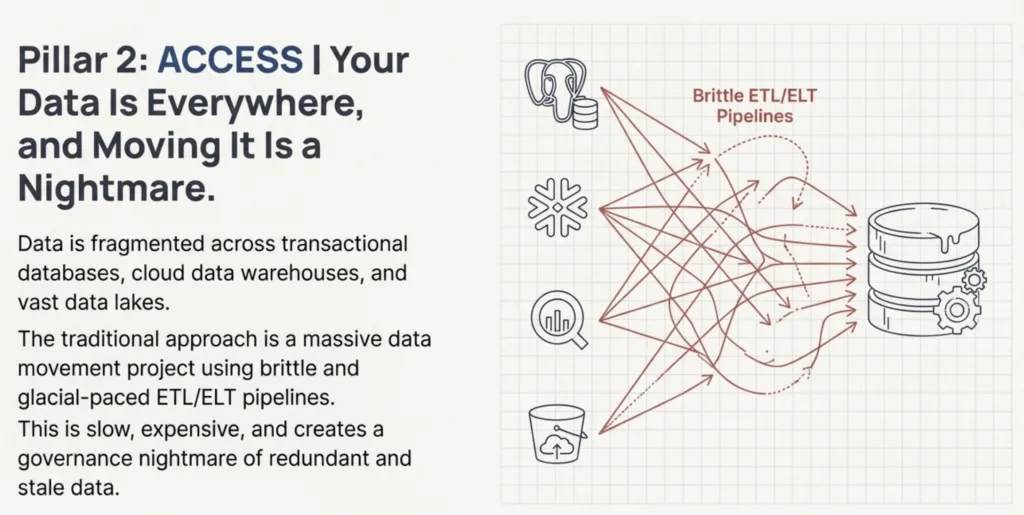
For most organizations, data isn't in one clean, convenient place. It's fragmented across a complex landscape of data silos: transactional databases like PostgreSQL, cloud data warehouses like Snowflake and BigQuery, and vast data lakes in object storage. An AI agent needs access to all of this data to answer comprehensive questions.
The traditional approach to solving this is a massive data movement project. Teams spend months building brittle and glacial-paced ETL/ELT pipelines to copy all the data into a single, centralized location. This is a slow, expensive process that creates a governance nightmare of redundant and stale data before the AI can even attempt to query it.
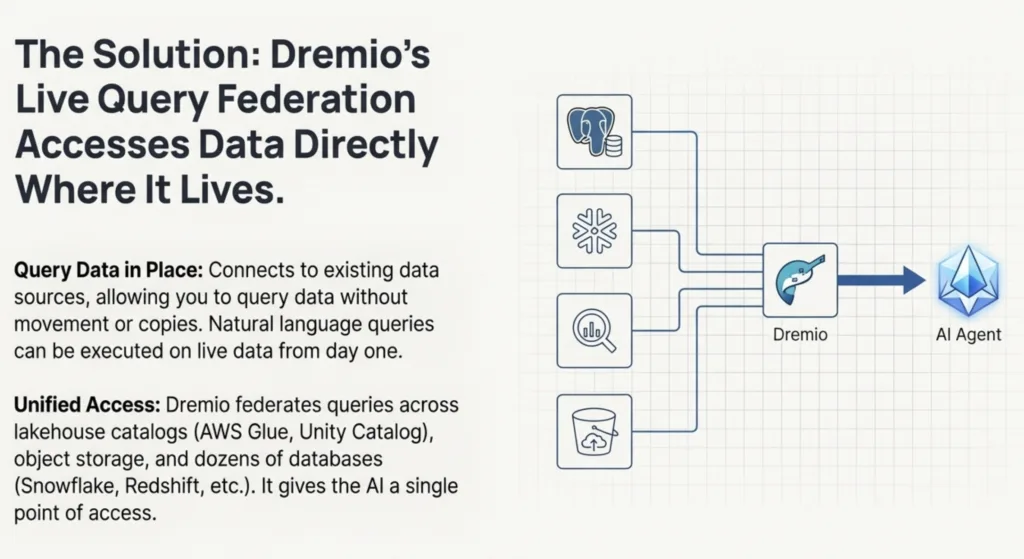
Dremio solves this with live Query Federation, allowing the AI to access data directly where it lives.
Query Data in Place: Dremio connects to your existing data sources and allows you to query data in place without the need for movement or copies. Natural language queries can be executed on live data from day one.
Unified Access: Dremio can federate queries across a wide range of sources, including lakehouse catalogs (like AWS Glue and Unity Catalog), object storage (Amazon S3, Azure Storage), and dozens of databases (including Snowflake, Redshift, and PostgreSQL). This gives your AI agent a single point of access to the entire data landscape.
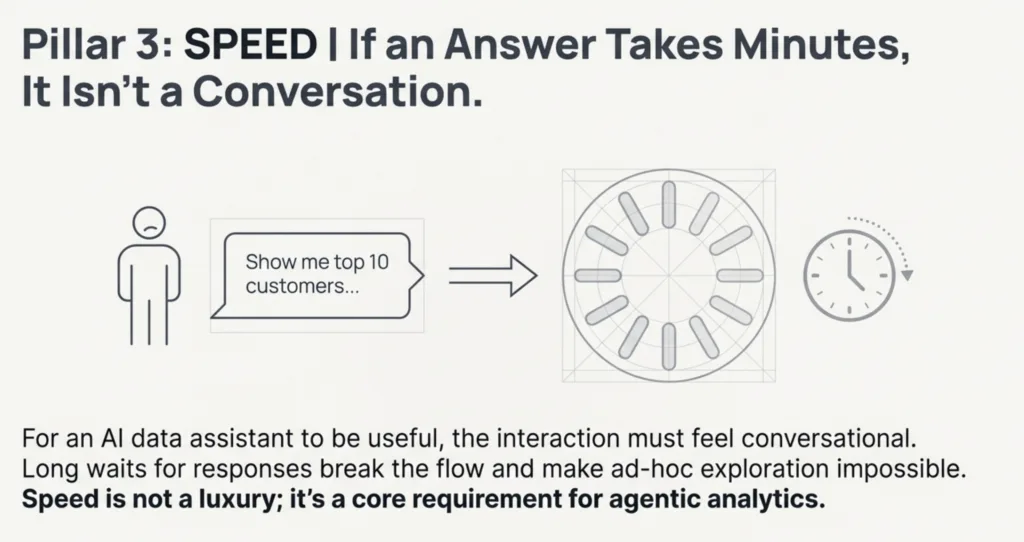
Takeaway 3: The Answers Are Too Slow to Matter
For an AI data assistant to be useful, the interaction must feel like a conversation. If you ask a question and have to wait three minutes for a response, the conversational flow is broken. Users will not adopt a tool that makes ad-hoc exploration and follow-up questions impossible due to slow performance. Speed is not a luxury; it's a core requirement for agentic analytics.
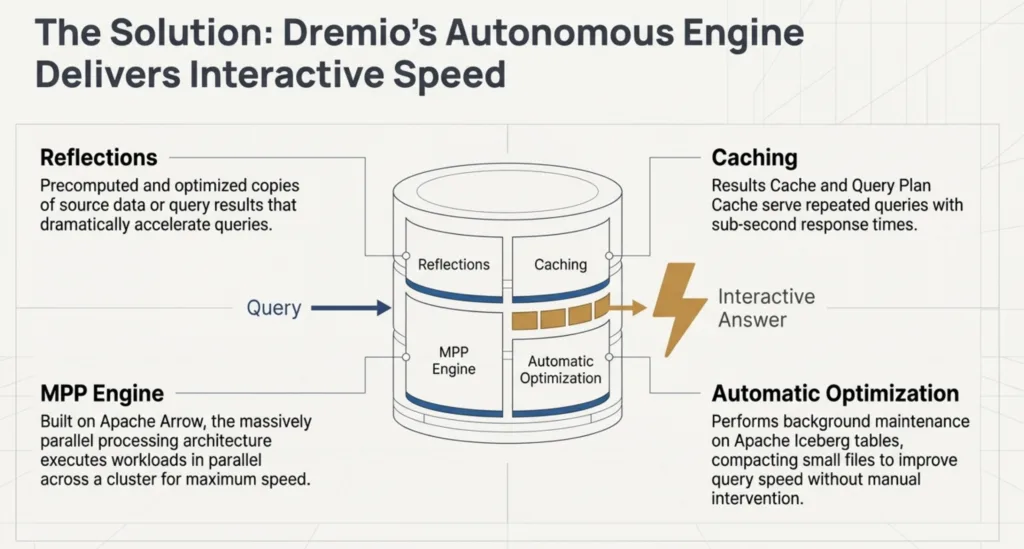
Dremio is built on a high-performance query engine with autonomous features designed to deliver interactive query speed, even on massive datasets.
Reflections: A Reflection is a precomputed and optimized copy of source data or a query result, designed to speed up query performance. Dremio uses them to dramatically accelerate queries, and they can be created and maintained automatically by Autonomous Reflections or managed manually.
Caching: To avoid redundant work, Dremio utilizes a Results Cache and a Query Plan Cache. If the same query is run multiple times, the results or the optimized execution plan can be served directly from cache, delivering sub-second response times.
MPP Engine Architecture: The query engine is built on Apache Arrow and uses a massively parallel processing (MPP) architecture. Workloads are divided into fragments and executed in parallel across a cluster of executors to maximize speed and throughput.
Automatic Optimization: Dremio automatically performs background maintenance on Apache Iceberg tables within its Open Catalog. It compacts small files into larger, more optimal ones, improving query speed without any manual intervention.
Takeaway 4: Your "AI" Is More Than Just a Chat Window
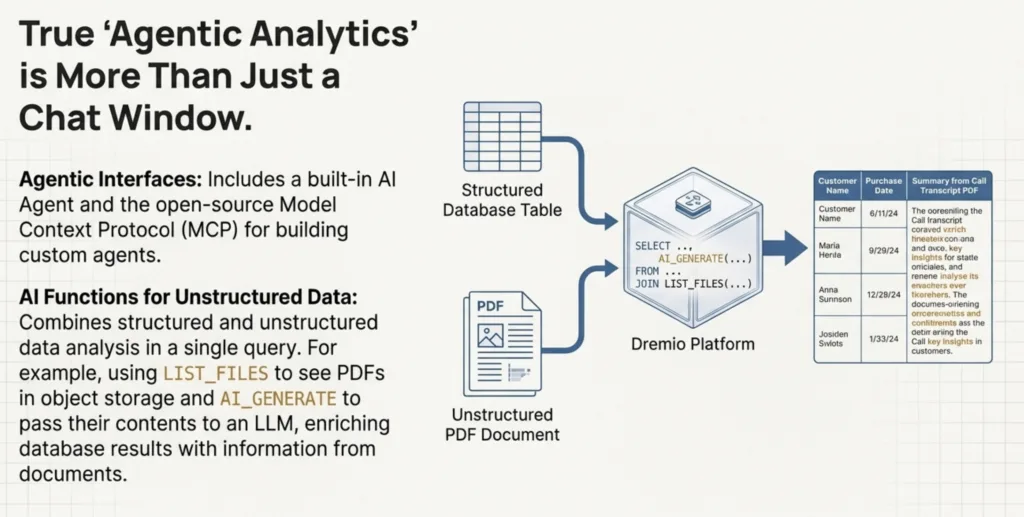
True agentic analytics goes beyond a simple text-to-SQL chat window. A genuinely "agentic" system should be able to reason, interact through different interfaces, and work with more than just perfectly structured, tabular data. It should be able to derive insights from the combination of all your data assets, including unstructured files.
Dremio provides the interfaces and functions to build a truly agentic system.
Agentic Interfaces: Dremio includes a built-in AI Agent that supports natural language queries and generates visualizations. For organizations that want to use other AI clients or build custom agents, Dremio's Model Context Protocol (MCP) is an open-source project that enables AI chat clients or agents to securely interact with your Dremio deployment.
AI Functions for Unstructured Data: Dremio can combine analysis of structured and unstructured data in a single SQL query. Using the LIST_FILES function, you can see files in object storage, and the AI_GENERATE function can pass the contents of those files (like PDFs) to an LLM to extract information. This allows you to ask questions that require pulling structured data from a database and enriching it with information extracted from unstructured documents in your data lake.
Takeaway 5: You Shouldn't Have to Build a Franken-Platform
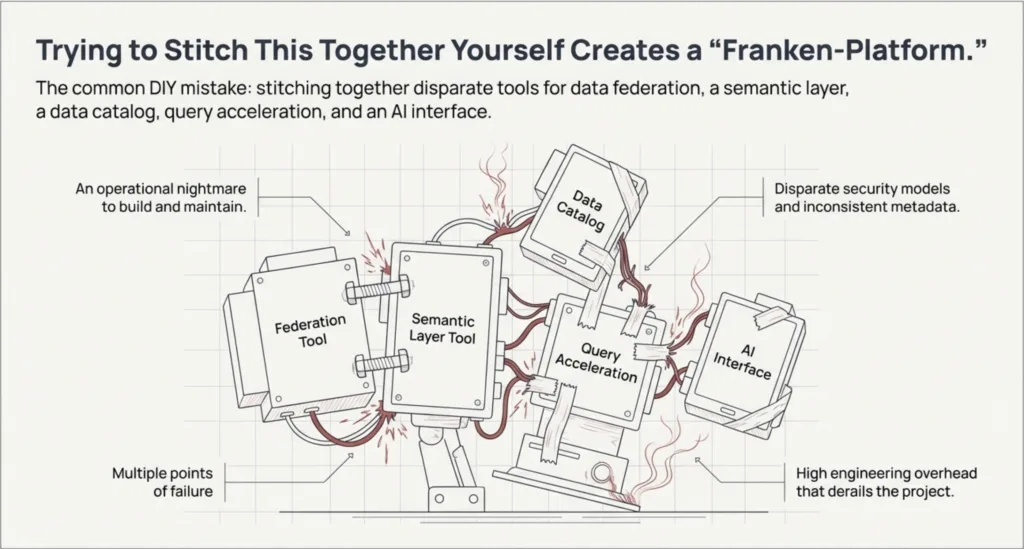
Faced with the challenges of context, data silos, and performance, many companies attempt a DIY solution. They try to stitch together a collection of disparate tools: one for data federation, another for a semantic layer, a third for a data catalog, a fourth for query acceleration, and a fifth for the AI interface.
The result is a complex, brittle, and expensive "Franken-Platform" that is an operational nightmare to build and maintain. Teams are forced to manage disparate security models, inconsistent metadata, multiple points of failure, and the high engineering overhead required just to keep the system running. The integration complexity alone can derail the entire project.
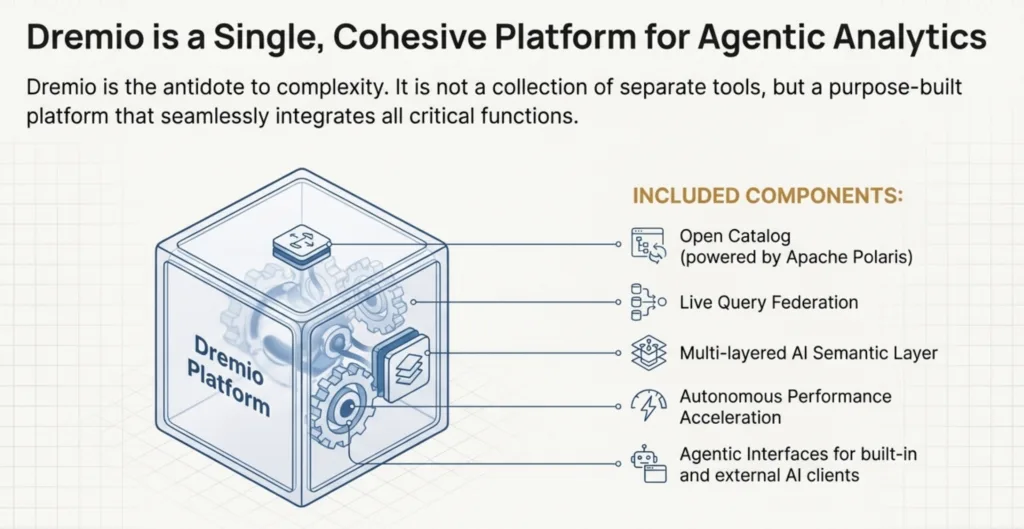
Dremio is designed as a single, cohesive platform that provides all the necessary components for agentic analytics.
Fully Integrated: Dremio is not a collection of separate tools. It is a purpose-built platform that seamlessly integrates all the critical functions needed to make your data AI-ready.
All Components Included: The platform includes a built-in Open Catalog (powered by Apache Polaris), live query federation, a multi-layered AI Semantic Layer, autonomous performance acceleration features like Reflections and caching, and agentic interfaces for both built-in and external AI clients. With Dremio, you get the complete data foundation required to deliver on the promise of agentic analytics without the complexity of building a Franken-Platform.
Conclusion: It’s Not the AI, It’s the Foundation
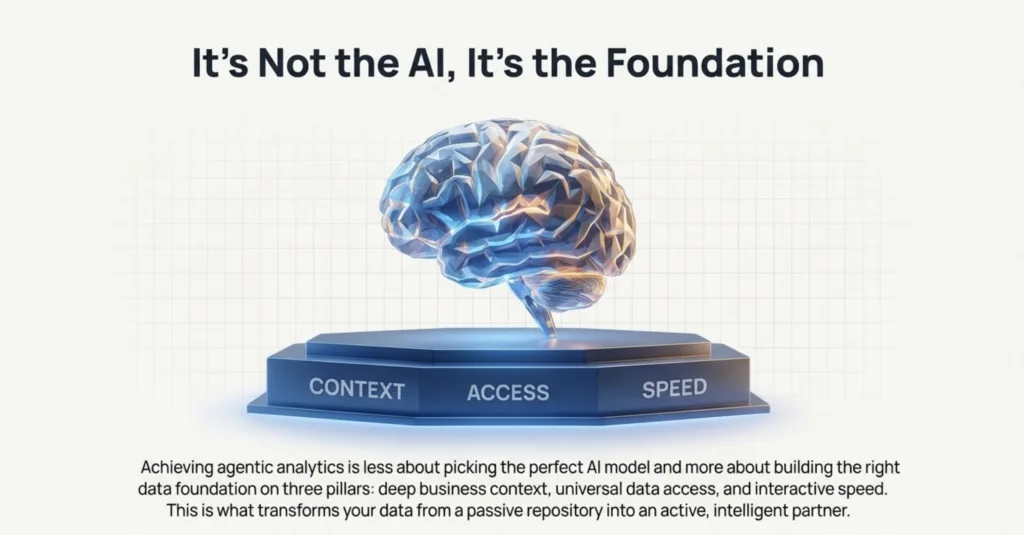
Achieving valuable agentic analytics is less about picking the perfect AI model and more about building the right data foundation. Success depends on three non-negotiable pillars: deep business context from a semantic layer, universal access through live data federation, and interactive speed delivered by autonomous performance features. This is what finally connects the power of AI to the reality of your enterprise data, transforming it from a passive repository into an active, intelligent partner in decision-making.
Now that your data can understand you, what is the first question you will ask?
Ingesting Data Into Apache Iceberg Tables with Dremio: A Unified Path to Iceberg
By unifying data from diverse sources, simplifying data operations, and providing powerful tools for data management, Dremio stands out as a comprehensive solution for modern data needs. Whether you are a data engineer, business analyst, or data scientist, harnessing the combined power of Dremio and Apache Iceberg will undoubtedly be a valuable asset in your data management toolkit.
Oct 12, 2023·Product Insights from the Dremio Blog
Table-Driven Access Policies Using Subqueries
This blog helps you learn about table-driven access policies in Dremio Cloud and Dremio Software v24.1+.
Aug 31, 2023·Dremio Blog: News Highlights
Dremio Arctic is Now Your Data Lakehouse Catalog in Dremio Cloud
Dremio Arctic bring new features to Dremio Cloud, including Apache Iceberg table optimization and Data as Code.