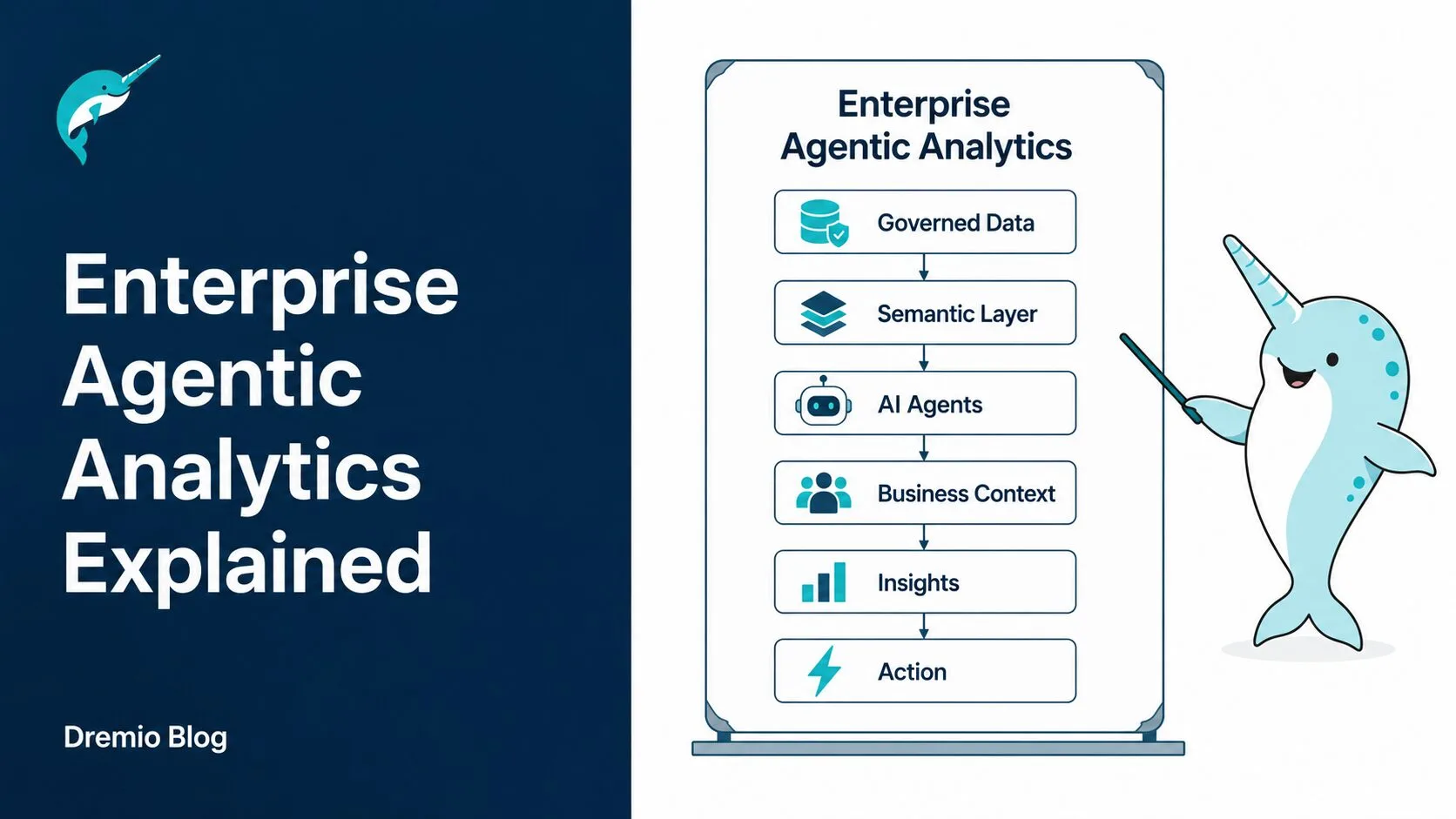
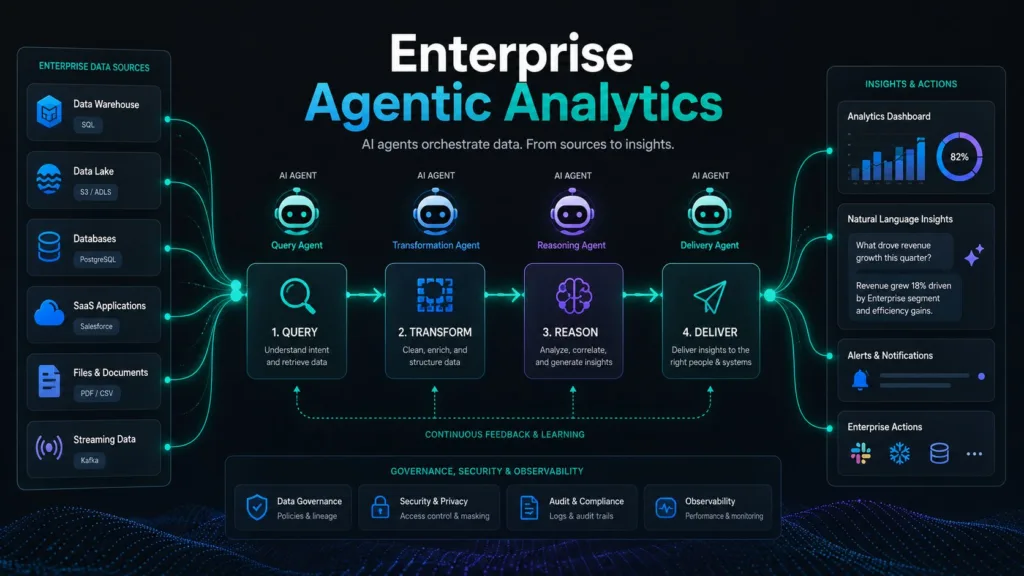
Enterprise data rarely sits in one place. It spreads across a warehouse, a few databases, an object store, and a handful of SaaS tools, each with its own access rules. Enterprise agentic analytics is the practice of letting AI agents work across all of that, running the multi-step analysis a human analyst used to do by hand, so a business question turns into a governed answer without a three-day wait. The hard part was never the single query. It was the chain of steps behind a real question, and the context that has to survive each one.
That chain is exactly where agentic workflows earn their keep. A PwC 2025 survey found 79% of organizations already adopting AI agents, yet Gartner projects that more than 40% of agentic AI projects will fail by 2027, mostly because teams underestimate cost, governance, and the data foundation agents need. This post explains what enterprise agentic analytics is, why agentic workflows matter for complex analysis, the use cases that pay off, how agents actually query enterprise data, what drives software cost, how to evaluate vendors, and how Dremio makes the data underneath all of it usable for AI.
Key highlights:
Enterprise agentic analytics uses AI agents to run multi-step analysis across distributed, governed data, moving from a plain-language question to a trusted answer with little manual effort.
Agentic workflows matter because they connect fragmented tasks, carry context across systems, and apply governance at every step instead of bolting it on at the end.
Software cost depends on architecture, usage, and integration, not a single list price, so the data foundation you run agents on drives both spend and success.
Dremio supports enterprise agentic analytics by unifying access across sources, applying shared definitions through an AI Semantic Layer, enforcing governance end to end, and accelerating every agent query.
What are enterprise agentic analytics?
Enterprise agentic analytics is data analysis where autonomous AI agents discover the right data, plan and run a sequence of analytical steps across governed enterprise sources, interpret the results, and return answers or recommended actions with little manual direction. The word "enterprise" carries weight here. It means the agent has to handle scale, security, and data spread across many systems, not just answer a question against one clean table. You can read a fuller definition in our guide to agentic analytics.
It helps to separate this from what came before. Traditional BI hands you a dashboard and leaves the interpreting to you. Basic conversational analytics adds a chat box, so you can ask one question and get one answer, but it stops there. Agentic analytics runs the whole chain. It asks its own follow-up questions, pulls from more than one source, and arrives at a conclusion. The agent does the legwork that used to sit between the dashboard and the decision.
Why agentic workflows matter for enterprise analytics
Most enterprise questions are not single queries. They are workflows: pull the data, segment it, compare it to last year, check a second source, explain the gap. Agentic workflows matter because they handle that full sequence as one governed process, which is what complex enterprise analysis actually requires.
1. Connect fragmented analytics tasks
A real business question usually spans several disconnected steps that a person stitches together by hand. The analyst exports from one tool, joins it to data from another, then rebuilds the same logic next week. An agentic workflow links those steps into one run, so the work happens once and repeats reliably.
Fewer manual handoffs between tools and teams.
One consistent process instead of a fragile chain of exports.
Repeatable runs that produce the same result every time.
2. Support iterative, multi-step analysis
Good analysis is rarely one and done. You find something, then ask why, then ask what changed. Agents handle that loop natively, running each step, reading the output, and deciding what to check next without a person restarting the process at every turn.
This is the difference between a tool that answers and a workflow that investigates. An agent can move from "revenue dropped" to "it dropped in one region" to "a pricing change caused it" in a single pass.
3. Preserve context across systems and interactions
Context is what breaks first when analysis crosses systems. A metric defined one way in finance means something else in sales, and the meaning gets lost in the handoff. Agentic workflows hold that context steady through every step, which is where strong context mapping pays off.
Metric definitions stay consistent from the first step to the last.
The agent remembers earlier steps instead of starting fresh each time.
Answers trace back to the same shared meaning, no matter which system they touch.
4. Apply governance throughout the workflow
Governance cannot be a checkpoint at the end. If an agent runs five steps across three sources, every one of those steps has to respect access rules. Strong data governance applies permissions at the engine level, so the agent only ever touches data the requesting user is cleared to see, at every stage of the workflow.
Access rules enforced on every step, not just the final result.
No side channel for an agent to reach restricted data.
A traceable record of what ran, which keeps audits clean.
5. Manage complexity at enterprise scale
Scale is what separates an enterprise workflow from a demo. Thousands of users and agents asking unpredictable questions against petabytes of data is a different problem than one analyst running one report. A capable enterprise data platform absorbs that complexity by optimizing itself, so performance holds as load climbs.
In real deployments, this self-optimizing approach accelerated 80% of workloads without manual tuning and dropped some query times from 13 seconds to 1 second. That is the kind of headroom enterprise agentic workflows need to stay usable under pressure.
AI agents improving enterprise analytics workflows: Use cases
AI agents support analytical work across departments by discovering the right data, running the follow-up analysis a question demands, and returning results in a format people can act on. The pattern repeats across functions even though the data changes. You can see more on this in our piece on AI analytics for agents.
Financial performance and variance analysis
A finance team closes the month and needs to know why operating margin missed plan. An agent pulls actuals against budget, isolates the line items driving the variance, cross-references headcount and vendor data, and explains the gap in plain language, all before the review meeting. Finance teams running this kind of agent have cut analysis and processing time by roughly half. Industries with heavy reporting loads see the sharpest gains, which is why financial services leads adoption.
Variance explained in minutes, not days of manual digging.
Consistent treatment of the same accounts across every close.
Analysts freed to interpret results instead of assembling them.
Sales and customer trend analysis
A retail merchandising lead wants to know why a product line slowed in one region. An agent segments sales by channel, store, and customer cohort, compares the trend to prior quarters, and flags the segment driving the change with a suggested response. This is a daily need in retail and consumer products, where demand shifts fast and a two-day reporting lag costs real revenue.
Trends caught while they still matter, not after the quarter closes.
Segment-level detail without filing a request to the data team.
A recommended action attached to the finding, not just a chart.
Supply chain and inventory optimization
A supply chain planner faces a demand spike across some regions and flat inventory in others. An agent reads real-time sales and stock data, predicts where shortages will hit, and recommends replenishment moves before shelves go empty. Walmart runs a version of this at scale, connecting 4,700 stores and fulfillment centers to a forecasting agent that makes replenishment decisions continuously.
Shortages predicted ahead of time, not discovered after the fact.
Inventory rebalanced across locations using live signals.
Fewer stockouts and less overstock sitting in the wrong place.
Operational monitoring and root-cause analysis
A plant manager sees yield drop on a production line and needs the cause fast. An agent monitors sensor and quality data, detects the anomaly, traces it to a specific machine or shift, and surfaces the root cause with the evidence behind it. This kind of root-cause work is high value in the manufacturing industry, where every hour of unplanned downtime is expensive.
Anomalies caught in real time instead of in a weekly report.
Root cause identified with a clear data trail.
Faster fixes and less downtime on the line.
Executive reporting and decision support
An executive wants a straight answer on how the quarter is tracking, not a stack of dashboards. An agent assembles the key metrics across functions, applies consistent definitions, and returns a clear summary with the drivers called out. That turns scattered business intelligence into decision support leadership can use in the moment. JPMorgan's agents now draft investment banking presentations in about 30 seconds, work that once took analysts hours.
One consistent view across functions instead of conflicting reports.
Drivers explained, not just numbers displayed.
Answers ready in the meeting, not the day after.
How do AI agents query enterprise data?
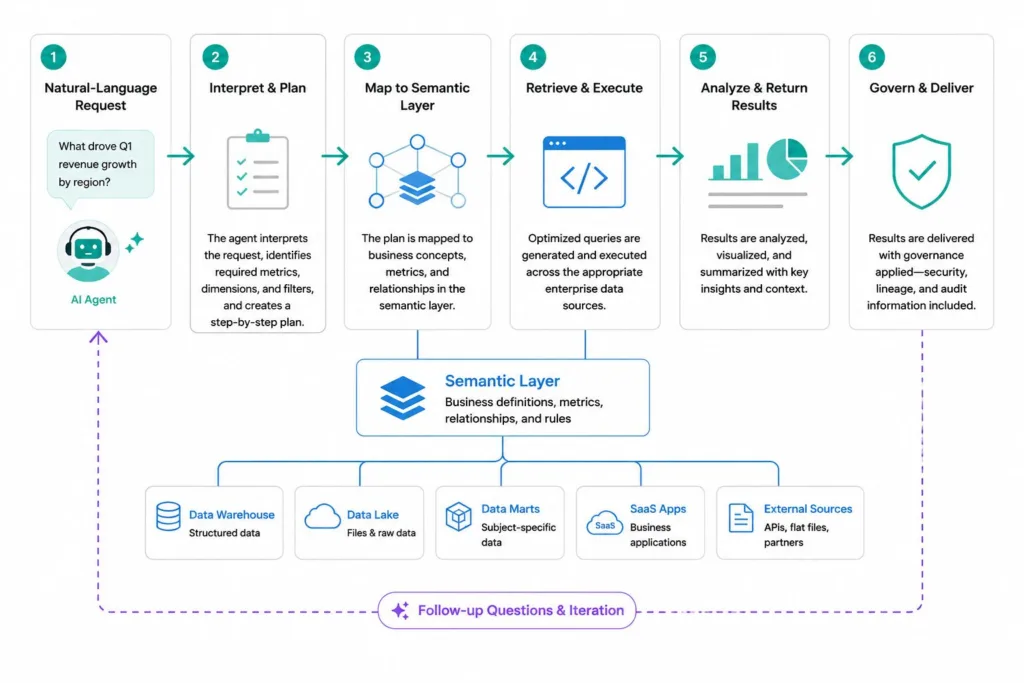
An AI agent queries enterprise data by turning a plain-language request into a governed query, running it, checking the result, and looping back when the answer needs more work. The process looks simple from the outside, but each step leans on a real data foundation underneath.
Interpret the user's intent: The agent reads the natural-language question and works out what is really being asked, including the metrics, filters, and time frame implied by it.
Discover relevant datasets and business definitions: It searches the semantic layer to find the right tables and the business meaning behind them, so it knows that "active customer" maps to a specific, agreed definition.
Generate the appropriate query: The agent writes optimized SQL against the correct sources, applying the joins and logic the question requires.
Execute the query and evaluate the results: It runs the query through the governed engine, then checks whether the output actually answers the question or looks off.
Perform follow-up analysis when required: If the first result raises a new question, the agent runs the next step on its own, drilling from what happened into why.
Return an answer, visualization, or recommended action: It delivers the result in a usable form, with the reasoning attached and a suggested next step where one fits.
Need to boost performance? Deliver lightning-fast results with Dremio's Intelligent Query Engine.
Enterprise agentic analytics software does not follow one standard price. Cost shifts with architecture, usage, and how much integration the deployment needs, so two companies can run the same vendor and pay very different bills. These six factors drive most of the difference.
1. Model deployment
The language models behind your agents carry real cost, and how you deploy them matters. A hosted commercial model bills per token, a self-hosted open model trades that for infrastructure spend, and the choice affects both price and control. Smart model deployment often means routing simple tasks to cheaper models and saving the expensive ones for hard reasoning.
2. Query and compute consumption
Agents generate far more queries than people do, because every follow-up step is another run. That makes data querying volume a primary cost driver. Platforms that cache and reuse optimized results, instead of recomputing from scratch each time, keep compute spend flat as agent activity climbs.
3. Number of users, agents and concurrent workloads
Cost scales with how many users and agents hit the system at once. Ten analysts running occasional reports is a different load than a thousand users and dozens of agents querying continuously. Concurrency drives the compute you have to provision, so pricing tied to peak workload deserves close attention.
4. Data sources and integration requirements
Every source an agent needs to reach adds integration work and cost. Connecting a clean warehouse is cheap. Wiring up a dozen databases, object stores, and SaaS tools, each with its own data source format and auth, is where budgets stretch. A platform that federates across sources without copying data cuts a large slice of that expense.
5. Semantic layer and governance configuration
The semantic layer and governance setup is upfront work that pays back later. Defining metrics, building semantic layers, and configuring access rules takes time, but skipping it produces wrong answers and security gaps that cost far more. Budget for this as foundation, not overhead.
6. Implementation and ongoing management
The last factor is the human cost of running the system. A platform that needs constant manual tuning eats engineering hours every week, while a self-managing one gives that time back. Dremio's autonomous approach is built to make data engineers up to 10x more productive by removing that recurring maintenance load.
How to evaluate agentic data analytics companies?
The only reliable way to evaluate a vendor is to test it against your own data, your own access policies, and the actual business questions your teams ask. A polished demo on clean sample data tells you almost nothing about how the platform behaves on your messy, governed, distributed reality. Use this table as a starting framework.
Evaluation criteria for enterprise agentic analytics vendors
Does performance hold under concurrency without constant manual tuning?
Interoperability and operational cost
Lock-in and hidden compute costs surface after you commit
Does it use open standards and open formats, and how does cost scale with usage?
How Dremio makes enterprise data usable for AI
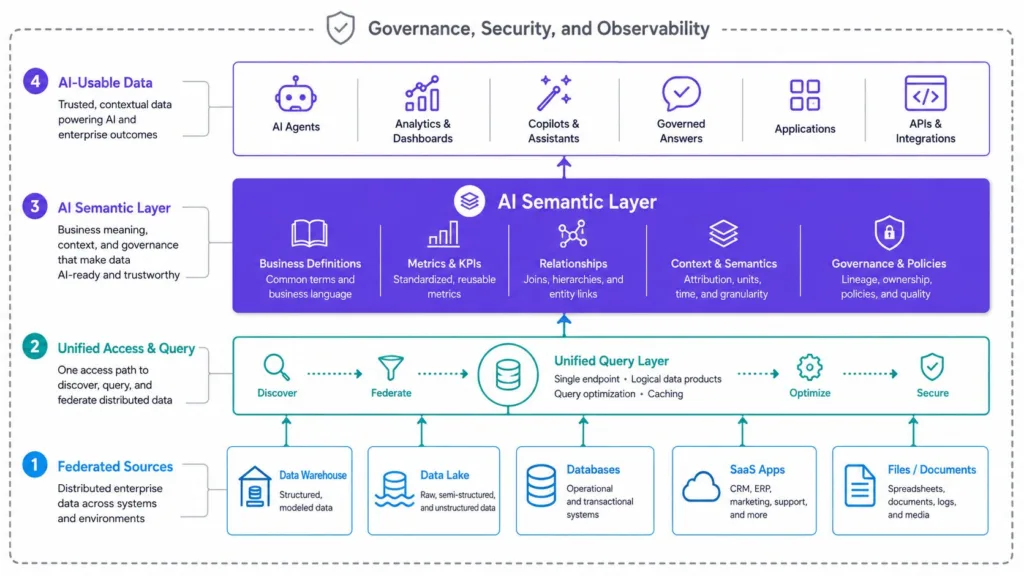
Agents are only as good as the data they can reach and understand, and that is the problem Dremio solves at the foundation. Dremio unifies access across distributed sources with Zero-ETL federation, so agents query data where it lives, across warehouses, databases, and object storage, without copying it into a proprietary store first.
On top of that access, Dremio's AI Semantic Layer gives agents shared business definitions. Instead of guessing what columns named amt and cust_id mean, an agent reads the same governed meaning a person would, which is what keeps answers accurate instead of plausible but wrong.
Governance runs through all of it. Permissions travel with the data end to end, enforced at the engine, so every agent query respects the rules and lands in an auditable job history. And because agents generate so many queries, Dremio accelerates them automatically with materializations and query rewrites that hold response times low as load grows. Unified access, shared meaning, enforced governance, and fast queries are the four things that turn raw enterprise data into something AI can actually use.
Scale your enterprise agentic analytics workflows with Dremio
Dremio is The Agentic Lakehouse, built for organizations that need fast, governed AI agent access to data spread across the enterprise. It brings unified access, semantic context, governance, and self-managing performance together in one open platform, so your agentic workflows scale without falling apart or locking you in. See the full picture on the Agentic Lakehouse for Enterprise page.
What you get with Dremio:
A built-in AI Agent that lets analysts and business users ask questions in plain language and get governed answers and visualizations in seconds.
An AI Semantic Layer that gives agents the business context they need to return accurate results instead of confident guesses.
Zero-ETL federation through the Intelligent Query Engine, querying structured, semi-structured, and unstructured data in place with no copying.
The first MCP interface in the industry, so agents from Anthropic, OpenAI, and Google connect to your governed data in minutes.
AI Functions in SQL, including AI_GENERATE, AI_CLASSIFY, AI_COMPLETE, and LIST_FILES, which pull structured insight out of PDFs, images, and documents with no extra pipeline.
Open Catalog powered by Apache Polaris, which Dremio co-created, for unified governance and lineage across any Iceberg-compatible engine.
Autonomous performance and end-to-end access control, so the platform tunes itself and permissions follow your data everywhere it goes.
Dremio runs natively on Apache Iceberg, Polaris, and Arrow, and the company co-created Arrow and Polaris and is a key Iceberg contributor. That open foundation is why agentic analytics on Dremio means no lock-in and no proprietary storage tax. Try connecting your AI agents to governed lakehouse data by getting in touch with the Dremio team at dremio.com/contact.
Book a demo today and explore how Dremio supports enterprise agentic analytics for organizations.
Frequently asked questions
How do enterprise agentic analytics differ from traditional business intelligence?
Traditional BI gives you dashboards and reports that you read and interpret yourself. Enterprise agentic analytics does the interpreting, runs the multi-step analysis across governed sources, and returns an answer with its reasoning and a recommended action. BI tells you what happened. An agent tells you what happened, why, and what to do next.
What are the biggest challenges when deploying AI agents on enterprise data?
The top three are wrong answers from missing context, data exposure from weak governance, and runaway cost from unoptimized queries. Gartner expects more than 40% of agentic AI projects to fail by 2027, largely because teams underestimate exactly these foundation problems. The agent is rarely the issue. The data layer underneath it usually is.
What are the levels of agentic analytics maturity?
Maturity tends to move through four stages, from human-driven analysis to fully autonomous workflows.
Level
What the agent does
1. Descriptive BI
Surfaces data in dashboards, a person interprets and acts
2. Conversational
Answers single questions in natural language
3. Assisted agentic
Runs multi-step analysis with a human reviewing each result
4. Autonomous
Investigates, decides, and acts within set guardrails
Most enterprises today sit between levels 2 and 3, moving toward 4 as their data foundation and governance mature.
What data foundation is required for agentic analytics?
Agents need four things from the data layer: unified access across all sources, a semantic layer that supplies business meaning, governance enforced at the engine, and performance that scales under heavy query load. Miss any one and agents produce slow, wrong, or unsafe results. Get all four right and enterprise agentic analytics works in production, not just in a demo.
Try Dremio Cloud free for 30 days
Deploy agentic analytics directly on Apache Iceberg data with no pipelines and no added overhead.
Intro to Dremio, Nessie, and Apache Iceberg on Your Laptop
Editor’s note, September 2026. This post was published in September 2023 and some product details have changed since. Nessie is still available and self-deployable under the Apache-2.0 licence, and it remains the clearest implementation of catalog-level branching. It is not an Apache Software Foundation project, and its development has slowed considerably. For how the current […]
Aug 16, 2023·Dremio Blog: News Highlights
5 Use Cases for the Dremio Lakehouse
With its capabilities in on-prem to cloud migration, data warehouse offload, data virtualization, upgrading data lakes and lakehouses, and building customer-facing analytics applications, Dremio provides the tools and functionalities to streamline operations and unlock the full potential of data assets.
Sep 30, 2026·Dremio Blog: Open Data Insights
Apache Iceberg 1.12.0: What’s New, Breaking Changes, and Upgrade Guide
Apache Iceberg 1.12.0 expands v3 engine support, REST catalog operations, streaming reliability, and v4 groundwork. Learn how to upgrade safely.