The amount of data enterprises generate has grown beyond what traditional storage and processing systems can handle. Enterprise data platforms have emerged as the infrastructure layer that brings order to this complexity, enabling analytics teams and AI systems to work from a single, governed foundation. This guide covers what enterprise data platforms are, how their architecture works, and what to look for when selecting one for your organization.
Key highlights:
Enterprise data platforms unify data access, governance, and processing across an organization's entire data estate.
Without a central enterprise data platform, analytics and AI initiatives suffer from fragmented, inconsistent data that undermines accuracy and speed.
The global Enterprise Data Management market is projected to grow from approximately USD 123 billion in 2025 to USD 136 billion in 2026, reflecting the scale of investment organizations are making in data infrastructure. (Fortune Business Insights)
Dremio is the Intelligent Lakehouse Platform for the Agentic AI Era, trusted by global enterprises including Shell, TD Bank, Michelin, and Farmer's Insurance.
What is an enterprise data platform?
An enterprise data platform is a unified technology system that collects, stores, governs, and serves data across an organization for analytics, reporting, and AI workloads. It acts as a central layer that connects data from multiple sources — databases, cloud storage, SaaS applications, on-premises systems — and makes it accessible to the people and tools that need it.
Enterprise data platforms go beyond simple storage. They include processing engines, governance controls, semantic layers, and query interfaces that allow organizations to manage data at scale. A modern enterprise data platform supports both human analysts running SQL queries and AI agents consuming data programmatically, all from the same governed infrastructure.
Why data platform strategies are critical for analytics and AI
Without an enterprise data platform, organizations cannot reliably support analytics and AI at scale. Data sits in disconnected systems with inconsistent formats, no shared business definitions, and no centralized governance. The result is slow decision-making, unreliable AI outputs, and high operational costs. A sound data platform strategy resolves these problems before they compound.
Disconnected data sources limit visibility
Data scattered across dozens of systems — cloud data warehouses, relational databases, data lakes, SaaS tools — makes it nearly impossible for analysts to get a complete picture. Teams spend more time locating and reconciling data than analyzing it. A unified enterprise data platform connects these sources and presents a consistent view, reducing the time analysts waste on data retrieval and preparation.
Eliminates manual data hunting across systems
Reduces errors from working with out-of-date or siloed copies
Gives leadership a single, trusted view of business performance
Inconsistent data quality impacts analytics accuracy
When data moves across systems without quality controls, errors accumulate. Duplicate records, mismatched formats, and null values corrupt analysis. AI models trained on low-quality data produce unreliable outputs. Enterprise data platforms enforce data quality rules at the point of ingestion and throughout the data lifecycle, so analysts and models work from clean, validated data.
Applies validation rules at ingestion to catch errors early
Flags anomalies and data drift before they reach dashboards or models
Creates audit trails that support data quality investigations
Data pipelines that move information from source systems to analytics tools are often slow, fragile, and expensive to maintain. When a pipeline breaks, analysts wait hours for data refreshes. When pipelines are delayed, business decisions are made on stale information. Enterprise data platforms reduce pipeline complexity by enabling federated access that queries data where it lives, cutting latency and reducing the number of moving parts.
Reduces dependence on fragile ETL pipelines
Delivers fresher data to analytics tools with less infrastructure overhead
Supports real-time and batch access from a single platform
Limited ability to scale AI and machine learning initiatives
AI models require massive amounts of high-quality, well-labeled training data. Without an enterprise data platform, scaling AI from a pilot to production means rebuilding data pipelines for each new model and fighting inconsistent formats across teams. A shared platform provides a single data foundation that every AI initiative draws from, reducing duplication and accelerating model development.
Provides a shared, governed data pool for AI and ML models
Standardizes feature engineering pipelines across teams
Supports the compute-intensive query patterns AI training requires
What are the use cases for an enterprise data platform?
Enterprise data platforms serve a broad range of use cases across analytics, governance, and AI. The table below covers the most common applications and the business impact each delivers.
Exposes curated data products to internal teams and external partners
Reduces data duplication and accelerates cross-team collaboration
How enterprise data platform architecture works
Enterprise data platform architecture is a layered system that ingests, processes, stores, and serves data for analytics and AI. Each layer handles a specific function, and together they create a pipeline from raw data to actionable insight. The architecture must handle growing data volumes, diverse source systems, and the low-latency demands of modern AI workloads.
1. Ingestion from multiple sources
The first layer handles data ingestion — collecting data from structured, semi-structured, and unstructured sources. This includes relational databases, cloud object storage, streaming platforms like Apache Kafka, SaaS APIs, and IoT devices. Modern platforms support both batch ingestion for large periodic loads and streaming ingestion for continuous data feeds.
Connects to hundreds of source systems through native connectors and APIs
Handles schema evolution as source data formats change
Supports structured, semi-structured, and unstructured data in a single pipeline
2. Storage and organization
Raw data lands in a central storage layer — often a cloud object store like Amazon S3 or Azure Data Lake Storage. Modern enterprise data platforms organize this data using open table formats like Apache Iceberg, which track metadata, support ACID transactions, and enable time-travel queries. This layer separates storage from compute, allowing organizations to scale each independently.
Open formats prevent vendor lock-in and reduce long-term storage costs
ACID transactions maintain data consistency across concurrent writes
Partitioning and clustering optimize query performance at scale
3. Transformation and processing
Raw data is rarely ready for analysis. The transformation layer cleans, joins, aggregates, and enriches data before it reaches analytics tools. This happens through batch processing jobs for large periodic transformations and streaming processing for near-real-time use cases. SQL-based transformation tools and distributed compute engines handle this work at scale.
Batch transformation handles large-scale historical data preparation
The semantic layer sits between the storage layer and end users. It translates raw data into business concepts — metrics, KPIs, dimensions — and makes them accessible through a consistent interface. This layer removes the need for each team to re-implement the same calculations, reducing errors and improving consistency across reports and AI models. Analysts, BI tools, and AI agents all draw from the same semantic definitions.
Defines business metrics once and shares them across all tools and teams
Supports natural language queries for business users without SQL expertise
Provides AI agents with the context they need to interpret data correctly
5. Governance, security and monitoring
Data governance controls who can access what data, how long data is retained, and how it moves through the system. Enterprise data platforms enforce role-based access controls, column-level security, row-level filtering, and data masking. Lineage tracking records where data came from and how it was transformed, supporting both compliance reporting and debugging.
Role-based access controls limit data exposure to authorized users
Data lineage tracks the full history of each dataset from source to report
What is the best data platform for enterprises?
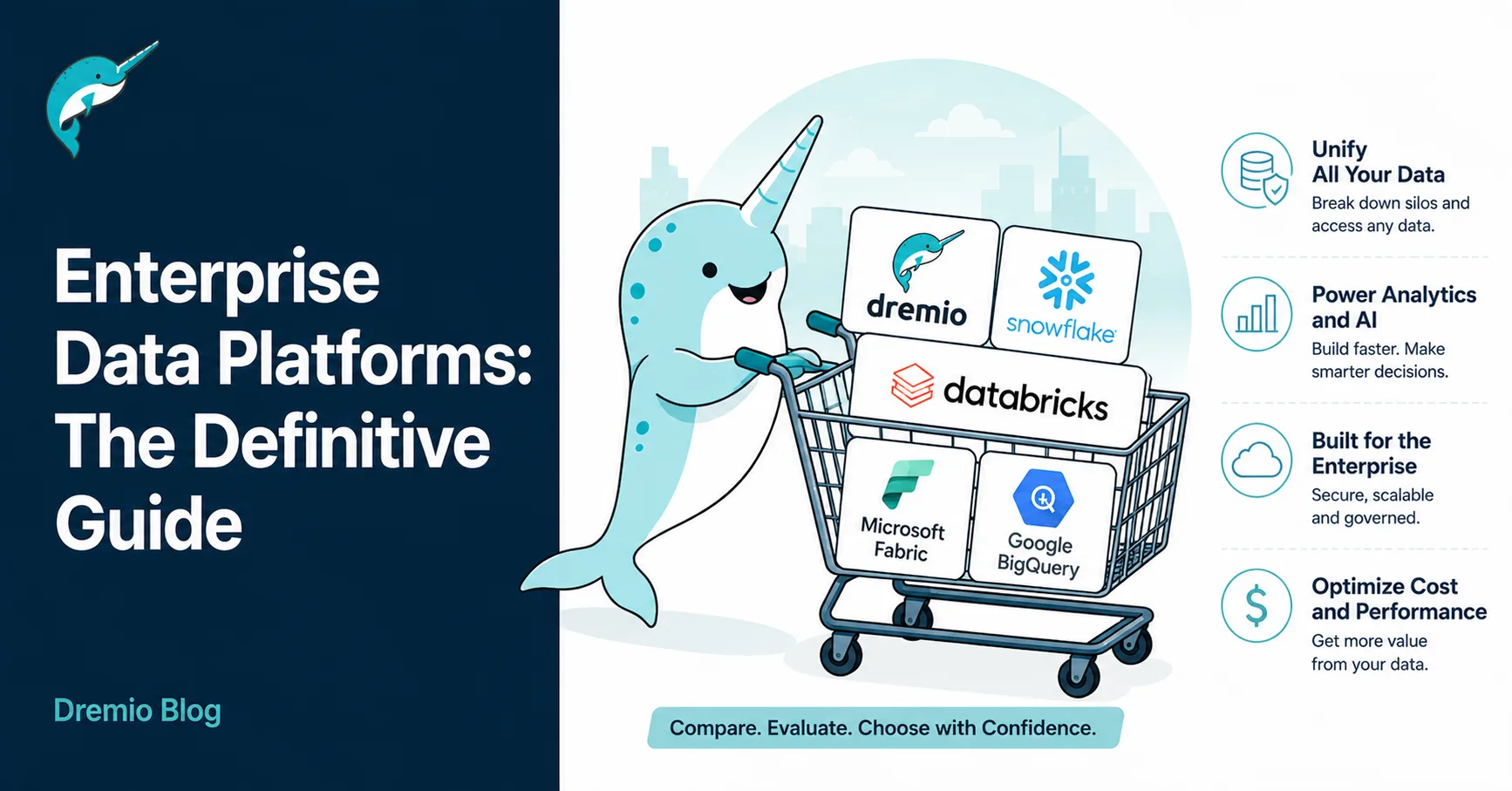
The best data platform for enterprise is one that unifies data access, enforces governance, supports both human analysts and AI agents, and scales without requiring constant manual intervention. Below are five platforms that represent the leading options in 2026, evaluated on key capabilities.
Top enterprise data platforms
Key features
Dremio
Agentic Lakehouse with Zero-ETL federation, unified semantic layer, autonomous query optimization, Apache Iceberg support, MCP for AI agents
Snowflake
Cloud-native data warehouse, elastic compute and storage scaling, SQL-first analytics, zero maintenance
Databricks
Unified analytics platform built on Apache Spark, Delta Lake format, strong for data engineering and AI/ML pipelines
Microsoft Fabric
All-in-one SaaS platform integrating Power BI, data engineering, and data warehousing; strong for Microsoft ecosystem organizations
Google BigQuery
Fully serverless SQL analytics, zero infrastructure management, massive scale with built-in ML capabilities
Benefits of selecting the right enterprise data management platform
Choosing the right enterprise data management platform transforms how an organization operates. The benefits below are outcomes of a deliberate, well-matched platform selection — not generic advantages of having any platform at all.
Faster time to insight: When data is centralized, governed, and queryable from a single layer, analysts spend time interpreting results rather than hunting for data across systems.
Improved data consistency: A shared semantic layer means every team works from the same metric definitions, eliminating the "two versions of the truth" problem that plagues fragmented data environments.
Reduced operational complexity: Modern platforms handle performance tuning, storage optimization, and infrastructure scaling automatically, freeing data engineering teams for higher-value work.
Scalable foundation for AI functions: A unified data platform gives AI models and agents access to governed, current data across the enterprise, making it possible to scale AI from pilot to production without rebuilding data pipelines for each new use case.
Greater alignment across teams: When analysts, data scientists, data engineers, and business users work from the same platform, fewer misunderstandings arise from inconsistent data or incompatible tools.
What should I look for in an enterprise data platform?
When selecting an enterprise data platform, the right choice depends on your team's workload profile, existing infrastructure, and AI ambitions. Prioritize scalability, support for diverse data types, architectural openness, governance depth, and query performance.
Scalability to handle growing data volumes
Scalability in data platforms means the ability to handle increasing data volumes, users, and query complexity without performance degradation or manual tuning. Look for platforms that separate compute from storage so each can scale independently. Platforms with autonomous optimization features — ones that tune query plans, manage caching, and organize data files without manual intervention — reduce the engineering burden as scale increases.
Verify the platform handles petabyte-scale datasets without major performance drops
Check whether compute resources scale automatically during peak query loads
Evaluate whether the platform requires manual performance tuning or handles it autonomously
Support for diverse data types and workloads
Enterprise environments contain structured tables, semi-structured JSON and Avro, unstructured files, and streaming data. A platform that handles only one type forces you to run multiple systems. Modern enterprise data platforms support complex data types natively — nested structures, arrays, maps, and geospatial data alongside standard relational tables.
Confirm support for Parquet, ORC, JSON, Avro, and open table formats like Apache Iceberg
Evaluate streaming data support for real-time analytics alongside batch workloads
Check whether the platform handles semi-structured and nested data without requiring schema flattening
Open architecture and interoperability
Vendor lock-in is a long-term risk. Platforms built on proprietary storage formats or closed APIs make it expensive to switch providers or add new tools. Look for AI stack interoperability — the ability to connect AI tools, BI platforms, and data science notebooks through open standards like Apache Arrow Flight and JDBC/ODBC.
Prioritize platforms built on open table formats such as Apache Iceberg
Verify compatibility with your existing BI tools, ML frameworks, and data science environments
Check whether the platform supports standard query interfaces that allow tool swapping without data migration
Strong data governance and security
Governance is non-negotiable for enterprise deployments, especially in regulated industries. The platform must provide role-based access controls, column and row-level security, data lineage tracking, and audit logging. As AI agents increasingly access data autonomously, governance must extend to machine identities and programmatic access patterns.
Verify support for column-level security and row-level filtering
Evaluate data lineage tracking depth — can you trace a metric back to its raw source?
Check whether the platform supports fine-grained permissions for both human and machine identities
Query performance directly impacts the productivity of every analyst and the response time of every AI application. Modern platforms use columnar storage formats, intelligent caching, and automatic query rewriting to minimize latency. Look for platforms that optimize queries transparently, without requiring analysts to restructure their SQL or data engineers to manually manage partitioning.
Benchmark query performance on representative workloads before committing to a platform
Evaluate caching strategies — result caching, metadata caching, and data reflections
Verify that query optimization works automatically rather than requiring manual tuning per query
Modernize your enterprise data management with Dremio
Dremio is the Intelligent Lakehouse Platform for the Agentic AI Era, built by the original co-creators of Apache Polaris and Apache Arrow. It gives enterprises fast, governed access to data across every source — without moving data or building fragile ETL pipelines. The Dremio Agentic Lakehouse architecture supports both human analysts and AI agents from a single, unified platform.
Key capabilities that set Dremio apart for enterprise data management:
Zero-ETL Federation: Query data across cloud, on-premises, and hybrid environments without moving it, eliminating ETL complexity and keeping data current.
Unified Semantic Layer: Define business metrics once and share them across BI tools, AI models, and data science notebooks for consistent, governed data access.
Autonomous Optimization: Dremio's self-managing engine continuously tunes query performance, manages data layouts, and applies intelligent caching without manual intervention.
Apache Iceberg Native: Built for open lakehouse architectures, Dremio eliminates vendor lock-in and supports the open standards modern data teams rely on.
AI Agent Support via MCP: Dremio connects AI agents to enterprise data through the Model Context Protocol, giving agents the context and access they need to operate reliably.
Trusted by Shell, TD Bank, Michelin, and Farmer's Insurance, Dremio helps thousands of enterprises turn fragmented data into a reliable foundation for analytics and AI.
Book a demo today and see why Dremio is the best enterprise data platform for supporting AI and analytics.
Frequently asked questions
What is enterprise data?
Enterprise data is all data an organization creates, collects, and uses to run its business operations. This includes transactional records, customer information, operational metrics, logs, documents, and external data feeds. Enterprise data lives across databases, cloud storage, SaaS platforms, and on-premises systems. Centralized management is critical for consistent analytics and AI accuracy.
Why is protecting my enterprise data layer so critical?
The enterprise data layer is the foundation that every analytics report, AI model, and operational dashboard depends on. If data is compromised, corrupted, or made unavailable, every downstream system that depends on it fails. Protecting the data layer through access controls, encryption, audit logging, and backup strategies prevents data loss, supports regulatory compliance, and maintains the trust that analytics outputs require.
What are the biggest challenges in managing an enterprise data platform ecosystem?
The most common challenges include managing data silos across multiple cloud and on-premises environments, maintaining data quality as data volumes grow, and enforcing governance across complex multi-cloud architectures. Organizations also struggle to scale query performance as analytics workloads increase, and to build pipelines that stay current as source system schemas change and AI use cases demand lower-latency access to fresher data.
How can I integrate an enterprise data platform architecture into my organization?
Start by inventorying your current data sources and identifying the highest-priority analytics and AI use cases. Choose a platform that supports your existing cloud infrastructure and connects to your current BI and data science tools. Roll out incrementally — start with the highest-value data domains, establish governance policies, and expand from there. Treat the platform as a product: assign ownership, define SLAs for data quality, and iterate based on user feedback.
Try Dremio Cloud free for 30 days
Deploy agentic analytics directly on Apache Iceberg data with no pipelines and no added overhead.
Ingesting Data Into Apache Iceberg Tables with Dremio: A Unified Path to Iceberg
By unifying data from diverse sources, simplifying data operations, and providing powerful tools for data management, Dremio stands out as a comprehensive solution for modern data needs. Whether you are a data engineer, business analyst, or data scientist, harnessing the combined power of Dremio and Apache Iceberg will undoubtedly be a valuable asset in your data management toolkit.
Sep 22, 2023·Dremio Blog: Open Data Insights
Intro to Dremio, Nessie, and Apache Iceberg on Your Laptop
Editor’s note, September 2026. This post was published in September 2023 and some product details have changed since. Nessie is still available and self-deployable under the Apache-2.0 licence, and it remains the clearest implementation of catalog-level branching. It is not an Apache Software Foundation project, and its development has slowed considerably. For how the current […]
Oct 12, 2023·Product Insights from the Dremio Blog
Table-Driven Access Policies Using Subqueries
This blog helps you learn about table-driven access policies in Dremio Cloud and Dremio Software v24.1+.