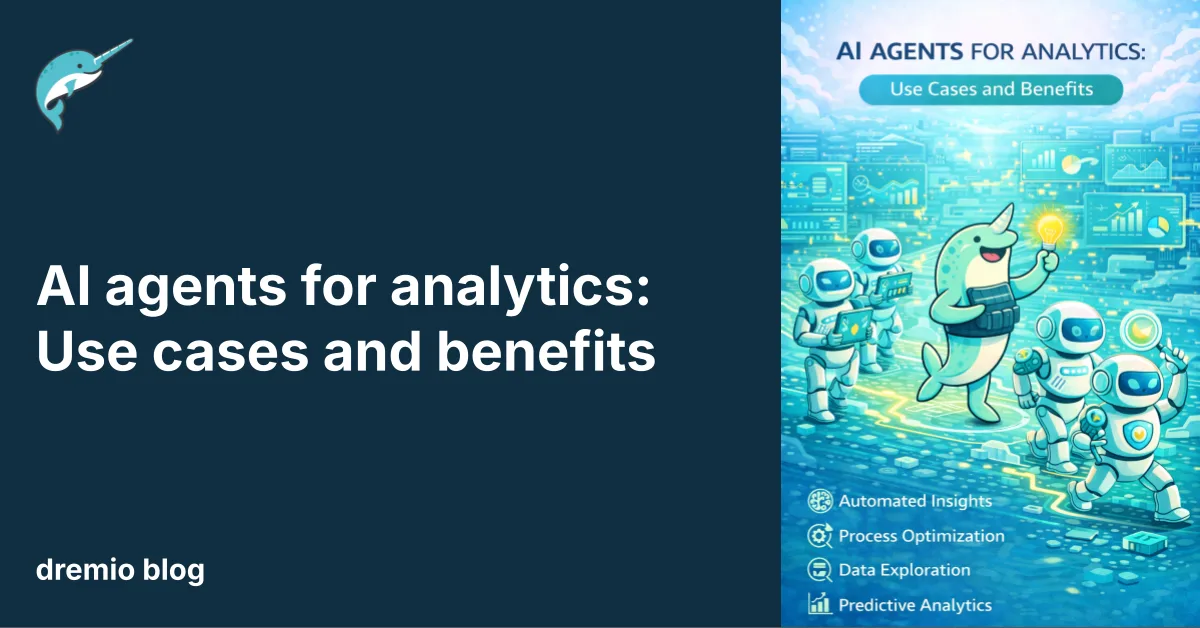
AI agents for analytics automate complex tasks, enabling proactive decision-making without human initiation.
These agents can monitor KPIs in real-time, detect fraud patterns, and provide self-service analytics for business users.
A modern lakehouse architecture supports these agents by providing governed access, consistent metrics, and high-performance query capabilities.
Best practices for implementing analytics agents include ensuring data quality, establishing security controls, and designing human-in-the-loop workflows.
Dremio offers a powerful platform for agentic AI analytics, combining features like a unified semantic layer and zero-ETL federation.
AI agents for analytics are transforming how enterprises interact with data. These autonomous systems go beyond traditional dashboards and copilots by independently planning, executing, and adapting complex analytical tasks. They detect anomalies, reason about root causes, orchestrate multi-step queries, and deliver insights without waiting for a human to write SQL or build a report.
The shift to agentic analytics marks a change in how organizations operate. According to Gartner, 40% of enterprise applications will integrate task-specific AI agents by end of 2026. For data teams facing growing demand and limited capacity, AI agents for analytics offer a path to faster answers, broader data access, and proactive monitoring at enterprise scale.
Key highlights:
AI agents for analytics are autonomous systems that plan, execute, and adapt multi-step analytical tasks with minimal human input.
Enterprise use cases span real-time KPI monitoring, fraud detection, self-service analytics, and predictive workflows.
A modern lakehouse architecture with governed data, a semantic layer, and open table formats is the foundation these agents require.
Dremio's agentic lakehouse platform provides the semantic intelligence, governed access, and autonomous performance tuning that AI agents need to operate reliably at scale.
Try Dremio’s Interactive Demo
Explore this interactive demo and see how Dremio's Intelligent Lakehouse enables Agentic AI
What are AI-powered analytics agents?
AI-powered analytics agents are autonomous software systems that receive a business question, break it into analytical sub-tasks, execute those tasks against governed data, and return validated results. These specialized agents differ from AI-assisted BI tools and copilots in a critical way: they operate independently across multiple steps without requiring human initiation at each stage.
A copilot suggests a SQL query when you ask for one. An analytics agent detects that weekly revenue has dropped, identifies the affected product lines, correlates the drop with a pricing change, and flags the finding for the executive team, all without prompting. This autonomy, combined with reasoning, orchestration, and continuous monitoring, is what separates agentic analytics from earlier AI-assisted tools. The result is measurable business outcomes: faster decisions, broader data access, and proactive risk detection.
Enterprise use cases for an analytics AI agent
AI agents for analytics deliver the most value when applied to workflows that are repetitive, time-sensitive, or too complex for manual analysis. The use cases below represent the areas where enterprises are seeing the strongest returns from analytics agents in production.
Real-time KPI monitoring and anomaly detection
Traditional dashboards show what happened. AI agents watch what is happening. An analytics agent can monitor hundreds of KPIs in real time, flag deviations from expected patterns, and explain the likely cause, all of which are directly tied to business objectives such as revenue targets, SLA compliance, or customer satisfaction scores.
When an agent detects a 15% drop in conversion rate at 2 AM, it does not wait for a morning standup meeting to surface the problem. It traces the issue to a checkout page error, estimates the revenue impact, and routes the alert to the right team. This kind of proactive monitoring turns analytics from a reporting function into an operational system.
Agents track KPIs across product, finance, marketing, and operations continuously
Anomaly detection tied directly to business objectives reduces time between issue and response
Fraud detection and compliance monitoring
Fraud patterns shift constantly, and rule-based systems miss novel attack vectors. Analytics agents perform data exploration across transaction logs, behavioral signals, and third-party risk feeds to detect suspicious activity in real time. They adapt as patterns change, without requiring manual rule updates.
Compliance monitoring follows the same principle. Rather than relying on periodic audits, agents continuously check data against regulatory requirements, flag violations, and generate audit trails. This combination of speed and breadth is difficult to replicate with manual analysis.
Agents scan transaction data across systems to detect fraud patterns that rules-based systems miss
Most business users do not write SQL. Agentic analytics closes this gap by letting users ask questions in natural language and receive accurate, governed answers. The agent translates the intent, selects the appropriate data sources, runs the query, and presents the results as a chart, table, or narrative summary.
This is not the same as chatbot-style Q&A. Self-serve analytics through agents means the system resolves ambiguity using a semantic layer, enforces row-level and column-level security, and explains its reasoning. Business users get trusted answers without filing tickets with the data team.
Natural language access gives business users direct, governed access to enterprise data
Agent-powered self-service reduces the backlog of ad-hoc requests on data engineering teams
Automated executive reporting
Executive reports often take hours to compile. An analytics agent automates this process by pulling data from multiple systems, calculating the required metrics, generating narrative summaries, and distributing the report on a set schedule.
More advanced agents adapt the report content based on what changed since the last period. If revenue in a region spiked or a key customer churned, the agent highlights those changes and provides context. This moves executive reporting from static summaries to actionable intelligence.
Agents compile, summarize, and distribute periodic reports without manual effort
Dynamic content highlighting surfaces the most important changes for executive attention
Predictive and prescriptive analytics workflows
Predictive analytics agents forecast outcomes like demand, revenue, or churn based on historical patterns. Prescriptive agents take this a step further by recommending specific actions, such as adjusting inventory, launching a retention campaign, or reallocating ad spend.
These agents run continuously, updating predictions as new data arrives. They can trigger automated workflows when predictions cross defined thresholds, connecting analytics directly to business operations.
Predictive agents forecast trends and update projections as new data arrives
Prescriptive agents recommend actions and trigger workflows automatically
How AI agent data analysis works
AI agents operate across a lifecycle of understanding, planning, executing, and validating. Each stage requires different capabilities, from natural language processing to governed data access. The steps below describe how AI systems break down a business question and deliver trusted answers. Understanding this lifecycle is critical for organizations designing agent-ready data architectures that let humans and agents explore data side by side.
1. Understanding business intent
The lifecycle starts when a user asks a question or an event triggers the agent. The agent parses the natural language input and translates it into an analytical objective. This requires understanding business context: "How is churn trending this quarter?" means something specific depending on how the organization defines churn, which customer segments are in scope, and which data sources contain the relevant events.
A strong semantic layer gives the agent this context. Without it, the agent must guess, and guesses lead to wrong answers. Intent understanding also includes recognizing follow-up questions and maintaining conversational context across multiple interactions.
Agents parse natural language and map it to specific business definitions and metrics
Contextual awareness allows agents to handle follow-up questions and multi-turn conversations
2. Planning and orchestrating tasks
Once the agent understands the intent, it creates a plan. For simple questions, this might be a single SQL query. For complex analyses, the plan involves multiple steps: pulling data from different sources, running transformations, applying filters, and combining results.
Orchestration is the agent's ability to execute these steps in the right order, handle dependencies, and adapt if one step fails. The best agents can adjust their plan mid-execution, for example, falling back to a broader date range if the requested window has no data.
Multi-step task planning breaks complex questions into ordered sub-tasks
Adaptive orchestration handles failures and adjusts plans without human help
3. Connecting to governed data systems
Agents need access to data, but that access must be governed. The agent connects to catalogs, semantic layers, and data sources while data governance policies control what it can read. Row-level and column-level security must apply to agent queries just as they apply to human queries.
This step also involves data discovery: the agent must find the right tables, understand their schemas, and confirm that the data source is appropriate for the question. Governed access prevents agents from returning data the user is not authorized to see.
Agents connect to data catalogs and semantic layers to discover and access the right data
Security policies enforce the same access controls for agent-initiated queries as for human queries
4. Validating and continuously monitoring data
After generating results, the agent validates them. This includes checking for data quality issues, confirming that numbers fall within expected ranges, and comparing results against historical baselines. Self-validation reduces the risk of delivering incorrect insights to business users.
Continuous monitoring extends beyond a single query. Agents can watch for data drift, schema changes, or quality degradation over time. When they detect problems, they flag the issue before it affects downstream dashboards or reports.
Self-validation checks results against data quality rules and historical baselines
Continuous monitoring detects data drift and quality degradation before they reach production reports
Core capabilities of AI agent analytics solutions
The foundational capabilities of AI agents for analytics determine how much value they deliver and how much trust organizations can place in their outputs. Agents capable of autonomous planning, governed access, and self-validation deliver a competitive advantage over basic AI-assisted tools. The table below maps core capabilities to their impact on business operations.
Core capabilities of an analytics AI agent
Why the capabilities matter for agentic analytics
Autonomous task planning and orchestration
Agents decompose complex business questions into sub-tasks and execute them without manual SQL or dashboard building, accelerating time to insight.
Natural language understanding and intent translation
Business users ask questions in plain language and receive accurate responses tied to governed metric definitions, removing the SQL barrier for non-technical teams.
Secure, governed data access
Agents respect row-level and column-level security, comply with regulatory requirements, and log every query for audit trails, protecting sensitive data across all interactions.
Continuous monitoring and anomaly detection
Agents proactively detect deviations from expected business patterns and alert stakeholders in real time, shifting analytics from reactive reporting to proactive business intelligence.
Self-validation and explainability mechanisms
Agents show their reasoning, validate results against quality rules, and flag uncertainty, giving users the transparency needed to trust and act on AI-generated insights.
Why analytics agents require a modern lakehouse
Analytics agents cannot function reliably on fragmented, ungoverned, or slow data infrastructure. A modern lakehouse gives agents the enterprise data foundation they need: consistent metrics, governed access, fast query performance, and multi-engine interoperability. Without this foundation, agents produce inaccurate results, violate access policies, or stall on slow queries. The sections below describe why each lakehouse capability is critical for AI-driven analytics agents.
Unified semantic layer for consistent metrics
Analytics agents need to understand what "revenue," "churn," and "active customer" mean. A unified semantic layer provides these definitions in a structured format that agents can consume programmatically. Without it, agents must guess at metric calculations, and different agents querying the same data may return conflicting answers.
The semantic layer also handles dimension mapping, join paths, and aggregation rules. When an agent asks for "monthly revenue by region," the semantic layer resolves which tables, columns, and calculations to use. This consistency is the foundation of trust in agent-generated insights.
Semantic definitions give agents a single source of truth for business metrics
Consistent metric resolution prevents conflicting answers from different agents or tools
Open table formats and interoperable data access
Analytics agents often combine data from multiple sources and query engines. Open table formats like Apache Iceberg allow agents to read and write data across Spark, Trino, Flink, Dremio, and other engines without format conversion or data copying.
This interoperability matters because agents may need to run a time-travel query in one engine and a streaming aggregation in another. Open formats make this possible without building custom integration layers.
Open table formats let agents access the same data across multiple engines without conversion
Format neutrality reduces infrastructure complexity and avoids vendor lock-in
High-performance query engine for autonomous workloads
Autonomous agents run queries continuously, often in parallel. A slow query engine creates a bottleneck that limits how many questions agents can process. High-performance data querying is not optional for agentic workloads; it is a requirement.
Sub-second query performance allows agents to explore hypotheses, run follow-up analyses, and validate results within a single interaction cycle. Without this speed, the agent's response time degrades to the point where human users lose trust or abandon the interaction.
Sub-second query performance lets agents complete multi-step analyses within seconds
Parallel query execution supports many agents running concurrently at enterprise scale
Built-in governance and role-based access controls
Agents must obey the same access rules as human users. Built-in governance includes row-level security, column-level masking, audit logging, and role-based access controls. These controls must apply at the platform level, not as an afterthought.
Without governance, agents could access sensitive data, return restricted information to unauthorized users, or generate results that violate compliance requirements. Platform-level governance ensures that every agent query is subject to the same controls.
Row-level and column-level security applies to every agent query, not just human queries
Audit logging tracks every agent action for compliance and accountability
Scalability across multi-engine and multi-cloud environments
Enterprise data lives across multiple clouds, regions, and storage systems. Analytics agents need to query data wherever it resides without requiring data movement. Scalability across multi-cloud environments means agents can access AWS, Azure, and GCP data sources through a single query interface.
Scaling also means handling more agents, more users, and more data without degradation. The platform must support elastic compute that grows with demand and shrinks when utilization drops.
Multi-cloud federation gives agents access to data across providers without data movement
Elastic compute scaling handles growing agent and user workloads without performance loss
Best practices for implementing an analytics agent
Deploying analytics agents requires careful planning across governance, data quality, and human oversight. The practices below help organizations build agent-ready data architectures that deliver trust, accuracy, and compliance from day one.
1. Ensure semantic consistency and data quality
Analytics agents are only as good as the data and definitions they use. Start by building or extending an AI semantic layer that standardizes metric definitions, dimension mappings, and access rules. Validate data quality at ingestion and set up monitoring to catch issues before agents consume bad data.
Without semantic consistency, agents produce conflicting results. Without data quality controls, they deliver insights based on incorrect or stale information. Both undermine trust and slow adoption.
Standardize metric definitions in a semantic layer before deploying agents
Implement automated data quality checks that run before agents access new data
2. Establish comprehensive security controls
Agents operate at machine speed, so security failures spread faster than with human users. Configure row-level and column-level security at the platform level so every agent query is governed. Set up audit logging to track what agents access and what results they return.
Security controls must also cover the agent's tool access. If an agent can call external APIs, write to databases, or trigger workflows, each action needs its own authorization and audit trail.
Apply platform-level security controls to all agent queries and actions
Log every agent interaction for compliance review and forensic analysis
3. Prioritize explainability and validation
Users must understand how an agent reached its conclusion. Build data validation into the agent workflow so every result includes lineage (which data sources, which calculations) and confidence indicators. Flag results that rely on incomplete data or fall outside expected ranges.
Explainability builds trust. When an agent surfaces an anomaly, the accompanying explanation allows the human reviewer to verify the finding and decide how to act. Without explainability, agents become black boxes that users avoid.
Include data lineage and confidence scores with every agent-generated result
Flag results that rely on incomplete or stale data
4. Design human-in-the-loop workflows
Not every agent action should be autonomous. High-stakes decisions, such as triggering a compliance alert or changing a pricing model, should route through a human reviewer before execution. Design workflows with clear escalation paths and approval gates.
Human-in-the-loop design also applies to agent training and improvement. When agents produce incorrect results, human feedback should flow back into the semantic layer or governance rules to prevent the same error from recurring.
Route high-stakes agent actions through human approval before execution
Use human feedback to improve semantic definitions and agent accuracy over time
Power agentic analytics with Dremio
Dremio is the agentic AI lakehouse platform built to give analytics agents trusted, governed, high-performance access to enterprise data. Dremio's architecture combines autonomous optimization, a unified semantic layer, and zero-ETL federation, providing the advanced data foundation that agents need to operate reliably at scale.
AI Semantic Layer: Consistent metric definitions and semantic search that agents use to find and query the right data
Autonomous optimization: Apache Arrow-powered processing with intelligent query rewriting, automatic caching, and Iceberg clustering, no manual tuning required
Native MCP server: Standardized Model Context Protocol connectivity that allows any AI agent framework to query Dremio directly
Zero-ETL federation: Query all enterprise data sources in place, across clouds and on-premises, without data movement
Enterprise governance: Row-level and column-level security, audit logging, and role-based access controls applied to every agent query
Book a demo today and see how Dremio can power AI agents for analytics with trusted, governed data at enterprise scale.
Frequently asked questions
How are AI agents different from dashboards?
Dashboards are static views that display pre-built charts and metrics. They show what happened but cannot investigate why or take action on the findings. AI agents operate autonomously: they detect anomalies, investigate root causes, generate follow-up analyses, and route findings to the right teams. Dashboards wait for humans to look at them. Agents act proactively.
Do AI agents replace data analysts?
No. AI agents augment the work of a data analyst by automating repetitive tasks like data profiling, report generation, and quality checks. This frees analysts to focus on interpretation, strategy, and complex problem-solving that requires domain expertise and judgment. The most effective deployments pair agents with human analysts in a collaborative workflow.
What data architecture is required for analytics AI agents to operate securely?
Analytics AI agents need a governed lakehouse architecture that includes a unified semantic layer for consistent metric definitions, role-based access controls with row-level and column-level security, open table formats for multi-engine interoperability, a high-performance query engine for autonomous workloads, and audit logging for compliance. Without these components, agents either cannot access the data they need or access data they should not, creating accuracy and compliance risks.
Try Dremio Cloud free for 30 days
Deploy agentic analytics directly on Apache Iceberg data with no pipelines and no added overhead.
Ingesting Data Into Apache Iceberg Tables with Dremio: A Unified Path to Iceberg
By unifying data from diverse sources, simplifying data operations, and providing powerful tools for data management, Dremio stands out as a comprehensive solution for modern data needs. Whether you are a data engineer, business analyst, or data scientist, harnessing the combined power of Dremio and Apache Iceberg will undoubtedly be a valuable asset in your data management toolkit.
Oct 12, 2023·Product Insights from the Dremio Blog
Table-Driven Access Policies Using Subqueries
This blog helps you learn about table-driven access policies in Dremio Cloud and Dremio Software v24.1+.
Aug 31, 2023·Dremio Blog: News Highlights
Dremio Arctic is Now Your Data Lakehouse Catalog in Dremio Cloud
Dremio Arctic bring new features to Dremio Cloud, including Apache Iceberg table optimization and Data as Code.