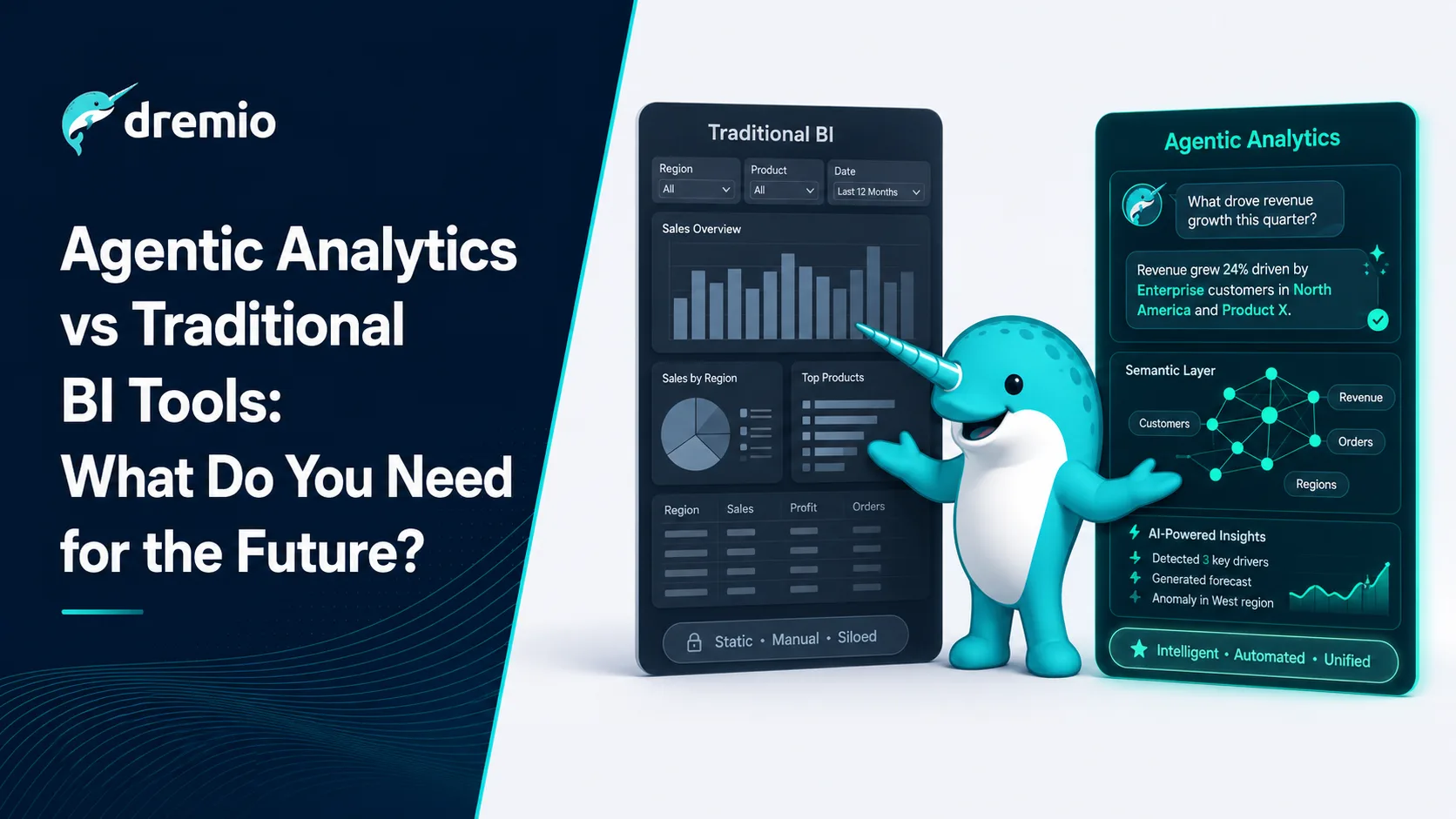
The way organizations analyze data is changing fast. Traditional BI dashboards and manual SQL queries served teams well for years, but they can't keep pace with the speed of modern business decisions. Agentic analytics vs traditional BI tools is now a critical comparison for any data leader planning their next move.
Agentic analytics platforms use AI agents that interpret questions in plain language, pull from governed data sources, and deliver answers in seconds. Traditional BI tools still play a role in structured reporting, but the gap between what teams need and what static dashboards deliver is growing wider every quarter.
Key highlights:
Agentic analytics is an AI-driven approach where autonomous agents interpret natural language questions, query governed metrics, and generate actionable insights without manual SQL or dashboard building.
Traditional BI tools focus on static dashboards and scheduled reports that require trained analysts to build and maintain, creating bottlenecks for business users who need answers fast.
A 2025 McKinsey report found that 62% of organizations are already experimenting with agentic AI, and Gartner forecasts agentic AI spending will grow from $15 billion to $753 billion by 2029.
Dremio's Agentic Lakehouse platform delivers agentic analytics through its AI Semantic Layer, built-in AI agent, native AI SQL functions, and MCP-based connectivity for third-party AI agents.
What is agentic analytics?
Agentic analytics is a data analysis approach where AI agents act independently to interpret questions, query data, and return insights with little to no human involvement. These agents go beyond simple chatbot interfaces. They reason through multi-step problems, select the right metrics from a governed catalog, and present findings with business context.
The term "agentic" refers to systems that show agency. They make decisions, plan actions, and pursue goals without constant direction. In the analytics context, this means AI that can:
Interpret business questions stated in natural language
Decide which data sources and metrics to query
Build and run the right analytical queries
Validate results for logical consistency
Present findings with relevant business context
A traditional analytics workflow might take days or weeks. A business user submits a request, an analyst writes SQL, builds a dashboard, runs it through review cycles, and deploys it. With agentic analytics, a user asks a question and gets an answer in seconds. The AI agent handles the interpretation, query construction, execution, and presentation on its own.
This shift matters because business questions change faster than BI teams can build reports. Gartner predicts that by 2028, 33% of enterprise software applications will include agentic AI capabilities, up from less than 1% in 2024 (Source: Gartner).
What are BI tools?
Business intelligence (BI) tools are software platforms that collect, process, and visualize data to support business decisions. They include data warehouses, dashboard builders, SQL query editors, and reporting engines that have served as the backbone of enterprise analytics for decades.
BI tools excel at structured reporting. Teams use them to track KPIs, generate scheduled reports, and build interactive dashboards that slice data by dimensions like region, product, or time period. Popular tools in this category include Tableau, Power BI, Looker, and Qlik.
These tools do have clear limitations. They depend on manual input at every stage. Someone must write the queries, design the visualizations, and interpret the results. Reports reflect historical data at scheduled intervals rather than real-time conditions. And the "self-service" promise of many BI platforms falls short in practice because users still need training in query languages, data modeling, and visualization best practices.
Data teams commonly spend 40-60% of their time maintaining existing dashboards rather than building new analyses (Source: Typedef). This creates long backlogs. By the time a report ships, the business context has often moved on.
What's the difference between BI tools and agentic analytics?
Traditional BI tools and agentic analytics differ in how they handle data access, user interaction, and output delivery. The comparison of agentic analytics vs traditional business intelligence comes down to automation, speed, and who can access insights. AI analytics vs traditional BI dashboards is not just a feature comparison. It reflects a structural shift in how organizations can operate.
Aspect
Traditional BI tools
Agentic analytics
Core function
Structured reporting, dashboards, and scheduled data visualization
AI-driven analysis, autonomous insight generation, and decision support
Data interaction
Manual SQL queries, drag-and-drop dashboard builders, and predefined filters
Natural language questions, conversational follow-ups, and iterative exploration
User role
Trained analysts and BI specialists who build and maintain reports
Any business user who can ask a question in plain language
Speed
Days to weeks for new reports, hours for dashboard refreshes
Seconds for ad-hoc answers, minutes for deep-dive investigations
Outputs
Static charts, tables, and PDF exports on fixed schedules
Dynamic insights, root-cause explanations, predictions, and triggered actions
Architecture
Dashboard-centric with decentralized metric definitions across tools
Semantic layer foundation with centralized metric governance and AI orchestration
Why should I switch to agentic analytics?
The decision to adopt agentic analytics goes beyond following a trend. It addresses real bottlenecks that cost organizations time, money, and competitive advantage. Here is why the shift makes sense for teams that have outgrown traditional BI.
Move from dashboards to decision automation
Static dashboards answer questions that someone predicted in advance. They break down when executives ask follow-up questions, request new dimensions, or want to test hypotheses that weren't built into the original report. This means every unexpected question goes into a backlog.
Agentic analytics removes that constraint. AI agents interpret new questions on the fly, pull from governed metric definitions, and return answers during the same meeting where the question was raised. Organizations using modern BI with agentic integrations report making decisions up to 5x faster while reducing manual analysis time by 73% (Source: SR Analytics).
Executives get answers during live meetings instead of waiting for follow-up reports
Product teams can test usage hypotheses in minutes, not sprint cycles
Finance teams reconcile numbers from a single source of truth rather than comparing conflicting dashboards
Reduce reliance on manual data exploration
Most organizations have roughly 50 employees for every data analyst (Source: Typedef). This means simple questions queue up behind urgent requests, and non-urgent analysis waits weeks. Analysts spend 30-40% of their time in meetings clarifying what business users actually want before they can start writing queries.
Generative AI changes this dynamic. Agentic systems let business users ask questions directly in plain language. The AI agent handles interpretation, metric selection, and query construction. Analysts shift from writing routine SQL to curating the semantic models and metric definitions that agents query from.
Marketing managers analyze campaign performance without filing a ticket
Sales leaders check pipeline metrics without waiting for weekly reports
Operations teams monitor process efficiency with real-time, plain-language queries
Deliver real-time, context-aware insights
Traditional BI dashboards update on schedules. Daily refreshes, hourly syncs, or at best near-real-time streaming into a warehouse. When a metric spikes or drops, teams often don't know until the next scheduled report hits their inbox.
Agentic analytics agents can monitor data continuously and surface anomalies as they happen. They correlate metric changes with system events, quantify impact, and suggest root causes. This shifts teams from reactive investigation to proactive response. Gartner predicts that by 2028, at least 15% of daily work decisions will be made autonomously by agentic AI (Source: Gartner).
Agents flag revenue drops and identify the affected segments before anyone asks
Customer success teams get alerts when account health scores change, with context about why
Supply chain teams see disruption signals correlated with operational data in real time
Scale analytics across teams without bottlenecks
BI teams operate as report factories. Every new question creates a new ticket, another dashboard, another row in the maintenance queue. Large companies average thousands of dashboards, and the median dashboard is viewed by just three people (Source: Typedef). This model doesn't scale.
Agentic analytics scales differently. One well-curated semantic model can serve hundreds of users asking thousands of unique questions. Agents assemble answers from pre-validated metric building blocks, so every answer uses the same definitions. No duplicated dashboards, no conflicting numbers, no maintenance backlog.
One metric definition for "revenue" serves every department, agent, and dashboard
New teams get data access without submitting BI requests or waiting for onboarding
IT and data teams spend less time on maintenance and more on strategic projects
Support AI-driven workflows and agents
Agentic analytics is not an isolated tool. It connects into broader AI workflows where agents take actions based on data insights. When an agent detects a performance issue, it can create an incident ticket, notify the right team, or trigger a remediation workflow.
Dremio's AI functions allow teams to embed LLM intelligence directly into SQL queries. This means classification, summarization, and entity extraction happen inside the data platform rather than requiring separate ML pipelines. AI agents can chain these functions together with standard SQL to build multi-step analytical workflows.
Agents classify support tickets and route them to the right team based on content analysis
Sales forecasting agents combine CRM data with unstructured call transcripts for richer predictions
Compliance agents scan documents and flag risks without manual review
What are the best agentic analytics tools right now?
The agentic analytics tools market is growing fast. Each platform takes a different approach to connecting AI agents with enterprise data. Here is how the leading options compare.
Best agentic analytics tools
Key features
Dremio
IAgentic Lakehouse with AI Semantic Layer, built-in AI agent, native AI SQL functions (AI_CLASSIFY, AI_COMPLETE, AI_GENERATE), MCP server for open agent connectivity, autonomous query optimization, and Zero-ETL federation across all data sources
Databricks
Genie conversational analytics, Agent Framework for custom multi-step agents, Unity Catalog governance, agentic dashboard authoring from prompts
Snowflake
Cortex Analyst for text-to-SQL, Cortex Agents for multi-step planning, Cortex Search for unstructured data, in-place intelligence with strong governance
Tableau (Salesforce)
Tableau Next with Agentforce integration, Tableau Pulse for proactive alerts, composable architecture with reusable semantic definitions, embedded in Slack and Salesforce
Microsoft Power BI
Copilot for report generation and DAX creation, deep Microsoft 365 and Fabric ecosystem integration, plug-and-play for existing Microsoft users
GoodData
Agent Builder with AI automation, context management layer, MCP server support, embedded analytics and data monetization focus
Tellius
Automated diagnostic analytics, natural language search, automated root cause analysis, augmented analytics for business users
Dremio stands apart because it combines the data platform and the agentic layer in one. Most other tools require you to stitch together a separate BI tool, a data warehouse, a semantic layer, and an AI integration. Dremio delivers all of these through a single Agentic Lakehouse built on open standards like Apache Iceberg, Apache Arrow, and the Model Context Protocol.
How to select the right agentic analytics solution
Choosing an agentic analytics solution requires more than comparing feature lists. The right platform depends on your existing data architecture, governance requirements, and how far you want AI agents to operate across your organization. Here are five criteria to guide the evaluation.
1. Evaluate integration with your data architecture
Your agentic analytics platform must connect with the data sources your teams already use. Look for platforms that support your current warehouse, lakehouse, or federated data setup without forcing data migration or duplication.
Dremio's Zero-ETL federation connects all enterprise data sources through a single query interface. Teams access data from cloud storage, relational databases, and data lakes without moving data into a separate warehouse first. This reduces pipeline complexity and keeps data fresh at the source. For more on how data infrastructure is evolving, review the latest trends shaping how organizations manage their data foundations.
Does the platform support your cloud provider (AWS, Azure, GCP)?
Can it query data in place without copying it into a proprietary format?
Does it integrate with your existing catalog and metadata management tools?
2. Assess the semantic layer and data modeling capabilities
A strong semantic layers is the foundation of accurate agentic analytics. Without one, AI agents write raw SQL against database schemas and produce inconsistent or wrong results. Industry reports show 40-50% accuracy for LLM-generated SQL without semantic structure (Source: Typedef). With semantic definitions, that accuracy jumps to 85-90%.
The semantic layer defines metrics once with clear calculation logic, maps table relationships, and enforces access controls at the metric level. Every query goes through these governed definitions, so agents use the same "revenue" calculation as the CFO's board deck.
Does the platform offer a built-in semantic layer, or does it require a third-party tool?
Can metrics be defined in code and version-controlled?
Does the semantic layer support AI-powered search for data discovery?
3. Prioritize real-time and scalable performance
Agentic analytics generates more queries than traditional BI because users ask more questions when answers arrive instantly. Your data platform must handle this increased query volume without performance degradation or cost spiraling.
Dremio's autonomous optimization engine continuously analyzes query patterns and creates intelligent data structures on its own. Apache Arrow-powered columnar processing delivers fast results, and end-to-end caching covers data, metadata, query plans, and query results. For teams building scalable data applications, this architecture handles growing workloads without manual tuning.
Does the platform auto-optimize query performance, or does it require manual partitioning and indexing?
Can it scale query concurrency as more users and agents access data?
Does it cache results to reduce redundant computation and warehouse costs?
4. Review governance and data control features
AI agents operating autonomously need clear guardrails. Without proper data governance, agents can expose sensitive data, use inconsistent metric definitions, or produce results that violate compliance requirements.
Look for platforms where agents inherit the same access controls as human users. Row-level security, column masking, and audit trails should apply to every agent-generated query. The platform should log all queries for review, trace data lineage, and support compliance workflows that regulators expect.
Does the platform enforce row-level and column-level security for agent queries?
Are all agent-generated queries logged and auditable?
Does it support data lineage tracking from source through agent output?
5. Confirm compatibility with AI and agent workflows
The best agentic analytics platforms don't lock you into a single AI vendor. Open standards like the Model Context Protocol (MCP) let you connect any AI agent framework to your data platform without custom integration code.
Dremio's MCP server lets AI agents from Claude, ChatGPT, LangChain, and other frameworks discover tools, query metadata, execute SQL, and perform semantic searches through a standard interface. This means you can swap AI models or agent frameworks without rebuilding your data connectivity layer.
Does the platform support open standards for AI agent connectivity (MCP, REST APIs)?
Can you connect third-party AI agents and LLMs without custom code?
Does the platform include built-in AI capabilities for teams that want a turnkey option?
Power agentic analytics with Dremio
Dremio is the Agentic Lakehouse platform built for the agentic AI era. From the original co-creators of Apache Polaris and Apache Arrow, Dremio is the only lakehouse that meets the needs of AI agents and humans through autonomous optimization, a unified semantic layer, and Zero-ETL federation. Trusted by thousands of global enterprises including Shell, TD Bank, Michelin, and Farmer's Insurance, Dremio eliminates the bottlenecks that prevent teams from getting value out of their data.
Dremio gives your organization the foundation to move from static dashboards to AI-driven insights and action:
AI Semantic Layer that provides governed business context, metric definitions, and AI-powered semantic search so agents always query the right data with the right definitions
Built-in AI agent for conversational analytics with no setup required, translating natural language into optimized SQL through the AI Semantic Layer
Native AI SQL functions (AI_CLASSIFY, AI_COMPLETE, AI_GENERATE) that embed LLM intelligence directly into queries for classification, summarization, and structured data generation
MCP server supporting open connectivity for any AI agent framework, so you can connect Claude, ChatGPT, LangChain, or custom agents to your data without custom code
Autonomous optimization with self-managing query performance, automatic Iceberg clustering, and end-to-end caching that handles growing agent workloads without manual tuning
Zero-ETL federation that connects all enterprise data sources through a single governed interface, giving agents access to data across clouds and systems without data movement
Exploring the benefits of agentic analytics vs traditional BI tools? Book a demo today and see how Dremio can help you move from static dashboards to real-time, AI-driven insights and action.
Try Dremio Cloud free for 30 days
Deploy agentic analytics directly on Apache Iceberg data with no pipelines and no added overhead.
Intro to Dremio, Nessie, and Apache Iceberg on Your Laptop
Editor’s note, September 2026. This post was published in September 2023 and some product details have changed since. Nessie is still available and self-deployable under the Apache-2.0 licence, and it remains the clearest implementation of catalog-level branching. It is not an Apache Software Foundation project, and its development has slowed considerably. For how the current […]
Aug 16, 2023·Dremio Blog: News Highlights
5 Use Cases for the Dremio Lakehouse
With its capabilities in on-prem to cloud migration, data warehouse offload, data virtualization, upgrading data lakes and lakehouses, and building customer-facing analytics applications, Dremio provides the tools and functionalities to streamline operations and unlock the full potential of data assets.
Aug 24, 2026·Dremio Blog: Open Data Insights
Migrating to Apache Iceberg: Strategies for Every Source System
This is Part 15, the final article of a 15-part Apache Iceberg Masterclass. Part 14 covered hands-on Dremio Cloud. This article covers the three migration strategies and how to execute a zero-downtime migration using the view swap pattern. Most organizations do not start with Iceberg. They have years of data in Hive tables, data warehouses, CSV files, databases, […]