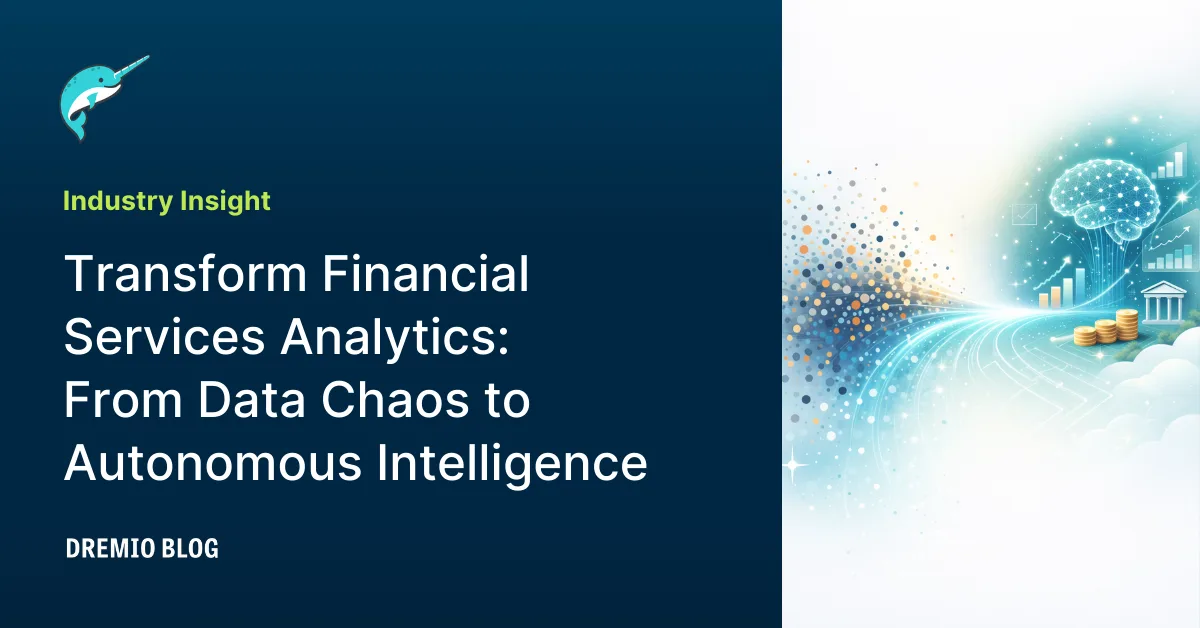
Most financial institutions today face the same bottleneck: fragmented, slow, and costly data systems that cripple the adoption of AI. Analysts wait hours for risk reports. Data engineers spend most of their time tuning queries instead of innovating. And autonomous AI agents hit performance walls and data inconsistencies that threaten compliance and decision quality.
The culprit? Legacy architectures. Banks maintain 10–15 disconnected core systems: customer data in one, transactions in another, risk models in a third. Integrating this data for Basel III, MiFID II, or DORA reports requires tedious manual work. Meanwhile, real‑time agentic AI applications such as fraud detection, compliance monitoring, risk management, all require instant access to consistent, unified data. Traditional warehouses can’t deliver sub‑second performance, predictable cost, or consistent semantics under such workloads.
There’s a better way…
Try Dremio’s Interactive Demo
Explore this interactive demo and see how Dremio's Intelligent Lakehouse enables Agentic AI
How Dremio Solves Financial Services’ Data Bottlenecks
Agentic Lakehouse for Next‑Gen AI
Dremio is the industry’s first agentic lakehouse, a fully managed, AI‑native data platform built for and managed by AI agents. Unlike legacy warehouses built for human Business Intelligence (BI) queries, Dremio provides self‑optimizing infrastructure tailored for autonomous, high‑concurrency workloads.
Unified Analytics: One View for All Agents
AI agents shouldn’t require separate infrastructures for fraud, risk, or compliance. Dremio’s federated query engine connects directly to all data sources - databases, lakes, warehouses, APIs, and queries them as if they’re one system. There’s no data duplication, movement, or ETL complexity.
Think of it like giving your agents a universal “master index” instead of duplicating data from dozens of filing cabinets. Data remains in low‑cost object storage (S3, Azure, GCS), slashing storage and compute costs while keeping everything instantly accessible.
Universal Semantic Layer: Shared Business Language
Consistency thrives when everyone, whether AI or a human speaks the same data language. Dremio’s universal semantic layer lets teams define critical metrics such as “Suspicious Transaction” or “Customer Risk Score” once. All agents and dashboards use identical definitions, ensuring governance, regulatory alignment, and auditability.
For financial institutions, this is transformative. It eliminates conflicting calculations across fraud systems, compliance checks, and human analysts, making data definitions consistent organization‑wide.
Autonomous Performance and AI Governance
Performance That Learns and Adapts
As autonomous agents launch thousands of queries per second, performance tuning traditionally becomes a full‑time burden. Dremio’s Active Metadata continuously observes query patterns and self‑optimizes, reorganizing data clusters and creating intelligent accelerations called Autonomous Reflections.
If a compliance agent often filters alerts by product and date, Dremio pre‑organizes and accelerates that data automatically. Engineers no longer need to manually build indexes or pre‑aggregations; Dremio adapts in real time, delivering 10–100× faster queries.
AI Agents as First‑Class Citizens
Unlike legacy platforms that tack on AI integrations, Dremio embeds AI directly into the platform. Its native AI Agent integrates with Dremio’s catalog and governance, and supports the open Model Context Protocol (MCP). That means any MCP‑enabled agent - OpenAI’s GPT, Google’s Gemini, Anthropic’s Claude, etc. can connect securely and query live data with full governance and audit trails.
Agents that analyze transactions, generate compliance filings, or manage credit exposure all operate under the same policy framework as human analysts, ensuring trust and regulatory consistency.
Cost, Agility, and Open Architecture
Predictable, Low‑Cost Scaling
AI‑driven workloads are notoriously spiky. Traditional warehouses charge per‑query or per‑compute‑second, creating severe cost surprises. Dremio’s pricing starts at just $0.20 per Dremio Compute Unit (DCU), with elastic scaling and no per‑query fees. Because all data remains in inexpensive cloud object storage, overall costs drop by 70-90%.
Real‑world impact:
A regional bank cut infrastructure costs by up to 80% and achieved 10× faster queries.
A $75 billion asset manager supports 300+ professionals with zero unplanned outages.
Dremio enables agentic AI at enterprise scale without unpredictable bills.
Fast, Fully Managed Deployment
Deploying a traditional data warehouse can take months. Dremio provisions in minutes, with no infrastructure to maintain, no complex migrations. Most enterprises achieve full production deployment within three months, often realizing ROI in their first quarter.
Open Lakehouse, No Lock‑In
Your data should never be trapped. Dremio embraces open standards, built on Apache Polaris and Iceberg REST Catalog specs. Any compatible engine - Spark, Trino, Flink can query your catalog directly. Data stored in open Iceberg format remains in your own cloud account, portable and future‑proof.
Through the Model Context Protocol, your preferred AI models connect directly, avoiding vendor‑specific integrations. This open ecosystem ensures interoperability and longevity, as innovations evolve faster than proprietary tools ever could.
Lake‑Centric Efficiency
Traditional architectures constantly move and duplicate data: from sources to staging, warehouses, data marts, BI tools, and AI silos. Each step incurs compute and storage costs.
Dremio’s lake‑centric design stops this waste. Data lives once in your object store and is queried directly - one copy serving every purpose: AI agents, BI dashboards, regulatory reporting, and data science models.
The results:
80-90% lower storage costs.
No ETL bottlenecks or egress fees.
Instant data availability for agentic AI.
The Future of Financial Data Infrastructure
Financial services need data platforms built not for yesterday’s BI but for today’s autonomous, intelligent systems. Dremio delivers unified data, shared semantics, self‑optimizing performance, and open‑architecture freedom, empowering firms to deploy agentic AI with confidence, control, and cost efficiency.
Try Dremio Cloud free for 30 days
Deploy agentic analytics directly on Apache Iceberg data with no pipelines and no added overhead.
Ingesting Data Into Apache Iceberg Tables with Dremio: A Unified Path to Iceberg
By unifying data from diverse sources, simplifying data operations, and providing powerful tools for data management, Dremio stands out as a comprehensive solution for modern data needs. Whether you are a data engineer, business analyst, or data scientist, harnessing the combined power of Dremio and Apache Iceberg will undoubtedly be a valuable asset in your data management toolkit.
Sep 22, 2023·Dremio Blog: Open Data Insights
Intro to Dremio, Nessie, and Apache Iceberg on Your Laptop
We're always looking for ways to better handle and save money on our data. That's why the "data lakehouse" is becoming so popular. It offers a mix of the flexibility of data lakes and the ease of use and performance of data warehouses. The goal? Make data handling easier and cheaper. So, how do we […]
Oct 12, 2023·Product Insights from the Dremio Blog
Table-Driven Access Policies Using Subqueries
This blog helps you learn about table-driven access policies in Dremio Cloud and Dremio Software v24.1+.