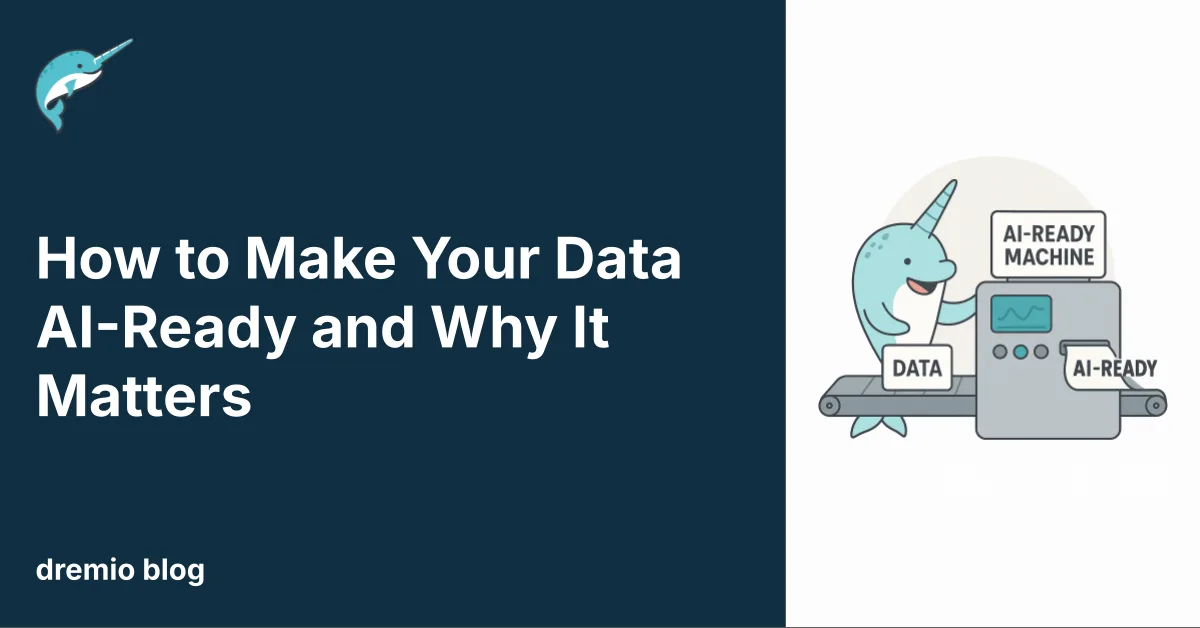
AI-ready data is essential for successful AI initiatives, ensuring it's clean, well-governed, and accessible.
Investing in data readiness avoids delays, reduces risks, and accelerates returns on AI projects.
Key practices include improving data quality, implementing governance, and automating validation processes.
Collaboration across teams enhances trust in data, leading to better AI adoption and insights.
Dremio's Intelligent Lakehouse provides a streamlined approach to make data AI-ready without unnecessary complexity.
The success of any AI initiative depends on the data that powers it. Without the right foundation, even the most advanced models will underperform. “AI-ready data” means your information is clean, well-governed, and accessible across teams, enabling accuracy, compliance, and scalability from the start.
Key Takeaways
Definition: AI-ready data is structured, trusted, and usable, prepared to support accurate, responsible, and scalable AI systems.
Why it matters: Enterprises that invest in readiness avoid delays, reduce risk, and see faster returns from AI projects.
Best practices: Preparing data for AI means cleaning, governing, and continuously monitoring it, not just at project kickoff.
Dremio advantage: With its intelligent Iceberg lakehouse, Dremio gives teams the architecture and automation they need to make data AI-ready, without moving or duplicating it.
Try Dremio’s Interactive Demo
Explore this interactive demo and see how Dremio's Intelligent Lakehouse enables Agentic AI
Why Data Preparation for AI Matters for Enterprises
Without AI-ready data, even the most promising initiatives stall. When information is scattered, outdated, or poorly documented, teams waste time fixing problems instead of building solutions. Reliable insights, compliant models, and scalable operations all depend on clean, accessible data.
Preparing data for AI isn’t just a technical step, it’s a strategic requirement. Data quality and governance directly impact the speed, accuracy, and outcomes of enterprise AI. Teams that prioritize readiness avoid unnecessary risk, reduce overhead, and gain faster returns on their investments.
Supporting Business Goals
Every AI initiative should tie back to a business goal: increasing revenue, improving customer experiences, or reducing costs. But those outcomes only materialize when the underlying data is trustworthy. In a recent industry study, enterprises reported that poor data quality is a leading reason AI projects fail to scale or deliver measurable impact.
AI-ready data helps align teams around outcomes instead of operations. When information is accurate and consistent, AI models can surface insights that drive action, without rework or delay. A hybrid lakehouse architecture makes this possible by simplifying how teams access and use data across environments.
Helps tie AI investments to specific KPIs
Reduces time spent on manual prep and cleanup
Supports more effective prioritization of AI use cases
Improving Model Accuracy
Model accuracy starts with data quality. Incomplete records, duplicated values, or outdated fields can lead to misleading predictions or outright failure. Even state-of-the-art models underperform when trained on flawed data.
AI-ready data ensures that inputs are clean, complete, and representative. This improves both the model’s reliability and its ability to adapt over time. Teams can spend more time fine-tuning model logic, and less time correcting data issues.
Reduces risk of biased or inaccurate results
Increases confidence in outputs and recommendations
Supports better performance across real-world scenarios
Enabling Governance and Compliance
AI systems must comply with internal policies and external regulations. That’s difficult without clear governance over where data came from, who touched it, and how it’s being used. When governance is added too late, companies face delays, or worse, penalties.
Starting with AI-ready data means models inherit those rules from the start. Metadata, lineage, and access controls are built in, not bolted on. This makes it easier to audit decisions, document compliance, and enforce standards as the project evolves.
Prevents unauthorized data use or exposure
Supports audit trails and explainability
Streamlines compliance with evolving regulations
Preventing Waste and Inefficiency
Many organizations discover too late that their data isn’t ready. That leads to duplicated work, delayed timelines, and ballooning budgets. According to Gartner, a majority of AI projects that fail do so because of unprepared data, not because of flawed algorithms.
AI-ready data helps avoid these pitfalls. Instead of scrambling to fix issues mid-project, teams can move confidently from proof of concept to production. Data products also help by packaging reusable, well-documented datasets that support repeatable workflows.
Avoids rework by catching problems early
Reduces development time and cost overruns
Makes datasets reusable across AI projects
Fostering a Data-Driven Culture
For AI to succeed, it must be more than a data science initiative, it must be embraced across the business. That only happens when teams trust the data and can access it easily. Data that is difficult to find or interpret becomes a bottleneck, not a catalyst.
When data is AI-ready, it supports collaboration and confidence. Business users can explore insights on their own, analysts can build models faster, and leadership can make decisions based on facts instead of assumptions. Over time, this creates a culture where data drives progress.
Encourages cross-team collaboration
Increases adoption of AI tools and insights
Builds organizational trust in data-led decisions
How to Make Data AI-Ready: 7 Key Steps
Making your data AI-ready isn’t a one-time project; it’s a strategic discipline. The right foundation allows you to build smarter, scale faster, and stay compliant over time. These seven steps offer a practical roadmap for teams looking to operationalize readiness across technology, governance, and culture.
Dremio helps accelerate this journey by streamlining data access, simplifying modeling, and automating many of the most time-consuming prep tasks. With the right platform and a strong process, AI readiness becomes repeatable and future-proof.
1. Assess Your Data Landscape
Start with visibility. Map your data sources, formats, owners, and usage. Identify silos, stale datasets, and metadata gaps. This baseline helps prioritize cleanup and highlights which data is relevant for AI use cases.
It’s also the time to flag sensitive or regulated data and clarify who needs access to what. Partner with domain experts to validate context and relevance. Document everything so governance and architecture work can build from a clear picture.
Inventory all data sources and pipelines
Identify quality risks, duplicates, and access gaps
Collaborate with stakeholders to validate priorities
2. Improve Data Quality and Completeness
Poor-quality data leads to poor predictions. Fix issues such as missing values, incorrect formats, and duplicates early in the process. Use profiling tools to measure accuracy, consistency, and completeness at scale.
Automation plays a key role here. Profiling and cleaning tools can catch issues faster than manual reviews. Consider embedding validation checks into pipelines to keep datasets clean from ingestion to production.
Apply rules to detect and correct errors.
Impute missing or incomplete fields.
Establish repeatable checks across critical datasets.
3. Implement Strong Governance
AI-ready data is secure, compliant, and traceable. That requires clear roles, definitions, and access policies. Governance ensures models aren’t trained on unauthorized, biased, or outdated inputs.
Start by defining owners and stewards for each domain. Align on data definitions, and embed security controls into your pipelines. Dremio’s semantic layer helps maintain consistent meaning and enforce access policies across all queries.
Assign owners to key datasets and definitions.
Embed privacy, retention, and access rules.
Use metadata and lineage to enforce accountability.
4. Standardize, Model, and Catalog Your Data
AI models need structured, well-documented data. Standardize naming conventions, model key business entities, and publish datasets with explicit metadata. This makes it easier to find, understand, and reuse data across teams.
Tools like Dremio and dbt simplify this process. You can define models as code, apply them to live data, and catalog results instantly, the outcome: trusted datasets that power repeatable insights.
Create reusable models for core entities (e.g. customer, product)
Document fields, transformations, and assumptions
Make curated datasets discoverable through a catalog
5. Leverage Modern Data Architectures
Traditional pipelines can’t keep up with the demands of AI. Modern architectures like lakehouses combine the scalability of lakes with the structure of warehouses. They support diverse data types and allow teams to query live data without duplication.
Dremio’s architecture is designed for this. It gives teams direct access to raw and modeled data, whether it lives in a cloud store or a relational system. This eliminates unnecessary movement and delivers consistent performance.
Use scalable storage for structured and unstructured data
Enable low-latency queries across live sources
Reduce ETL overhead with virtualized access
6. Automate Validation, Monitoring, and Versioning
Your data will change, your prep process needs to keep up. Automate validation steps to catch issues before they affect model accuracy. Monitor for schema changes, null spikes, or outliers in real time.
Versioning is also essential. Keep a record of which data version was used for each model build. That way, you can reproduce results, trace regressions, and avoid “silent” data drift.
Set automated checks for freshness, completeness, and schema.
Track and log changes in data pipelines
Version key datasets to ensure reproducibility
7. Continuously Monitor and Improve
Readiness isn’t static. As new models, sources, and regulations emerge, your data foundations need to evolve. Build metrics into your pipelines to monitor quality and surface new issues.
Schedule regular reviews to revisit ownership, access, and documentation. The most effective teams treat AI data preparation as a living process rather than a one-time task.
Monitor KPIs like data quality score and time-to-readiness
Reassess governance policies and data usage regularly
Adapt tools and practices to new business needs
AI Data Preparation Best Practices
AI success depends on more than a single clean dataset; it depends on sustained readiness. This means treating data prep as a set of habits rather than just a task. A lakehouse for AI-ready data supports this by combining performance, governance, and flexibility into a single platform. But the real differentiator is how you manage and maintain data over time.
The following best practices help ensure your data remains trusted, compliant, and scalable as new models, use cases, and teams come on board.
Align Data Strategy and Governance
Start with strategy. Define what “good data” means for your organization and how you’ll measure it. Tie those standards to business goals, and assign ownership so every dataset has clear accountability.
Then build governance into your workflows—not on top of them. Policies should control access, privacy, and lineage without slowing down development. Document decisions so teams can move fast and stay compliant.
Establish data standards aligned to business KPIs
Assign owners and stewards for all critical domains
Build in access, security, and retention policies
Foster Collaboration Across Teams
AI projects work best when technical and business teams are aligned. Encourage shared definitions, consistent documentation, and open access to trusted data. When everyone uses the same models and metrics, insights flow faster.
Break down silos by creating cross-functional ownership. Analysts, data scientists, and engineers should co-own data products—not just consume them. Collaboration strengthens both quality and adoption.
Promote shared data definitions and training
Encourage cross-functional feedback on data quality
Make documentation easy to find and contribute to
Automate Where Possible
Manual data prep doesn’t scale. Automate common tasks like profiling, validation, and lineage tracking. These systems catch issues early and enforce standards without adding overhead.
Automation also frees up time for higher-value work—like refining features or experimenting with new model inputs. The more consistent your pipelines, the more repeatable your AI outcomes.
Use automated profiling to detect errors and anomalies
Embed validation rules into pipelines
Track schema and lineage changes automatically
Adopt Open Standards
Open formats and interfaces future-proof your stack. They let you swap tools, scale platforms, and avoid vendor lock-in. They also improve collaboration by making data easier to share and reuse.
Start by choosing open table formats and query engines. Then ensure your catalog, governance, and metadata tools support common APIs and standards. Flexibility matters when tech evolves fast.
Use open formats like Iceberg for table storage
Standardize on accessible query interfaces
Choose interoperable tools that support ecosystem growth
Measure and Iterate on Data Preparation
What gets measured improves. Track metrics like data freshness, completeness, and quality over time. Use these signals to catch problems early and guide continuous improvement.
Review your processes regularly. As new models launch and teams grow, your data needs will evolve. Build in feedback loops to refine strategy, tooling, and documentation.
Monitor key data readiness metrics continuously
Conduct periodic reviews with data owners
Adjust workflows and tools based on model performance
Streamline Your Workflow With Dremio’s AI-Ready Data Center Solution
Building AI-ready data doesn’t have to mean building from scratch. Dremio’s Intelligent Lakehouse makes it simple to prepare, manage, and scale data for AI, without the cost, complexity, or rigidity of traditional data warehouses. With built-in governance, live query performance, and native support for open standards, it’s engineered to meet the demands of both humans and AI agents.
Unlike fragmented architectures that require constant data movement and tuning, Dremio’s intelligent Iceberg lakehouse gives teams fast, governed access to live data, right where it resides. From ingestion to insight, Dremio helps you build AI-ready data products that are reusable, secure, and easy to scale. Book a demo today and see how Dremio can help make your data AI-ready, while streamlining your pipelines and delivering lightning-fast insights at scale.
Frequently Asked Questions
What is data preparation for AI?
Data preparation for AI refers to the process of cleaning, structuring, and governing data so it can be used effectively by machine learning models and generative systems. This includes standardizing formats, labeling key fields, and ensuring data is complete and accurate.
An active data architecture supports this by giving teams live access to governed datasets across sources, without duplicating or moving data. The goal is to accelerate development, reduce risk, and enable teams with AI-ready data from day one.
What are the benefits of adopting an AI-ready data center solution?
Adopting an AI-ready data solution streamlines the entire AI lifecycle, from discovery to deployment. It improves reliability, shortens development cycles, and reduces technical debt over time.
Accelerating AI deployment: Clean, accessible data lets teams build and launch models faster, without spending weeks cleaning and validating inputs.
Enhancing scalability: Once pipelines are in place, data products can support multiple AI use cases without redundant prep work or duplicated datasets.
Increasing trust and explainability: Clear lineage, definitions, and governance make AI outputs easier to trace, debug, and explain across the organization.
Enabling real-time intelligence: With live access to data, AI systems can respond instantly to new signals, powering use cases like fraud detection and personalized recommendations.
What are the biggest challenges in data preparation for AI/ML?
Many organizations struggle to get data ready for AI due to a mix of technical and cultural hurdles. These challenges often delay progress, inflate costs, or derail projects entirely.
Data silos and inconsistency: Disconnected systems and misaligned definitions prevent teams from using data cohesively across projects.
Poor data quality: Missing values, incorrect formats, and unclean inputs all undermine model performance and reduce trust in predictions.
Lack of governance: Without clear roles, access rules, and data lineage, it's hard to ensure compliance, or even know which data to use.
Legacy infrastructure: Outdated systems often lack the speed, flexibility, and scalability needed to support modern AI workloads.
Skill gaps and cultural resistance: Teams may lack the data literacy, engineering resources, or executive support required to prepare data at scale.
Try Dremio Cloud free for 30 days
Deploy agentic analytics directly on Apache Iceberg data with no pipelines and no added overhead.
Ingesting Data Into Apache Iceberg Tables with Dremio: A Unified Path to Iceberg
By unifying data from diverse sources, simplifying data operations, and providing powerful tools for data management, Dremio stands out as a comprehensive solution for modern data needs. Whether you are a data engineer, business analyst, or data scientist, harnessing the combined power of Dremio and Apache Iceberg will undoubtedly be a valuable asset in your data management toolkit.
Sep 22, 2023·Dremio Blog: Open Data Insights
Intro to Dremio, Nessie, and Apache Iceberg on Your Laptop
We're always looking for ways to better handle and save money on our data. That's why the "data lakehouse" is becoming so popular. It offers a mix of the flexibility of data lakes and the ease of use and performance of data warehouses. The goal? Make data handling easier and cheaper. So, how do we […]
Oct 12, 2023·Product Insights from the Dremio Blog
Table-Driven Access Policies Using Subqueries
This blog helps you learn about table-driven access policies in Dremio Cloud and Dremio Software v24.1+.