The traditional data lakehouse was designed for human analysts. Every architectural decision, from how performance is tuned to how business context is stored, assumed that a person would be sitting at the end of the pipeline, writing queries, interpreting results, and carrying those results into decisions. That assumption is no longer reliable.
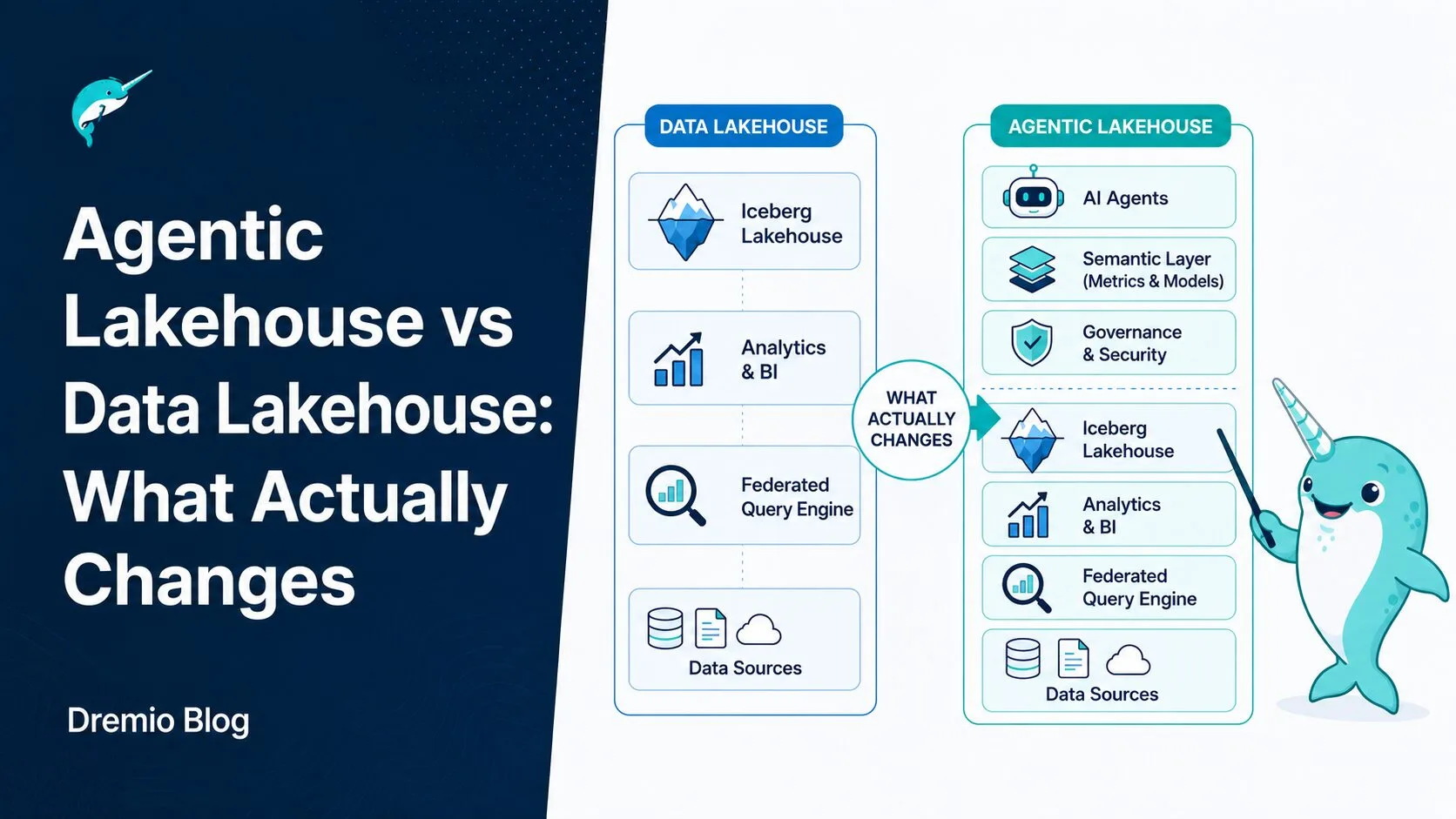
AI agents are becoming legitimate data consumers. They issue queries programmatically, chain multiple requests in a single task, run at unpredictable times, and act on results without waiting for human review. The traditional lakehouse was not built for this. That does not mean it was built wrong. It means the Agentic Lakehouse vs data lakehouse comparison is really a story about evolution, not replacement.
This post walks through exactly what changes when you move from a traditional lakehouse to an agentic one. Not the marketing version of that answer. The architectural version: seven concrete structural differences, who needs to act on them now, and how to get there incrementally from where you are today.
The Foundation Both Architectures Share
Before getting into what changes, it's worth being precise about what does not. Both architectures are built on the same three-layer foundation.
Object storage (Amazon S3, Azure ADLS, Google Cloud Storage) serves as the persistence layer. Data lives in Parquet files on cheap, scalable object storage. Neither architecture requires a proprietary storage format or vendor-controlled block storage.
Apache Iceberg is the open table format that brings ACID transactions, schema evolution, time travel, and hidden partitioning to files in object storage. Iceberg is the layer that transformed a collection of Parquet files into a queryable, reliably consistent table. This does not change in an agentic context. If you have already adopted Iceberg, that investment carries forward completely. You can read more about Iceberg's architecture in the Apache Iceberg Architectural Guide.
A SQL query engine (Dremio, Trino, Spark SQL) executes distributed queries against the Iceberg tables. The SQL interface itself does not change. Analysts still write SQL. BI tools still connect via JDBC/ODBC or Arrow Flight. Existing queries continue to work.
The Agentic Lakehouse inherits all of this. The object storage layer, the Iceberg format, and the SQL interface are unchanged. What changes is everything built above and around this foundation to serve a different class of consumer.
Change 1: The Primary Consumer Is No Longer Only Human
The traditional lakehouse was optimized for a specific type of query pattern: human analysts writing SQL against dashboards, scheduled jobs running nightly ETL, and ad-hoc exploration sessions that happen during business hours. These patterns are predictable in important ways. Queries tend to repeat. Peak load is foreseeable. A human interprets results before they influence anything.
AI agents break every one of these assumptions.
An agent working through a business analysis task might issue 15 sub-queries in sequence, each building on the result of the last. It does not work business hours. It does not repeat the same queries that a dashboard does. It generates novel SQL based on its reasoning about what it needs to know next. And it acts on the result without a human reviewing it first.
This is not a problem that can be solved by adding more compute to a traditional lakehouse. The issue is not throughput. The issue is that the platform was not designed to serve an autonomous reasoning system alongside human analysts. It lacks the interfaces, the metadata accessibility, and the governance structure that agent consumers require.
The shift is this: in an agentic lakehouse, the platform must simultaneously serve human consumers (BI tools, SQL analysts, scheduled jobs) and AI consumers (agents, LLM pipelines, copilot systems). These consumers have different latency expectations, different metadata needs, and different governance requirements. The platform must handle both without degrading either.
Change 2: The Performance Model Must Adapt Automatically
In a traditional lakehouse, performance tuning is a manual process. A DBA identifies a slow dashboard, looks at the query plan, and creates a materialized view that covers that specific access pattern. In Dremio, these are called Reflections. They work very well when the query patterns are known in advance because those patterns repeat predictably. The DBA's effort pays off over hundreds of dashboard refreshes.
The problem with this model in an agentic context is straightforward: agents generate queries that no human DBA has seen before. An agent reasoning through a customer segmentation problem might join five tables in a combination that has never appeared in production. Manual tuning cannot anticipate that. By the time a DBA notices the pattern and creates a Reflection, the agent has already moved on to a different query structure.
Autonomous Reflections solve this by observing actual query patterns as they occur and automatically building and maintaining materialized views based on real usage. No human defines what should be accelerated. The system decides based on evidence. When query patterns change (as they do when agents explore new analytical paths), stale Reflections are retired and new ones are created. You can read more about how this works in Dremio's Autonomous Performance post.
C3 (Coordinated Columnar Cache) adds an intelligent caching layer at the columnar level. Rather than caching entire query results, C3 caches frequently accessed column data in a format that can serve many different queries. This is particularly effective for agents that repeatedly access the same base columns in different combinations.
Result caching handles a third scenario: when the same query appears multiple times within a session or across agent runs. The cache returns the stored result immediately without re-executing the query against object storage.
Together, these three mechanisms mean the performance layer adapts to actual agent and human usage patterns without requiring a human to anticipate those patterns first.
What This Means for DBA Workload
The DBA role does not disappear. It changes. Instead of spending time writing CREATE REFLECTION statements and monitoring query plans manually, DBAs spend time on architecture decisions and governance design. The operational layer becomes self-managing.
Change 3: Business Context Moves Into the Platform
Every organization has a definition of "revenue." The problem is that, in a traditional lakehouse, that definition usually lives in the BI tool. Tableau has it as a calculated field. Power BI has it as a DAX measure. Looker has it as a LookML metric. Each definition might be slightly different, calibrated to the specific team or use case that created it.
This fragmentation creates two problems. The first is consistency: when the Tableau dashboard says one revenue number and the Power BI report says another, someone has to investigate which definition is correct and why they differ. The second problem is more fundamental: AI agents cannot read Tableau calculated fields.
When an agent needs to answer "what is our revenue by region this quarter?", it queries the data platform directly. It does not open Tableau. If the semantic definition of "revenue" lives only inside Tableau, the agent has no access to it. It will construct its own definition based on whatever columns it can find, which may or may not match the business intent.
The solution is to move business context into the data platform itself, where it is accessible to all consumers: BI tools, AI agents, SQL clients, REST APIs, and any other interface that connects to the platform. This is what a proper semantic layer does.
In Dremio's AI Semantic Layer, business logic is encoded in semantic views: SQL views with rich metadata, column-level descriptions, certified metric definitions, and business-friendly naming. These views are first-class objects in the platform, not tool-specific configurations. When a BI tool queries for revenue, it gets the same definition as when an AI agent queries for revenue. When a new tool or agent framework connects, it inherits that consistency automatically.
The practical result is that the data platform becomes the single source of truth for business meaning, not just for raw data. This is a structural change to where business logic lives, not a change to the SQL interface itself.
Change 4: Governance Must Be Structural, Not Procedural
Traditional data governance is largely procedural. A human analyst builds a report. A data lead reviews it for accuracy. A business stakeholder approves it before it influences a decision. This works because the human is the last step before action. The governance checkpoint is the human review.
AI agents break this model. An agent might execute 200 queries in a single afternoon session, generating insights that immediately feed into automated workflows. There is no practical way to put a human checkpoint on each of those 200 queries. Procedural governance simply does not scale to agent workloads.
The shift required is from procedural governance to structural governance: policies enforced automatically at the platform level, before any query result reaches a consumer.
Dremio's Fine-Grained Access Control (FGAC) enforces access at the row, column, and table level. When an agent connects to Dremio, it authenticates with specific credentials. Those credentials determine exactly which rows and columns it can see, regardless of how it constructs its query. The agent cannot get around row-level filters by writing clever SQL. The enforcement happens in the query engine before results are returned.
Audit logging records every query issued against the platform, including agent queries, with metadata about who or what issued them, what they queried, and what they received. This gives security and compliance teams full visibility into agent behavior without requiring any additional instrumentation in the agent itself.
MCP authentication means agents connecting via the Model Context Protocol must authenticate through structured protocols that map to specific permission sets. An agent does not get anonymous access. It gets exactly the access its identity permits.
Data contracts via Iceberg schema enforcement provide a final layer: the schema cannot be changed in ways that break downstream consumers without explicit migration steps. This protects agents from silent data changes that would corrupt their reasoning.
Change 5: New Interfaces for a New Type of Consumer
The traditional lakehouse provides a mature set of interfaces. SQL consoles for analysts. JDBC/ODBC drivers for BI tools. Arrow Flight for high-performance programmatic access. REST APIs for application integration. These continue to work. They serve human consumers well and there is no reason to remove them.
What changes is that additional interfaces are required to serve AI agent consumers.
MCP Server (Model Context Protocol) is the most important new interface. MCP is an open protocol developed by Anthropic that allows AI frameworks (LangChain, LlamaIndex, Claude, and others) to connect to data tools in a standardized way. When Dremio exposes an MCP Server, any compatible AI framework can connect and query data without custom integration work. The agent gets structured access to schemas, tables, and query execution. Read more in the MCP Beginner Guide.
Built-in AI Agent provides a natural language interface for business users who should not be writing SQL. The important distinction here is that this is not a chatbot. It is a data reasoning engine that interprets business questions, constructs SQL, executes queries against the semantic layer, and returns precise data-grounded answers. It uses the semantic layer to understand what business terms mean, which means its answers are consistent with what BI tools report.
AI SQL Functions extend SQL itself with the ability to call large language models inline. This opens analytical patterns that were previously impossible in pure SQL.
-- Classify customer support tickets by sentiment and category
SELECT
    ticket_id,
    customer_id,
    AI_CLASSIFY(ticket_text, ['billing', 'technical', 'general']) AS category,
    AI_SENTIMENT(ticket_text) AS sentiment_score
FROM support_tickets
WHERE created_date >= CURRENT_DATE - INTERVAL '30' DAY;
This query runs against Iceberg data in Dremio, calls an LLM for classification and sentiment inline, and returns results in a single SQL response. No Python preprocessing required. No external pipeline.
Python agent primitives let data engineers building agentic pipelines interact with Dremio using agent-friendly abstractions rather than raw JDBC connections. These libraries handle connection management, schema introspection, and query execution in patterns that fit naturally into LangChain chains or custom agent loops.
Change 6: Metadata Stops Being Documentation and Starts Being Infrastructure
In a traditional lakehouse, metadata is documentation. Someone writes a description for a table when they create it, or more commonly, they intend to write it and do not. The catalog becomes a collection of tables with names like fact_transactions_v3_final and no description. Humans tolerate this because they can ask a colleague what the table contains. AI agents cannot ask colleagues.
When an agent attempts to query data, it needs to understand what each table and column means in order to construct correct SQL. Without metadata, the agent guesses. It might join customer_id from one table to account_id from another, creating a silent wrong join that produces incorrect results without any error message.
Active metadata is metadata that the agent consumes at query time, not documentation that humans read at planning time. This requires:
AI-generated metadata: Dremio can analyze existing data and automatically generate table descriptions, column-level descriptions, and data classifications. This dramatically reduces the cost of maintaining catalog coverage. Rather than requiring a human to document every column manually, the AI generates a starting point that humans can refine.
Semantic search: Agents find data by concept rather than by table name. Searching for "customer churn" should surface all tables related to customer attrition, subscription cancellations, and retention metrics, regardless of how those tables are named.
Data lineage: Agents reasoning about whether to trust a data source benefit from knowing where the data came from. A Iceberg table populated from a certified ETL pipeline is more trustworthy than one populated from an ad-hoc script. Lineage metadata makes this distinction visible.
Open Catalog (Dremio's implementation of Apache Polaris) provides a standard for catalog interoperability across multiple query engines and tools. When metadata is stored in an open catalog, it is accessible to all engines that connect to it, not just Dremio. This matters for organizations running heterogeneous query environments.
Change 7: The Platform Manages Its Own Operations
A traditional lakehouse requires ongoing human operational work. DBAs schedule compaction jobs to merge small Iceberg files that accumulate from streaming writes. They monitor query performance and investigate slow queries. They rebuild indexes and refresh statistics. They plan maintenance windows to run OPTIMIZE TABLE commands without impacting production queries.
This is not a criticism of the traditional model. It was designed when operational complexity was manageable for a small DBA team overseeing a finite set of tables with predictable access patterns.
In an agentic lakehouse, the operational surface expands. More tables. More query patterns. More consumers. The compaction and tuning work scales with the number of tables and query patterns, not with the size of the DBA team. At some point, the manual approach cannot keep up.
Automatic Table Optimization handles Iceberg maintenance operations without scheduled jobs. File compaction, file sizing, sort order optimization, and snapshot expiration run continuously in the background based on table activity. A table with heavy streaming ingestion gets compacted more aggressively. A table accessed only for monthly reporting gets lighter treatment. The system makes these decisions based on actual usage.
Autonomous Reflections manage the entire lifecycle of materialized views: creation, refresh, and retirement. No human schedules a Reflection refresh. The system detects when a Reflection is stale and rebuilds it. When a query pattern disappears (because an agent moved on to a different analysis), the corresponding Reflection is retired to avoid wasting storage.
Autonomous performance monitoring detects query degradation and remediates it. When a query that used to run in 2 seconds starts taking 20 seconds, the system investigates whether a Reflection is stale, whether the underlying data has grown significantly, or whether a new Reflection would help.
The DBA role in an agentic context shifts toward architecture and governance: designing the data model, defining access control policies, curating the semantic layer, and reviewing the system's autonomous decisions. The repetitive operational work moves to the platform.
Who Needs to Make This Transition Now
Not every organization is in the same position relative to this transition. The urgency depends on what your AI agents are doing today.
You need this now if AI agents are already querying your production data. If you have deployed a copilot, an automated analytics agent, or any LLM-powered pipeline that issues SQL against your lakehouse, you are already operating in an agentic context without the infrastructure that context requires. The governance gaps, the metadata gaps, and the performance tuning gaps are not theoretical problems. They are affecting your agents today.
The specific symptoms to look for: inconsistent answers from different tools (semantic layer gap), agent queries that time out or run much slower than dashboard queries (performance model gap), inability to audit what an agent queried (governance gap), and agents that construct wrong joins because they do not understand what columns mean (metadata gap).
You have time to plan if you are still evaluating AI analytics or preparing for your first agent deployment in the next 6 to 12 months. You have the luxury of building the foundation before the agents arrive. This is the better position to be in because retrofitting governance and semantic structure after agents are running is significantly harder than building it before.
The recommendation for this group: start with the semantic layer and FGAC governance setup before you deploy any agents. When the first agent connects, it should connect to a platform that already has the structure it needs.
The Migration Path: Incremental, Not Big Bang
The most important practical point about moving from a traditional lakehouse to an agentic one is that you do not need to rebuild your infrastructure. The Dremio Agentic Lakehouse is designed to layer on top of your existing lakehouse investment, not replace it.
Stage 1: Federation
Connect Dremio over your existing data sources. This requires no data movement. Dremio federates queries across your existing Iceberg tables on S3 (or ADLS or GCS), your existing databases, and any other sources. Analysts immediately get a unified SQL interface. You have not changed anything about your existing data. You have added a query layer on top of it.
This stage alone delivers value: analysts stop writing custom connectors, BI tools connect to a single endpoint, and you get centralized query monitoring.
Stage 2: Semantic Layer
Start adding semantic views for your most frequently queried datasets. You do not need to document everything before you get value. Start with the 5 or 10 datasets that drive the most business decisions. Define your core metrics (revenue, active users, conversion rate) in Dremio views with proper column descriptions and business logic.
This stage delivers consistent metric definitions across all connected tools and prepares the metadata foundation that agents will rely on.
Stage 3: Autonomous Performance
Enable Autonomous Reflections and C3. Let the system observe your existing query patterns for a few days. It will start building materialized views based on actual usage. For existing dashboard queries, you will often see significant latency improvements within the first week.
This stage reduces compute costs (fewer full scans against object storage) and prepares the performance layer for agent query diversity.
Stage 4: Agent Interfaces
Connect your first AI agent via MCP, or enable the built-in AI Agent for business users. At this point, your platform has the semantic context agents need, the governance policies to control their access, and the performance infrastructure to serve their queries without degrading human-facing dashboards.
Each stage delivers standalone value. You do not have to complete all four stages to see benefit from stage one. Organizations that start this process incrementally consistently find that each stage pays for itself before they move to the next.
What This Means for Your Architecture Roadmap
The Agentic Lakehouse is not a different architecture from your existing lakehouse. It is four additional structural layers built on top of a foundation you have likely already built: an AI Semantic Layer, Autonomous Performance, active metadata, and agent-specific interfaces.
If you are planning your data architecture roadmap for the next 12 to 18 months, the practical question is not "should we build an agentic lakehouse?" The practical question is: "where is our highest-value starting point?"
For organizations where inconsistent metrics are the primary pain point, start with the semantic layer. For organizations where AI agents are already running but governance is unclear, start with FGAC and audit logging. For organizations where query performance is the constraint, start with Autonomous Reflections.
The organizations building this foundation now will not need to retrofit it when AI agents become standard consumers. The organizations that delay will find that retrofitting semantic structure and governance controls around active agents is a significantly harder problem than building that structure before the agents connect.
The foundation of open storage, open table format, and open SQL interface that you have already built is exactly right. The question now is what you build on top of it.
Try Dremio Cloud free for 30 days and see how Autonomous Reflections, the AI Semantic Layer, and MCP agent connectivity work together in a single platform. Start at dremio.com/get-started.
Keep learning
For a deeper treatment of the topics in this post, download Apache Iceberg: The Definitive Guide by Tomer Shiran, Jason Hughes, and Alex Merced, free from Dremio.
Intro to Dremio, Nessie, and Apache Iceberg on Your Laptop
Editor’s note, September 2026. This post was published in September 2023 and some product details have changed since. Nessie is still available and self-deployable under the Apache-2.0 licence, and it remains the clearest implementation of catalog-level branching. It is not an Apache Software Foundation project, and its development has slowed considerably. For how the current […]
Aug 16, 2023·Dremio Blog: News Highlights
5 Use Cases for the Dremio Lakehouse
With its capabilities in on-prem to cloud migration, data warehouse offload, data virtualization, upgrading data lakes and lakehouses, and building customer-facing analytics applications, Dremio provides the tools and functionalities to streamline operations and unlock the full potential of data assets.
Sep 30, 2026·Dremio Blog: Open Data Insights
Apache Iceberg 1.12.0: What’s New, Breaking Changes, and Upgrade Guide
Apache Iceberg 1.12.0 expands v3 engine support, REST catalog operations, streaming reliability, and v4 groundwork. Learn how to upgrade safely.