The concept of a semantic layer has evolved from a simple dictionary to a complex system necessary for AI understanding and acting on data.
Dremio's Semantic Layer facilitates a central understanding of data across various sources, eliminating data silos and improving query efficiency.
Key components include Virtual Datasets for consistent metrics, and Wikis and Labels for added context, enhancing both user and AI comprehension.
Dremio employs generative AI to create and maintain the semantic layer, transforming it into a self-documenting asset that enhances data modeling.
This shift enables organizations to achieve practical agentic analytics, turning the semantic layer into an active intelligence tool for business data.
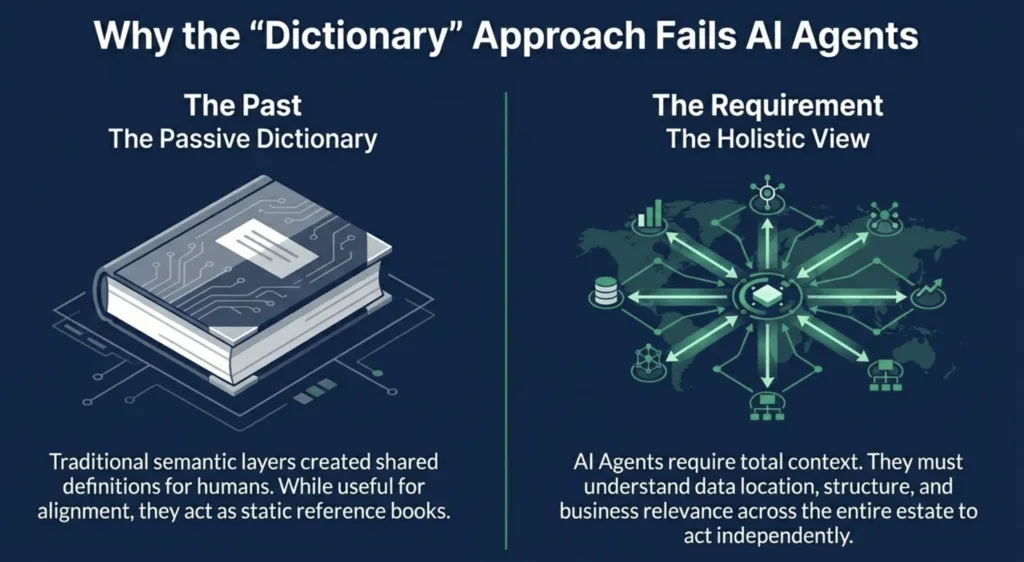
For years, the term "semantic layer" has described a straightforward concept: creating a consistent, shared dictionary for canonical business datasets and metrics. This has been undeniably useful for ensuring that everyone in an organization is speaking the same language when it comes to data. However, as valuable as this has been, it is becoming insufficient for the challenges and opportunities of today.
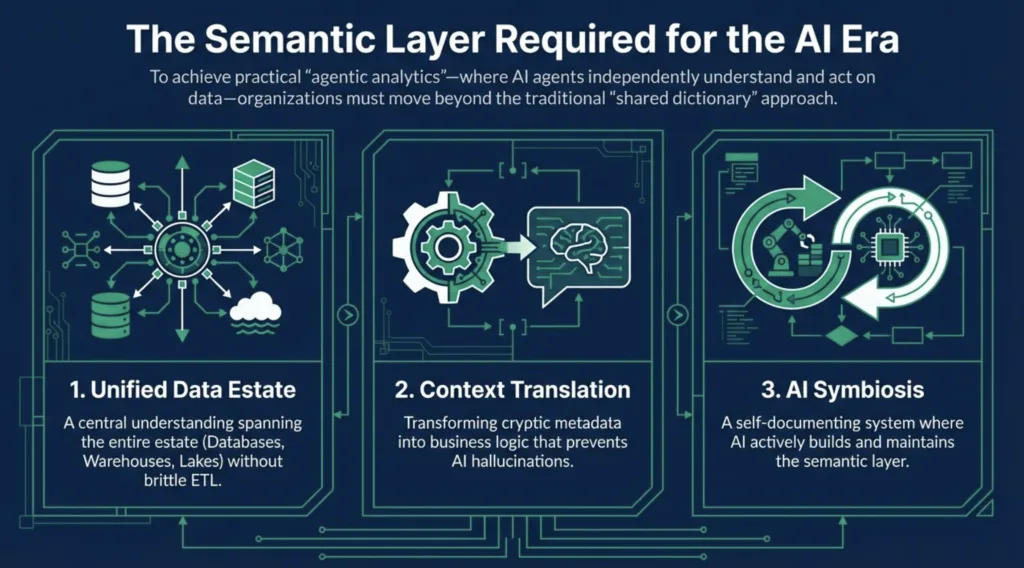
In the era of AI, a simple dictionary isn't enough. To achieve practical "agentic analytics", where AI agents can independently understand and act on data, you need to create a central understanding of your data that spans your entire data estate, including databases, data warehouses, and data lakes. Dremio's Semantic Layer makes this leap, and the ways it achieves this are not what you'd expect.
Try Dremio’s Interactive Demo
Explore this interactive demo and see how Dremio's Intelligent Lakehouse enables Agentic AI
Dremio’s Open Catalog, The Brain of your Entire Data Estate
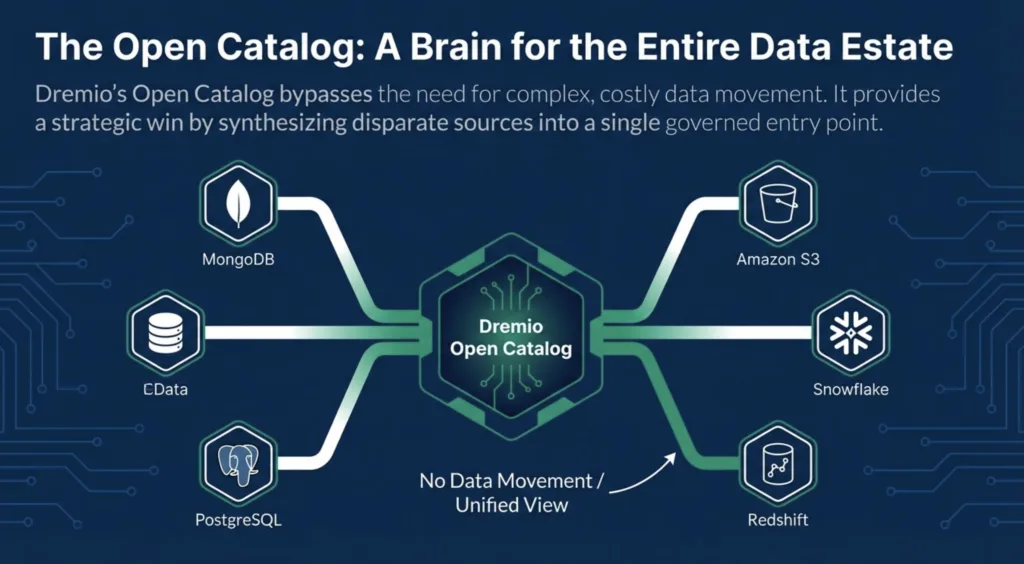
The first is that Dremio's Semantic Layer doesn't just catalog data in the lakehouse; it creates a central understanding across an organization's entire data real estate. This architecture provides a massive strategic win, allowing enterprises to bypass brittle ETL pipelines and eliminate the data silos that drain resources and time. Instead of requiring complex and costly data movement, it provides AI agents a holistic view of all data in place.
This is possible because Dremio’s Open Catalog features a sophisticated hybrid architecture that works by synthesizing Apache Polaris-tracked tables and sql views with federated connectivity. The architectural mapping is precise: one Dremio Organization maps to an Apache Polaris Realm (unit of Apache Polaris multi-tenancy), and one Dremio Project maps to a catalog in that realm. The formula is simple but powerful:
"Federated Sources" include everything from object storage like Amazon S3, to databases like PostgreSQL and MongoDB, and even data warehouses like Snowflake and Redshift. This unification is not just a metadata trick; it’s a high-performance query federation strategy. Dremio intelligently delegates parts of the query to the source system using techniques like predicate pushdowns, ensuring federated queries are as efficient as possible. The result is a single, governed entry point for the entire enterprise, giving AI the complete context it needs.
The Anatomy of the Semantic Layer
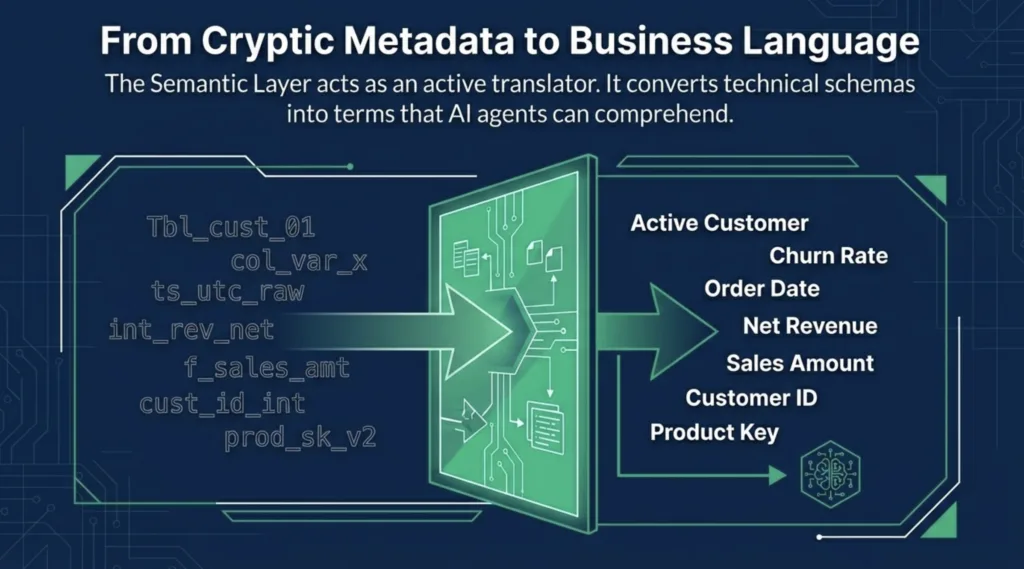
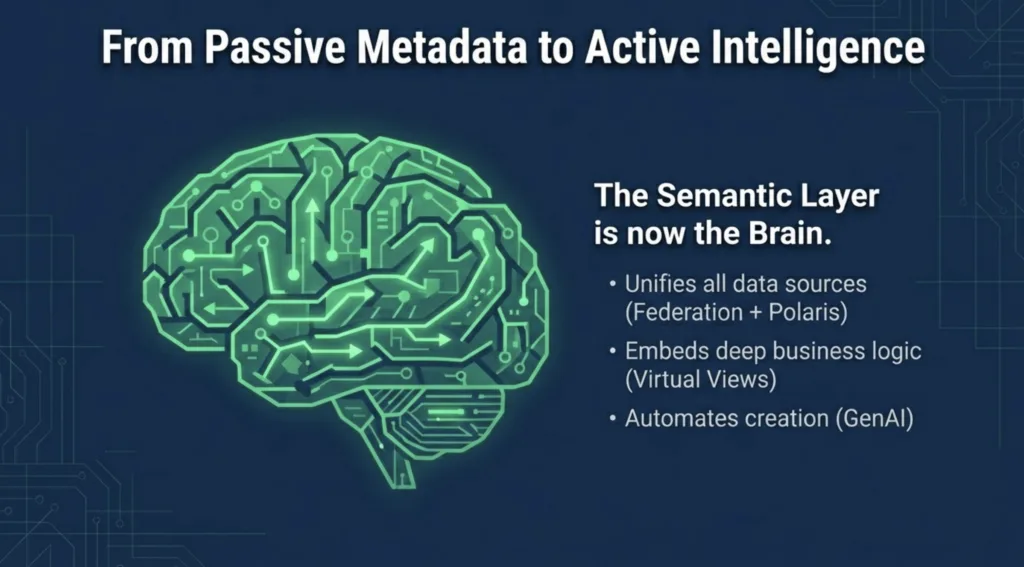
Here is where the magic happens. The Semantic Layer stops being a passive dictionary and becomes an active translator, teaching the AI to speak the unique language of your business. It translates complex technical metadata, like cryptic column names and table structures, into understandable business terms that both humans and AI agents can comprehend.
This is achieved through several key components:
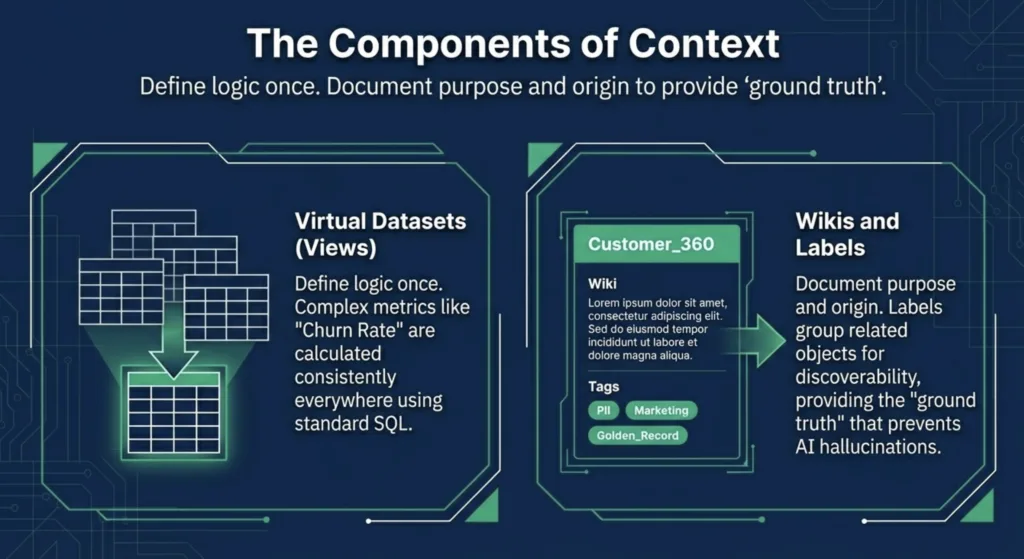
Virtual Datasets (Views): Users can use simple SQL to define business logic, joins, and transformations one time. These virtual datasets can then be reused everywhere, ensuring that complex business metrics like "churn rate" or "active customer" are calculated consistently across all tools and reports.
Wikis and Labels: Users can add Wiki content directly to datasets and columns to document their purpose, origin, and business relevance. They can also apply Labels to group related objects, which provides crucial context and dramatically improves discoverability for both humans and AI.
This rich context is what prevents AI "hallucinations." When a user asks a question in natural language, Dremio's AI Agent leverages these definitions and documentation to accurately understand the user's intent and generate the correct query.
The Self-Documenting Lakehouse
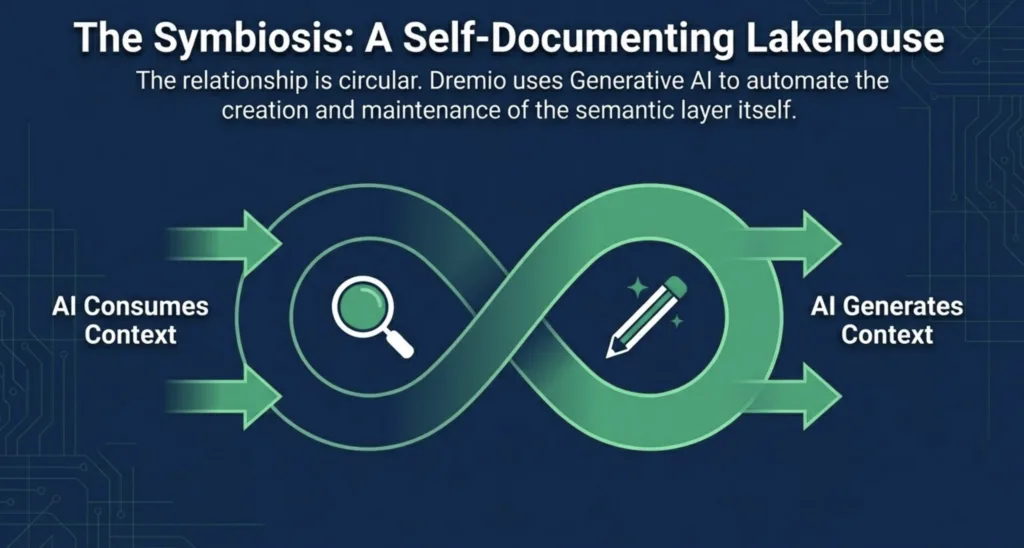
Perhaps the most counter-intuitive takeaway is that the relationship between AI and the semantic layer is symbiotic. Dremio uses generative AI to automate the creation and maintenance of the semantic layer itself, transforming the catalog into a living, self-documenting asset.
This human-AI collaboration works in two primary ways:
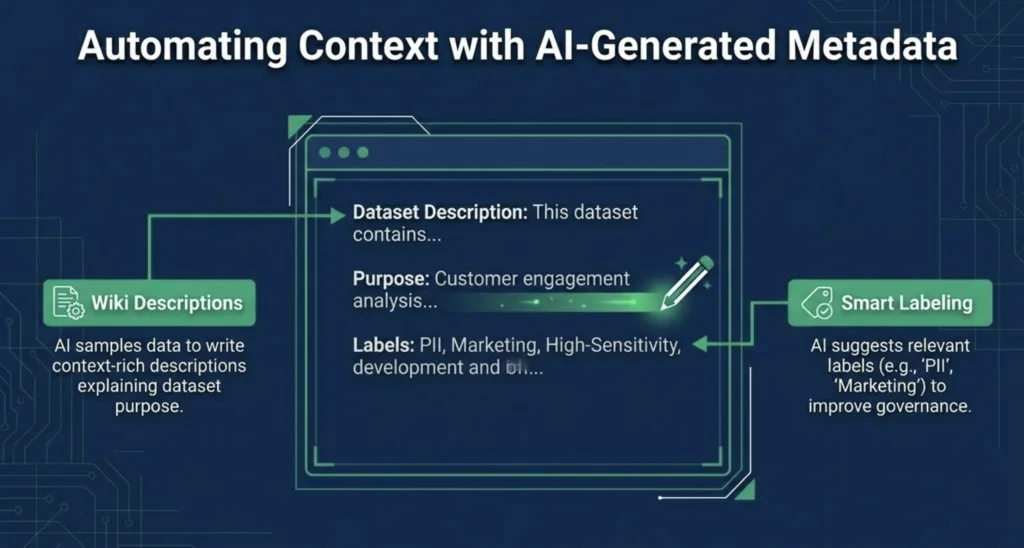
AI-Generated Metadata: By sampling the data within a table, the AI can automatically generate context-rich Wiki descriptions that explain the purpose of the dataset. It can also suggest relevant Labels (e.g., 'PII', 'Marketing') to improve organization and governance.
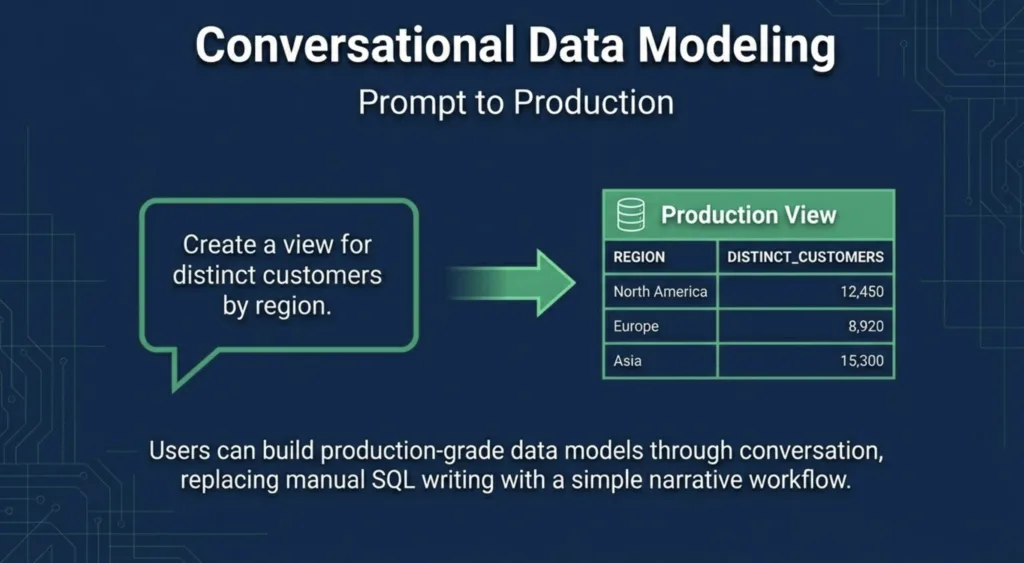
Automated Data Modeling: Instead of manually writing SQL, a user can build a production-grade data model through conversation. This workflow turns a complex engineering task into a simple narrative. A user can prompt the AI Agent to identify raw tables, then conversationally generate the sql to create the virtual views for a full medallion architecture. The conversation might look like this:
Bronze: "Generate SQL for Bronze views of the raw orders and customers tables. Rename cryptic columns to be more readable and cast timestamps to UTC."
Silver: "Now, write the SQL for a Silver view that joins the Bronze views on customer_id and filters out any null revenue."
Gold: "Finally, create a Gold view from the Silver layer that calculates total revenue and average order value, grouped by region and month."
This symbiotic relationship frees data teams from tedious manual documentation and modeling. It allows them to shift from reactive maintenance to proactive value creation, dramatically accelerating an organization's journey to practical agentic analytics.
Conclusion: From Passive Metadata to Active Intelligence
The fundamental shift described here is the evolution of the semantic layer from a passive "phone book" for data into an active, intelligent "brain" for the entire enterprise. This new paradigm provides the "agentic context" essential for AI to work accurately and reliably with your unique business data. By unifying all data sources, embedding deep business logic, and using AI to automate its own creation, this modern semantic layer removes the barriers that once made conversational analytics a distant dream.
Now that your data can finally understand you, what is the first question you will ask?
Ingesting Data Into Apache Iceberg Tables with Dremio: A Unified Path to Iceberg
By unifying data from diverse sources, simplifying data operations, and providing powerful tools for data management, Dremio stands out as a comprehensive solution for modern data needs. Whether you are a data engineer, business analyst, or data scientist, harnessing the combined power of Dremio and Apache Iceberg will undoubtedly be a valuable asset in your data management toolkit.
Oct 12, 2023·Product Insights from the Dremio Blog
Table-Driven Access Policies Using Subqueries
This blog helps you learn about table-driven access policies in Dremio Cloud and Dremio Software v24.1+.
Aug 31, 2023·Dremio Blog: News Highlights
Dremio Arctic is Now Your Data Lakehouse Catalog in Dremio Cloud
Dremio Arctic bring new features to Dremio Cloud, including Apache Iceberg table optimization and Data as Code.