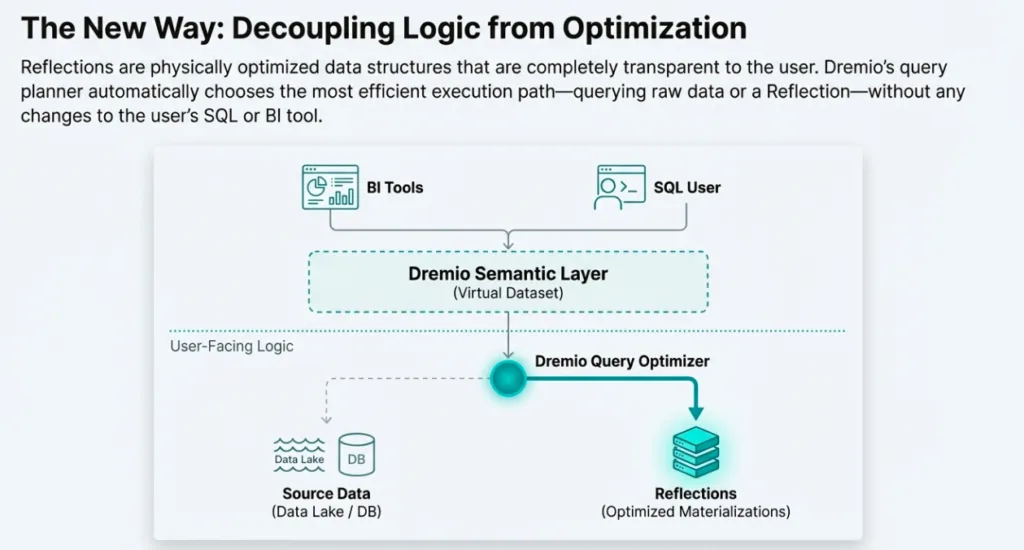
Dremio Reflections provide an advanced alternative to traditional materialized views, automating query acceleration while ensuring data freshness.
They support two primary types: Raw Reflections optimize source data, while Aggregation Reflections pre-calculate summary values for quick queries.
Reflections refresh automatically when source data changes, eliminating the risk of querying stale data and ensuring integrity.
Dremio's Autonomous Reflections simplify management by automatically adjusting to user query patterns, removing the need for manual tuning.
With built-in intelligence, Dremio enhances performance and offers smart recommendations for optimizing reflections without constant oversight.
The demand for fast, interactive query performance is universal. For decades, the go-to solution for accelerating slow queries has been the materialized view, a pre-computed dataset that stores the results of a query. This approach saves the database from performing expensive joins or aggregations on raw data for every single request.
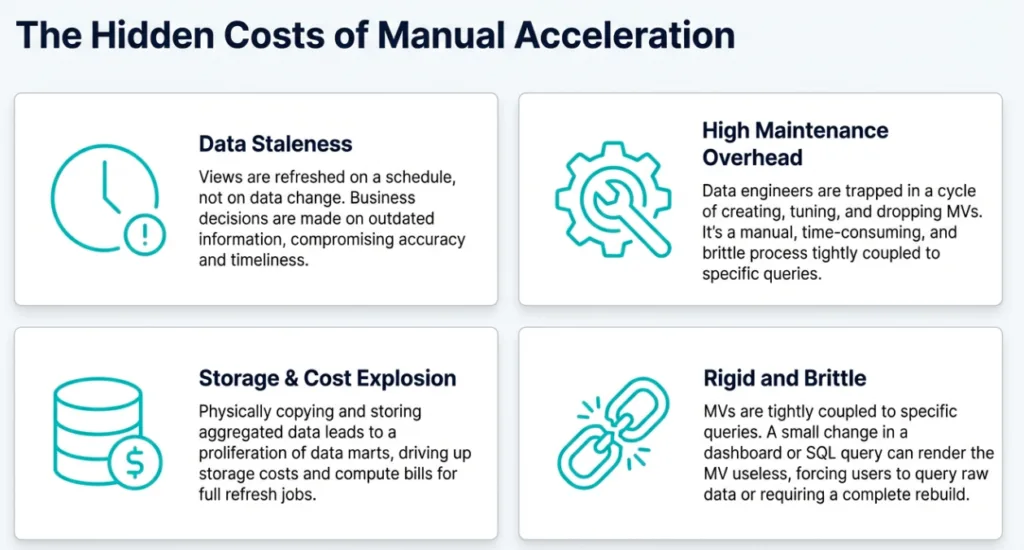
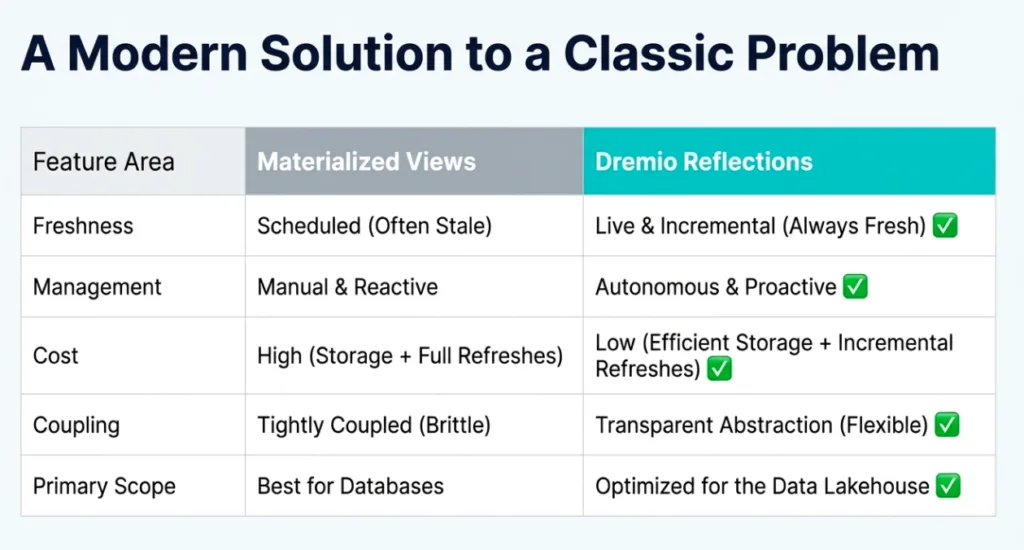
However, traditional materialized views are a double-edged sword, often becoming a constant source of operational anxiety. While they can provide significant speedups, they are brittle and come at a high cost of ownership. Data teams must spend considerable time manually creating, managing, and scheduling refreshes, forcing a painful trade-off between data freshness and management effort. This introduces administrative overhead and creates the risk of queries running on stale data, eroding analytical trust.
Dremio Reflections offer a modern, intelligent, and autonomous alternative that overcomes these traditional challenges. Built for the scale and flexibility of the data lakehouse, Reflections automates the difficult work of query acceleration. Here are five fundamental ways Dremio Reflections render traditional materialized views obsolete.
Try Dremio’s Interactive Demo
Explore this interactive demo and see how Dremio's Intelligent Lakehouse enables Agentic AI
1. The Foundation: Simple, Powerful Raw and Aggregate Reflections
At its core, Dremio provides two fundamental types of manual reflections that users can create to accelerate queries: Raw and Aggregation. These serve as the foundational building blocks for its more advanced acceleration capabilities.
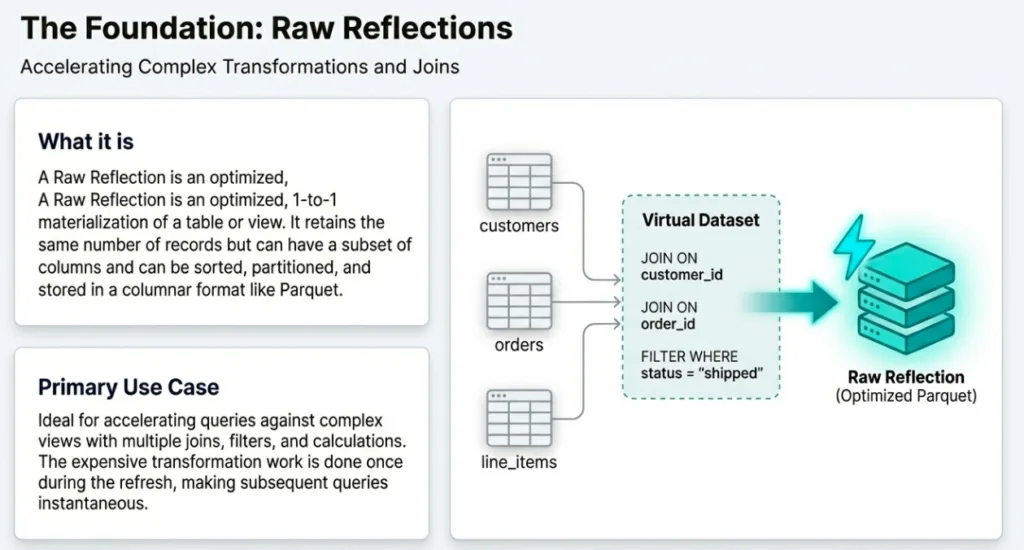
A Raw Reflection is a type of materialization that is an optimized version of the source data, often including specific sort and partition orders to accelerate a wide range of queries. The creation of a Raw Reflection is tracked as a traceable event in the sys.project.history.events system table, providing complete administrative visibility into its lifecycle.
Aggregation Reflections are specifically designed to accelerate queries that involve aggregations like SUM, COUNT, AVG, MIN, and MAX. By pre-calculating these values, Dremio can return results for dashboard queries and summary reports almost instantaneously. Like Raw Reflections, their creation is fully audited in the sys.project.history.events system table.
Starting with these two simple yet powerful primitives gives users direct control over query acceleration when needed. This manual control provides a solid foundation, setting the stage for the more autonomous and intelligent capabilities that truly set Dremio apart. With these foundational building blocks in place, Dremio then solves one of the biggest operational headaches of any materialization strategy: data freshness.
2. Never Query Stale Data: Automatic, Live Refreshes
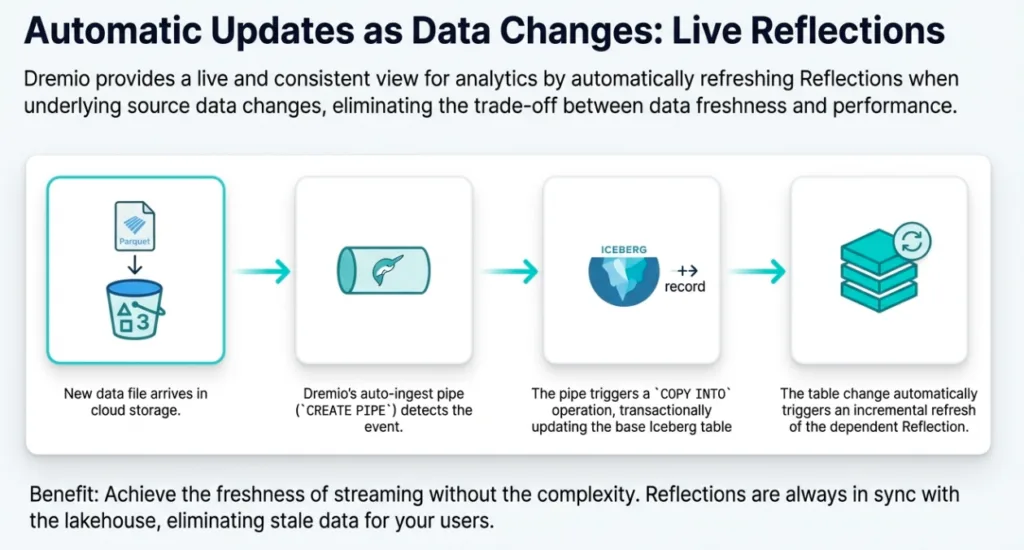
One of the most significant pain points of traditional materialization strategies is the analytical risk and eroded trust caused by querying stale data. The burden of scheduling and managing refresh jobs often leads to queries running against outdated materializations, producing incorrect analytics. Dremio eliminates this problem with an automatic, "live" refresh mechanism.
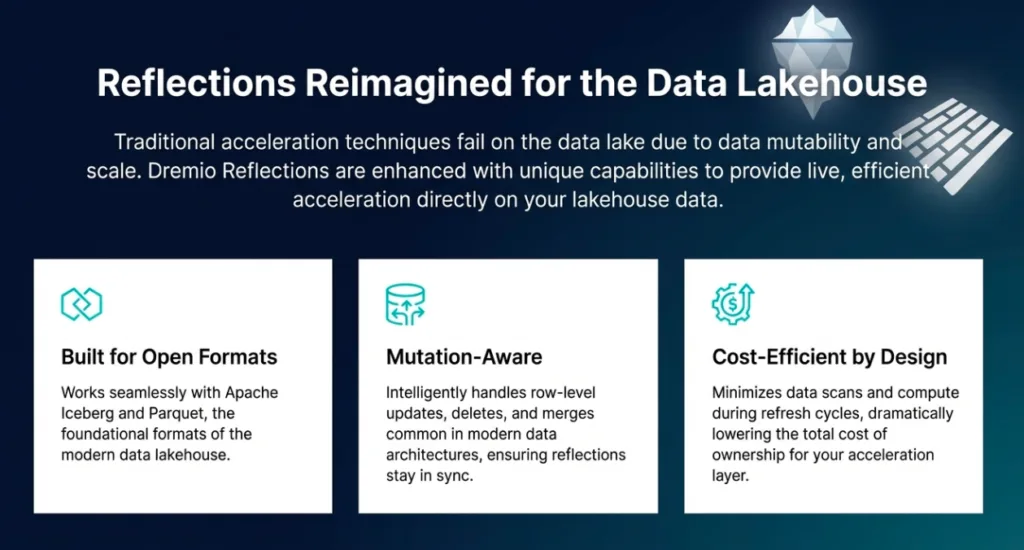
Reflections built on modern data lake table formats are designed to stay fresh automatically whenever the source data changes. This behavior ensures that the materialization is always in sync with the underlying data without requiring manual intervention or complex scheduling.
The specific refresh triggers depend on the underlying data format:
For Iceberg Tables: Reflections refresh automatically when the table is modified, whether by Dremio or another engine. Dremio polls tables for changes every 10 seconds.
For Parquet Datasets: Reflections refresh automatically when the dataset's metadata is updated in Dremio.
This automatic behavior guarantees that queries are always accelerated using the most recent data available. If a Reflection has not yet been refreshed, Dremio's query planner will seamlessly fall back to the raw data source, ensuring query correctness is never compromised. This isn't just an automatic refresh; it's a guarantee of data integrity for every accelerated query, making 'stale data' a relic of the past.
3. Work Smarter, Not Harder: Efficient Incremental Refreshes
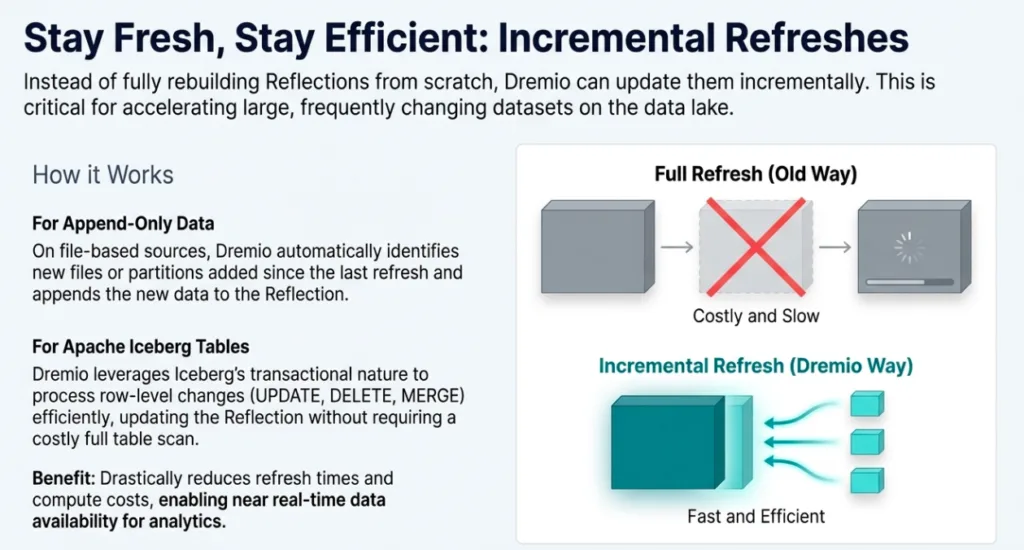
Traditional materializations often rely on a complete refresh, a brute-force approach in which the entire pre-computed table is dropped and rebuilt from scratch. This is computationally expensive and time-consuming. Dremio takes a much more efficient approach with incremental refreshes.
For Reflections built on Apache Iceberg tables and Parquet datasets, Dremio can perform an incremental refresh. This process is far more intelligent and resource-friendly than a complete rebuild.
The Dremio engine intelligently inspects partition metadata to identify exactly which data has changed, allowing it to restrict the refresh to only those modified partitions.
This surgical approach to refresh makes it economically feasible to accelerate petabyte-scale datasets. This task would be prohibitively expensive and slow using the brute-force full refreshes of traditional systems. While live and incremental refreshes deliver massive efficiency gains, Dremio's ultimate advantage lies in eliminating the need for an administrator to manage this process.
4. The Ultimate Upgrade: Autonomous Reflections
The most significant leap beyond traditional materialized views is Dremio's Autonomous Reflections. This feature shifts the responsibility for performance tuning from the data administrator to the Dremio engine itself, freeing data teams from the endless cycle of manual tuning.
With Autonomous Reflections enabled, Dremio automatically learns from user query patterns over the last seven days. Based on this analysis, the engine intelligently creates, manages, and drops Reflections on its own to optimize performance where it is needed most.
Learn how Dremio automatically learns your query patterns and manages Reflections to optimize performance accordingly. This capability is available for Iceberg tables, UniForm tables, Parquet datasets, and any views built on these datasets.
Users can enable this powerful feature in their project preferences. Once active, Dremio automatically provisions a dedicated Small internal refresh engine for Autonomous Reflection jobs. To optimize costs and resource usage, this engine automatically shuts down after just 30 seconds of idle time. This autonomous capability frees up data teams from the tedious cycle of performance monitoring and manual tuning, allowing them to focus on analysis rather than infrastructure management.
5. Built-in Intelligence: Smart Matching and Recommendations
Dremio’s intelligence extends beyond just creating Reflections; it also excels at using them. The query planner is smart enough to leverage a Reflection even when a query is not an exact match. For example, in the case of non-duplicating joins, Dremio can accelerate a query that references only some of the joins present in a Reflection, eliminating the need to create dozens of materializations for every possible table combination.
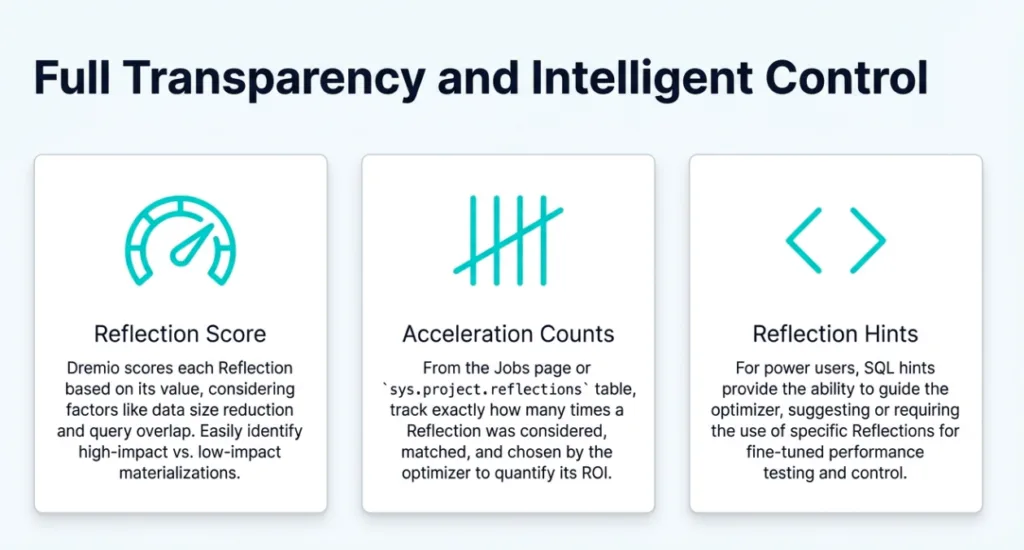
When a query is run, the relationship between the query job and any potential Reflections is categorized, giving users insight into the planner's decisions:
CONSIDERED: The Reflection was defined on a dataset used in the query but was not chosen because it didn't cover a required field.
MATCHED: The Reflection could have been used to accelerate the query, but Dremio determined that it would provide no benefit or that another Reflection was a better choice.
CHOSEN: The Reflection was actively used to accelerate the query.
This intelligence operates on a spectrum: for ultimate hands-off management, it drives Autonomous Reflections. When manual control is preferred, the same intelligence surfaces its findings as actionable, prioritized recommendations. The system generates suggestions to add or remove Reflections based on query patterns, sorted by overall effectiveness, considering metrics like the estimated number of accelerated jobs and the potential time saved. This ensures the system continually optimizes performance, whether through fully autonomous management or by providing clear, data-driven recommendations to the user.
Conclusion: Stop Managing, Start Analyzing
Dremio Reflections don't just accelerate queries; they accelerate the entire analytics lifecycle by removing performance tuning from the critical path. By reclaiming the time and cognitive overhead traditionally spent on manual materialization management, Reflections empower data teams to shift their focus from infrastructure management to insight delivery. The combination of automatic freshness, efficient incremental updates, and autonomous, learning-based management creates a system that is always on, always fresh, and always fast, without the constant manual intervention.
If your current query acceleration strategy requires constant manual tuning and guesswork, isn't it time to adopt a system that thinks for you?
Ingesting Data Into Apache Iceberg Tables with Dremio: A Unified Path to Iceberg
By unifying data from diverse sources, simplifying data operations, and providing powerful tools for data management, Dremio stands out as a comprehensive solution for modern data needs. Whether you are a data engineer, business analyst, or data scientist, harnessing the combined power of Dremio and Apache Iceberg will undoubtedly be a valuable asset in your data management toolkit.
Oct 12, 2023·Product Insights from the Dremio Blog
Table-Driven Access Policies Using Subqueries
This blog helps you learn about table-driven access policies in Dremio Cloud and Dremio Software v24.1+.
Aug 31, 2023·Dremio Blog: News Highlights
Dremio Arctic is Now Your Data Lakehouse Catalog in Dremio Cloud
Dremio Arctic bring new features to Dremio Cloud, including Apache Iceberg table optimization and Data as Code.