The Apache Iceberg data lakehouse simplifies data management but often requires complex integration efforts.
Dremio offers an integrated platform that bundles essential components for a complete Iceberg lakehouse experience.
It automates Iceberg table management, improving performance and reducing the need for manual maintenance.
Dremio's semantic layer transforms raw data into usable products, making it accessible to business users.
Its built-in AI Agent allows users to query data using natural language, democratizing data access and ensuring security.
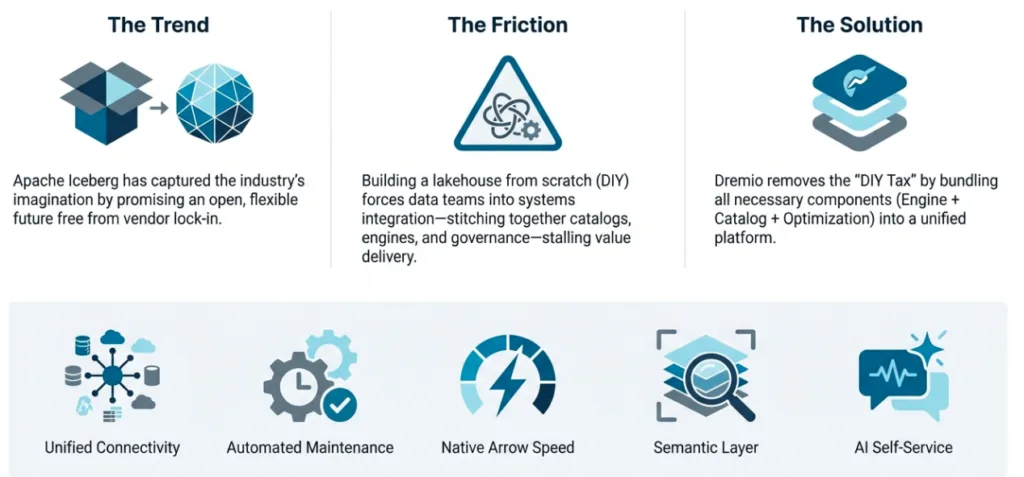
The Apache Iceberg data lakehouse has captured the industry's imagination, and for good reason. It promises an open, flexible future where you aren't locked into a single vendor's ecosystem. But there’s a significant gap between that promise and the reality of implementation.
Building a production-grade lakehouse from scratch is a massive undertaking. Data teams often find themselves in the business of systems integration, manually stitching together a complex puzzle of open-source components. You need a catalog for metadata, a query engine for execution, optimization services to keep it fast, and governance tools to keep it secure. This DIY approach can delay value and drain resources.
Dremio offers a different path. It's an integrated platform that bundles all necessary components into a cohesive, high-performance lakehouse. It simplifies the journey, removing the operational headaches so your team can focus on delivering insights.
Here are five impactful ways Dremio delivers a complete Iceberg lakehouse experience, right out of the box
Try Dremio’s Interactive Demo
Explore this interactive demo and see how Dremio's Intelligent Lakehouse enables Agentic AI
1. It's a Unified Engine, Not Just a Catalog
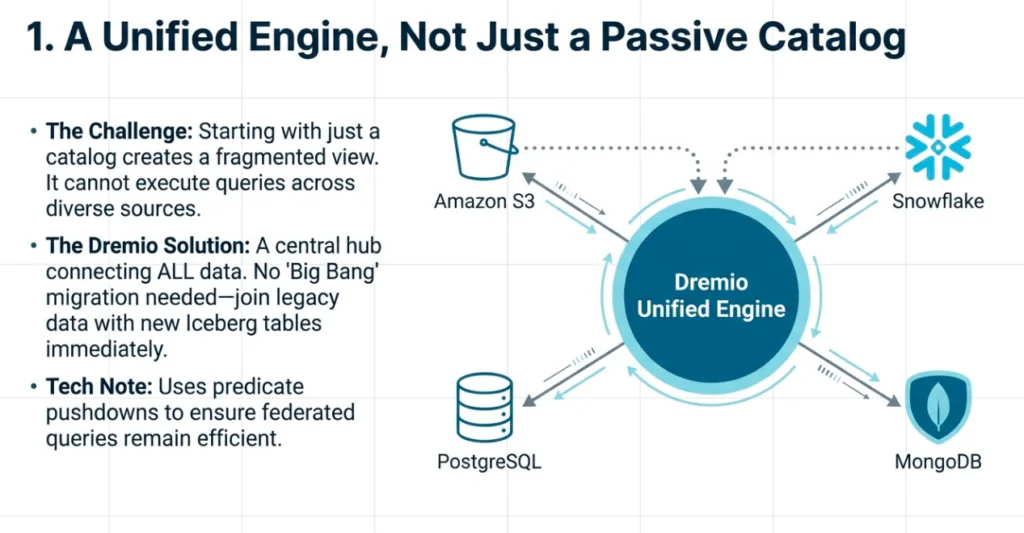
A common tactical misstep when building an Iceberg lakehouse is starting with just a catalog, which is only one piece of the puzzle. Dremio is a complete, high-performance query engine that acts as a central hub for all your data, wherever it lives.
Unlike standalone catalogs, Dremio can connect to and query a vast array of existing data sources. This includes object storage such as Amazon S3, relational and NoSQL databases such as PostgreSQL and MongoDB, and even traditional data warehouses such as Snowflake and Redshift.
This provides a strategic on-ramp for adoption. You can begin building your Iceberg lakehouse without a disruptive "big bang" migration. Your analysts and data scientists can immediately join data from legacy systems with new Iceberg tables, providing a smooth, incremental path to a modern data architecture. To boost performance, Dremio intelligently delegates parts of the query to the source system using techniques like predicate pushdowns, ensuring federated queries are as efficient as possible.
2. Iceberg Table Management is on Autopilot
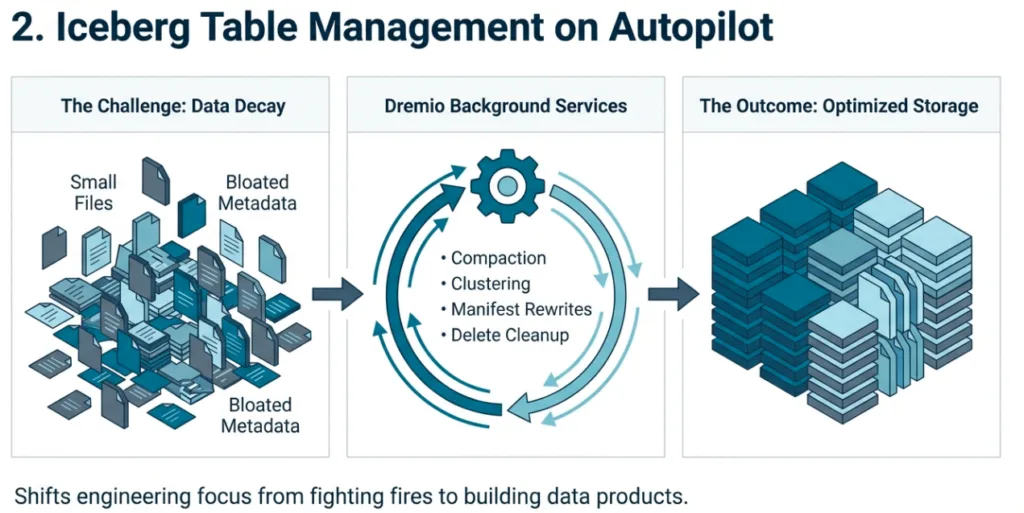
An Iceberg lakehouse isn't a "set it and forget it" system. As new data is ingested and updated, tables can accumulate thousands of small files and bloated metadata, which quickly degrades query performance. Managing this requires constant maintenance.
Dremio automates this entire process for Iceberg tables managed by its Open Catalog. The platform runs background maintenance jobs that optimize table structure for speed. This process compacts small files into larger ones, clusters related data, rewrites manifest files for faster metadata reads, and removes obsolete position-delete files.
This transforms the data engineering function from reactive maintenance to proactive value creation. Instead of fighting fires and performing manual tuning, your team can focus on building new data products. This automation not only improves query speed but also reduces storage costs, all without any manual intervention.
3. Your Queries Get a Serious Speed Boost, Automatically
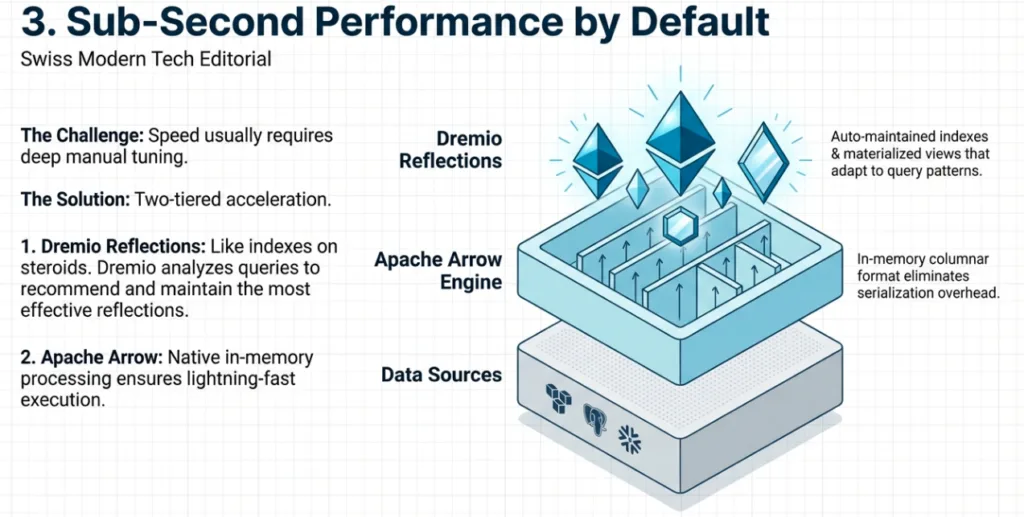
Sub-second query performance is the goal for any analytics platform, but achieving it often requires deep expertise. Dremio’s multi-layered approach to acceleration makes high performance the default, not the exception.
The primary technology here is Dremio Reflections, physically optimized copies of your data, like indexes or materialized views on steroids, that Dremio maintains automatically. As users run queries, Dremio analyzes query patterns and provides recommendations for creating the most effective Reflections. Performance improves over time, adapting to your specific workloads without manual tuning.
Under the hood, Dremio’s performance is supercharged by Apache Arrow, the open-source columnar data format that Dremio co-created. In most data stacks, moving data between systems requires costly serialization and deserialization, a massive performance bottleneck. Because Dremio uses Arrow as its native in-memory format, it eliminates this overhead entirely, ensuring lightning-fast processing both within Dremio and across federated sources.
4. A Semantic Layer Turns Raw Data Into Usable Data Products
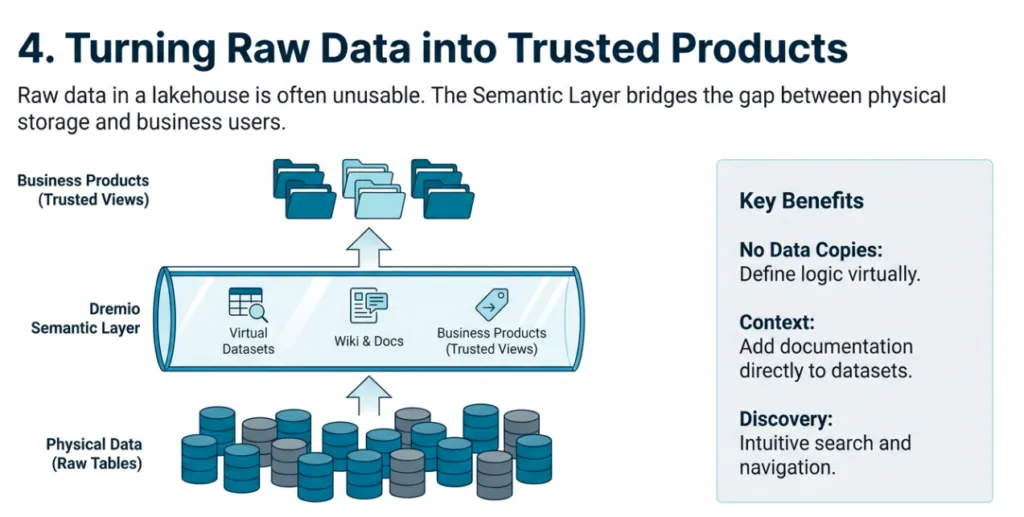
That ability to query any in-place source becomes truly transformative when you add Dremio's built-in semantic layer. Raw data sitting in a lakehouse isn’t valuable until business users can easily find, understand, and trust it. A semantic layer bridges this gap.
Using simple SQL, users can create virtual datasets (Views) that transform, join, and aggregate data without creating physical copies. This allows you to define business logic once and reuse it everywhere, ensuring consistency across all tools and reports.
To further enrich the data, you can create Wiki content to document datasets and columns, providing crucial context for analysts. You can also apply Labels to group related objects together, making data discovery intuitive. This integrated approach turns your lakehouse from a simple storage location into a well-organized, trusted source for analytics.
5. You Can Talk to Your Data in Plain English
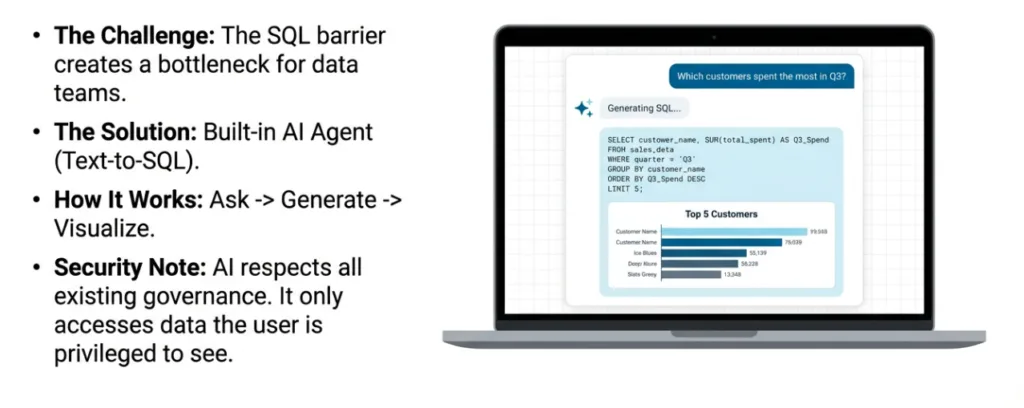
Perhaps the most surprising feature is Dremio’s built-in AI Agent, which delivers a truly conversational analytics experience. This interface allows any user, regardless of technical skill, to ask questions of their data using natural language.
A business user can ask, "Which customers have spent the most with us?" and the AI Agent will generate the necessary SQL, execute it against the data, and return the answer. It can go even further, detecting patterns in the result set and automatically creating visualizations to highlight key insights.
This powerful feature finally delivers on the promise of self-service analytics. Crucially, the AI doesn't bypass security; it only accesses data and entities that the logged-in user has privileges for, respecting your governance policies. It democratizes data access by removing the SQL barrier, empowering stakeholders to get answers instantly.
Conclusion: Beyond the Hype, a Practical Path to the Lakehouse
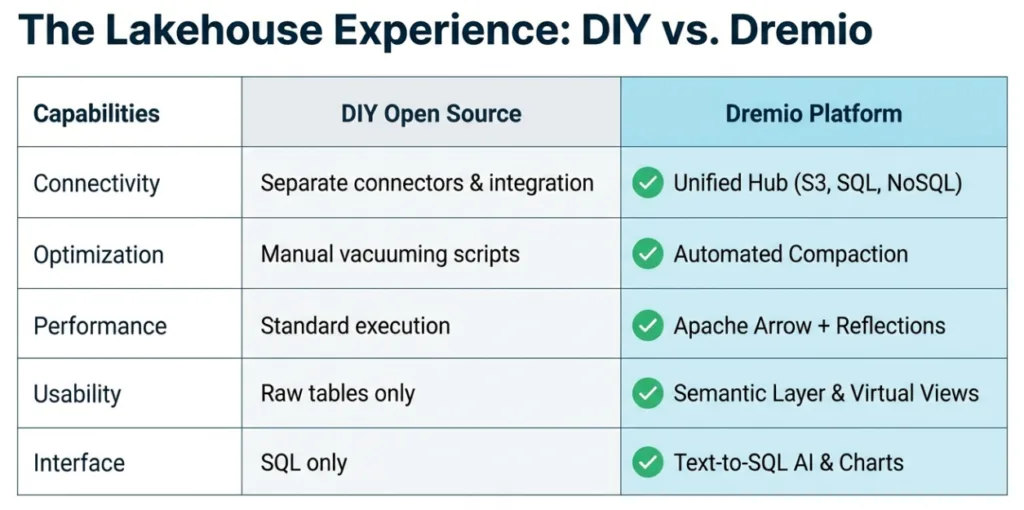
The true value of Dremio isn't just one feature, but its integrated, "all-in-one" platform. This approach contrasts sharply with the DIY method, which often results in a lakehouse that is perpetually a work-in-progress, stitched together with technical debt. Dremio provides a lakehouse that delivers insights from day one. It provides the catalog, the query engine, automated optimization, the semantic layer, and the self-service tools needed for a complete, enterprise-grade solution.
This shifts the focus from building infrastructure to building value. So, it's worth asking: If building a data lakehouse didn't require a team of specialists to glue together a dozen different tools, what could your data team accomplish?
Ingesting Data Into Apache Iceberg Tables with Dremio: A Unified Path to Iceberg
By unifying data from diverse sources, simplifying data operations, and providing powerful tools for data management, Dremio stands out as a comprehensive solution for modern data needs. Whether you are a data engineer, business analyst, or data scientist, harnessing the combined power of Dremio and Apache Iceberg will undoubtedly be a valuable asset in your data management toolkit.
Oct 12, 2023·Product Insights from the Dremio Blog
Table-Driven Access Policies Using Subqueries
This blog helps you learn about table-driven access policies in Dremio Cloud and Dremio Software v24.1+.
Aug 31, 2023·Dremio Blog: News Highlights
Dremio Arctic is Now Your Data Lakehouse Catalog in Dremio Cloud
Dremio Arctic bring new features to Dremio Cloud, including Apache Iceberg table optimization and Data as Code.