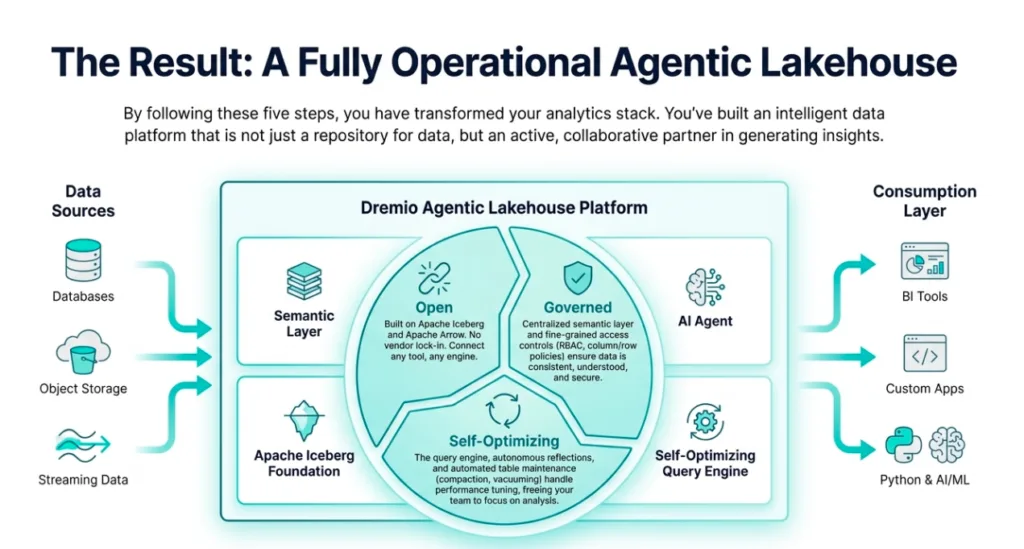
Dremio eliminates analytics bottlenecks by providing a high-performance semantic layer over your data.
With Dremio, you can connect diverse data sources effortlessly and use plain English for queries through the AI Agent.
Adopting Apache Iceberg in your lakehouse enhances performance and reduces costs, using features like Autonomous Reflections and partition pruning.
Curating a semantic layer organizes data and builds trusted products, allowing the AI to respond accurately to natural language queries.
Dremio empowers a culture of curiosity, enabling anyone to explore data without needing to be a data engineer.
The answer to your most critical business question is likely sitting somewhere in your data. The problem? That data is spread across a dozen different systems, from object stores and databases to third-party applications. Getting a straight answer often requires complex ETL pipelines, data copies, and specialized technical skills, creating a frustrating "analytics bottleneck" that slows business down.
Dremio is designed to shatter that bottleneck by creating a seamless, high-performance semantic layer over your entire data estate. What if you could skip the complex setup and start asking your data questions in plain English, right now? Let's walk through how Dremio's AI-powered lakehouse makes that possible in five simple steps.
Try Dremio’s Interactive Demo
Explore this interactive demo and see how Dremio's Intelligent Lakehouse enables Agentic AI
1. Step Zero: Your Lakehouse is Ready Before You Are
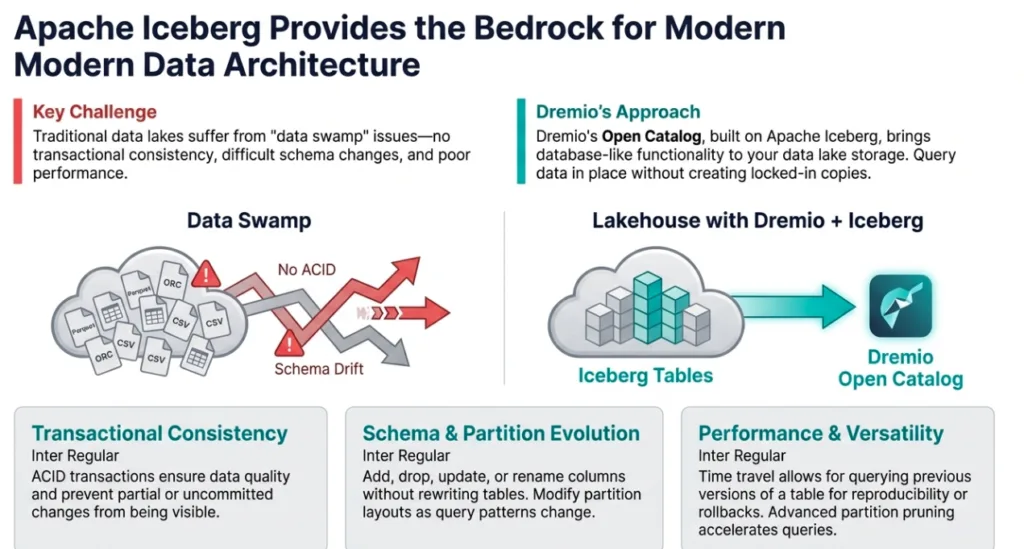
The journey to data-driven insights often begins with a lengthy and complex infrastructure setup. With Dremio, that entire process is handled for you. Your first lakehouse project is created automatically the moment you sign up, complete with a powerful, pre-configured Open Catalog for Apache Iceberg.
Crucially, this isn't just a basic catalog; it's an enterprise-grade, open-standard foundation for your data. It provides features like automatic table maintenance and, most importantly, multi-engine compatibility via the Iceberg REST API. This commitment to open standards prevents lock-in and ensures your data remains accessible to other tools like Spark and Flink. This "instant-on" approach means your foundation for high-performance, open analytics is in place before you even connect your first data source.
2. Connect Everything, Question Anything
With your lakehouse ready, the next step is to connect your data, wherever it lives. Dremio can immediately connect to a diverse array of sources, from object stores like Amazon S3 and Azure Storage to databases like Google BigQuery and PostgreSQL, and many more. Once a source is connected, there's no waiting period or complex integration required to start deriving value.
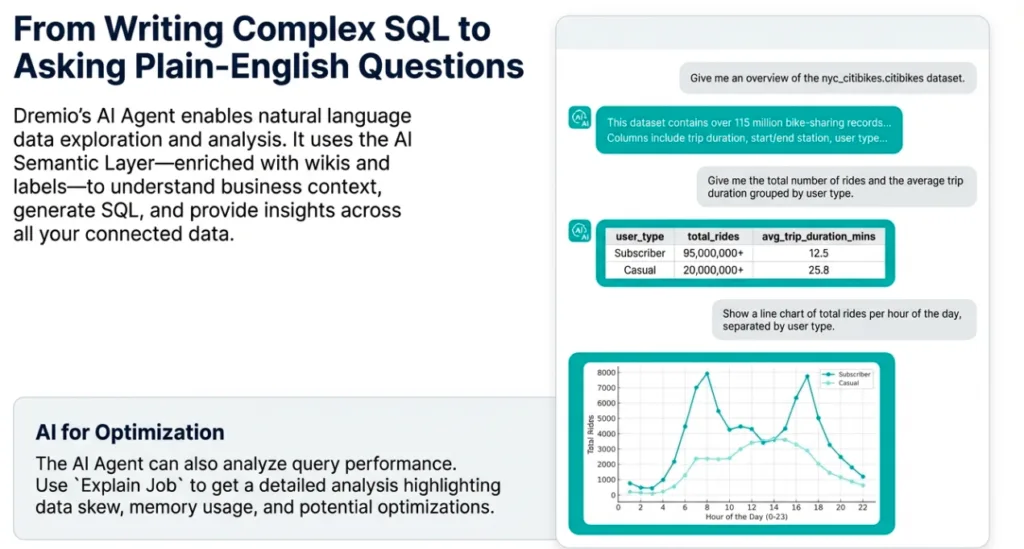
You can immediately use Dremio's AI Agent for natural language queries and data exploration. Simply ask a question in plain English, and the AI will find the relevant data and provide an answer. For example, a user could start exploring a dataset with a simple prompt:
"Give me an overview of the nyc_citibikes.citibikes dataset"
This powerful capability isn't limited to a small, pre-processed subset of your information. It works across your entire connected data estate, allowing you to ask questions of all your data from a single, unified interface.
3. Unlock Next-Level Performance and Savings with Apache Iceberg
While Dremio's AI Agent works with any connected source, adopting the Apache Iceberg table format within your lakehouse significantly accelerates query performance and cost efficiency. Dremio's Open Catalog is built for Iceberg and enables powerful features like automatic table maintenance, including compaction and vacuuming, to keep your data optimized.
For performance, Dremio’s Autonomous Reflections automatically create and manage data materializations that optimize queries on Iceberg tables, UniForm tables, Parquet datasets, and any views built on these datasets. You can monitor their impact through metrics that show the "Total jobs accelerated, total job time saved, and average job speedup from Autonomous Reflections."
The cost-saving benefits are just as significant. If you use your own object storage bucket, such as Amazon S3, as the catalog store for your project, Dremio's "storage fees do not apply." Furthermore, by partitioning Iceberg tables, Dremio can employ partition pruning. This is a query optimization technique in which Dremio intelligently reads only the folders, or "partitions," of data required to answer a question, bypassing irrelevant data entirely. For instance, in a dataset partitioned by country, a query on global data can be optimized to "scan only the US and UK directories, significantly reducing the amount of data that is scanned," which directly translates to lower compute costs and faster results.
4. A Smarter Semantic Layer Creates a Genius AI
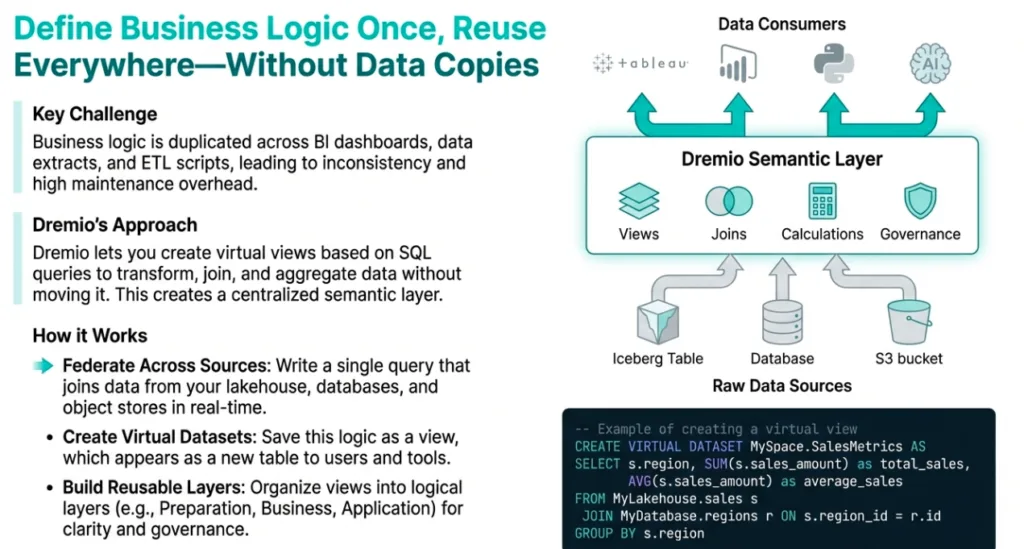
The real magic happens when you begin to curate Dremio's semantic layer. By organizing your data and adding business context, you are not just labeling columns; you are building trusted, discoverable data products that the entire organization, including the AI, can consume.
Layering views achieve this. A common best practice is to have a "preparation layer," where views map one-to-one with source tables, and a "business layer," where joins occur to provide a holistic view. To enrich this layer, you can use Dremio's wiki and label functionalities to add descriptions and context. Better yet, Dremio's Generative AI can automatically generate these wikis and labels based on the data's schema and content.
This rich semantic layer also provides a visual data lineage graph, allowing users to understand a data product's origin and transformations, ensuring trust and transparency. The AI Agent then leverages this entire ecosystem, using capabilities like "semantic search" to find the most relevant data products for a user's natural language query, ensuring you're always working with the correct information.
5. The Flywheel Effect: Immediate Value, Infinite Improvement
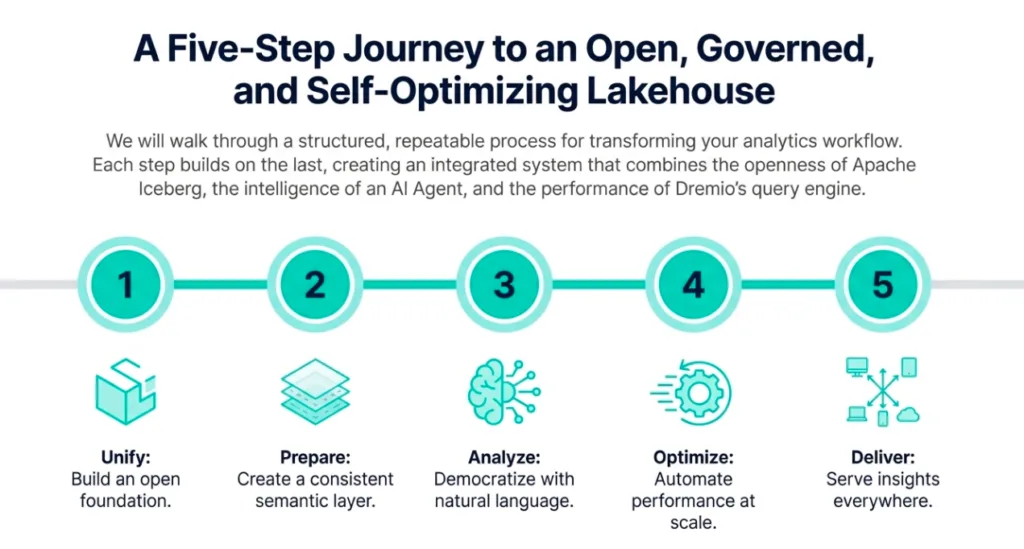
The core message is simple: Dremio provides immediate value with agentic analytics, and this value grows in a virtuous cycle as you further embrace the platform. The journey is a flywheel of continuous improvement:
Sign up for an instant lakehouse with a ready-to-use, open Iceberg catalog.
Connect your data and start asking questions immediately with the AI Agent.
Adopt Iceberg to accelerate performance and reduce costs with features like Autonomous Reflections and partition pruning.
Curate the semantic layer by building data products with views, wikis, and labels, making the AI smarter and more accurate with every addition.
This cycle transforms how organizations interact with their data, collapsing the time from question to insight. It empowers a cultural shift towards data self-service, breaking down the traditional divide between data engineers and data consumers. As the platform itself states:
"Discovery, exploration, and analysis that could previously take hours can now be done in minutes with Dremio's AI Agent."
Conclusion: What Will You Ask?
The traditional barriers between complex, distributed data and clear, actionable answers have been removed. With an intelligent, AI-native data lakehouse, you no longer need to be a data engineer to explore your data; you just need to be curious.
This isn't just about faster queries; it's about fostering a culture of curiosity and enabling anyone in your organization to test a hypothesis or explore an idea at the speed of thought. The true power lies not in the answers you get, but in the new, more ambitious questions you'll be empowered to ask.
If you could ask your entire data estate one question today, what would it be?
Try Dremio Cloud free for 30 days
Deploy agentic analytics directly on Apache Iceberg data with no pipelines and no added overhead.
Ingesting Data Into Apache Iceberg Tables with Dremio: A Unified Path to Iceberg
By unifying data from diverse sources, simplifying data operations, and providing powerful tools for data management, Dremio stands out as a comprehensive solution for modern data needs. Whether you are a data engineer, business analyst, or data scientist, harnessing the combined power of Dremio and Apache Iceberg will undoubtedly be a valuable asset in your data management toolkit.
Oct 12, 2023·Product Insights from the Dremio Blog
Table-Driven Access Policies Using Subqueries
This blog helps you learn about table-driven access policies in Dremio Cloud and Dremio Software v24.1+.
Aug 31, 2023·Dremio Blog: News Highlights
Dremio Arctic is Now Your Data Lakehouse Catalog in Dremio Cloud
Dremio Arctic bring new features to Dremio Cloud, including Apache Iceberg table optimization and Data as Code.