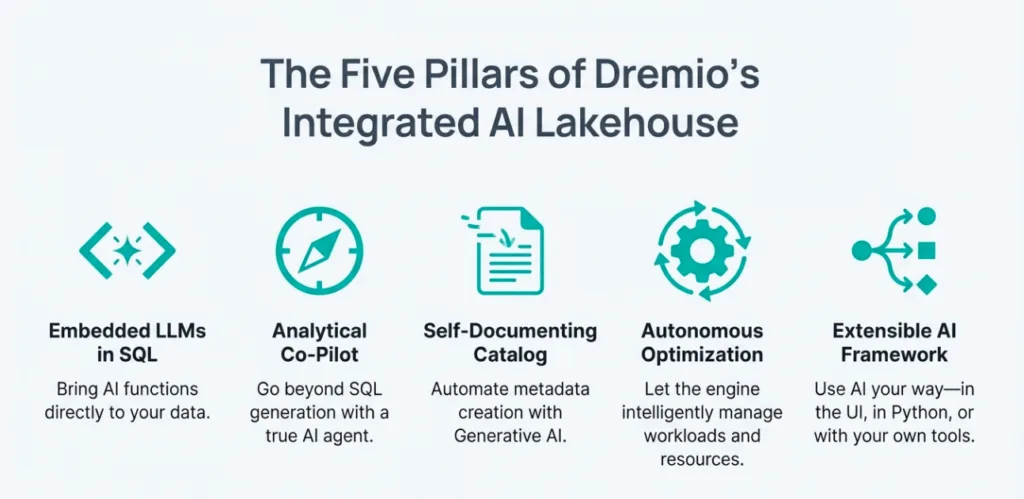
Dremio integrates AI deeply into its platform, transforming data interaction beyond simple query generation.
Key features include LLM capabilities in SQL, an AI Agent for data analysis, AI-generated metadata, and autonomous resource optimization.
Users can interact with AI through the UI or programmatically via Python, making it accessible for all data personas.
These AI features automate tedious tasks, enhance data exploration, and optimize performance, laying the groundwork for a smarter data stack.
Dremio's approach illustrates how integrated AI can alleviate manual tasks, empowering data teams to focus on meaningful work.
It's impossible to have a conversation about data platforms today without AI coming up. The hype is real, and the promise of generative AI is transforming how we think about data interaction. While much of the initial focus has been on natural language-to-SQL chatbots, this is only scratching the surface of what’s possible.
The most valuable AI isn't a standalone feature; it's deeply integrated into the fabric of a platform, solving the tedious, time-consuming, and complex problems that data teams face every day. It's about making the entire data lifecycle smarter, faster, and more efficient. Dremio is a platform that embeds AI in these practical, high-impact ways.
This article explores five of the most impactful AI and autonomous features offered by Dremio. These capabilities go far beyond basic query generation, providing intelligent assistance for everything from data enrichment and exploration to performance optimization and documentation.
Try Dremio’s Interactive Demo
Explore this interactive demo and see how Dremio's Intelligent Lakehouse enables Agentic AI
1. Bring the Power of LLMs Directly into Your SQL Editor
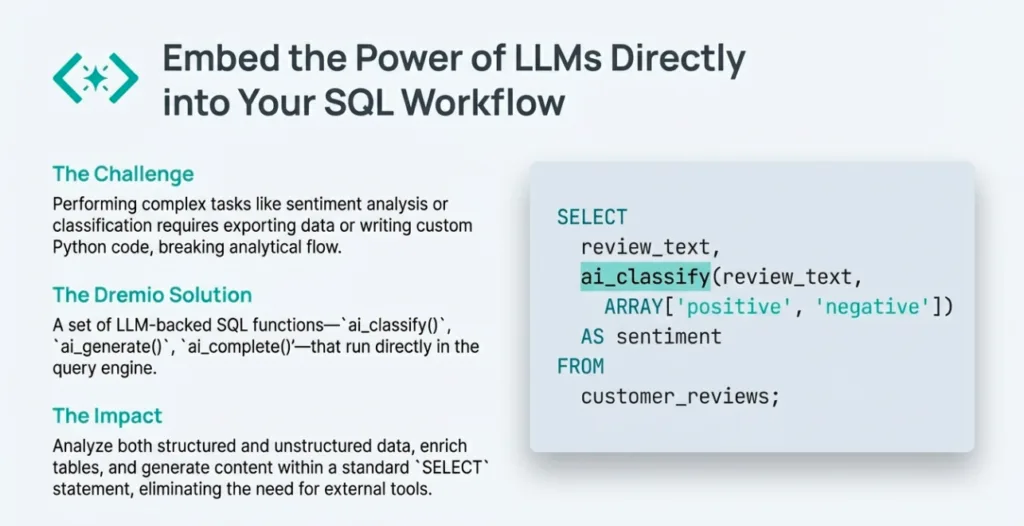
One of the most direct ways to leverage AI is to bring it into the tools you already use. Dremio does this by embedding Large Language Model (LLM) capabilities directly into its SQL engine through a set of powerful AI Functions.
These are not standard SQL functions; they are LLM-backed functions that can be called within any query. The key functions include ai_classify(), ai_generate(), and ai_complete(), allowing you to perform sophisticated tasks on both structured and unstructured data from the comfort of the SQL editor. Imagine running sentiment analysis on customer review text or classifying product descriptions, all within a standard SELECT statement, without writing a single line of Python or exporting data.
By integrating these capabilities directly into SQL, Dremio enables users to perform complex AI tasks such as classification and content generation within their existing workflows, eliminating the need for external tools or complex integrations while expanding data processing beyond traditional structured data.
2. Go Beyond SQL Generation with an Integrated AI Agent
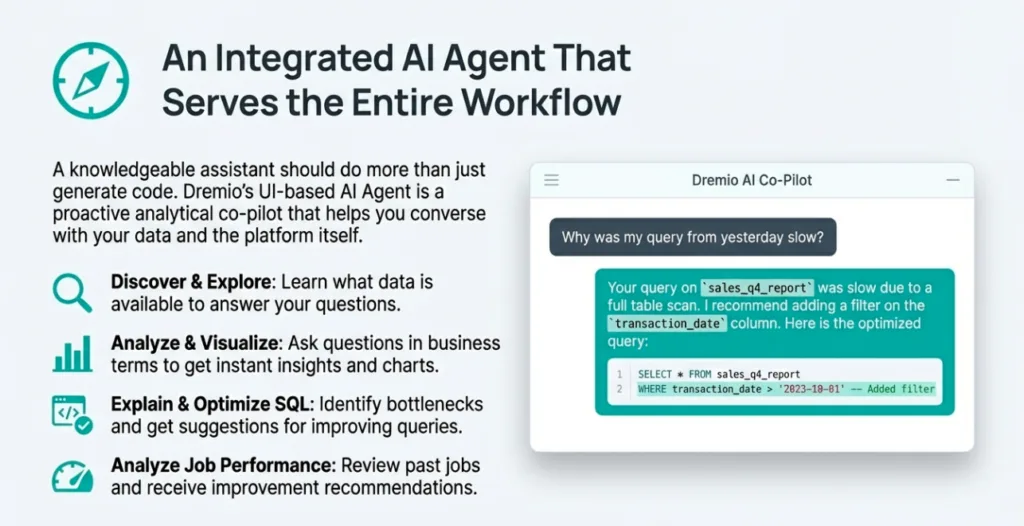
While generating SQL from natural language is useful, a knowledgeable assistant should do more. Dremio’s UI-based AI Agent is designed to be a proactive analytical co-pilot, allowing users to converse with their data and the platform itself. It goes beyond fundamental analysis to detect patterns in the data and return actionable insights, shortening the path from question to insight.
The AI Agent becomes a comprehensive assistant for the entire analytical workflow. Specifically, it can help you:
Discover and Explore: Learn about the data that is available to you to answer your business questions.
Analyze: Ask questions in plain business terms to get instant insights and detect patterns in your data.
Visualize: Quickly create charts to visualize patterns and trends directly within the Dremio console.
Explain and Optimize SQL: Ask the agent to review existing SQL queries, identify bottlenecks, and suggest optimizations.
Analyze and Improve Job Performance: Have the agent review past jobs, identify performance issues, and suggest improvements.
This integrated approach makes the AI Agent more than a code generator; it becomes an intelligent partner that helps users explore data, refine queries, and understand system performance, all through a simple conversational interface.
3. Let the Lakehouse Document Itself with AI-Generated Metadata
Data documentation is critical for governance and discoverability, but it's a manual, tedious task that often falls behind. Dremio addresses this challenge by using Generative AI to automate the creation of essential metadata in its AI Semantic Layer, allowing your data catalog to practically document itself.
By understanding the schema and sampling the data within a dataset, Dremio’s AI can automatically generate clear, context-rich descriptions (wikis) for your tables and views. This helps users quickly understand the purpose and content of a dataset without having to hunt down a subject matter expert. The AI can also suggest relevant tags (labels) for datasets, further improving organization and searchability.
This transforms the data catalog from a passive repository into a living, self-documenting asset. It dramatically reduces the manual effort required from data teams and makes it easier for all users to find the data they need. This isn't just about saving time; it's about building a foundational layer of trust and context that makes the entire semantic layer more reliable for both human users and AI agents.
4. Get Intelligent Workload and Resource Optimization
A brilliant platform doesn't just accelerate queries; it autonomously manages its own resources to reduce Total Cost of Ownership (TCO) and ensure peak performance. Dremio's approach to performance is built on intelligent, self-managing optimization that operates behind the scenes, delivering speed and efficiency without requiring constant manual intervention.
Two key mechanisms deliver on this strategy:
Autonomous Reflections: Reflections are optimized materializations of query results, such as precomputed data aggregates and sorts, that the query optimizer can use transparently to accelerate workloads. With Autonomous Reflections, Dremio analyzes the query workload over time and automatically creates and manages the most effective reflections to speed up common query patterns.
Results Cache: This feature improves performance and reduces compute costs by automatically caching and reusing the results from previous queries. If an identical query is run and the underlying data has not changed, Dremio can return the result directly from the cache, delivering instant results and avoiding redundant computation.
These autonomous features mean the platform is constantly learning from usage patterns and optimizing itself. This reduces the burden of manual performance tuning and ensures the lakehouse is running as efficiently as possible with a true intelligent query engine.
5. Use AI Your Way: In the UI, in Python, or Through Your Favorite Tool
Dremio’s philosophy is that AI capabilities should be an extensible part of the platform, not a locked-in feature. This is delivered through a three-pronged approach to democratize AI access for every data persona, from the analyst in the UI to the developer in their IDE.
For analysts, the UI-based AI Agent provides a direct, conversational way to interact with data.
For developers and data scientists who prefer a code-first approach, the dremioframe Python library includes a built-in DremioAgent. This allows them to programmatically generate code, SQL, and even Data Quality (DQ) recipes by inspecting a dataset's schema.
Furthermore, Dremio’s agentic capabilities can be extended to your preferred AI clients, such as ChatGPT or Claude. By leveraging Dremio’s Model Context Protocol (MCP) server, an open standard introduced by Anthropic, Dremio allows users to bring their own custom tools and data sources to the AI model, creating a flexible and extensible intelligence layer. This multi-faceted approach ensures that every user can access Dremio's AI capabilities from the environment where they are most productive.
Conclusion
Dremio's approach reveals a clear vision for the future of the data stack: AI is not a bolt-on feature but a foundational capability woven throughout the entire data lakehouse platform. By focusing on practical applications that automate tedious tasks, simplify complex interactions, and optimize performance autonomously, Dremio is demonstrating how integrated AI can solve real-world problems for data teams.
The features highlighted here are just the beginning of a shift toward a more intelligent data stack. As these capabilities become more deeply embedded, they promise to free up data practitioners from low-value work and empower them to focus on what matters most. It leaves us with a final question to consider: When AI is seamlessly integrated into every layer of the data stack, what manual tasks will you be happy to never do again?
Ingesting Data Into Apache Iceberg Tables with Dremio: A Unified Path to Iceberg
By unifying data from diverse sources, simplifying data operations, and providing powerful tools for data management, Dremio stands out as a comprehensive solution for modern data needs. Whether you are a data engineer, business analyst, or data scientist, harnessing the combined power of Dremio and Apache Iceberg will undoubtedly be a valuable asset in your data management toolkit.
Oct 12, 2023·Product Insights from the Dremio Blog
Table-Driven Access Policies Using Subqueries
This blog helps you learn about table-driven access policies in Dremio Cloud and Dremio Software v24.1+.
Aug 31, 2023·Dremio Blog: News Highlights
Dremio Arctic is Now Your Data Lakehouse Catalog in Dremio Cloud
Dremio Arctic bring new features to Dremio Cloud, including Apache Iceberg table optimization and Data as Code.