Apache Hadoop was the default platform for big data processing for much of the 2010s. By 2026, most organizations have moved on. The architecture that made Hadoop groundbreaking — distributed storage with MapReduce computation — has been replaced by faster, more flexible, and less operationally demanding systems. This guide covers the 11 best Hadoop alternatives available today, what makes each one worth considering, and how to choose the right platform for your organization's needs.
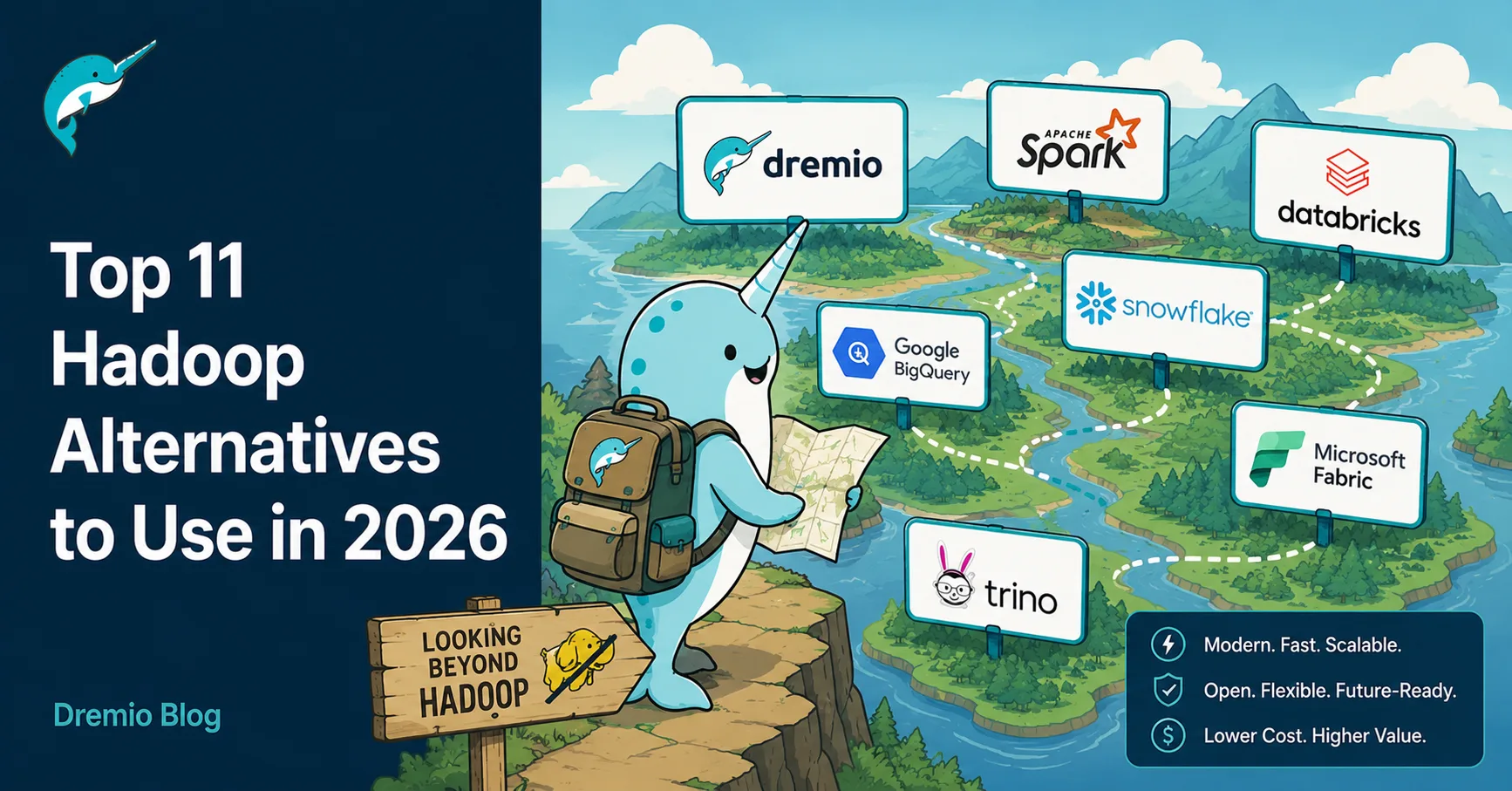
Top Hadoop Alternatives 2026
Key features
Dremio
Zero-ETL federation, unified semantic layer, autonomous query optimization, Apache Iceberg native, MCP for AI agents
Apache Spark
Distributed batch and streaming processing, massive ecosystem, runs on all major clouds
Databricks
Unified data analytics and AI platform, built on Spark, Delta Lake, strong ML tooling
Snowflake
Cloud-native data warehouse, elastic scaling, zero-maintenance SQL analytics
Google BigQuery
Fully serverless SQL, massive scale, zero infrastructure management
Microsoft Fabric
All-in-one SaaS, integrates Power BI, data engineering, data warehousing
Trino
Distributed SQL query engine, federated queries across multiple sources without data movement
Starburst
Enterprise Trino distribution with governance, security, and data catalog
Apache Flink
Real-time event streaming and stateful stream processing, sub-second latency
Amazon EMR
Managed cloud service running Spark, Hive, and other engines; simplifies Hadoop migration
Apache Hadoop is an open-source framework for distributed storage and processing of large datasets across clusters of commodity hardware. It stores data using the Hadoop Distributed File System (HDFS) and processes it using the MapReduce programming model, which breaks large computation jobs into parallel tasks distributed across many machines.
Hadoop was designed to solve a specific problem: how to store and process data volumes that no single server could handle. When it launched in 2006, it made large-scale data processing accessible without requiring specialized hardware. Organizations ran Hadoop clusters to process web logs, transaction records, and other large datasets that SQL databases of the time could not handle at scale.
The architecture requires managing YARN for resource scheduling, HDFS for distributed storage, and a collection of tools — Hive, Pig, HBase, and others — for different processing needs. This complexity has proven to be Hadoop's primary liability as cloud-native alternatives matured. Managing a Hadoop cluster requires specialized operations expertise. Performance tuning is manual and time-consuming. The batch-only MapReduce model is poorly suited to real-time analytics and the low-latency demands of modern AI workloads. Most organizations evaluating Hadoop alternatives today are either actively migrating existing clusters or preventing new workloads from landing on Hadoop infrastructure.
11 best alternatives to Hadoop in 2026
Moving beyond Hadoop requires selecting platforms that match your workload profile. The alternatives below cover the full spectrum — from query engines and data warehouses to streaming processors and managed cloud services. This section guides the Hadoop modernization decision by giving you the information needed to evaluate each option on its merits.
1. Dremio
Dremio is the Intelligent Lakehouse Platform for the Agentic AI Era, built by the original co-creators of Apache Polaris and Apache Arrow. It provides fast SQL access directly on data lakes — against Apache Iceberg, Parquet, and other open formats stored in cloud object storage — without requiring data movement or complex ETL pipelines. Dremio queries data where it lives and accelerates results through intelligent caching, data reflections, and autonomous query optimization.
What separates Dremio from other Hadoop alternatives is its combination of federation and semantic layer capabilities. Organizations can query data across Amazon S3, Azure Data Lake Storage, on-premises databases, and SaaS sources through a single SQL interface, with consistent governance applied across all sources. The unified semantic layer ensures that business metrics and KPIs are defined once and available to every tool, from Tableau and Power BI to AI models and autonomous agents. Dremio's Model Context Protocol (MCP) support makes it a natural foundation for organizations building agentic AI systems on top of their data.
Dremio pros:
Zero-ETL federation eliminates the need to move data before querying it
Autonomous query optimization delivers fast performance without manual tuning
Unified semantic layer provides consistent business context for analysts and AI agents
Apache Iceberg native — fully supports open table formats without vendor lock-in
Trusted by Shell, TD Bank, Michelin, and Farmer's Insurance for enterprise-scale workloads
2. Apache Spark
Apache Spark is a distributed computing framework designed for batch processing, stream processing, and machine learning at scale. It replaced MapReduce as the dominant processing engine for large datasets by using in-memory computation to deliver far faster performance on iterative workloads. Spark is the core engine underlying Databricks and is available as a managed service on AWS (EMR), Google Cloud (Dataproc), and Azure (HDInsight).
Spark's primary strength is its versatility. The same platform handles batch ETL jobs, streaming data pipelines, SQL queries (via Spark SQL), and machine learning model training (via MLlib). Organizations migrating heavy processing workloads from Hadoop frequently land on Spark — either self-managed or through Databricks — because the programming model is similar enough to require minimal refactoring.
Apache Spark pros:
Fastest in-memory processing engine for large-scale batch and streaming workloads
Unified API covers SQL, streaming, and machine learning in a single framework
Massive open-source community and ecosystem of integrations
Memory management and tuning remain complex at scale
Less suited to ad-hoc interactive SQL compared to specialized query engines
3. Databricks
Databricks is a unified analytics platform built on Apache Spark, offering managed infrastructure, a collaborative notebook environment, Delta Lake for transactional data management, and strong integration with AI and ML tooling. It is widely regarded as the leading platform for data engineering and AI/ML workflows in 2026, and the primary destination for organizations migrating complex Spark workloads away from Hadoop.
Delta Lake — Databricks' open table format — adds ACID transactions, schema enforcement, and time travel to cloud object storage, providing Hadoop HDFS-like reliability without the operational overhead of managing a distributed filesystem. Databricks Unity Catalog adds governance and data cataloging across all data assets in the platform.
Databricks pros:
Industry-leading platform for data engineering and AI/ML at scale
Delta Lake provides ACID transactions and reliability on cloud storage
Strong integration with Python, ML frameworks, and AI tooling
Cons of Databricks:
Cost can grow at scale, especially for always-on compute clusters
Deeply tied to Databricks ecosystem — Delta Lake is less interoperable with non-Databricks tools than open formats like Apache Iceberg
Query performance for ad-hoc SQL is not as optimized as purpose-built SQL engines
4. Snowflake
Snowflake is a cloud-native data platform built from the ground up for SQL analytics. It separates storage and compute entirely, allowing each to scale independently. Organizations pay for the compute they use and store data in Snowflake's cloud-managed storage at low per-byte cost. Snowflake is the dominant choice for teams prioritizing SQL analytics, BI reporting, and ease of operations.
Snowflake's primary advantage over Hadoop is simplicity. There are no clusters to manage, no HDFS to tune, and no manual partitioning to optimize. Analysts interact with Snowflake through standard SQL, and the platform handles performance, scaling, and maintenance automatically.
Snowflake pros:
Zero-maintenance cloud-native warehouse with no infrastructure management required
Elastic compute scaling handles unpredictable query load without over-provisioning
Strong SQL compatibility and broad BI tool integration
Cons of Snowflake:
Proprietary storage format creates dependency on Snowflake's platform
Cost can escalate quickly for high-concurrency or large-compute workloads
Less suited to streaming workloads and real-time processing compared to purpose-built streaming platforms
5. Google BigQuery
Google BigQuery is a fully serverless, highly scalable data warehouse. Unlike Snowflake — which requires selecting a virtual warehouse size — BigQuery allocates compute automatically based on query demand, with no configuration required. It is built for massive-scale SQL analytics within the Google Cloud ecosystem and integrates natively with Vertex AI for machine learning workloads.
BigQuery's strength is its ability to handle extraordinarily large datasets without any infrastructure management. Organizations regularly run queries over petabyte-scale tables in seconds. Its serverless model means there is no idle compute cost between queries.
Google BigQuery pros:
Fully serverless — no compute configuration or cluster management required
Handles petabyte-scale queries with sub-second to second-range latency
Native integration with Google Cloud services and Vertex AI
Cons of Google BigQuery:
Deeply tied to Google Cloud ecosystem, limiting multi-cloud flexibility
On-demand pricing can be unpredictable for high-volume query workloads
Less suitable for workloads requiring cross-cloud or hybrid data access
6. Microsoft Fabric
Microsoft Fabric is an all-in-one SaaS data and analytics platform that integrates data engineering, data warehousing, real-time intelligence, and Power BI into a unified environment. It is Microsoft's answer to the platform consolidation trend — rather than requiring organizations to stitch together Azure Data Factory, Azure Synapse, and Power BI separately, Fabric provides all of these capabilities through a single interface with a shared data lake (OneLake) underneath.
Microsoft Fabric is a strong choice for organizations deeply invested in the Microsoft ecosystem. Teams already using Azure, Microsoft 365, and Power BI gain the most from Fabric's unified integration.
Microsoft Fabric pros:
Unified platform covering data engineering, warehousing, and BI from a single interface
OneLake provides a single storage layer shared across all Fabric workloads
Deep integration with Microsoft 365, Azure AI, and Power BI
Cons of Microsoft Fabric:
Best suited for organizations within the Microsoft ecosystem; limited multi-cloud support
Still maturing as a platform — some capabilities are less developed than in standalone Azure services
Vendor lock-in risk with OneLake and Fabric-specific workload types
7. Trino
Trino (formerly PrestoSQL) is an open-source distributed SQL query engine designed for federated analytics across multiple data sources. It allows organizations to query data in Amazon S3, HDFS, relational databases, Hive Metastore-managed tables, and other sources without moving data into a central repository. Trino is the query engine of choice for data mesh architectures where data is intentionally distributed across domain-owned storage systems.
Trino's distinguishing feature is its ability to join data across heterogeneous sources in a single query — for example, joining a table in a PostgreSQL database with a Parquet file in S3 without ETL. This makes it a powerful tool for organizations that want to embrace a decentralized data architecture rather than centralizing everything into a single warehouse.
Trino pros:
Federated queries across multiple storage systems without data movement
Strong for data mesh architectures where data ownership is distributed
Open-source with an active community and broad connector ecosystem
Cons of Trino:
Requires substantial infrastructure management and tuning for production deployments
No built-in governance, catalog, or semantic layer — requires additional tooling
Performance for complex analytical queries can be lower than warehouse-native engines
8. Starburst
Starburst is the enterprise distribution of Trino, adding governance, security, a data catalog, and enterprise support on top of the open-source Trino engine. Organizations that need Trino's federated query capabilities in a production enterprise environment — with proper access controls, data cataloging, and vendor support — typically choose Starburst over self-managed Trino.
Starburst Galaxy, its managed cloud offering, reduces the infrastructure burden of running Trino at scale by handling cluster management, upgrades, and monitoring automatically. Starburst Data Products adds data product management capabilities on top of the query engine.
Starburst pros:
Enterprise-grade Trino with governance, security, and data catalog built in
Data Products feature supports data mesh governance and ownership models
Cons of Starburst:
High licensing cost for enterprise features beyond open-source Trino
Federated query performance can lag behind warehouse-native engines for complex workloads
Catalog and governance capabilities are less mature than dedicated governance platforms
9. Apache Flink
Apache Flink is an open-source distributed stream processing framework designed for high-throughput, low-latency stateful stream processing. It excels at use cases that require processing continuous event streams in real time — fraud detection, IoT telemetry, financial transaction monitoring, and real-time recommendation systems. Flink processes each event as it arrives, with sub-second latency, and maintains state across event windows for complex pattern detection.
Flink is the preferred choice for organizations that need true real-time event processing, not just near-real-time batch processing. It is available as a managed service on AWS (Amazon Kinesis Data Analytics for Apache Flink), Google Cloud (Dataflow), and through standalone deployments.
Apache Flink pros:
Sub-second latency for real-time event stream processing
Stateful stream processing handles complex event patterns and time windows
Scales to handle very high event throughput from IoT, logs, and transaction systems
Cons of Apache Flink:
Complex operational model — requires deep expertise to manage and tune
Not suited for ad-hoc SQL analytics or batch workloads that don't require real-time processing
Debugging and monitoring distributed stream processing is inherently more complex than batch workloads
10. Amazon EMR
Amazon EMR (Elastic MapReduce) is a managed cloud service that runs Apache Spark, Hive, Presto, and other open-source frameworks on AWS infrastructure. It is the most common migration path for organizations moving Hadoop workloads off on-premises clusters — EMR provides a familiar execution environment with considerably reduced operational overhead, since AWS manages cluster provisioning, patching, and scaling automatically.
EMR supports both persistent clusters (for continuous workloads) and transient clusters (spun up for a job and terminated after completion, reducing cost). For organizations with existing Hadoop workloads that need to move to the cloud without a complete re-architecture, EMR provides a pragmatic migration path.
Amazon EMR pros:
Managed Spark, Hive, and Hadoop on AWS with reduced operational overhead
Supports both persistent and transient clusters for cost optimization
Integrates natively with AWS storage (S3), security (IAM), and data services
Cons of Amazon EMR:
Still requires meaningful infrastructure expertise to configure and optimize effectively
Tied to the AWS ecosystem, limiting portability to other cloud providers
More operationally complex than fully managed SaaS platforms like Snowflake or BigQuery
11. Cloudera Data Platform (CDP)
Cloudera Data Platform is the enterprise hybrid and multi-cloud data platform that emerged from the merger of Cloudera and Hortonworks — the two major commercial Hadoop distributions. CDP is the logical migration path for organizations running existing Cloudera Enterprise or Hortonworks deployments that need to modernize without a complete rewrite. It supports Apache Spark, Impala, Hive, and other engines on public cloud infrastructure or on-premises hardware.
CDP's strength is its governance and compliance capabilities. Cloudera SDX (Shared Data Experience) provides centralized security, governance, and metadata management across all CDP workloads, making it well-suited for industries with strict regulatory requirements.
Cloudera Data Platform pros:
Natural upgrade path for existing Cloudera and Hortonworks customers
Strong governance and security through Cloudera SDX
Supports hybrid and multi-cloud deployments with consistent tooling
Cons of Cloudera Data Platform:
Higher licensing cost compared to open-source alternatives
Complexity of the platform can be large for teams without existing Cloudera expertise
Less optimized for modern cloud-native and AI workloads compared to purpose-built alternatives
How to select a good alternative for Hadoop
Selecting the right Hadoop alternative requires matching platform capabilities to your organization's specific workloads, team skills, and strategic direction. The criteria below cover the most important dimensions of the evaluation.
Support for modern data architectures
The platform should fit your target data architecture — whether that is a centralized data warehouse, a data lakehouse, a federated data mesh, or a hybrid approach. Modern data architectures are built on open formats and open standards that allow multiple tools to access the same data without proprietary lock-in. Evaluate whether the platform supports open table formats like Apache Iceberg and whether it can integrate with the rest of your existing data ecosystem.
Verify support for open table formats and open query protocols
Check whether the platform integrates with your existing BI, ML, and data engineering tools
Evaluate whether the architecture is open enough to evolve as your requirements change
Some workloads require batch processing — large-scale transformations that run on a schedule. Others require real-time processing — continuous query results updated as new data arrives. Many organizations need both. Evaluate whether the platform can handle your mix of batch and streaming workloads, or whether you need separate platforms for each workload type.
Map your workloads to batch, micro-batch, and real-time processing requirements
Evaluate whether a single platform can serve all workload types or whether a multi-platform approach is needed
Test latency and throughput for real-time workloads under realistic concurrency conditions
Scalability and performance at scale
The platform must handle your current data volumes and the volumes you expect over the next three to five years. Scalable data applications require platforms that can scale compute independently of storage, handle growing query concurrency, and maintain performance without constant manual tuning. Evaluate how the platform scales under load and what operational effort scaling requires.
Benchmark query performance at current and projected data volumes
Test behavior under peak concurrency — query performance should not degrade measurably under load
Evaluate whether scaling is manual (resize clusters) or automatic (serverless or autonomous)
Ease of use and operational simplicity
Easy data access is one of the most frequently cited reasons organizations move away from Hadoop. If the new platform requires the same level of operational expertise as Hadoop, the migration delivers limited value. Prioritize platforms with low operational overhead, minimal manual tuning, and self-service access for analysts who don't have engineering expertise.
Evaluate the operations burden — what does day-to-day platform management look like?
Check whether analysts can access data without engineering involvement for every new query or dataset
Assess onboarding time for new users, particularly business analysts who are not SQL experts
The platform must integrate with the tools your teams already use and the AI systems your organization is building. This includes BI platforms (Tableau, Power BI, Looker), ML frameworks (scikit-learn, TensorFlow, PyTorch), and AI orchestration systems. Check whether the platform exposes standard interfaces (JDBC, ODBC, Arrow Flight) that your tools can connect to without custom integration work.
Verify compatibility with your existing BI tools and data science environments
Check whether the platform supports MCP or other AI agent integration protocols
Evaluate the connector ecosystem — how many source and destination integrations are available out of the box?
Benefits of moving towards an agentic lakehouse architecture
The Hadoop infrastructure model treats data as a static resource that must be extracted, transformed, and loaded before it can be used. An agentic lakehouse architecture treats data as a live asset that AI agents and humans can query, reason over, and act on in real time. This shift changes what data infrastructure can deliver.
AI-Ready datacontext: An agentic lakehouse provides AI agents with semantic context alongside raw data, allowing them to interpret and use data correctly without custom integration work for each new use case.
Simplified data architecture: The agentic lakehouse consolidates storage, governance, federation, and the semantic layer into a single platform, reducing total cost of ownership (TCO) by eliminating the need to stitch together multiple specialized tools.
Unified data governance and reliability: Governance is built into the lakehouse architecture rather than applied as a separate layer, ensuring consistent policy enforcement for both human users and AI agents.
Elimination of data silos: A unified view of data across all sources — without requiring data movement — gives every analyst and AI agent access to the same governed data foundation.
Elastic, on-demand scalability: Compute scales up and down based on demand, eliminating the over-provisioned, always-on cluster model that drives Hadoop's high operational cost.
Overcome the limitations of Hadoop with Dremio
Dremio is the best alternative to Hadoop for organizations that need fast, governed, AI-ready access to data at scale. As the agentic lakehouse platform built by the original co-creators of Apache Polaris and Apache Arrow, Dremio replaces Hadoop's complexity with a self-managing, open-format data platform that supports both humans and AI agents.
What Dremio delivers that Hadoop cannot:
Sub-second query performance on open data lakes through intelligent caching, data reflections, and autonomous query optimization — no cluster tuning required.
Zero-ETL federation across cloud, on-premises, and hybrid data sources — query data where it lives rather than extracting and loading it first.
Open standards built on Apache Iceberg, Apache Arrow, and Apache Polaris — no proprietary formats that trap data in a single vendor's ecosystem.
AI agent support via MCP — Dremio connects autonomous AI agents to enterprise data through the Model Context Protocol for governed, programmatic data access.
Autonomous optimization — Dremio's self-managing engine handles performance tuning, caching, and data layout optimization without manual intervention.
Book a demo today and see why Dremio is one of the best Hadoop competitors for enterprises, helping slash operational costs and accelerate query performance.
Frequently asked questions
Why would an enterprise consider a Hadoop alternative?
Most enterprises consider Hadoop migration for three primary reasons: operational complexity, query performance, and AI readiness. Managing a Hadoop cluster requires specialized engineers to maintain HDFS, tune YARN, and manage a collection of tools for different workload types. Modern alternatives deliver better query performance out of the box, require less operational effort, and support the real-time and AI workload patterns that Hadoop's batch-only MapReduce model cannot address.
What is the best alternative to Hadoop for big data analytics?
The best alternative depends on your primary use case. For organizations that want fast SQL analytics directly on a Hadoop data lake without moving data, Dremio is the strongest choice. It delivers warehouse-grade query performance on open lake storage without proprietary formats or complex ETL pipelines. For organizations prioritizing heavy Spark-based data engineering and AI/ML, Databricks is the leading option. For pure SQL analytics with zero infrastructure management, Snowflake or BigQuery are strong alternatives.
What is a cheaper way to store and query petabytes of data than Hadoop?
Cloud object storage (Amazon S3, Azure Data Lake Storage, Google Cloud Storage) combined with an open table format like Apache Iceberg delivers far lower storage costs than HDFS at petabyte scale. Querying this data with a modern engine like Dremio — which accelerates results through intelligent caching and data reflections rather than requiring expensive compute clusters to run continuously — reduces both storage and compute costs compared to maintaining Hadoop infrastructure.
Which tools are faster than Hadoop for running SQL reports?
Most modern SQL query engines dramatically outperform Hadoop's MapReduce-based Hive for SQL querying. Dremio, Trino, Snowflake, BigQuery, and Databricks SQL all deliver query performance that is orders of magnitude faster than Hive on Hadoop for typical reporting and analytics workloads. Dremio specifically delivers sub-second query response times on large datasets through its columnar processing engine, Apache Arrow-based memory management, and intelligent result caching.
Try Dremio Cloud free for 30 days
Deploy agentic analytics directly on Apache Iceberg data with no pipelines and no added overhead.
Ingesting Data Into Apache Iceberg Tables with Dremio: A Unified Path to Iceberg
By unifying data from diverse sources, simplifying data operations, and providing powerful tools for data management, Dremio stands out as a comprehensive solution for modern data needs. Whether you are a data engineer, business analyst, or data scientist, harnessing the combined power of Dremio and Apache Iceberg will undoubtedly be a valuable asset in your data management toolkit.
Sep 22, 2023·Dremio Blog: Open Data Insights
Intro to Dremio, Nessie, and Apache Iceberg on Your Laptop
Editor’s note, September 2026. This post was published in September 2023 and some product details have changed since. Nessie is still available and self-deployable under the Apache-2.0 licence, and it remains the clearest implementation of catalog-level branching. It is not an Apache Software Foundation project, and its development has slowed considerably. For how the current […]
Oct 12, 2023·Product Insights from the Dremio Blog
Table-Driven Access Policies Using Subqueries
This blog helps you learn about table-driven access policies in Dremio Cloud and Dremio Software v24.1+.