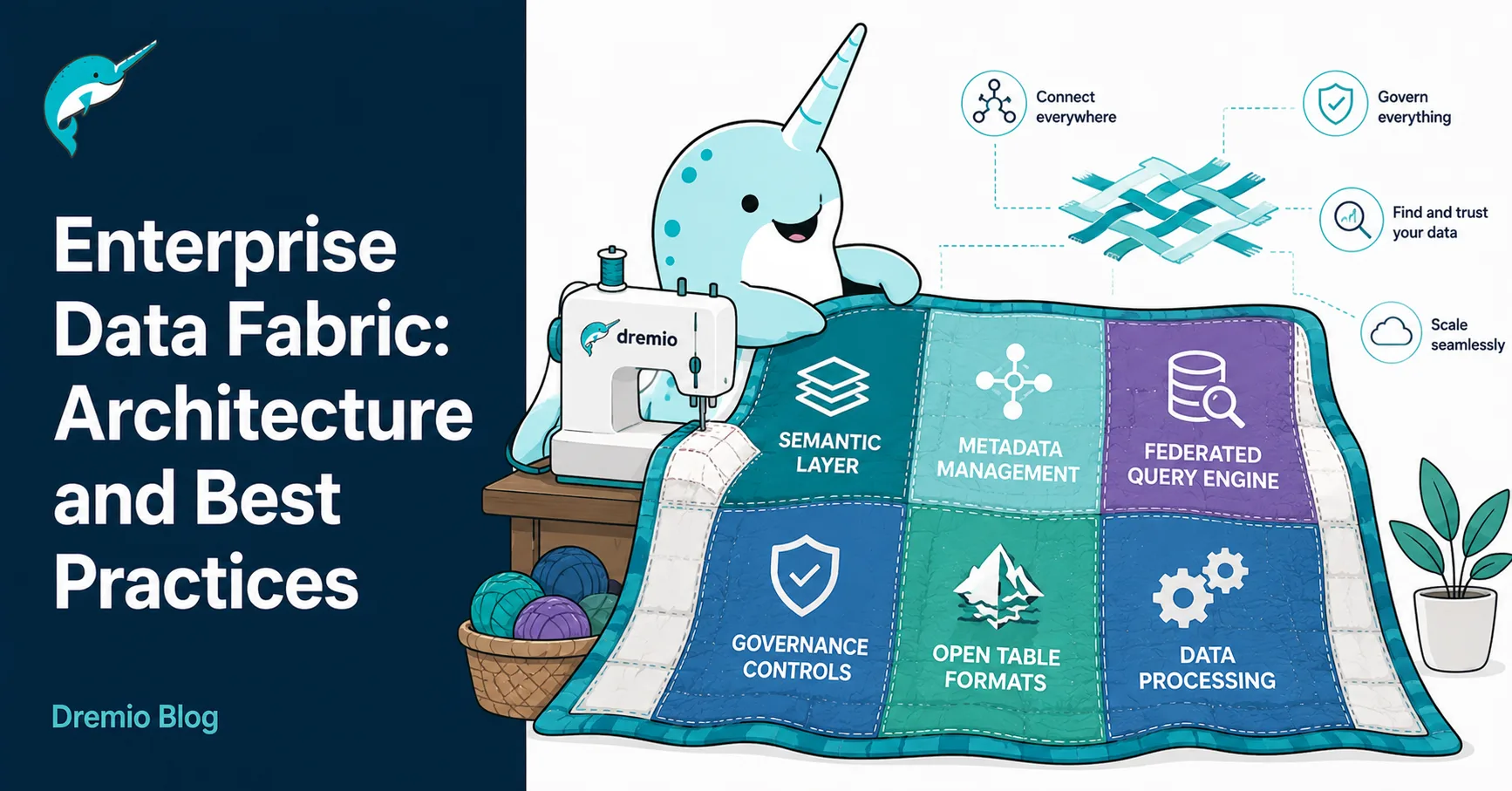
Enterprise data fabrics have become a central topic for data and technology leaders working to support AI, real-time analytics, and cross-cloud operations. As organizations accumulate data across cloud providers, on-premises systems, SaaS applications, and partner environments, the challenge of maintaining consistent, governed, and accessible data grows with each new source added. This guide explains what an enterprise data fabric is, how the architecture works, and the practices organizations follow to build and operate one effectively.
Key highlights:
An enterprise data fabric is a unified architecture that provides consistent data access, governance, and integration across distributed cloud, on-premises, and hybrid environments.
The global data fabric market is projected to grow from USD 3.2–3.8 billion in 2025 to USD 4.1–4.9 billion in 2026, driven by AI adoption and multi-cloud complexity. (Research and Markets, Grand View Research)
Modern data fabrics are incorporating AI-driven automation for metadata management, governance, and data quality monitoring — making them the foundational layer for agentic AI systems.
Dremio is the Intelligent Lakehouse Platform for the Agentic AI Era, providing the Zero-ETL federation, unified semantic layer, and autonomous optimization that an AI-ready enterprise data fabric requires.
What is an enterprise data fabric?
An enterprise data fabric is an architecture layer that unifies access to distributed data across cloud, hybrid, and on-premises environments while improving governance, consistency, and accessibility for analytics and AI workloads. It connects data where it lives — without requiring it to be moved into a single central repository — and applies consistent policies for security, quality, and semantic interpretation across all sources.
The concept of data fabric contrasts sharply with traditional data integration approaches. Traditional approaches relied on moving data to a central data warehouse through batch ETL processes — a model that created delays, duplication, and rigid pipelines that broke whenever source systems changed. Enterprise data fabric architectures address this by federating access across sources, applying metadata and governance as a shared layer, and making data available through a single interface that abstracts the complexity of the underlying environment.
Traditional integration creates copies; data fabric creates connections. Traditional integration delays data freshness by hours or days; data fabric queries sources directly for up-to-date results. Traditional integration requires heavy pipeline maintenance; data fabric reduces operational overhead through federation and automation.
How enterprise data fabric architecture impacts AI and analytics
Fragmented enterprise environments create compounding challenges for analytics, governance, and AI. When data lives in different systems with different schemas, different access controls, and different quality standards, the work of making it available for analysis multiplies at every level. For modern AI workloads — particularly agentic AI systems that need to query, reason over, and act on data autonomously — this fragmentation creates failures that are difficult to diagnose and expensive to fix.
Enterprise data fabric architectures address these challenges at the structural level rather than through point solutions. The fabric acts as the connective layer that normalizes access, enforces policy, and provides context regardless of where data physically resides.
Eliminate data silos across enterprise environments
A data silo forms when data is stored in a system that other parts of the organization cannot easily access. Silos accumulate over time through acquisitions, departmental tool sprawl, and the natural tendency of teams to optimize for their own needs rather than organizational access. Enterprise data fabric breaks down silos by establishing a federation layer that exposes data from every source through a common interface and query model.
Creates a unified namespace across storage systems, databases, and cloud providers
Eliminates the need to duplicate data across teams to enable cross-functional analysis
Reduces the data engineering overhead required to build and maintain point-to-point integrations
Improve AI and analytics readiness
AI models and analytics workloads share a common requirement: they need clean, current, contextualized data. When data is siloed and inconsistently governed, AI agents produce unreliable outputs and analysts spend most of their time preparing data rather than using it. A data fabric architecture addresses both problems by providing a unified access layer that enforces quality standards, tracks metadata, and exposes semantic context alongside the data itself.
Makes high-quality data available to AI agents and analytics tools without manual preparation
Supports retrieval-augmented generation (RAG) patterns by providing current, governed data to AI models
Reduces time analysts spend on data preparation by maintaining consistent, ready-to-use data products
Strengthen governance and consistency
Governance in fragmented data environments is inconsistent by definition. Each system enforces its own access rules, and there is no shared view of who accessed what data, where it came from, or how it was transformed. Enterprise data fabrics centralize governance without centralizing storage — policies are applied at the fabric layer and enforced across every connected source, regardless of its location or underlying technology.
Applies unified access controls, encryption, and masking across all connected data sources
Tracks lineage from raw source to final report or model output across the entire fabric
Modern enterprise data environments span multiple cloud providers, legacy on-premises systems, and a growing collection of SaaS applications. Managing each integration independently creates operational complexity that scales with every new source added. A data fabric architecture reduces this complexity by providing a single integration layer that handles connectivity, schema mapping, and governance uniformly across all sources.
Replaces a web of point-to-point integrations with a single federated access layer
Reduces the number of data pipelines that need to be built, monitored, and maintained
Simplifies onboarding of new data sources by applying existing governance policies automatically
Core components of data fabric architecture
A well-designed enterprise data fabric architecture includes several core components that work together to provide consistent, governed, and AI-ready data access.
Enterprise data fabric components
What it does
Why it matters
Semantic layer
Translates raw data into consistent business metrics, KPIs, and dimensions
Ensures AI models and human analysts interpret data the same way across all tools
Handles both streaming event data and large-scale batch workloads
Supports operational analytics alongside historical reporting from a single platform
How to build an enterprise data fabric
Building an enterprise data fabric is a phased process. Each step builds on the previous one, moving from inventory and governance to federation, enablement, and ongoing monitoring. The goal is a fabric that provides consistent, governed, AI-ready access to all enterprise data — without requiring wholesale migration of existing systems.
1. Assess existing data sources and silos
Before building the fabric, you need a clear inventory of every major data source in the organization. This includes production databases, data warehouses, cloud object stores, SaaS applications, and any streaming data feeds. Document the owner, format, access controls, update frequency, and business value of each source.
This inventory serves two purposes. It identifies the highest-priority sources to connect first, and it surfaces governance gaps — sources that contain sensitive data but lack proper access controls or documentation. Without this step, the fabric is built on incomplete foundations that create problems downstream.
Document all major data sources, including shadow IT systems often missed in formal audits
Identify which sources are highest priority for analytics and AI use cases
Flag sources with governance gaps for remediation before connection to the fabric
2. Standardize metadata and governance policies
Before connecting sources to the fabric, establish the governance policies that will apply across all of them. Define role-based access control (RBAC) structures, data classification tiers (public, internal, confidential, restricted), masking rules for sensitive fields, and retention policies.
Metadata standards are equally important. Define how data sources will be cataloged, what tags and business terms will be used, and who is responsible for maintaining metadata quality over time. Consistent metadata makes data discoverable and interpretable across the fabric without requiring manual documentation for every table and field.
Define data classification tiers and the access rules that apply to each
Establish a shared business glossary for key terms, metrics, and dimensions
Assign metadata stewardship responsibilities to prevent catalog decay over time
3. Create a semantic layer for consistent analytics
A semantic layer translates the raw tables and columns of source systems into the business metrics, KPIs, and dimensions that analysts and AI tools actually use. Building this layer is one of the most important steps in fabric implementation. Without it, every team re-implements the same metric calculations independently, creating inconsistencies that undermine trust in data.
The semantic layer should define revenue, customer counts, conversion rates, cost metrics, and other core KPIs in a single place. All BI tools, AI models, and reporting dashboards draw from these shared definitions. Changes to business logic need to happen in one place and propagate automatically to every tool that uses the affected metrics.
Define all core business metrics centrally rather than in individual reports or models
Connect BI tools, AI models, and data science notebooks to the semantic layer through standard interfaces
Version control semantic definitions so changes can be reviewed and rolled back if needed
4. Connect cloud, hybrid and on-premises environments
With governance policies and metadata standards in place, begin connecting data sources to the federated query layer. Start with the highest-priority sources identified in the inventory step. Configure access credentials, test query performance, and validate that governance policies are applying correctly before moving to the next source.
For hybrid environments, connectivity between cloud and on-premises systems requires careful attention to network latency, security boundaries, and data transfer costs. Federation approaches that query data in place — rather than pulling it across network boundaries — minimize latency and cost for cross-environment queries.
Use federation to query on-premises sources without replicating data to the cloud
Validate governance policy enforcement for each new source before opening access to users
Monitor query performance per source and optimize as usage patterns emerge
5. Enable AI and analytics workloads
Once the fabric provides consistent, governed access to all priority data sources, configure the tooling that analytics and AI workloads use to consume it. This includes BI platforms, SQL query tools, machine learning frameworks, and AI agent systems. Each tool should connect through the semantic layer rather than directly to source systems.
For real-time analytics use cases, verify that the fabric's query engine can handle the throughput and concurrency requirements of the workload. For AI agent use cases, configure access patterns that allow agents to query data autonomously while respecting governance controls.
Connect BI tools to the semantic layer through JDBC/ODBC or Arrow Flight interfaces
Expose data to AI agents through governed APIs that enforce access controls automatically
Configure query caching and result acceleration to meet the performance requirements of high-concurrency workloads
6. Monitor performance, quality and usage
A data fabric is not a one-time build. It requires ongoing monitoring to stay healthy as data volumes grow, source systems change, and usage patterns evolve. Establish monitoring for query performance, data quality, governance policy compliance, and catalog accuracy.
Set up alerts for data quality anomalies — unexpected changes in row counts, null rates, or value distributions — that indicate problems upstream. Review access audit logs regularly to confirm that governance policies are being enforced correctly. Track query performance trends to identify sources that need optimization as usage grows.
Monitor data quality metrics per source and set alerts for anomalies
Review governance audit logs on a scheduled basis to catch policy violations early
Track query latency and concurrency trends to identify optimization opportunities before users are impacted
What should you add to your data fabric architecture?
Modern enterprise data fabrics require more than basic integration capabilities to support AI, analytics, and real-time enterprise operations. As AI workloads mature and agentic systems become standard, the fabric must support new capabilities that were not part of original implementations.
AI-ready semantic layers
A standard semantic layer provides consistent metric definitions for human analysts. An AI semantic layer goes further by exposing business context, relationships between entities, and natural language query support that AI models and agents can consume directly. This layer allows AI systems to find relevant data, interpret it correctly, and use it to reason and act — without requiring custom integration work for each new AI use case.
Add natural language query interfaces to the semantic layer for both human and AI consumers
Expose entity relationships and business context through semantic APIs that AI agents can traverse
Build AI-specific data products — pre-joined, pre-filtered datasets — that reduce the query complexity agents must handle
Vector and unstructured data support
Most data fabric implementations are built around structured and semi-structured data. Supporting AI use cases like retrieval-augmented generation (RAG), document search, and multimodal analytics requires adding vector storage and unstructured data support to the fabric. This allows AI models to query both structured business data and unstructured content from the same governed environment.
Integrate vector databases (e.g., Pinecone, pgvector) into the fabric's governance layer
Apply the same access controls and lineage tracking to vector stores as to structured data
Build unified query paths that combine structured data results with vector similarity results for AI agents
Real-time query acceleration
AI agents and operational analytics workloads often require sub-second query response times. Standard federated query engines may not achieve this performance for complex queries over large datasets. Adding query acceleration layers — intelligent caching, precomputed aggregates, and data reflections — allows the fabric to meet latency requirements without replicating data or building dedicated data marts.
Deploy intelligent caching that learns from query patterns and pre-warms frequently accessed results
Use data reflections or materialized views for high-frequency aggregation queries
Configure acceleration policies per workload type to avoid over-provisioning infrastructure
Fine-grained governance and access controls
Basic role-based access controls are insufficient for modern AI environments. AI agents access data programmatically using service accounts, and a single agent may access data on behalf of multiple users with different permission levels. Fine-grained governance — attribute-based access control (ABAC), attribute-based data masking, and purpose-based access policies — is required to govern agent access safely.
Implement ABAC policies that evaluate context (user role, data classification, purpose) at query time
Apply context-aware masking that adjusts data visibility based on the identity and context of the requester
Audit all programmatic access by AI agents separately from human access for compliance reporting
Data observability and monitoring
Observability goes beyond basic monitoring. A data observability platform tracks data quality, pipeline health, and usage patterns continuously, alerting teams to anomalies before they affect downstream analytics or AI outputs. Building observability into the fabric — rather than adding it as a separate system — gives teams a single view of fabric health across all connected sources and workloads.
Deploy automated quality checks that run continuously rather than only at scheduled intervals
Track data lineage through the full pipeline to quickly identify the source of quality issues
Build dashboards that show fabric health, data freshness, and query performance in a single view
Support for agentic AI workflows
Agentic AI systems — systems that take autonomous actions based on data — require the fabric to support new interaction patterns. Agents need to discover available data, understand its structure and business meaning, query it in real time, and receive updates when relevant data changes. The fabric must provide APIs and integration points that make these patterns possible at enterprise scale.
Expose a data catalog API that agents can use to discover and understand available datasets
Support event-driven notifications so agents receive alerts when relevant data changes
Integrate with AI orchestration frameworks through standard protocols like the Model Context Protocol (MCP)
Data fabric vs AI fabric: What's the difference?
Data fabrics and AI fabrics serve related but distinct purposes. Understanding the difference helps organizations decide which capabilities to prioritize as they mature their data architecture.
A data fabric provides the foundational infrastructure: federated access, governance, metadata management, and semantic consistency. An AI fabric extends this foundation with capabilities specifically designed for AI workloads — semantic search, vector retrieval, AI orchestration, and support for autonomous agent workflows.
Aspect
Data Fabric
AI Fabric
Primary purpose
Unified data access and governance across distributed sources
Enabling AI agents and models to discover, access, and act on enterprise data
Core focus
Federation, integration, governance, metadata
Semantic context, vector retrieval, AI orchestration, agent support
Supported workloads
SQL analytics, BI reporting, batch processing, data sharing
RAG, agent workflows, model training, real-time AI inference
Data types
Structured, semi-structured, streaming
All data fabric types plus vectors, embeddings, and unstructured content
Governance priorities
Access control, lineage, compliance, data quality
All data fabric governance plus agent identity management and purpose-based access
AI fabrics extend modern data fabric architectures by introducing semantic context, AI orchestration, and support for agentic AI workflows. Several capabilities are central to this extension, and AI-ready data preparation is the prerequisite for all of them:
Retrieval-augmented generation (RAG): The fabric provides current, governed data to AI models as context, reducing hallucinations and improving output accuracy.
AI agents: Agents query the fabric autonomously to complete tasks, requiring low-latency access to well-documented, consistently governed data.
Semantic retrieval: Natural language queries are translated into data retrieval operations against the semantic and vector layers of the fabric.
AI governance: Access controls, audit logging, and purpose-based policies extend to cover the specific risk profile of AI agent access.
Context-aware analytics: AI models use semantic layer definitions to interpret data in business terms rather than raw column names and technical schemas.
Enterprise data fabric best practices
1. Prioritize open and interoperable architectures
Building an enterprise data fabric on open standards — open table formats, open APIs, and open query protocols — protects the organization from vendor lock-in and makes it easier to add new tools over time. Proprietary formats trap data in specific platforms and make it expensive to switch or augment the stack as requirements evolve.
Open formats like Apache Iceberg allow any compatible engine to read and write the same data, creating true interoperability across the modern data ecosystem. Open query interfaces like Apache Arrow Flight enable high-performance data exchange between tools without proprietary connectors.
Build storage on open table formats (Apache Iceberg, Apache Hudi, Delta Lake)
Use open query protocols (JDBC, ODBC, Arrow Flight) for tool connectivity
Avoid proprietary APIs that lock data access into a single vendor's ecosystem
2. Reduce unnecessary data movement
Data migration between systems increases latency, creates data duplication, and adds infrastructure costs. Every copy of data that exists is another copy that needs to be governed, secured, and kept current. The data fabric model reduces movement by querying data in place through federation, reserving physical data copies for cases where performance or compliance genuinely requires them.
Default to federation over replication for analytical workloads that can tolerate federated query latency
Reserve physical data copies for high-frequency, low-latency workloads where federation cannot meet performance requirements
Audit all data replication jobs regularly to identify copies that are no longer needed
3. Build governance into every layer
Governance applied only at the query layer — through a single access control enforcement point — is fragile. If an application bypasses the query layer and accesses storage directly, governance fails. Centralized governance that applies at every layer of the fabric — storage, catalog, query, and API — provides defense in depth that remains effective even when individual components are accessed directly.
Apply encryption and access controls at the storage layer, not only at the query layer
Enforce governance rules through the catalog so they apply regardless of how data is queried
Validate governance coverage for all access paths, including direct API calls to source systems
4. Design for AI and agentic workloads
AI workloads have different characteristics than human analytics workloads. They generate more queries, often at higher concurrency. They need semantic context alongside raw data. They access data programmatically using service accounts rather than named user credentials. Designing the fabric for AI workloads from the start — rather than adapting a human-centric architecture after the fact — produces better outcomes.
Build the semantic layer with AI consumption in mind from the beginning
Provision separate access patterns for AI agents with appropriate governance and rate limits
Include vector storage and embedding support as first-class capabilities rather than bolted-on additions
5. Maintain semantic consistency across teams
Semantic drift — when different teams define the same metric differently — is one of the most damaging problems in enterprise data environments. It creates situations where the same question produces different answers depending on which report or system you consult. The semantic layer must be the single source of truth for all business definitions, and changes must go through a formal review process.
Require all new metric definitions to go through a central review before being added to the semantic layer
Version all semantic definitions and maintain a changelog that documents what changed and why
Run regular audits to identify cases where reports or AI outputs are using locally defined metrics instead of shared definitions
6. Continuously monitor data quality and performance
Data quality degrades over time as source systems change, business processes evolve, and data volumes grow. A data fabric that was high-quality at launch requires ongoing investment to stay that way. Automated quality monitoring — checks that run continuously against every connected source — catches problems before they propagate to analytics outputs or AI models.
Deploy automated quality checks per source with alerts for anomalies in row counts, null rates, and value distributions
Track quality metrics over time to identify sources that are degrading and need remediation
Include query performance monitoring so latency regressions are caught and addressed promptly
Build an AI-ready data fabric for your enterprise with Dremio
Dremio is the Intelligent Lakehouse Platform for the Agentic AI Era, built by the original co-creators of Apache Polaris and Apache Arrow. It provides the core capabilities that an enterprise data fabric requires: Zero-ETL federation across all data sources, a unified semantic layer that serves both human analysts and AI agents, and autonomous optimization that keeps query performance high without manual tuning.
Zero-ETL Federation: Connect to cloud, on-premises, and hybrid data sources and query them in place — no data movement required.
Unified Semantic Layer: Define business metrics once and share them across all tools, dashboards, and AI systems from a single, governed layer.
AI Semantic Layer: Exposes business context and natural language query support for AI agents through Dremio's dedicated AI semantic layer capabilities.
Autonomous Optimization: Self-managing query engine that tunes performance, manages caching, and organizes data files automatically.
Apache Iceberg Native: Full support for open table formats, providing interoperability with any compatible tool in the data ecosystem.
MCP Support: AI agents connect to Dremio through the Model Context Protocol for governed, autonomous data access.
Book a demo today and see why Dremio is a strong foundation for your AI-ready enterprise data fabric.
Try Dremio Cloud free for 30 days
Deploy agentic analytics directly on Apache Iceberg data with no pipelines and no added overhead.
Ingesting Data Into Apache Iceberg Tables with Dremio: A Unified Path to Iceberg
By unifying data from diverse sources, simplifying data operations, and providing powerful tools for data management, Dremio stands out as a comprehensive solution for modern data needs. Whether you are a data engineer, business analyst, or data scientist, harnessing the combined power of Dremio and Apache Iceberg will undoubtedly be a valuable asset in your data management toolkit.
Sep 22, 2023·Dremio Blog: Open Data Insights
Intro to Dremio, Nessie, and Apache Iceberg on Your Laptop
Editor’s note, September 2026. This post was published in September 2023 and some product details have changed since. Nessie is still available and self-deployable under the Apache-2.0 licence, and it remains the clearest implementation of catalog-level branching. It is not an Apache Software Foundation project, and its development has slowed considerably. For how the current […]
Oct 12, 2023·Product Insights from the Dremio Blog
Table-Driven Access Policies Using Subqueries
This blog helps you learn about table-driven access policies in Dremio Cloud and Dremio Software v24.1+.