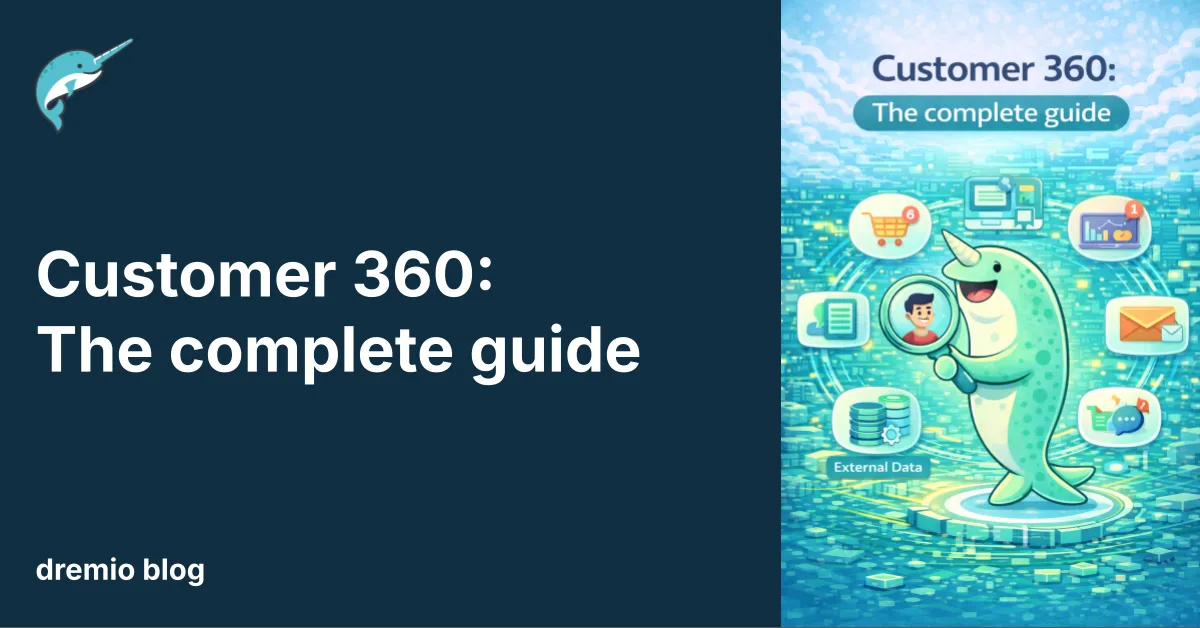
Customer 360 is the practice of unifying all customer data into a single, governed view that spans every touchpoint and system. When customer information is scattered across CRM platforms, marketing tools, support tickets, billing systems, and social channels, teams make decisions based on incomplete pictures. A customer 360 strategy consolidates this data so every department works from the same foundation.
Building a true customer 360 requires more than connecting dashboards. It demands integrated data modeling, semantic consistency, and governed access across systems. This guide covers what customer 360 means, why enterprises need it, how the analytics work, and how to implement a customer 360 dashboard that scales with your business.
Key highlights:
Customer 360 is a unified approach that consolidates customer data from every system and touchpoint into a single, governed view for analytics and decision-making.
Fragmented customer systems cause inconsistent metrics, duplicated effort, and missed opportunities for personalization and retention.
A modern customer 360 data model is an architectural process that spans ingestion, identity resolution, semantic modeling, and AI activation.
Dremio provides the open lakehouse foundation for building a scalable, governed customer 360 dashboard with zero-ETL federation and a unified semantic layer.
What is customer 360?
Customer 360 is a comprehensive, unified representation of all data related to a customer across all interactions, channels, and internal systems. It includes structured data such as purchase history and account details, alongside unstructured data such as support transcripts and social media interactions. A true 360-degree view of customer data is not just a dashboard or a CRM export. It requires integrated data modeling, standardized metrics, and governed analytics across systems.
The term has been a strategic priority for over a decade, but most enterprises still work with fragmented customer information spread across 10 to 20 or more systems. A well-built customer 360 data model connects these sources into a single source of truth where every metric, customer lifetime value, churn risk, and engagement score is calculated consistently. The goal is to improve customer experiences at every touchpoint by giving sales, marketing, support, and product teams access to the same complete, governed customer profile.
Why enterprises need a 360-degree view of customer data
Fragmented systems prevent organizations from achieving a true 360-degree view of customer data. When customer information lives in separate databases, each department sees a different version of the customer. Marketing targets users who have already churned. Support agents lack purchase history. Sales teams miss upsell signals. The benefits of a customer 360 strategy address these gaps directly by providing every team with consistent, complete customer intelligence. 360-degree customer view implementations on modern data architectures solve these problems at scale.
Eliminate data silos across customer systems
Customer data from various sources, CRM, marketing automation, e-commerce platforms, support tools, and billing systems, typically lives in separate databases with different schemas, identifiers, and update cadences. These silos mean no single team has a complete picture. A customer 360 approach breaks these silos by connecting data flow across all systems into a unified model.
When silos persist, teams duplicate effort. Marketing builds its own customer segments from its own data. Sales builds a separate view from CRM data. Neither is complete, and neither matches. Eliminating silos is the first step toward trustworthy customer analytics.
Connect customer data across CRM, marketing, billing, support, and IoT systems
Replace departmental customer views with a single, governed, enterprise-wide profile
Improve personalization and customer engagement
Personalization depends on knowing the full customer context. A support agent who can see recent purchases, browsing behavior, and marketing engagement can resolve issues faster and recommend relevant products. An email campaign that accounts for recent support interactions avoids sending promotions to frustrated customers.
Personalized customer experiences drive measurable results. According to Salesforce, 85% of business buyers expect companies to provide a consistent experience across every channel. A customer 360 model makes this possible by giving every system access to the same complete customer profile.
Use complete customer context to personalize support, marketing, and sales interactions
Avoid sending irrelevant communications to customers based on incomplete data
Enable real-time decision-making
Static, batch-updated customer reports are too slow for competitive markets. A comprehensive view of customer data that updates in real time allows teams to act on changes as they happen: a high-value customer showing signs of churn, a spike in support requests for a specific product, or a sudden increase in website engagement.
Real-time customer 360 analytics turn unified customer information into immediate action. Marketing can trigger retention campaigns within minutes of detecting churn risk. Sales can reach out to engaged prospects while interest is high.
Real-time updates let teams act on customer signals within minutes, not days
Unified customer information supports immediate response to churn, engagement, and revenue signals
Align cross-functional teams with consistent metrics
When marketing, sales, support, and product each define "active customer" differently, cross-functional meetings become debates over data rather than decisions about strategy. A customer 360 model standardizes these definitions so every team measures the same metrics.
Consistent metrics also improve executive visibility. When the board asks for customer retention rates, a unified model delivers a single number, not four conflicting figures from four departments.
Shared metric definitions end the "whose numbers are right?" debate across departments
Executive dashboards built on consistent data accelerate strategic decisions
Support AI-driven customer insights and automation
AI agents and machine learning models need broad, consistent data to generate accurate predictions. A customer 360 model provides the training data for churn prediction, next-best-action recommendations, and automated segmentation. Without a unified foundation, AI models train on incomplete data and produce unreliable results.
Building stronger customer relationships requires understanding the full customer journey. AI-driven analytics on customer 360 data enable proactive engagement by identifying at-risk accounts before they churn, recommending products based on complete purchase histories, and automating routine interactions.
AI models trained on unified customer data produce more accurate predictions
Automated customer insights drive proactive engagement and retention at scale
How customer 360 analytics work
Customer 360 analytics works by unifying, modeling, and activating data across systems. This is an architectural process, not just a reporting workflow. A 360-degree customer view requires five stages, from raw data ingestion through to AI-powered activation. Each stage builds on the previous one.
Ingesting and federating customer data
The first step is connecting to all customer data sources. This includes CRM platforms, marketing automation tools, e-commerce databases, support ticket systems, billing platforms, and third-party data providers. Data federation allows queries to span these sources without copying all data into a central warehouse.
Federation is critical because customer data changes frequently and is distributed across diverse systems. Copying everything into one place creates lag, duplication, and governance complexity. A federated approach lets you query data where it lives while maintaining a unified view.
Connect CRM, marketing, billing, support, and third-party data sources
Use federation to query data in place without full replication
Normalizing and unifying identifiers
Customers appear differently across systems. An email address in the CRM, a device ID in the mobile app, and a loyalty number in the point-of-sale system may all belong to the same person. Entity resolution maps these disparate identifiers to a single customer profile.
This step also standardizes data formats. Addresses, phone numbers, and dates must be normalized so queries and joins work reliably. Without identity unification, the 360 view contains duplicate profiles and incomplete records.
Map email, device ID, loyalty number, and other identifiers to a single customer entity
Standardize data formats for reliable joins and queries across systems
Modelling business logic
Business logic defines how raw data becomes meaningful metrics. Customer lifetime value, churn probability, engagement score, and segment classification are all calculated from the unified data. A semantic layer centralizes these definitions so every tool and user queries the same metric.
Modeling also includes defining dimensions (geography, product line, customer tier), hierarchies (region → country → city), and relationships (customer → accounts → orders → line items). This structure supports both predefined reports and ad-hoc exploration.
Define metrics like CLV, churn risk, and engagement score in a semantic model
Map dimensions, hierarchies, and relationships for flexible analytics
Creating curated views
Curated views are pre-built, purpose-specific views of the customer 360 data model. An executive dashboard might show top-level retention trends. A marketing view might expose segment-level engagement metrics. A support view might display recent interactions and account health.
These views serve as the interface between the data model and downstream consumers. They enforce access controls, apply formatting, and optimize query performance for specific use cases.
Build purpose-specific views for executives, marketing, sales, and support teams
Apply access controls and query optimization at the view level
Activating analytics and AI
The final stage is activating the customer 360 model for analytics, AI, and operational systems. This includes connecting dashboards, feeding data to ML models, and exposing APIs that operational systems use to personalize customer interactions in real time.
Activation also means connecting AI agents to the customer 360 model so they can answer customer questions, detect anomalies, and trigger automated workflows based on customer behavior.
Connect dashboards, ML models, and AI agents to the unified customer data model
Enable real-time personalization through APIs that operational systems consume
Key benefits of a modern customer 360 data strategy
A modern customer 360 data strategy delivers measurable business impact across analytics, operations, and customer engagement. The benefits below describe the core outcomes enterprises achieve when customer data is unified, governed, and activated.
Unified cross-channel visibility: One complete customer profile that spans every channel, system, and interaction, eliminating blind spots that cause inconsistent experiences.
Faster, data-driven decision-making: Real-time access to unified customer metrics accelerates decisions across sales, marketing, support, and executive leadership.
Improved personalization and data segmentation: Granular customer segments built on complete data enable targeted campaigns, relevant product recommendations, and personalized support.
Proactive churn and risk detection: AI models trained on unified customer data identify at-risk accounts before they churn, enabling proactive retention campaigns.
Scalable foundation for AI and automation: A governed customer 360 model provides the training data and real-time context that AI agents need to deliver accurate, automated customer insights.
How to implement a customer 360 dashboard in your enterprise
Implementing a customer 360 dashboard requires architectural planning, not just visualization tools. Success depends on unified data, standardized metrics, and governed access across systems. The steps below outline a practical path from requirements to production. You can build a customer 360 view on an open lakehouse platform to accelerate this process.
1. Define use cases and stakeholders
Start by identifying the business questions the customer 360 dashboard must answer. Sales may need account health scores. Marketing may need segment-level engagement trends. Support may need interaction histories with purchase context. Each use case defines the data required and the metrics that matter.
Map stakeholders to their specific needs. Executive dashboards differ from operational views. Getting alignment early prevents scope creep and ensures the dashboard delivers value from day one.
List the top 5-10 business questions the dashboard must answer
Map each stakeholder group to specific metrics and views
2. Audit data systems
Catalog every system that contains customer data. For each system, document what data it holds, how frequently it updates, what identifiers it uses, and who owns it. This audit reveals gaps, duplicates, and inconsistencies that the data model must address.
Pay attention to data quality. Systems with stale, incomplete, or inconsistent data need cleansing before they can feed a reliable customer 360 view. According to McKinsey, organizations with unified customer data report 23% higher customer satisfaction scores, so the investment in data quality pays off.
Catalog every customer data source and its update cadence, identifiers, and owner
Assess data quality and identify systems that need cleansing before integration
3. Choose an architecture strategy
Decide between a centralized data warehouse, a data lakehouse, or a federated approach. Lakehouses offer the best combination of flexibility, governance, and AI readiness. They handle both structured and unstructured customer data, support ACID transactions, and scale cost-effectively on cloud object storage.
The architecture choice affects cost, latency, and governance complexity. A federated lakehouse approach queries data in place, reducing data movement and simplifying compliance with data residency requirements.
Evaluate lakehouse, warehouse, and federated architectures for fit with your data landscape
Consider data residency and compliance requirements when choosing an architecture
4. Establish a governance model
Define access controls, data classification, and audit requirements before building the dashboard. Sensitive customer data (PII, financial data, health information) needs column-level masking and row-level security. Audit logs should track who accessed what data and when.
Governance should be built into the platform, not added as an afterthought. Platform-level governance ensures that every query, whether from a human or an AI agent, respects the same access rules.
Apply column-level masking for PII and sensitive customer data
Configure audit logging to track all data access for compliance
5. Roll out dashboards
Deploy dashboards iteratively, starting with the highest-value use case. Build curated views for each stakeholder group and connect them to the semantic model. Test that the metrics match the expected values and that the access controls work correctly.
Train users on the dashboard and gather feedback. The first version rarely covers every need, so plan for iteration based on what users actually use and request.
Start with the most impactful use case and expand from there
Gather user feedback and iterate on views and metrics
6. Measure adoption and iterate
Track dashboard usage, query patterns, and user satisfaction. Identify metrics that are never viewed (and remove them) and questions that users ask but the dashboard cannot answer (and add them). Customer 360 dashboards evolve as the business grows.
Set up a regular cadence for reviewing and updating the data model. New data sources, changing business definitions, and evolving compliance requirements all require model updates.
Monitor usage metrics to identify high-value and underused dashboard components
Schedule regular reviews to update the data model as business needs evolve
Best platforms for building 360-degree customer profiles
Enterprises have multiple options for building a 360-degree view of customers. The right platform depends on your existing data stack, the breadth of customer data you need to unify, and your long-term AI and automation plans. The categories below provide context on platform types rather than a ranked list. You can enhanced customer 360 capabilities by combining these approaches.
Customer data platforms (CDPs)
CDPs like Segment, Treasure Data, and mParticle specialize in collecting, unifying, and activating customer data for real-time audience targeting. They excel at identity resolution and cross-channel activation, making them strong for marketing-driven customer 360 use cases.
Key benefits of this approach:
Real-time audience segmentation and activation across marketing channels
Built-in identity resolution that maps customers across devices and platforms
Fast time-to-value for marketing and personalization use cases
CRM-centric platforms
CRM platforms like Salesforce, HubSpot, and Microsoft Dynamics provide customer views integrated with sales and marketing workflows. They offer strong relationship management features and built-in analytics for pipeline and retention tracking.
Key benefits of this approach:
Deep integration with sales, marketing, and support workflows
Built-in pipeline analytics and customer relationship tracking
Large ecosystems of third-party apps and integrations
Enterprise BI and analytics suites
BI suites like Tableau, Power BI, and Looker provide visualization and reporting layers that can present customer 360 data. They connect to underlying data sources and render dashboards, charts, and reports for business users.
Key benefits of this approach:
Industry-leading visualization and self-service reporting capabilities
Broad connectivity to data warehouses, lakehouses, and databases
Strong sharing and collaboration features for cross-team reporting
Data warehouse and lakehouse platforms
Lakehouse platforms like Dremio, Snowflake, Databricks, and BigQuery provide the scalable data foundation for customer 360. They unify structured and unstructured data, support semantic modeling, enforce governance, and serve both analytics and AI workloads.
Key benefits of this approach:
Scalable storage and compute for large customer datasets across multiple sources
Semantic modeling and governance built into the data platform
Support for both traditional BI and AI/ML workloads on the same foundation
AI-enabled analytics and agentic platforms
AI-enabled platforms like ThoughtSpot and Tellius add automated insight generation, natural language querying, and agentic workflows on top of customer data. They excel at surfacing patterns and anomalies that manual analysis would miss.
Key benefits of this approach:
Automated anomaly detection and pattern discovery across customer data
Natural language access to customer insights for non-technical users
Agentic workflows that monitor customer metrics and trigger alerts autonomously
How to choose the right customer 360 tools
Selecting the right customer 360 tools requires evaluating architecture, governance, and long-term scalability — not just dashboard features. Alignment with enterprise data strategy is critical because the customer 360 model becomes a foundational asset that many systems depend on.
What to evaluate in customer 360 tools
Why it matters
Alignment with existing data architecture
Tools must integrate with your current sources, clouds, and storage systems. Evaluate native data integration capabilities and whether the platform queries data in place or requires full replication.
Data quality and metric consistency
Inconsistent metrics undermine trust. Check whether the platform enforces semantic definitions across all queries and whether data quality monitoring is built in.
Scalability and performance
Customer data volumes grow continuously. The platform must scale storage and compute independently, handling growing query volumes without degradation.
Governance, security and compliance controls
PII and sensitive customer data require row-level and column-level security, audit logging, and compliance with GDPR, HIPAA, and data residency requirements.
AI and automation readiness
AI models and agents need governed access to unified customer data. Check whether the platform exposes metadata and APIs that AI agents can consume programmatically.
Best practices for scaling your customer 360 data model
Scaling a customer 360 data model requires disciplined architecture, governance, and performance planning. Growth in data volume, systems, and users increases complexity over time. The practices below help organizations maintain quality and performance as the model evolves.
1. Maintain consistent customer identifiers across systems
As new data sources are added, each brings its own customer identifiers. Without a maintained mapping, the unified profile fragments. Establish a master identifier strategy and enforce it across all new integrations.
Run identity resolution processes on a regular cadence. New customer records, mergers, and acquisitions all introduce identifier conflicts that must be resolved to maintain a clean, unified profile.
Define a master customer identifier and enforce it across all integrations
Run identity resolution regularly to catch new duplicates and identifier conflicts
2. Govern metrics and semantic definitions centrally
Metric drift is one of the biggest risks to a customer 360 model at scale. As teams add new metrics or modify existing ones, definitions can diverge. Data governance for customer 360 means centralizing all metric definitions in a semantic layer and requiring review for any changes.
Semantic governance also applies to dimensions and hierarchies. When a new product line or geographic region is added, the semantic model must be updated consistently across all views and reports.
Centralize metric definitions in a semantic layer and require approval for changes
Update dimensions, hierarchies, and classification rules as the business evolves
3. Optimize performance as data volumes grow
Customer 360 tables grow continuously as new interactions, transactions, and behavioral events are recorded. Performance must be monitored and optimized through partitioning, clustering, caching, and query acceleration.
Open table formats like Apache Iceberg support partition evolution, time travel, and efficient metadata management that keep query performance stable even as tables grow to billions of rows.
Monitor query performance and add caching, clustering, or partitioning as volumes grow
Use open table formats that support partition evolution without full rewrites
4. Continuously validate and refine the model
A customer 360 model is never finished. New data sources, changing business definitions, and evolving customer behaviors all require model updates. Set up automated validation that checks for data freshness, completeness, and consistency on every refresh.
Schedule regular reviews with business stakeholders to confirm that the model still answers the questions that matter. Remove unused metrics, add newly relevant ones, and adjust thresholds for anomaly detection and churn scoring.
Run automated validation on every data refresh to catch quality issues early
Review the model regularly with business stakeholders to keep it aligned with current needs
Create a powerful customer 360 dashboard with Dremio
Dremio provides the open lakehouse foundation for building and scaling a customer 360 dashboard with enterprise-grade governance and performance. Dremio Cloud gives teams a managed platform that unifies customer data across sources without data movement.
Zero-ETL federation: Query customer data across CRM, marketing, billing, and support systems in place, without copying or moving data
AI Semantic Layer: Consistent customer metric definitions (CLV, churn risk, engagement score) that every dashboard, report, and AI agent uses
Enterprise governance: Row-level and column-level security for PII and sensitive customer data, with full audit logging for compliance
Open table formats: Apache Iceberg support for scalable, time-travel-capable customer data tables that grow without performance degradation
Autonomous optimization: Intelligent query rewriting, automatic caching, and Iceberg clustering that keep customer 360 queries fast as data volumes scale
Book a demo today and learn how Dremio powers a scalable, governed customer 360 foundation for enterprise AI.
Try Dremio Cloud free for 30 days
Deploy agentic analytics directly on Apache Iceberg data with no pipelines and no added overhead.
Ingesting Data Into Apache Iceberg Tables with Dremio: A Unified Path to Iceberg
By unifying data from diverse sources, simplifying data operations, and providing powerful tools for data management, Dremio stands out as a comprehensive solution for modern data needs. Whether you are a data engineer, business analyst, or data scientist, harnessing the combined power of Dremio and Apache Iceberg will undoubtedly be a valuable asset in your data management toolkit.
Oct 12, 2023·Product Insights from the Dremio Blog
Table-Driven Access Policies Using Subqueries
This blog helps you learn about table-driven access policies in Dremio Cloud and Dremio Software v24.1+.
Aug 31, 2023·Dremio Blog: News Highlights
Dremio Arctic is Now Your Data Lakehouse Catalog in Dremio Cloud
Dremio Arctic bring new features to Dremio Cloud, including Apache Iceberg table optimization and Data as Code.