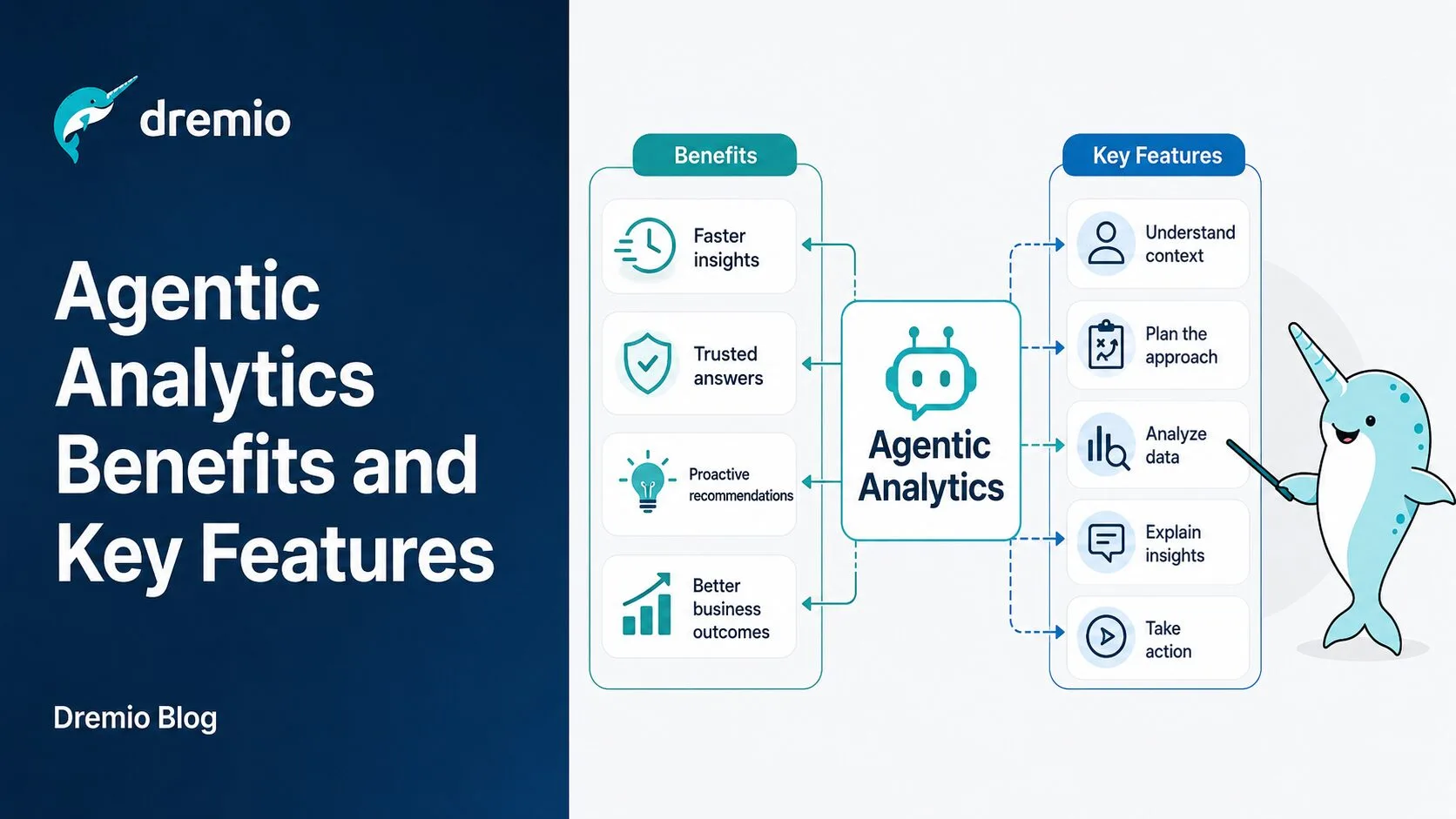
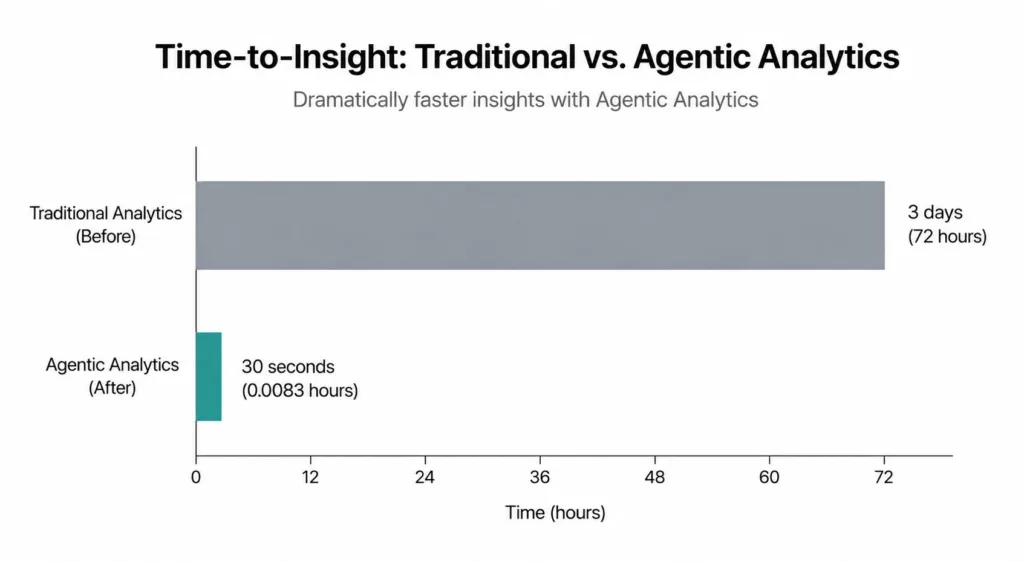
Most enterprise data teams are buried. A business user files a ticket for a number, waits three days, gets a dashboard that almost answers the question, then files another ticket to adjust it. Enterprise agentic analytics breaks that loop by putting AI agents to work directly on governed data, so the person who has the question can get a trusted answer in the time it takes to type it.
This shift is already happening at scale. A 2025 PwC survey found that 79% of organizations say AI agents are being adopted in their companies, and Deloitte projects that the share of generative AI adopters piloting agentic AI will climb from 25% in 2025 to 50% by 2027. Gartner now tracks agentic analytics as a top emerging capability for enterprise BI in its 2025 Market Guide. This post explains what agentic analytics is, the benefits it brings to enterprise teams, how it sharpens decision-making, the features that separate real platforms from thin demos, and where Dremio fits.
Key highlights:
Agentic analytics uses AI agents to discover data, plan and run analytical steps, interpret results, and recommend or take action with little manual effort.
Enterprise teams get faster answers, shorter ticket queues, and consistent business definitions across every question they ask.
Strong agentic analytics needs more than a large language model wired to a database. It needs unified access, semantic context, governance, and performance that holds up under load.
Dremio delivers agentic analytics on an open lakehouse, with a built-in AI Agent, an AI Semantic Layer, and the first MCP interface in the industry for connecting outside agents to governed data.
What is agentic analytics?
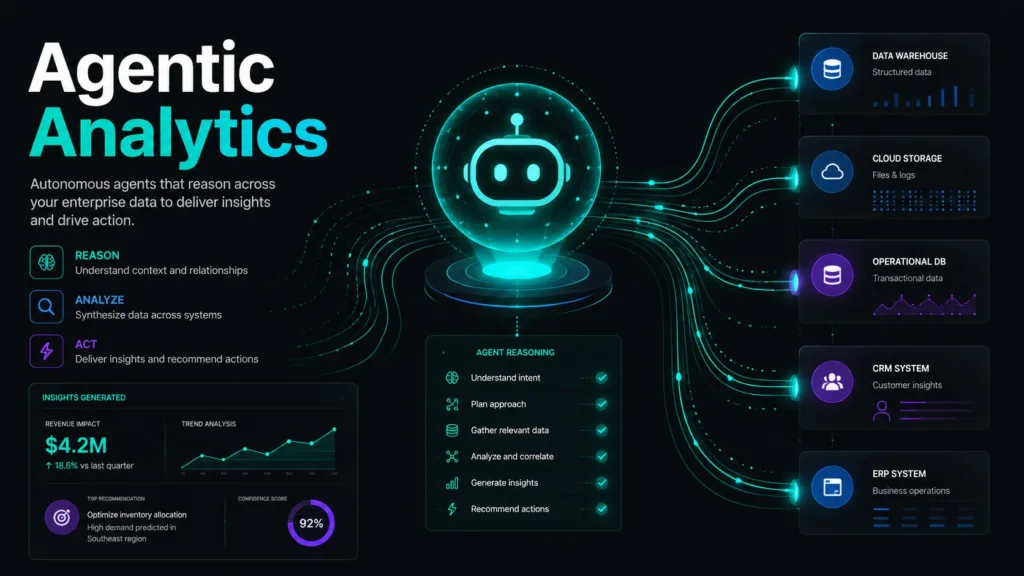
Agentic analytics is a method of data analysis where autonomous AI agents discover the right data, plan and run the analytical steps, interpret the results, and return answers or recommended actions with little manual direction. Instead of a person writing SQL or clicking through a dashboard, an agent reads the question, decides what data it needs, runs the queries, checks the output, and explains what it found. You can read a deeper breakdown in our guide to agentic analytics.
The difference from older approaches comes down to who does the work and how many steps the system can handle on its own. Traditional BI gives you dashboards. You still have to read them, form a hypothesis, and ask a data analyst to dig deeper. Conversational analytics added a chat box on top, so you could ask "what were sales last quarter" and get a single answer back. That is useful, but it stops at one question. Agentic analytics goes further. It chains multiple steps together, follows the trail, and acts.
Capability
Traditional BI
Conversational analytics
Agentic analytics
Who drives the analysis
The analyst
The user, one question at a time
The agent, end to end
Typical output
A static dashboard
A single answer
An answer, the reasoning, and a recommended action
Multi-step reasoning
Manual
Limited
Built in
Acts on the result
No
No
Yes, within set guardrails
Here is a concrete example. Sales drop in one region. A traditional dashboard shows the dip and stops there. An agent segments the data by traffic source, device, and geography, finds the drop is concentrated among mobile users, cross-references recent deployments, spots a payment gateway change from a specific date, then flags it with a suggested fix. Same data. Very different result.
What are the benefits of agentic analytics for enterprise teams?
The benefits of agentic analytics show up most clearly at the team and organization level, not just for one analyst running one report. When every business function can ask hard questions and get trusted answers without waiting in a queue, the whole company moves faster.
Expanded self-service analytics
For years, self-service meant handing business users a dashboard tool and hoping they could find what they needed. Most could not, so they filed tickets anyway. Agents change the floor of what self-service means, because the user no longer has to know table names, join logic, or where the data lives.
A marketer can ask why churn rose last month and get a real answer, not a link to a report. That widens the pool of people who can actually use enterprise data. See how this connects to a broader self-service analytics strategy.
Reduced pressure on data teams
Data teams spend a huge share of their week on repetitive request work. Pull this number. Add a filter. Rebuild this view. Agentic analytics absorbs that recurring load, which frees engineers and analysts to work on the harder problems that actually need a human.
The effect on the data team is real and measurable. Amazon's SCOT Finance Analytics team used Dremio to eliminate 60 hours of work per project and cut query times from 60 seconds to 4 to 6 seconds, while supporting more than 1,000 users. That is time the team got back to build, not babysit.
Improved productivity across workflows
Productivity gains compound when answers arrive in seconds instead of days. A product manager validates a hunch before the standup. A finance lead checks a forecast assumption mid-meeting. The work keeps moving because nobody is stuck waiting on a request.
This is the quiet benefit that adds up over a quarter. Shave a two-day wait off a hundred decisions and you have changed how the business operates, not just how fast one query runs.
Enhanced insight consistency
Ask five analysts to define "active customer" and you may get five answers. That inconsistency is where trust in data breaks down. Agents that draw from a shared semantic layer apply the same definition every time, so the number is the number no matter who asks.
Consistency matters more as more people and more agents query the same data. When every answer traces back to one governed source of truth, you stop arguing about whose spreadsheet is right and start acting on the result.
Scaled access to enterprise business intelligence
Traditional business intelligence tends to concentrate in the hands of a few power users. Everyone else consumes pre-built reports. Agentic analytics flips that ratio, because natural language lowers the skill barrier to near zero.
That scale is the point. When a thousand people can each get a governed answer to a specific question, BI stops being a bottleneck and becomes a shared utility the whole company runs on.
How does agentic analytics improve decision-making?
Agentic analytics improves decision-making by collapsing the distance between asking a business question and receiving a relevant, trusted answer you can act on. The slow part of most decisions was never the thinking. It was the waiting: waiting for a query, a report, a follow-up, a meeting. Agents remove most of that wait.
Faster access to insights: Answers arrive in seconds, so decisions happen while the moment still matters instead of after the opportunity has passed.
Automated multi-step analysis: The agent runs the full chain of queries, segmentation, and cross-referencing that used to take an analyst hours, and it does it in one pass.
More effective follow-up questions: Because the agent keeps context, you can drill from "what happened" to "why" to "what should we do" without restarting from scratch each time.
Consistent use of business context mapping: Every answer applies the same metric definitions and relationships, so two teams asking the same question get the same number.
A clearer path from insight to action: The agent does not just surface a chart. It explains the cause and recommends a next step, which is what a decision actually needs.
McKinsey's June 2025 research on the agentic AI advantage makes the same point at the enterprise level. The value shows up when organizations move past insight generation into faster decision cycles and automated follow-through. The companies that win are the ones that act on what they learn, not the ones that simply learn faster.
What features should you look for in an agentic analytics solution?
Plenty of vendors will tell you they do agentic analytics. Most of them are pointing a large language model at a database and calling it a day. That setup hallucinates column names, ignores governance, and falls over the moment two people ask at once. Real enterprise agentic analytics needs a foundation underneath the agent. Here are the seven features that separate a working platform from a demo.
Feature
What it gives you
Natural language query capability
Plain-English questions translated into correct, optimized SQL
Unified enterprise data access
One governed view across every source, no copying
Semantic context and business definitions
A shared vocabulary so agents read your data correctly
Governance and access controls
Permissions enforced at the engine, not the chat layer
Explainable and auditable results
A traceable record of what the agent ran and why
Scalable query performance
Sub-second answers that hold up under concurrent load
Agent and application interoperability
Open standards so any agent or tool can connect
1. Agentic analytics with natural language query capability
Natural language query capability lets a user ask a question in plain English and get an accurate answer back, with the system handling the translation into SQL behind the scenes. Good natural language processing is more than pattern matching. It reads intent, maps business terms to the right tables, applies the correct filters and joins, and runs an optimized query, all without the user touching code.
Why it matters:
It opens data to people who will never write SQL, which is most of the company.
It removes the slowest step in self-service, the handoff to a technical analyst.
It only works well when the language model sits on top of real business context, not raw table names.
2. Unified enterprise data access
Unified enterprise data access means agents can reason across all your data, on-prem and cloud, lakehouse and database, without anyone copying it into a single proprietary store first. A query engine that federates across sources gives the agent one place to look, so it never has to guess which silo holds the answer. Strong unified data analytics and clean data access are what make a question like "which customer segment has the highest refund rate by product category" answerable at all, since that single question touches customer, order, and product data at once.
Why it matters:
An agent can only answer questions about data it can reach, so fragmentation directly limits what you can ask.
Querying data in place avoids the cost, delay, and drift of building copies for every use case.
One access layer means one place to apply governance, instead of a dozen.
3. Semantic context and business definitions
Semantic context is the layer that tells an agent what your data actually means. Without it, an agent sees columns named amt, stat, and cust_id and has to guess, and wrong guesses produce SQL that runs fine but returns the wrong answer. A Semantic Layer maps those raw fields to business concepts like "active customer" or "annual recurring revenue," along with the relationships between tables, so the agent reasons with your vocabulary instead of inventing its own.
Why it matters:
It is the single biggest factor in whether agent answers are trustworthy or misleading.
Shared definitions keep every team and every agent aligned on what a metric means.
It turns raw storage into something an agent can actually reason about safely.
4. Governance and access controls
Governance decides who sees what, and a real agentic platform enforces it at the query engine, not in the chat interface where an agent could route around it. Strong data governance means permissions travel with the data end to end, so an agent acting for a given user returns only the rows that user is cleared to see. The agent has no side channel and no way to bypass the rule.
Why it matters:
AI without enforced access controls is a data leak waiting to happen.
Permissions that live at the engine apply to every agent automatically, with no per-agent setup.
Regulated industries cannot adopt agentic analytics at all without this layer.
5. Explainable and auditable results
Explainability means you can see how the agent reached its answer, and auditability means there is a permanent record of it. Every query an agent runs should create a job entry that captures the SQL, the user or service account behind it, the timestamp, rows returned, and run time. That record is what lets a governance team review activity, set alerts for unusual patterns, and prove compliance later.
Why it matters:
People will not trust an answer they cannot trace back to its source.
Auditors and regulators need a record, not a black box.
A full job history turns "the AI said so" into "here is exactly what it ran."
6. Scalable query performance
Scalable performance is the difference between a slick demo and a platform a thousand people can lean on. When agents fire unpredictable data querying at all hours, manual tuning breaks down, so the system has to optimize itself. Automatic materializations and query rewrites can keep response times sub-second even as load climbs, which ties directly into performance management at enterprise scale. In real deployments, this approach accelerated 80% of workloads without manual tuning and dropped some query times from 13 seconds to 1 second.
Why it matters:
Agents generate far more queries than humans, so performance has to scale without a person tuning it.
Slow answers kill the core promise of agentic analytics, which is speed.
Self-optimizing performance keeps cost flat as usage grows.
7. Agent and application interoperability
Interoperability means any agent or tool can connect to your data through an open standard instead of a custom integration. The Model Context Protocol gives compliant agents a single governed gateway, so you configure it once and any agent that speaks the protocol connects automatically. Real interoperability keeps you free to bring whichever agent you want, from Claude to ChatGPT to Gemini to your own, without rebuilding the plumbing each time.
Why it matters:
Open standards prevent lock-in to one vendor's agent or stack.
One governed interface beats a dozen brittle custom connectors.
You can adopt new agents as they appear, without touching the data layer.
Enable better agentic analytics for enterprises with Dremio
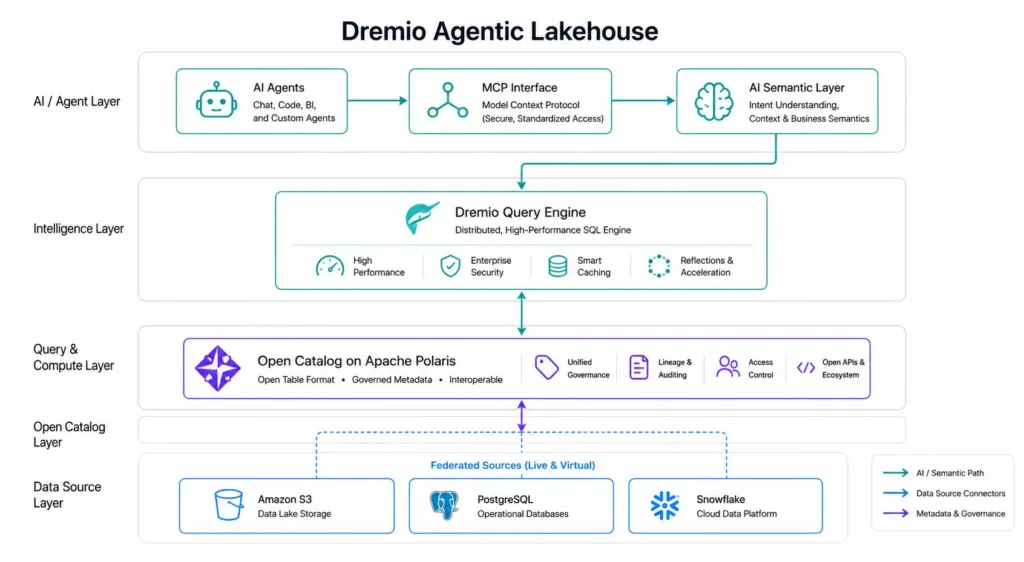
Dremio is an open, high-performance lakehouse platform built to speed up AI and analytics across distributed enterprise data. It is The Agentic Lakehouse, the only data platform built for agents and managed by agents, and it brings every feature above together in one place. Explore the full platform in Dremio's Agentic Lakehouse.
What you get with Dremio:
A built-in AI Agent that lets business users and analysts ask questions in plain language and get governed answers and visualizations in seconds.
An AI Semantic Layer that gives agents the business context they need to avoid hallucinations and return accurate results.
Zero-ETL federation through an Intelligent Query Engine that queries structured, semi-structured, and unstructured data where it lives, with no copying.
The first MCP interface in the industry, so MCP-enabled agents from Anthropic, OpenAI, and Google connect to your governed data in minutes.
AI Functions in SQL like AI_GENERATE, AI_CLASSIFY, AI_COMPLETE, and LIST_FILES, which pull structured insight out of PDFs, images, and documents without a separate pipeline.
Open Catalog powered by Apache Polaris, which Dremio co-created, for unified governance and lineage across any Iceberg-compatible engine.
End-to-end access control and a full job history, so permissions travel with your data and every agent query is auditable.
Dremio runs natively on Apache Iceberg, Polaris, and Arrow, and the company is a co-creator of Arrow and Polaris and a key Iceberg contributor. That open foundation is why agentic analytics on Dremio means no lock-in and no proprietary storage tax. Try connecting your AI agents to governed lakehouse data through Dremio's MCP server by getting in touch with the Dremio team at dremio.com/contact.
Book a demo today and explore how Dremio can power agentic analytics across your enterprise data.
Frequently asked questions
How does agentic analytics work?
An AI agent takes a question, figures out which data it needs, generates and runs the queries, checks the results, and returns an answer with its reasoning. It leans on a semantic layer to read your data correctly, a governance layer to stay within permissions, and a query engine to run fast. The agent handles the multi-step chain that a human analyst used to run by hand.
How is agentic analytics different from traditional BI?
Traditional BI gives you dashboards and reports that you read and interpret yourself. Agentic analytics does the interpreting, follows the trail across multiple steps, and recommends an action. BI tells you what happened. An agent tells you what happened, why, and what to do about it, then can act within guardrails you set.
Will agentic analytics replace data analysts?
No. It changes what analysts spend their time on. Agents absorb the repetitive pull-this-number work, which frees analysts for the harder problems: defining metrics, designing the semantic layer, validating models, and governing how agents behave. The role shifts from running queries to shaping and overseeing the system that runs them.
What are the main risks of adopting agentic analytics?
The biggest risks are wrong answers from missing context, data exposure from weak governance, and runaway cost from unoptimized queries. Each maps to a feature above. A strong semantic layer prevents bad SQL, engine-level access controls prevent leaks, and self-optimizing performance keeps cost in check. The risk is not the agent. It is deploying one without the governed foundation underneath it.
Try Dremio Cloud free for 30 days
Deploy agentic analytics directly on Apache Iceberg data with no pipelines and no added overhead.
Ingesting Data Into Apache Iceberg Tables with Dremio: A Unified Path to Iceberg
By unifying data from diverse sources, simplifying data operations, and providing powerful tools for data management, Dremio stands out as a comprehensive solution for modern data needs. Whether you are a data engineer, business analyst, or data scientist, harnessing the combined power of Dremio and Apache Iceberg will undoubtedly be a valuable asset in your data management toolkit.
Sep 22, 2023·Dremio Blog: Open Data Insights
Intro to Dremio, Nessie, and Apache Iceberg on Your Laptop
Editor’s note, September 2026. This post was published in September 2023 and some product details have changed since. Nessie is still available and self-deployable under the Apache-2.0 licence, and it remains the clearest implementation of catalog-level branching. It is not an Apache Software Foundation project, and its development has slowed considerably. For how the current […]
Oct 12, 2023·Product Insights from the Dremio Blog
Table-Driven Access Policies Using Subqueries
This blog helps you learn about table-driven access policies in Dremio Cloud and Dremio Software v24.1+.