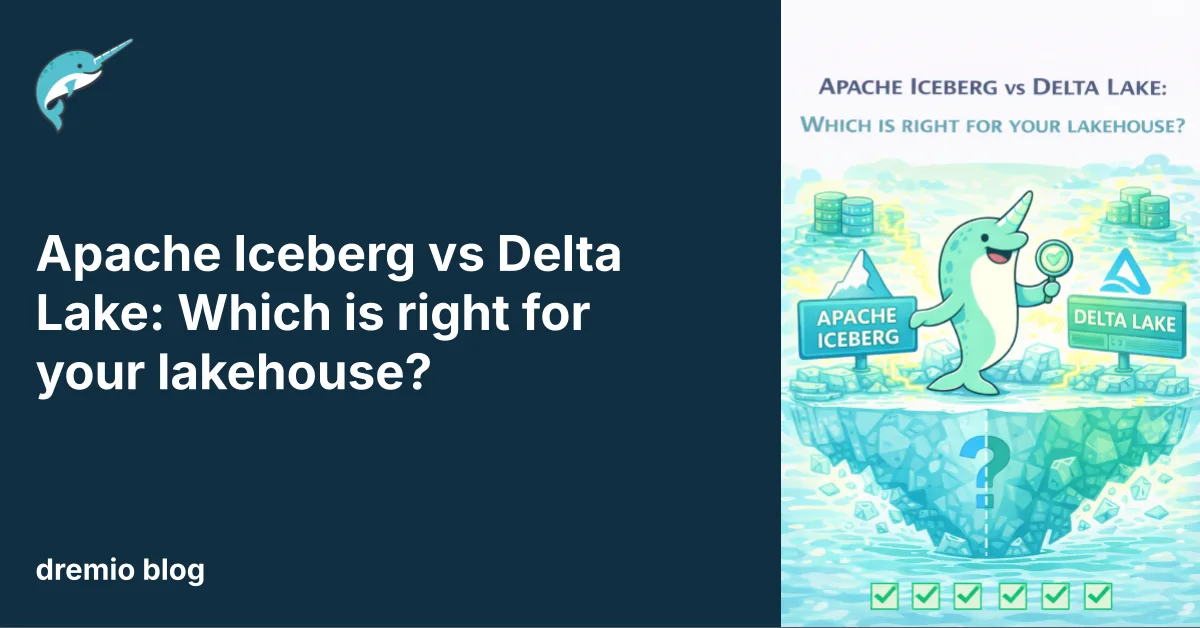
Choosing between Apache Iceberg and Delta Lake affects how open, flexible, and future-proof your lakehouse architecture will be. Both table formats bring ACID transactions, schema evolution, and time travel to data lakes, but they differ in metadata design, engine compatibility, governance structure, and long-term portability. The Apache Iceberg vs Delta Lake decision shapes how your organization runs analytics, supports AI workloads, and avoids vendor lock-in.
This comparison breaks down the architectural differences, ecosystem dynamics, and strategic implications of each format. Whether you are building a new lakehouse or modernizing an existing one, the table format you choose determines which engines, catalogs, and tools can work with your data.
Capabilities of Iceberg vs Delta Lake
Apache Iceberg
Delta Lake
Metadata architecture and transaction model
Hierarchical manifest-based structure (Avro), scales to billions of files with fast query planning
Transaction log (delta_log) with JSON records and Parquet checkpoints, optimized for Spark
Engine compatibility and query interoperability
Engine-agnostic: native support in Spark, Flink, Trino, Presto, Dremio, Athena, Snowflake
Spark-optimized with connectors for other engines, UniForm for cross-format reads
Apache Software Foundation, community-led governance with 30+ contributing companies
Linux Foundation, but roadmap influenced primarily by Databricks
Vendor lock-in and long-term portability
Low: specification-driven, no single-vendor dependency
Moderate: strongest performance and features within Databricks/Spark ecosystem
What is Apache Iceberg?
Apache Iceberg is an open table format specification created at Netflix and now maintained by the Apache Software Foundation. It adds reliable ACID transactions, schema evolution, time travel, and partition evolution to data stored in cloud object stores like S3, ADLS, and GCS. Iceberg treats the table format as a pure specification, not a library tied to a specific engine.
Iceberg's design separates the format definition from any single runtime. The specification describes how metadata and data files are organized, how transactions are committed, and how catalogs interact with tables. Multiple engines can read and write the same Iceberg table concurrently because the format is vendor-neutral. This approach has led to broad adoption across Spark, Flink, Trino, Presto, Dremio, Snowflake, and AWS Athena.
What is Delta Lake?
Delta Lake is an open-source storage layer originally created by Databricks and now hosted under the Linux Foundation. It extends Parquet files with a transaction log that records every change to a table, adding ACID compliance, time travel, and schema enforcement to data lake workloads.
Delta Lake is deeply integrated with Apache Spark, where it delivers its strongest performance and feature coverage. The _delta_log directory stores JSON transaction records and periodic Parquet checkpoints that track the state of the table. Databricks has expanded Delta Lake's reach through features like UniForm, which allows Delta tables to be read by Iceberg and Hudi clients, broadening interoperability beyond the Spark ecosystem.
Differences between Apache Iceberg and Delta Lake
Both formats solve similar problems, but they take different architectural approaches. These differences affect how tables scale, which engines can access the data, and how much control you retain over your data infrastructure.
Metadata architecture and transaction model
Iceberg uses a hierarchical metadata structure: a table metadata file points to manifest lists, which point to manifest files containing data file references and column-level statistics. This design allows queries to prune irrelevant files before scanning any data, which is critical for tables with billions of files. All metadata is stored in Avro format, and updates are atomic. This metadata architecture scales predictably as tables grow.
Delta Lake uses a flat transaction log stored in a _delta_log directory. Each transaction creates a JSON file, and periodic Parquet checkpoints consolidate the log for faster reads. This design is simple and works well in Spark-centric environments, but checkpoint performance can vary with very large tables or high write throughput.
Why it matters:
Iceberg's manifest-based pruning delivers faster query planning at petabyte scale
Delta's transaction log is simpler to understand but can require more frequent checkpointing for large tables
Both support ACID transactions, but Iceberg's metadata scales more predictably with table size
Engine compatibility and query interoperability
Iceberg was built as an engine-agnostic format. It has native, production-grade support in Spark, Flink, Trino, Presto, Dremio, AWS Athena, Snowflake, and StarRocks. The REST catalog API allows any language or cloud to interact with Iceberg tables without relying on a specific engine's runtime. This means you can write data with Spark and query it with Trino without compatibility issues.
Delta Lake is optimized for Apache Spark and delivers its best performance and feature coverage within the Spark and Databricks ecosystem. Connectors exist for other engines, but the depth of integration and performance are strongest with Spark. Delta Connect is a newer initiative that decouples table access from Spark, offering clients in Rust, Go, and other languages.
Delta's Spark optimization is an advantage for Spark-first organizations
Organizations running diverse query engines get more flexibility from Iceberg
Catalog and governance flexibility
Iceberg defines a REST catalog specification that any vendor can implement. This has led to multiple production-ready catalog implementations, including Apache Polaris (co-created by Dremio), AWS Glue, Project Nessie, and the Hive Metastore. Organizations can switch catalogs or run multiple catalogs without changing their table format.
Delta Lake's governance center is Unity Catalog, which is managed by Databricks. The Hive Metastore is also supported, but advanced governance features (lineage, access control, data sharing) are most complete within Unity Catalog.
Why it matters:
Iceberg's catalog flexibility reduces dependency on any single vendor's governance tool
Delta's Unity Catalog provides a comprehensive governance solution for Databricks-centric organizations
Catalog choice directly affects data portability and multi-vendor strategy
Ecosystem and roadmap control
Iceberg is governed by the Apache Software Foundation, with contributions from engineers at over 30 companies including Apple, Netflix, Dremio, Snowflake, AWS, and Cloudera. The roadmap is decided through the ASF's consensus-based governance process, which prevents any single company from controlling the format's direction. This open data ecosystem model gives users confidence in long-term neutrality.
Delta Lake is hosted by the Linux Foundation, which provides organizational governance. The reality is that Databricks contributes the majority of code and drives most roadmap decisions. This is not inherently negative, as Databricks has invested heavily in Delta Lake's development, but it does mean one company has outsized influence on the format's direction.
Why it matters:
Iceberg's community governance gives users a voice in the format's future
Delta's Databricks-led development delivers rapid feature releases
Long-term strategic bets are safer when no single vendor controls the specification
Vendor lock-in and long-term portability
Iceberg's specification-driven design means data is portable across engines, catalogs, and clouds. If you move from one query engine to another, or from one cloud provider to another, your Iceberg tables remain fully accessible. No single vendor owns the runtime or the catalog.
Delta Lake's strongest features and performance are within the Databricks ecosystem. UniForm improves cross-format reads, and Delta Connect broadens language support, but the fullest Delta Lake experience remains tied to Spark and Databricks tooling.
Why it matters:
Iceberg minimizes the risk of data lock-in across engines, catalogs, and clouds
Delta delivers a strong integrated experience within Databricks
Organizations prioritizing long-term flexibility and multi-vendor choice lean toward Iceberg
Choosing between Delta Lake and Iceberg: Why open and interoperable data management matters
Modern lakehouses are no longer just analytics platforms. They are the data foundation for AI agents, automation systems, and real-time decision pipelines. The table format you choose either opens or constrains the tools, engines, and workflows that can interact with your data.
Multi-engine analytics is the new default
Most enterprises now run more than one query engine. A team might use Spark for data engineering, Trino for ad-hoc analytics, and Dremio for BI workloads, all against the same data. A table format that supports only one engine forces data copying or limits tool choice.
Iceberg's native multi-engine support lets teams pick the right tool for each job
Multi-engine architectures reduce dependency on a single vendor's pricing and roadmap
AI and agentic systems depend on metadata transparency
AI agents need clear metadata to discover, understand, and query data. They cannot resolve ambiguous column names or navigate inconsistent catalog structures. Formats with rich, structured metadata and open catalog APIs give AI systems the context they need to operate accurately.
Iceberg's manifest files include column-level statistics that AI systems can use for intelligent pruning
Open catalog APIs allow AI agents to discover tables and metadata programmatically
Hybrid and multi-cloud architectures demand portability
Organizations running workloads across AWS, Azure, GCP, and on-premises need data formats that work across all environments. A format tied to a single vendor's cloud or runtime creates friction when workloads move. Portability across multi-cloud environments is a strategic requirement.
Iceberg tables stored in S3, ADLS, or GCS are accessible from any compatible engine
Cloud-agnostic table formats reduce egress costs and avoid provider lock-in
Decoupled storage, compute, and catalog layers reduce risk
When storage, compute, and catalog are tightly coupled, switching any one component requires changing all three. Decoupled architectures let organizations upgrade engines, change catalogs, or move storage independently, reducing migration risk and cost.
Iceberg's separation of format, catalog, and engine means each can evolve independently
Decoupled layers protect against single-vendor failures or pricing changes
Long-term format governance influences strategic control
Your table format is a long-term infrastructure decision. If the organization that controls the format changes its direction, pricing, or licensing, your data infrastructure is affected. Community-governed formats reduce this risk by distributing control across multiple stakeholders.
Apache governance means no single company can change Iceberg's specification unilaterally
Strategic data infrastructure decisions should account for governance model and long-term neutrality
How the Iceberg data format aligns with an open lakehouse strategy
Agentic AI systems often combine Spark, Trino, Python-based processing, vector engines, and streaming frameworks. Table formats must support multi-engine read and write access without friction. Iceberg's design was built for this reality. The format is open-sourced and specification-driven, making it a natural fit for organizations committed to an open lakehouse strategy.
Iceberg is a specification, not a library. Any query engine that implements the specification can read and write Iceberg tables. This is fundamentally different from formats that are tightly coupled to a specific engine's runtime. Specification-driven design means engine choice is a deployment decision, not a data format constraint.
Spark, Flink, Trino, Presto, and Dremio all implement the Iceberg specification independently
Teams can switch engines or add new ones without migrating data
Iceberg's hierarchical metadata structure handles metadata management for tables with billions of files. The manifest-based approach allows queries to prune partitions and files before scanning, which keeps query planning fast even as tables grow. This scalability is critical for real-time data pipelines and high-volume ingestion workloads.
Manifest files contain column-level statistics for partition pruning at query time
Metadata snapshots provide time travel and audit capabilities without performance degradation
Iceberg's REST catalog API means organizations can choose the catalog that fits their governance needs. Apache Polaris, AWS Glue, Project Nessie, and the Hive Metastore all support Iceberg tables. Switching data catalogs does not require migrating data or changing table formats.
REST catalog API provides a standard interface for catalog operations across vendors
The Apache Software Foundation's governance model requires consensus among contributors from multiple companies. No single vendor can push changes that benefit only its products. This transparency gives users confidence that the format will remain neutral and open.
Specification changes require community review and approval
Contributions from 30+ companies prevent roadmap capture by any single vendor
5. Alignment with open lakehouse platforms
Iceberg's design aligns with the open lakehouse model: open formats, open catalogs, and engine-agnostic data access. Platforms like Dremio, Snowflake, AWS, and Cloudera all invest in Iceberg support because it enables the multi-vendor, multi-engine architectures that enterprises need.
Major cloud providers and data platforms invest in Iceberg because it fits their customers' multi-vendor strategies
Open lakehouse architectures reduce total cost of ownership by avoiding single-vendor premiums
Enable an open, AI-ready lakehouse with Apache Iceberg and Dremio
Dremio is an agentic lakehouse platform designed around open table formats and open data architecture. As co-creators of Apache Arrow and Apache Polaris, Dremio has deep roots in the open-source data ecosystem. For organizations weighing Apache Iceberg vs Delta Lake, Dremio's architecture is built for the openness and flexibility that Iceberg delivers.
Native Iceberg support: Full read/write support with DML, DDL, schema evolution, time travel, and partition evolution
Autonomous optimization: Intelligent clustering, automatic caching, and transparent query rewriting, no manual tuning
Open catalog integration: Works with Apache Polaris, AWS Glue, Nessie, and other Iceberg catalogs
Zero-ETL federation: Query Iceberg tables alongside other data sources without data movement
AI-ready architecture: Semantic layer, metadata-rich catalog, and MCP connectivity for agentic AI systems
Book a demo today and see how Dremio works with the Iceberg data format to power open, interoperable and AI-ready lakehouse architectures.
Frequently asked questions
What are the main use cases for Delta Lake vs Iceberg?
Delta Lake is used most often in Spark-centric data engineering and machine learning pipelines, where deep Spark integration and Databricks tooling add value. Enterprises choose Iceberg to build multi-engine analytics architectures that span Spark, Flink, Trino, Dremio, and other tools. Iceberg's engine neutrality makes it the preferred format for organizations that want to avoid tying their data infrastructure to a single vendor's query engine.
Can I use Delta Lake outside Databricks?
Yes. Delta Lake is open source and can be used with Apache Spark outside of Databricks. Delta Connect also provides access for clients in Rust, Go, and other languages. UniForm allows Delta tables to be read through Iceberg and Hudi interfaces. That said, the most complete feature set and performance optimizations are available within Databricks and Spark environments.
Which open table format is best for AI workloads?
For AI workloads that require multi-engine data access, rich metadata, and open catalog integration, Apache Iceberg is the stronger choice. AI agents and LLMs need transparent metadata, consistent catalog APIs, and format-level support for diverse engines. Iceberg's specification-driven design and manifest-based metadata provide the foundation for high-performing, AI-ready data pipelines. Organizations building data lakehouse architectures for AI should prioritize format neutrality and metadata richness, both areas where Iceberg leads.
Try Dremio Cloud free for 30 days
Deploy agentic analytics directly on Apache Iceberg data with no pipelines and no added overhead.
Intro to Dremio, Nessie, and Apache Iceberg on Your Laptop
We're always looking for ways to better handle and save money on our data. That's why the "data lakehouse" is becoming so popular. It offers a mix of the flexibility of data lakes and the ease of use and performance of data warehouses. The goal? Make data handling easier and cheaper. So, how do we […]
Aug 16, 2023·Dremio Blog: News Highlights
5 Use Cases for the Dremio Lakehouse
With its capabilities in on-prem to cloud migration, data warehouse offload, data virtualization, upgrading data lakes and lakehouses, and building customer-facing analytics applications, Dremio provides the tools and functionalities to streamline operations and unlock the full potential of data assets.
Aug 24, 2026·Dremio Blog: Open Data Insights
Migrating to Apache Iceberg: Strategies for Every Source System
This is Part 15, the final article of a 15-part Apache Iceberg Masterclass. Part 14 covered hands-on Dremio Cloud. This article covers the three migration strategies and how to execute a zero-downtime migration using the view swap pattern. Most organizations do not start with Iceberg. They have years of data in Hive tables, data warehouses, CSV files, databases, […]