Life sciences analytics teams know the dynamic well: the question takes five minutes to ask and six weeks to answer. By the time the extract is ready, the interim analysis window has passed, the formulary negotiation is over, or the adverse event report is already pressing the 15-day FDA deadline.
This is the default operating mode across pharmaceutical, biotech, and medical device organizations today. Clinical data managers, pharmacovigilance analysts, RWE researchers, and commercial analytics directors are perpetually downstream of a data engineering backlog that was never designed to keep pace with the decisions they need to make.
Why Life Sciences Analytics Data Keeps Falling Behind the Business
The fragmentation is structural. A clinical data manager preparing for a DSMB interim analysis might need data from a Medidata Rave EDC system, a LIMS for lab results, a biomarker database, and a CTMS for enrollment status. None of those systems share a common data model or patient identifier. Getting them reconciled is a multi-week data engineering project, every time.
On the commercial side, brand and market access teams are working with a patchwork of CRM exports, specialty pharmacy data feeds, and payer contracting records assembled by a small data engineering team that is perpetually backlogged. Launch tracking dashboards run two to four weeks stale. Market access analyses rely on snapshots that do not reflect last week’s formulary decisions.
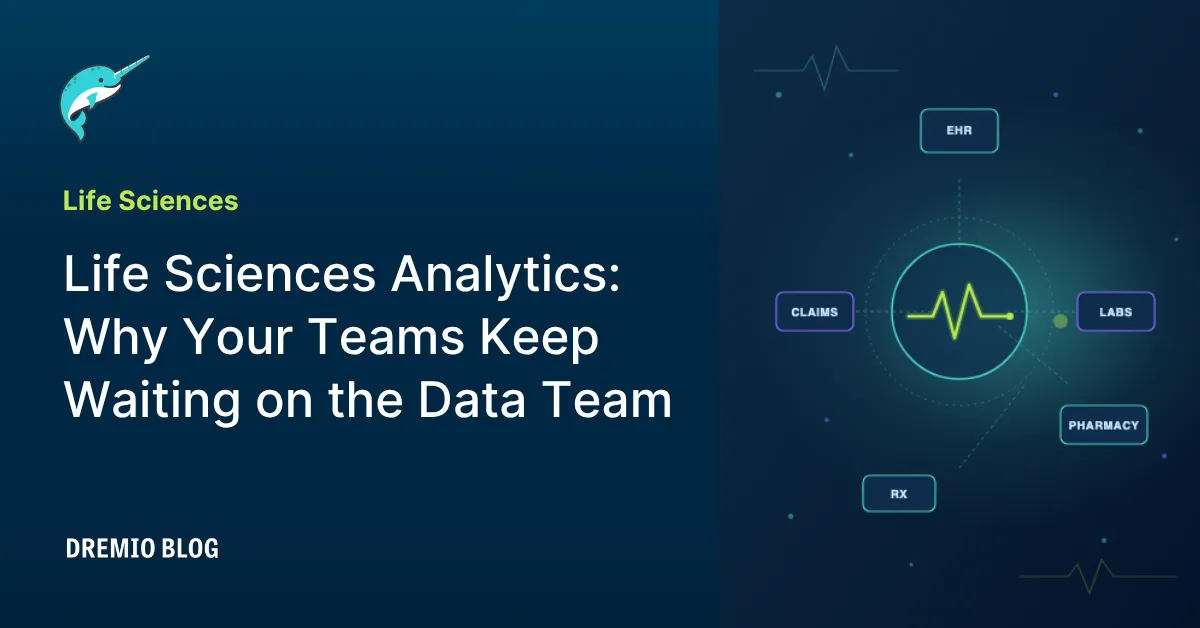
RWE programs add more complexity. Unifying claims, EHR, lab, and patient-reported data across incompatible formats is a months-long effort. Most RWE researchers spend the majority of their time wrangling data rather than generating evidence.
For an industry where regulatory timelines are not negotiable and hypothesis validation delays carry a direct financial cost, this is not a technology inconvenience. It is a business risk.
What Forward-Looking Life Sciences Teams Are Doing Differently
The shift that works does not look like a new central data warehouse. It looks like a query layer that sits across what already exists, governed from a single policy engine.
Clinical data managers should be able to query EDC, LIMS, imaging archives, and biomarker data from one SQL interface without copying data into a repository first. RWE researchers should be able to join claims and EHR records on demand, with PHI enforced at the column level. Pharmacovigilance analysts should have real-time correlation across trial data and MedWatch reports, with every query automatically generating the FDA audit trail. 21 CFR Part 11, GxP, and HIPAA mean that fast answers are not enough. Defensible, auditable answers are.
Dremio’s Agentic Lakehouse connects clinical, research, safety, and commercial data across every source without pipelines, with governance built in. Its Iceberg-native foundation stores every table in an open format, readable by any query engine, without proprietary lock-in. In an industry where vendor relationships outlast the initial contracts, that distinction matters.
For organizations already running SAS, Snowflake, or Databricks, Dremio is not a replacement. It is the governed federation layer that connects what you already have, including existing sources like EDC, LIMS, CRM, and specialty pharmacy feeds. Teams typically go from connection to first query in days, without schema migration.
The same infrastructure that removes the extraction bottleneck today is the governed foundation AI agents need tomorrow. Life sciences teams that solve data unification now are not just moving faster on submissions and evidence generation. They are building the layer that makes pharmacovigilance automation, trial optimization, and AI-driven drug discovery possible.
How Research Teams Are Replacing the Data Request Queue with Self-Service Access
Consider a genomics research program running dozens of concurrent studies on a shared biobank dataset. Each team needs access to specific subsets: whole-genome sequences, clinical phenotypes, lab results, imaging records. The data exists. The problem is getting the right data to the right team, with the right access controls, without a centralized extraction queue slowing every study in line.
In a typical research environment, a bioinformatician files a data access request. The central data team reviews it against the study protocol, extracts the relevant subset, and delivers a file or database extract. For a program running 50 or 100 concurrent studies, this creates a permanent backlog. Senior researchers spend their time managing queues rather than running analyses. Every cohort update or new study arm requires another ticket.
With Dremio, governance moves to the query layer. Research teams query genomic and phenotypic data directly through a single SQL interface, with Polaris Catalog enforcing field-level access controls per project. A pharmacogenomics team can query whole-genome sequences and adverse event phenotypes across 50,000 participants without seeing data from a concurrent oncology study on the same platform. Access rules are defined once per project and applied automatically at query time, shifting the central data team’s role from extraction and delivery to policy governance.
How Genomics England Governs 400 Research Projects Without a Data Request Queue
Genomics England manages the 80-petabyte National Genomic Research Library for 280,000 participants and 400 active research projects on Dremio. Before modernizing their architecture, 1,859 researchers depended on a centralized team to process data access requests manually, creating a bottleneck that slowed every study across the library.
Today, researchers get direct self-service access to more than 6,000 phenotypic data fields, with granular access controls ensuring each of the 400 concurrent projects sees only the data it is authorized for. No central extraction queue. Governance enforced at the query layer, at the scale of a national genomic research program.
For life sciences organizations managing multiple concurrent studies and trials, this is what data access governance without a centralized bottleneck looks like.
Life sciences teams are not short of data. They are short of the infrastructure to use it at the speed the business requires. As long as commercial analytics directors, pharmacovigilance analysts, and clinical data managers are waiting on data engineering, the organization is working with a structural constraint that talent alone cannot close.
Read how life sciences teams use Dremio or book a 30-minute demo to see it for your environment at dremio.com.
Try Dremio Cloud free for 30 days
Deploy agentic analytics directly on Apache Iceberg data with no pipelines and no added overhead.