Data-driven decision-making struggles with bottlenecks, requiring specialized skills and complex queries.
Agentic analytics transforms data interaction; users can ask questions in plain language and receive clear answers.
Dremio's AI Agent utilizes a Semantic Layer, Wikis, and Labels to understand business context and data semantics.
Query federation allows the AI Agent to access all data sources seamlessly, breaking down silos.
Autonomous Reflections optimize performance over time, while the MCP framework enables action-oriented AI agents.
We collect data from applications, sensors, and customer interactions, storing it across databases, data warehouses, and cloud object storage. Yet, for all this information, getting clear, actionable answers remains the single biggest bottleneck to data-driven decision-making. Answering even a simple business question often requires specialized technical skills, complex SQL queries, and a deep understanding of where different datasets are physically located.
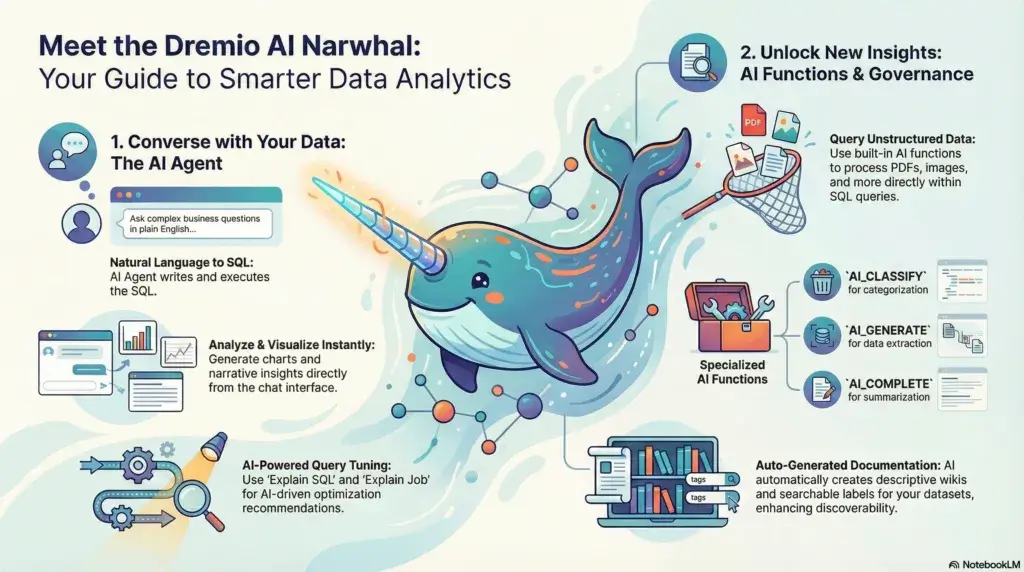
The future of data interaction isn't about writing better queries; it's about having a conversation. This is the promise of 'agentic analytics', transforming your data lakehouse from a passive repository into an active, intelligent partner. You ask a question in plain business language, "Which product line had the highest growth in the last quarter across all regions?", and the agent understands the question's context, finds the right data, generates the query, and delivers a clear answer. This isn't just a future concept; it's a reality enabled by modern data lakehouse platforms.
This post explores four surprising capabilities within the Dremio lakehouse platform that form the foundation for this powerful new way of working with data.
1. Your AI Agent Doesn't Just Read Data, It Understands It
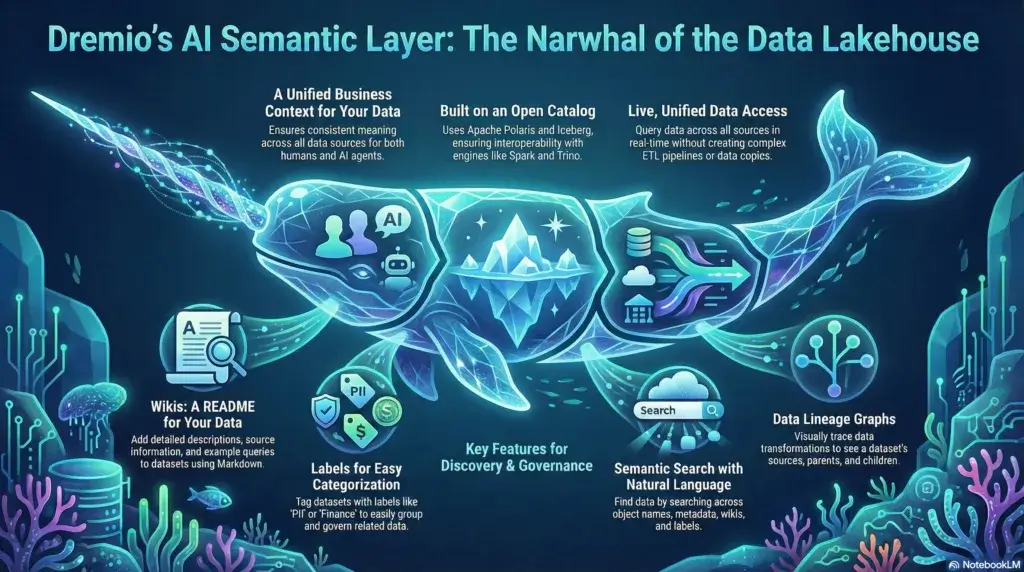
The foundational surprise is this: a truly effective AI agent doesn't just read data; it must speak the language of your business. This is accomplished through Dremio's Semantic Layer, which acts as the "brain" mapping complex, raw physical data to intuitive, business-friendly terms.
This is achieved through a multi-layered approach, from raw data preparation to a curated business layer, that organizes data to match the way your teams think, not the way the data is physically stored. But the key to making this intelligence accessible to an AI agent lies in two specific features: Wikis and Labels.
These are not just static documentation. The AI Agent actively uses the information in Wikis (which provide detailed, Markdown-supported descriptions for datasets) and Labels (which categorize data, such as PII or Finance) to grasp the semantics of the data environment. When a user asks a question, the agent refers to this context to adhere to the established definitions.
This is a critical capability for agentic analytics. An agent that understands business context, knowing that a dataset labeled "PII" is sensitive or that another labeled "Finance" is the official source for financial reporting, can answer nuanced questions more accurately and safely, moving far beyond simple keyword matching.
But understanding the what is only half the battle. A truly effective agent also needs to know where to look, without limitation.
2. The Surprise: Your AI Agent Has a Universal Passport to All Your Data.
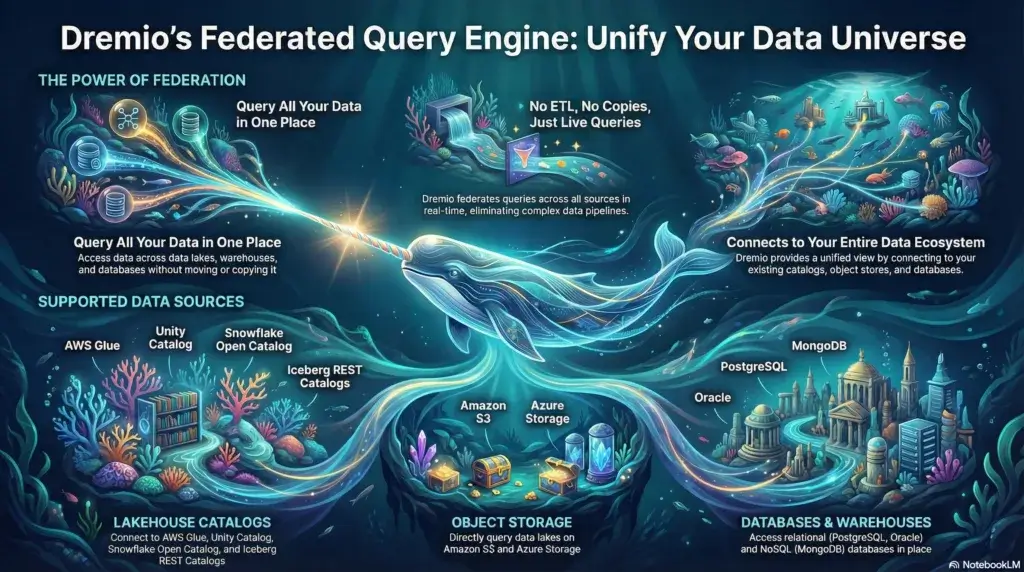
An AI agent's intelligence is limited by its access. Siloed data creates blind spots. Dremio’s query federation eliminates these blind spots, giving the agent a universal passport to query your entire data estate, from the data lake to legacy databases, as if it were one single, logical source.
The platform can connect to and query data from a wide variety of sources simultaneously. This includes object storage, databases, data warehouses, and even other Dremio Software clusters to create a comprehensive federated architecture.
This is what transforms an AI agent from a siloed tool into a true enterprise intelligence. A business user can ask a high-level question, and the agent can generate and execute a single query that joins data from a relational database with data from a lakehouse catalog. The user, and the agent, don't need to know or specify where the underlying data resides, breaking down data silos and dramatically simplifying data access.
With unified access to all data, the next critical question becomes speed. An agent that provides brilliant answers slowly is still a bottleneck.
3. The System Gets Faster By Itself, Just by Watching You Work
In traditional data systems, performance is a debt that accrues over time, paid back with slow queries and manual tuning. The counter-intuitive truth of the Dremio lakehouse is that performance is an asset that compounds over time, automatically.
The core feature here is Autonomous Reflections. As the platform documentation states, "Dremio automatically learns your query patterns and manages Reflections to optimize performance accordingly." In simple terms, the system watches the questions you and your AI agent ask, and then proactively builds and maintains physically optimized data structures, called Reflections, to make the answers to those questions dramatically faster the next time. This intelligent acceleration is applied automatically to modern data lake formats like Apache Iceberg and Parquet, targeting your most valuable analytical assets.
This is complemented by auto-scaling query engines that automatically start, stop, and scale based on query demand, ensuring computational resources are used efficiently. The result is a system that learns and adapts, creating a virtuous cycle of improvement.
Each cycle teaches something new, and when cycles happen quickly, learning compounds. You and your teams develop sharper intuition about what questions to ask, what patterns matter, and which actions drive results.
This removes the traditional burden of performance tuning. The platform's own intelligence ensures that both the AI agent and the business user get faster answers over time, without needing a database administrator to step in.
Now, with intelligence and speed, the final leap is to move from passive answers to interactive action.
4. You Can Have a Conversation with Your Data (And It Can Take Action)
The final piece is moving from a simple request-and-response model to a truly interactive conversation. This is enabled by Dremio’s AI Agent, but the architecture goes a step further with the Dremio Model Context Protocol (MCP) Server. By building on an open protocol, Dremio provides a standardized, extensible framework for developers to create custom, action-oriented AI agents that go far beyond simple Q&A.
The MCP Server uses a three-pronged approach to connect an AI model to the data environment:
Tools (model-controlled): These are functions that AI models can call to perform specific actions. Think of them as the "hands" of the AI – they can execute queries, modify data, or trigger processes.
Resources (application-controlled): These provide read-only access to data sources, giving the AI model the context it needs to understand the environment without allowing modifications.
Prompts (user-controlled): These are pre-defined templates that help users ask questions effectively, guiding them toward the most impactful interactions.
This is a major leap forward for agentic analytics. It moves beyond just answering questions. The MCP framework allows developers to build custom agents that don't just provide information but can also take action. An agent could be designed to not only identify a data quality issue but also trigger a data cleansing pipeline, creating a truly interactive and automated workflow.
Conclusion: What Will You Ask Your New Data Assistant?
The era of agentic analytics is here, transforming how we interact with data. Instead of being a passive repository, your data lakehouse can become an active, intelligent partner in your decision-making process.
These four capabilities are not just a list of features; they are a reinforcing system. The semantic layer provides the context, federation provides the reach, autonomous optimization delivers the speed, and the MCP framework enables the final, crucial step: action. This is the complete blueprint for agentic analytics.
Now that your data can have an intelligent agent, what is the first business problem you would ask it to solve?
Try Dremio Cloud free for 30 days
Deploy agentic analytics directly on Apache Iceberg data with no pipelines and no added overhead.
Ingesting Data Into Apache Iceberg Tables with Dremio: A Unified Path to Iceberg
By unifying data from diverse sources, simplifying data operations, and providing powerful tools for data management, Dremio stands out as a comprehensive solution for modern data needs. Whether you are a data engineer, business analyst, or data scientist, harnessing the combined power of Dremio and Apache Iceberg will undoubtedly be a valuable asset in your data management toolkit.
Sep 22, 2023·Dremio Blog: Open Data Insights
Intro to Dremio, Nessie, and Apache Iceberg on Your Laptop
Editor’s note, September 2026. This post was published in September 2023 and some product details have changed since. Nessie is still available and self-deployable under the Apache-2.0 licence, and it remains the clearest implementation of catalog-level branching. It is not an Apache Software Foundation project, and its development has slowed considerably. For how the current […]
Oct 12, 2023·Product Insights from the Dremio Blog
Table-Driven Access Policies Using Subqueries
This blog helps you learn about table-driven access policies in Dremio Cloud and Dremio Software v24.1+.