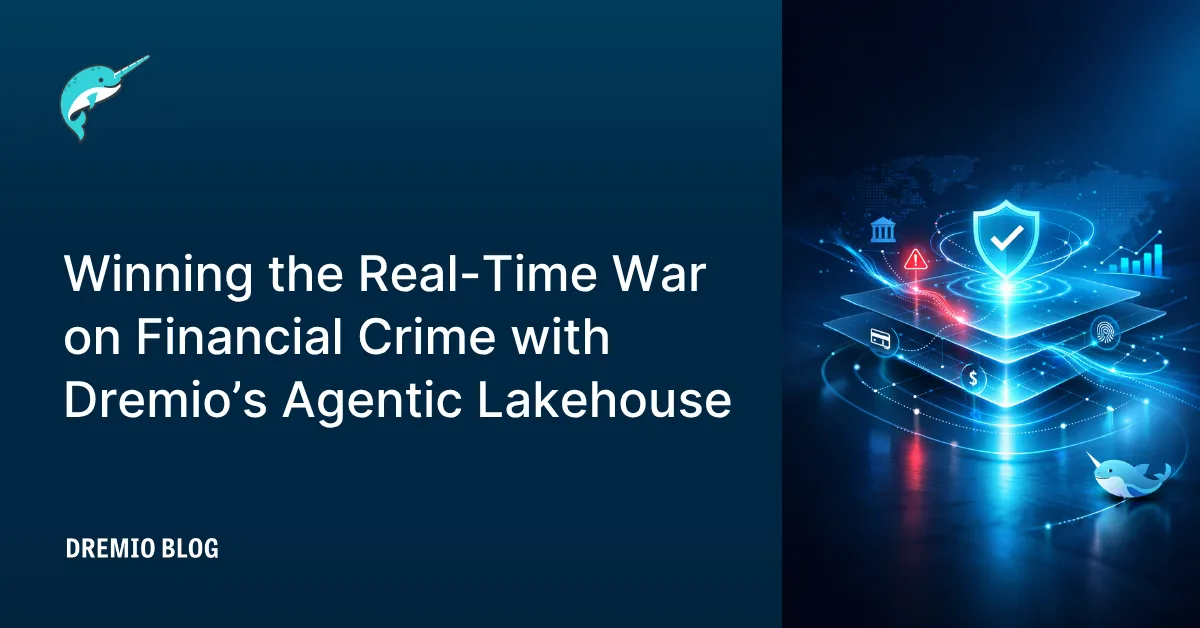
Financial crime has become a trillion‑dollar problem, and the only sustainable way to fight it is with AI‑driven, real‑time analytics on complete, well‑governed data. Dremio’s Agentic Lakehouse platform is designed to give Financial Services organizations exactly what effective fraud and AML programs need: unified data, governed access, and sub‑second analytics across historical and streaming data.
The new face of financial crime
Criminals are innovating faster than many institutions’ defenses. Generative AI, synthetic identities, real‑time payment scams, and global mule networks are reshaping the fraud and AML landscape.
Scam losses worldwide surpassed an estimated 1.03 trillion dollars in 2024, highlighting how industrialized fraud has become.
Fraud scams and bank fraud schemes alone drove about 485.6 billion dollars of projected losses globally, alongside an estimated 3.1 trillion dollars in illicit fund flows.
Over half of fraud cases now involve AI in some form, from deepfake voice and video to highly personalized phishing and social‑engineering campaigns.
At the same time, regulators are pushing harder: AML‑related fines remain in the multiple‑billion‑dollar range each year, driven by failures in transaction monitoring, KYC, and SAR reporting.
Try Dremio’s Interactive Demo
Explore this interactive demo and see how Dremio's Intelligent Lakehouse enables Agentic AI
The size of the problem: global and regional
Financial crime is both massive and unevenly distributed across regions, channels, and products.
Global: The latest Nasdaq Verafin Global Financial Crime Report estimates 3.1 trillion dollars in illicit flows, with 485.6 billion dollars in fraud scams and bank fraud schemes.
Americas: The Americas account for hundreds of billions in criminal proceeds, including drug trafficking, human trafficking, and other organized crime, plus tens of billions in check and payments fraud.
EMEA: Europe, the Middle East, and Africa see substantial scam losses and bank fraud, along with persistent regulatory focus on AML controls and sanctions.
Asia‑Pacific: APAC now represents nearly half of global payments fraud losses, driven by rapid digitalization, instant payments, and high online‑commerce penetration.
In the United States alone, consumers reported losing more than 12.5 billion dollars to fraud in 2024 – a 25% increase over the prior year – even as report volumes stayed roughly flat, meaning more reports now involve actual financial loss.
Selected statistics by region (illustrative)
Region
Key fraud / crime indicators
Global
3.1T dollars illicit flows, 485.6B dollars fraud scams and bank fraud schemes.
Americas
21B dollars in check fraud, majority of global check fraud losses.
EMEA
Significant share of 485.6B dollars global scam and bank fraud losses.
Asia‑Pacific
Nearly half of global payments fraud losses; expected to lead online payment fraud by 2025.
For Financial Services leaders, this isn’t just a revenue‑leakage problem; it is a systemic risk, a regulatory exposure, and a trust issue with customers and markets.
Why traditional fraud and AML defenses are failing
Most incumbent fraud and AML environments were not designed for today’s threat velocity or data complexity.
Common pain points include:
Siloed data: Transaction logs, customer profiles, device signals, behavioral data, alerts, case‑management notes, and external watchlists often sit in different systems, making holistic risk scoring difficult.
Batch‑oriented monitoring: Many AML transaction monitoring systems still operate in overnight or intraday batches, creating detection gaps that real‑time payments exploit.
Static rules: Hard‑coded rules generate high false‑positive rates, can’t adapt quickly to new typologies, and are easy for sophisticated criminals to reverse‑engineer.
Limited AI deployment: Even when advanced models exist, they are often confined to isolated data science environments and never operationalized at production scale on live data.
Meanwhile, adversaries are weaponizing AI: creating convincing deepfakes to bypass identity verification, orchestrating cross‑border mule networks, and probing channels at machine speed.
Emerging trends in fighting financial crime
Leading institutions are responding by modernizing the full fraud and AML stack – technology, data, and operating model.
Key trends include:
AI as frontline defense: Around 90% of financial institutions now use AI to accelerate fraud investigations and detect new attack patterns in real time, applying AI to scams, transaction fraud, and AML alike.
Real‑time risk scoring: Streaming architectures feed live transactional, behavioral, and device data into models that score each event in milliseconds and can automatically block, step‑up authenticate, or escalate to human review.
Holistic customer and counterparty views: Modern lakehouse architectures bring together structured, semi‑structured, and unstructured data – from KYC and sanctions to chat logs and alert histories – to build dynamic risk profiles.
Agentic analytics: AI agents are emerging that continuously monitor KPIs, watch for fraud patterns, and automate routine investigations on top of a governed lakehouse foundation.
Regulatory‑grade governance: Fines and enforcement actions are pushing firms toward centralized controls, explainable models, robust lineage, and repeatable evidence trails, all built on transparent data platforms.
These trends converge on a need that traditional data warehouses and point solutions cannot meet: an open, governed, real‑time analytics platform that can support AI, agents, and human investigators equally well.
How Dremio’s Agentic Lakehouse powers real‑time fraud and AML
Dremio’s Agentic Lakehouse platform is designed to give Financial Services organizations exactly what effective fraud and AML programs need: unified data, governed access, and sub‑second analytics across historical and streaming data.
1. Unified, governed fraud and AML data hub
Dremio enables you to centralize fraud, AML, and risk data on open lakehouse storage (such as cloud object stores) while providing a secure, semantic layer for all analytics and AI.
Open lakehouse foundation: Store transactions, alerts, KYC documents, case notes, device fingerprints, sanctions hits, and external threat intel in open table formats and access them through Dremio’s intelligent engine.
Unified semantic layer: Create governed, business‑friendly views of “Customer,” “Transaction,” “Alert,” and “Case” that power reporting, AI models, and agent workflows without duplicating data into multiple marts.
Built‑in security and governance: Enforce fine‑grained access control, data masking, and row‑level policies so fraud teams, AML investigators, and data scientists can work from the same data while honoring least‑privilege and regulatory constraints.
This reduces the data‑engineering overhead that has historically slowed down fraud and AML innovation, letting you focus on models, typologies, and operations rather than plumbing.
2. Millisecond analytics for real‑time fraud detection
Real‑time fraud prevention depends on the ability to correlate a live transaction with a rich context – customer behavior, historical patterns, and cross‑channel signals – in milliseconds.
Dremio’s Agentic Lakehouse delivers:
Millisecond query performance on live and historical data, enabling real‑time analysis for fraud and risk workloads as demonstrated by large Financial Services customers running at global scale.
Native support for streaming and micro‑batch data, so transaction logs, authentication events, device telemetry, and external risk signals land quickly in the lakehouse and become queryable almost immediately.
Feature‑ready data for ML: Fraud and AML models depend on time‑windowed aggregates and complex features (for example, “number of cross‑border transfers over the past hour for a new device”). Dremio can compute and serve these features on the lakehouse without duplicating pipelines across multiple systems.
The result is an operational fabric where real‑time scoring, alerting, and automated interdiction can run directly on your governed data, rather than on stale extracts.
3. AI and agentic workflows embedded in the lakehouse
Dremio’s platform is built to support AI agents and advanced analytics as first‑class citizens on top of your lakehouse.
AI agents for analytics: Dremio’s Agentic Lakehouse enables AI agents that can plan and execute multi‑step tasks such as monitoring fraud KPIs, detecting emerging patterns, and guiding analysts to relevant data and context.
Explainable investigations: Because models and agents operate on transparent, governed tables and semantic objects, it is easier to explain why a transaction was flagged, how a risk score was computed, and which data elements were used – critical for model risk management and regulatory scrutiny.
Self‑service for fraud and AML teams: Analysts can explore data, tune rules, and test new typologies directly against the lakehouse, shortening the loop between discovery and production.
Institutions like Vanguard and the World Bank Group are already using Dremio to support mission‑critical analytics and AI on massive data estates, including real‑time risk and fraud workloads.
4. End‑to‑end value for Financial Services
For Financial Services organizations, this architecture translates into tangible benefits across fraud and AML functions.
Lower fraud losses: Combining real‑time transaction logs with full‑context customer data and AI models reduces undetected fraud while minimizing customer friction.
Stronger AML posture: A single, governed data platform improves monitoring coverage, SAR quality, sanctions screening analytics, and the evidence trail for regulators.
Faster time‑to‑insight: Customers have seen analytics cycles reduced from weeks to hours and processing windows cut from many hours to minutes by consolidating on Dremio’s lakehouse.
Future‑ready innovation: With AI agents and advanced analytics grounded in open data formats and a semantic layer, you can adopt new tools, models, and cloud services without locking into proprietary stacks.
Putting it together: a modern fraud and AML reference pattern
A Dremio‑powered fraud and AML stack for a modern bank or payments company typically looks like this:
Ingest and land
Stream transactions, login events, device fingerprints, KYC updates, and external watchlists into your cloud lake in near real time.
Use Dremio to expose these feeds as queryable tables and views within seconds or minutes.
Model and score
Data scientists build and train fraud and AML models – supervised, unsupervised, graph‑based – directly on the curated lakehouse data.
At runtime, applications call scoring services that use Dremio to retrieve rich features and profiles in milliseconds for each event.
Detect and interdict
Real‑time pipelines compare risk scores and business rules to dynamic thresholds and policies.
High‑risk events automatically trigger holds, step‑up authentication, or escalations, while AI agents continuously refine thresholds based on new patterns.
Investigate and report
Investigators use Dremio’s semantic layer to explore full customer and counterparty histories, link related alerts, and build cases faster.
Reporting and dashboards for operational metrics, model performance, and regulatory obligations run off the same governed data.
In a world where financial crime is measured in trillions and adversaries are using AI at scale, the institutions that will win are those that can see, understand, and act on risk in real time. Dremio’s Agentic Lakehouse gives Financial Services organizations the unified data foundation and intelligent analytics layer required to do exactly that.
Try Dremio Cloud free for 30 days
Deploy agentic analytics directly on Apache Iceberg data with no pipelines and no added overhead.
Ingesting Data Into Apache Iceberg Tables with Dremio: A Unified Path to Iceberg
By unifying data from diverse sources, simplifying data operations, and providing powerful tools for data management, Dremio stands out as a comprehensive solution for modern data needs. Whether you are a data engineer, business analyst, or data scientist, harnessing the combined power of Dremio and Apache Iceberg will undoubtedly be a valuable asset in your data management toolkit.
Sep 22, 2023·Dremio Blog: Open Data Insights
Intro to Dremio, Nessie, and Apache Iceberg on Your Laptop
We're always looking for ways to better handle and save money on our data. That's why the "data lakehouse" is becoming so popular. It offers a mix of the flexibility of data lakes and the ease of use and performance of data warehouses. The goal? Make data handling easier and cheaper. So, how do we […]
Oct 12, 2023·Product Insights from the Dremio Blog
Table-Driven Access Policies Using Subqueries
This blog helps you learn about table-driven access policies in Dremio Cloud and Dremio Software v24.1+.