Most data teams spend months assembling a lakehouse from separate components: a catalog here, an ETL pipeline there, a query engine bolted on top. Then they repeat the process when leadership asks for "AI-powered analytics." The result is a stack of loosely connected tools, each with its own governance model, its own failure modes, and its own learning curve.
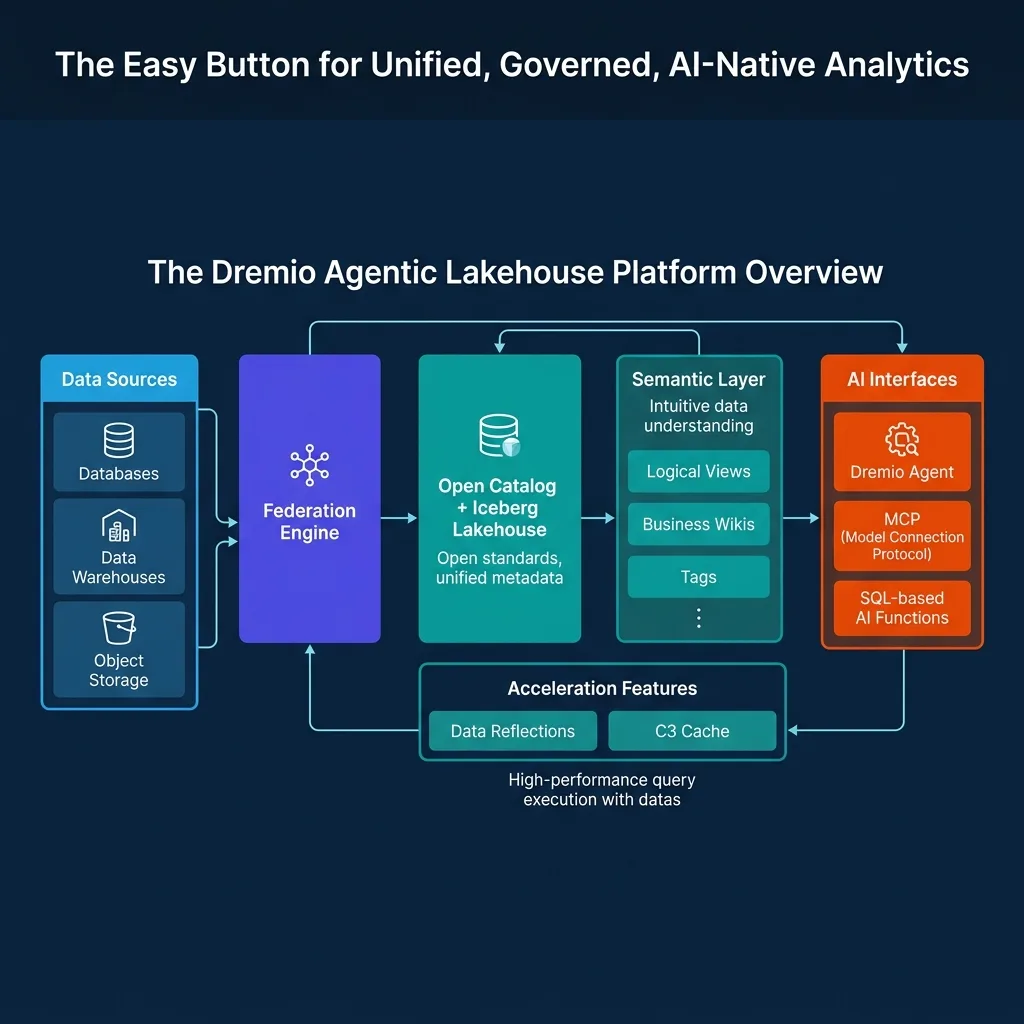
Dremio takes a different approach. It combines query federation, an Iceberg-native lakehouse, a built-in semantic layer, and governed AI interfaces into a single platform. You do not need to wire together five different systems to get from raw data to a business user asking questions in plain English.
This post walks through the four capabilities that make Dremio the easy button for building a unified, governed, AI-native data platform.
Query Federation: Use All Your Data from Day One
The traditional path to data unification is ETL: extract data from every source, transform it, and load it into one central system. This works until you count the cost. ETL pipelines are expensive to build, brittle to maintain, and they guarantee your "unified" view is always stale. By the time data lands in the warehouse, it can be hours or days old.
Dremio's federated query engine skips that entire process. It connects directly to your existing data sources and queries them in place. PostgreSQL, MySQL, MongoDB, S3, Snowflake, BigQuery, Redshift, AWS Glue, Unity Catalog, and more. All of them appear in a single namespace. You write standard SQL, and Dremio handles the rest.
The engine is not just proxying queries. It uses predicate pushdowns to push filtering work to each source system, reducing the volume of data that moves over the network. If you need to join a PostgreSQL customer table with an S3-based clickstream dataset, Dremio executes the join without copying either dataset into a staging area first.
The practical impact: on day one, your analysts and AI agents can access data from every connected source through a single governed interface. No migration project. No six-month ETL buildout.
Federation gives you immediate access, but many workloads benefit from consolidation into a managed lakehouse. Historical data, high-volume analytical tables, and datasets that need automated optimization are better served by Apache Iceberg tables that Dremio manages directly.
This is where DIY lakehouse projects typically fall apart. You pick a catalog, configure compaction jobs, set up manifest optimization, build monitoring for small-file accumulation, and write custom scripts for vacuuming obsolete data. Each piece works in isolation, but integrating them into a reliable production system takes engineering effort that never ends.
Dremio's Open Catalog, built on Apache Polaris, handles all of this automatically. When you create Iceberg tables in Dremio, background jobs take care of compaction, manifest rewrites, data clustering, and vacuuming. You do not configure these jobs. They run based on the table's actual usage patterns.
Performance That Manages Itself
Performance tuning in a traditional lakehouse means manually creating materialized views and hoping you guessed the right query patterns. Dremio automates this with two features:
Feature
What It Does
Reflections
Pre-computed, optimized copies of data stored as Iceberg tables. The query optimizer transparently routes queries to the fastest available Reflection. Users never reference Reflections directly.
Autonomous Reflections
Dremio analyzes your actual query patterns over a 7-day window and automatically creates, manages, and drops Reflections. No human decision-making required.
On top of that, Columnar Cloud Cache (C3) stores frequently accessed data on local NVMe drives at executor nodes. This turns cloud object storage latency into local-disk speed without any configuration.
Governance Built Into the Catalog
Dremio's Open Catalog does not just store metadata. It enforces access controls at the data layer. Role-Based Access Control (RBAC) governs who can see what at the folder, dataset, and column level. Fine-Grained Access Control (FGAC) goes further with UDF-based row-level security and column-level masking, capabilities that standard Iceberg REST catalogs cannot provide.
The result: your data is open (stored in Apache Iceberg, accessible by any compatible engine), but your governance is tight.
The AI Semantic Layer: Context That Makes AI Accurate
Give an LLM direct access to a raw database, and it will generate SQL. The SQL will probably run. It will probably return results. And those results will probably answer the wrong question. The model does not know that "revenue" in your organization means net revenue after returns, or that "active customer" excludes trial accounts that never converted.
Dremio's AI Semantic Layer fixes this by embedding business context directly into the data platform.
Virtual Views: Define Business Logic Once
Views in Dremio are SQL-defined business logic that you create once and reuse everywhere. A view called active_customers can encode all the filters, joins, and exclusions that define what "active" means in your company. Every dashboard, report, and AI query that references this view gets the same answer.
Bronze views standardize raw source data (cast dates, rename ambiguous columns)
Silver views apply cross-source joins and business metrics
Gold views produce final, AI-ready datasets with classifications and scores
Wikis and Tags: Self-Documenting Data
Every dataset and column in Dremio can have Wikis (human-readable documentation) and Tags (categorical labels) attached to it. This metadata is what the AI Agent reads before generating SQL. Better metadata means better answers.
Dremio can also auto-generate this documentation. Its generative AI capability samples your table data and schema, then produces Wiki descriptions and automatically suggests Tags. You review and enhance the output instead of writing everything from scratch.
Governed Agentic AI: Multiple Ways to Talk to Your Data
With federated access, a managed Iceberg lakehouse, and a rich semantic layer in place, your data is ready for AI. Dremio provides several governed interfaces to connect AI to your data.
The Built-In AI Agent
Dremio's AI Agent lives inside the platform UI. You type a question in plain English, and the agent writes SQL, executes it against your governed views, returns results, and generates charts. It suggests follow-up questions based on what it finds. It is not a standalone chatbot bolted onto a database. It is an analytical co-pilot that inherits all the governance policies (RBAC and FGAC) already defined in your catalog.
MCP Server: Extend to Any AI Client
Dremio's open-source Model Context Protocol (MCP) server lets external AI tools connect directly to your Dremio environment. ChatGPT, Claude Desktop, or any custom agent that supports MCP can discover datasets, read schema information, and execute governed queries through a standardized interface. The AI client gets the same semantic context and security controls as the built-in agent.
AI SQL Functions: LLMs Inside Your Queries
For teams that prefer SQL-first workflows, Dremio embeds LLM capabilities directly into the query engine:
Function
What It Does
AI_GENERATE
Extracts structured data from unstructured sources (PDFs, documents) based on a schema and prompt context
AI_CLASSIFY
Categorizes text data directly in SQL (sentiment analysis, PII detection, topic classification)
AI_COMPLETE
Summarizes data or documents into narrative insights
Combined with LIST_FILES (which lets you see files in object storage), these functions allow you to analyze unstructured documents alongside your structured tables in a single query. Run sentiment analysis on customer reviews, extract invoice data from PDFs, or classify support tickets, all without exporting data or writing Python.
The Tradeoffs to Know
Dremio is not the right tool for every workload. Transactional write-heavy applications (OLTP) should stay in their purpose-built databases. Dremio is an analytical engine, not a replacement for PostgreSQL or MongoDB as an application backend.
Federation introduces network latency. If your query joins a PostgreSQL table in us-east-1 with an S3 bucket in eu-west-1, the data has to travel. Reflections and caching mitigate this for repeated queries, but the first execution will be slower than querying co-located data.
Autonomous Reflections need a 7-day observation window before they start optimizing. Day-one performance for brand-new query patterns relies on the engine's baseline optimizations (C3 caching, predicate pushdowns, vectorized execution). The system gets faster over time, not instantly.
Start Where You Are
Dremio is designed for incremental adoption. You do not need to migrate everything on day one. A practical starting path:
Connect your existing sources through federation. Get a unified view without moving data.
Identify high-volume datasets that would benefit from Iceberg table management and migrate those first.
Build semantic views on the datasets your analysts query most. Add Wikis and Tags.
Enable the AI Agent and let business users start asking questions against the governed semantic layer.
Each step delivers value independently. You do not need to complete all four before anyone benefits.
Try Dremio Cloud free for 30 days and see how quickly you can go from scattered data silos to governed agentic analytics on a unified platform.
Keep learning
For a deeper treatment of the topics in this post, download Apache Iceberg: The Definitive Guide by Tomer Shiran, Jason Hughes, and Alex Merced, free from Dremio.
Ingesting Data Into Apache Iceberg Tables with Dremio: A Unified Path to Iceberg
By unifying data from diverse sources, simplifying data operations, and providing powerful tools for data management, Dremio stands out as a comprehensive solution for modern data needs. Whether you are a data engineer, business analyst, or data scientist, harnessing the combined power of Dremio and Apache Iceberg will undoubtedly be a valuable asset in your data management toolkit.
Oct 12, 2023·Product Insights from the Dremio Blog
Table-Driven Access Policies Using Subqueries
This blog helps you learn about table-driven access policies in Dremio Cloud and Dremio Software v24.1+.
Aug 31, 2023·Dremio Blog: News Highlights
Dremio Arctic is Now Your Data Lakehouse Catalog in Dremio Cloud
Dremio Arctic bring new features to Dremio Cloud, including Apache Iceberg table optimization and Data as Code.