Traditional data catalogs are now bottlenecks for AI; the Dremio Open Catalog transforms this into an active knowledge base.
Dremio integrates with Federated Sources, unifying data management across diverse platforms beyond just Iceberg tables.
Dremio enhances data governance with Fine-Grained Access Control, improving security for modern enterprise needs.
The Semantic Layer in Dremio allows for richer context, enabling better natural language interactions with data.
For optimized architecture, adopt the 'Ingest Anywhere, Consume Here' approach, leveraging Dremio for autonomous data management.
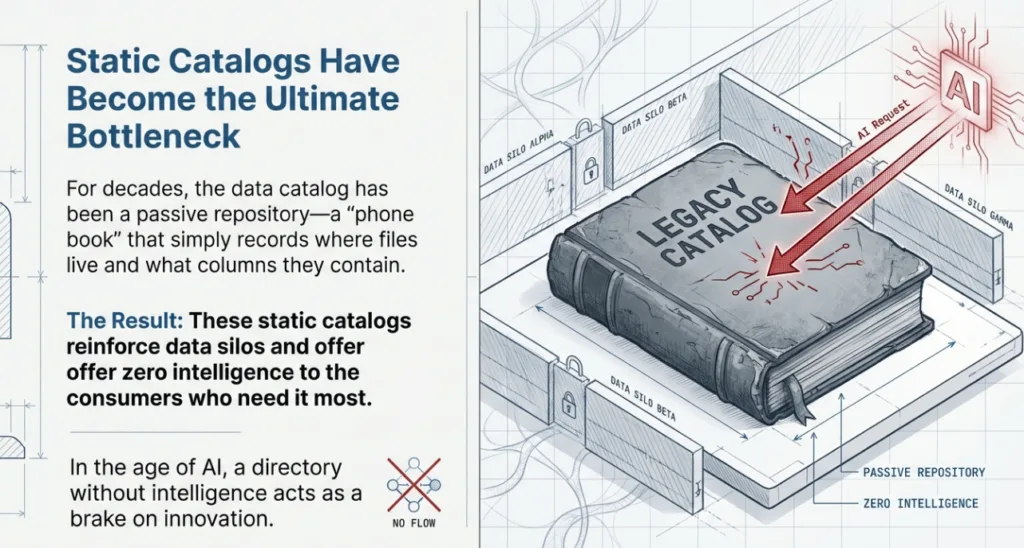
For decades, the data catalog has been a passive repository, a "phone book" for data that simply recorded where files lived and what columns they contained. These traditional, static catalogs have become the ultimate bottleneck in the age of AI, reinforcing data silos and offering zero intelligence to the consumers who need it most.
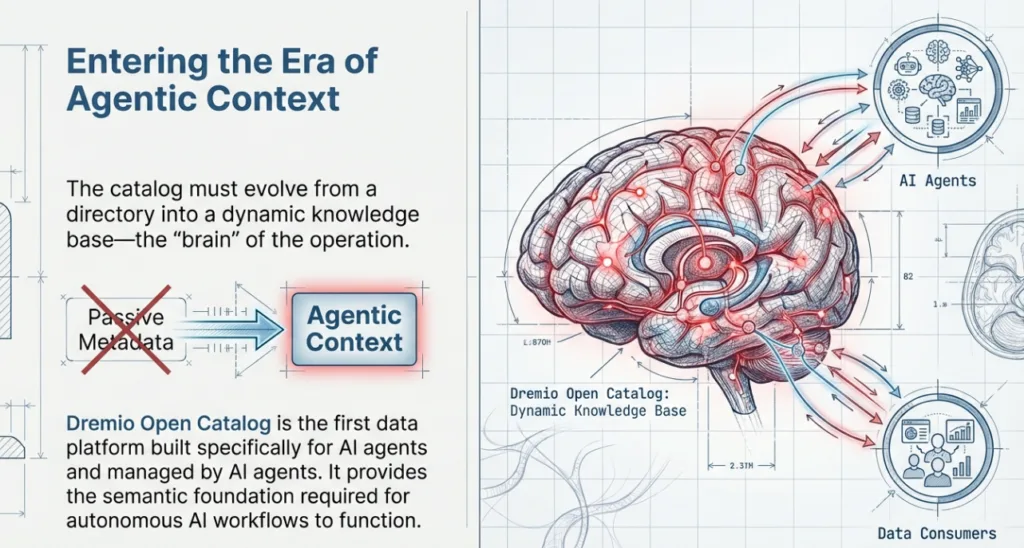
We are now entering the era of the Agentic Lakehouse. In this paradigm, the catalog is no longer a directory; it is a dynamic knowledge base, the "brain" of the operation. Dremio has delivered the first data platform built specifically for AI agents and managed by AI agents. By unifying data access and delivering autonomous performance without the complexity of traditional data warehouses, Dremio’s Open Catalog represents a fundamental shift. It moves us from "passive metadata" to "agentic context," providing the semantic foundation required for autonomous AI workflows to actually work.
Takeaway 1: More Than a Mirror, The Polaris-Dremio Hybrid Structure
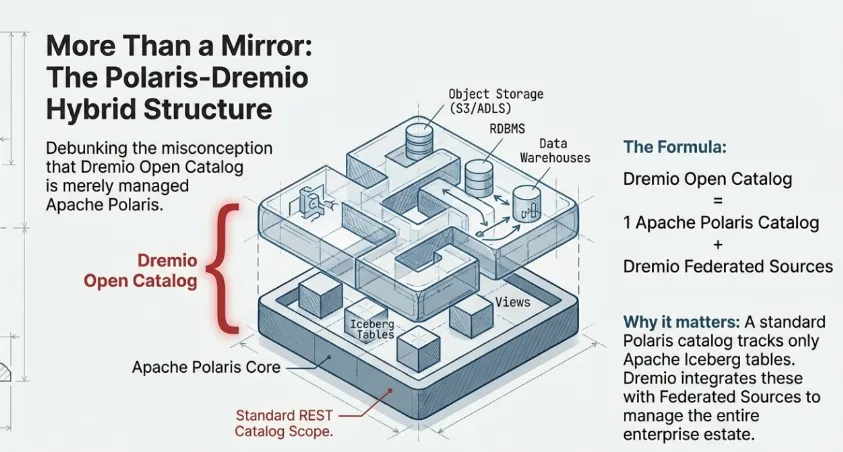
A common industry misconception is that the Dremio Open Catalog is merely a managed instance of Apache Polaris. While it is built on open standards, the architecture is a sophisticated hybrid that extends far beyond the scope of a standard Iceberg REST catalog.
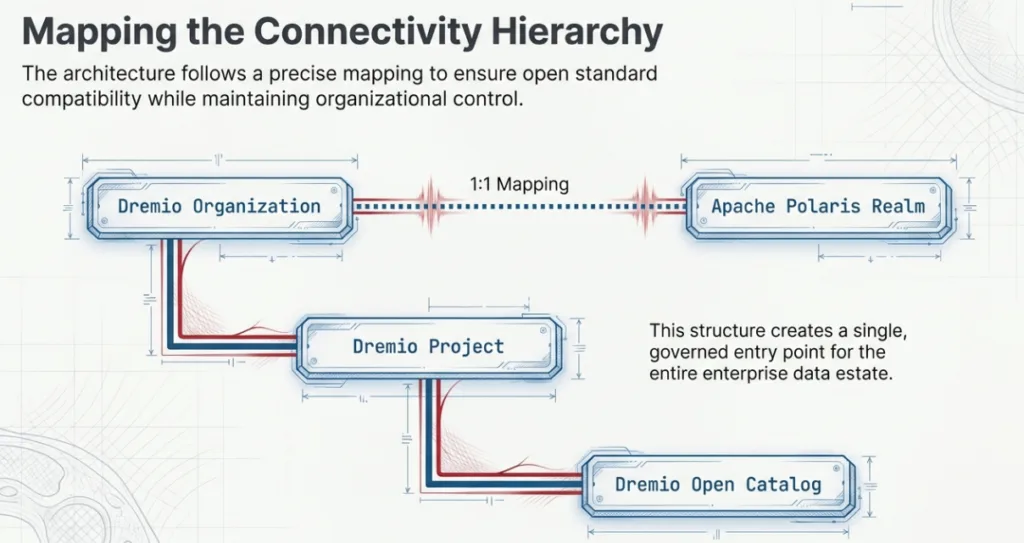
Architecturally, the mapping is precise: one Dremio Organization maps to an Apache Polaris Realm (an isolated collection of catalogs and identities), and one Dremio Project maps to a Dremio Open Catalog. However, the functional scope is where Dremio differentiates. While a standard Polaris catalog tracks only Apache Iceberg tables/views, Dremio integrates these with "Federated Sources." This includes Object Storage, Databases, Data Warehouses, and other Lakehouse catalogs, creating a unified architecture that manages both native Iceberg data and external relational sources.
By synthesizing Polaris-tracked tables with federated connectivity, Dremio serves as a single, governed entry point for the entire enterprise data estate, regardless of where that data physically resides.
Takeaway 2: The Hidden Governance Gap (RBAC vs. FGAC)
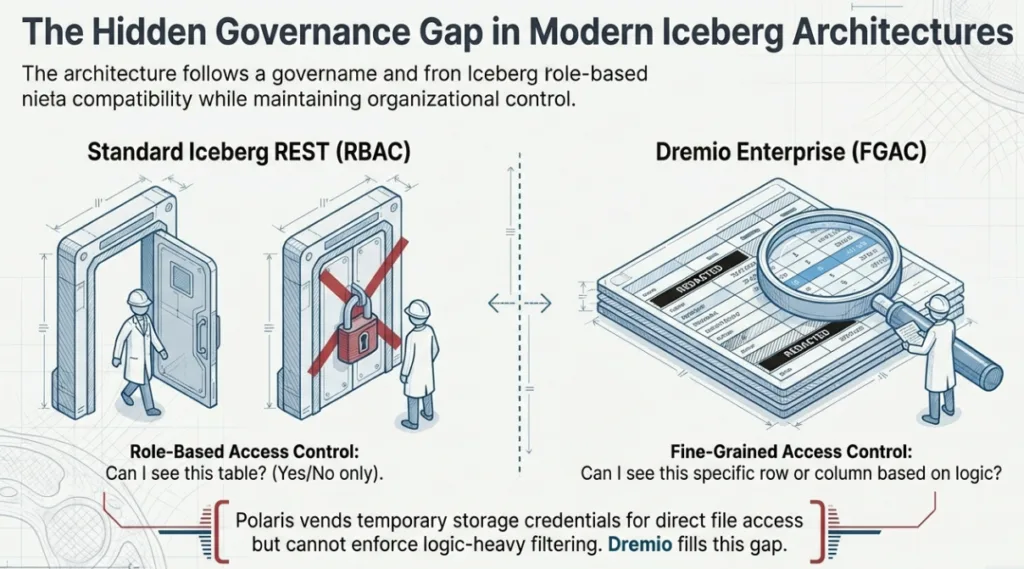
There is a critical governance gap in the current state of Iceberg interoperability. While any tool compatible with the Iceberg REST protocol can access any supporting catalog, they are typically limited to Role-Based Access Control (RBAC). This means external engines like Apache Spark or Flink can see tables and namespaces, but they lack the ability to enforce the complex security logic modern enterprises demand.
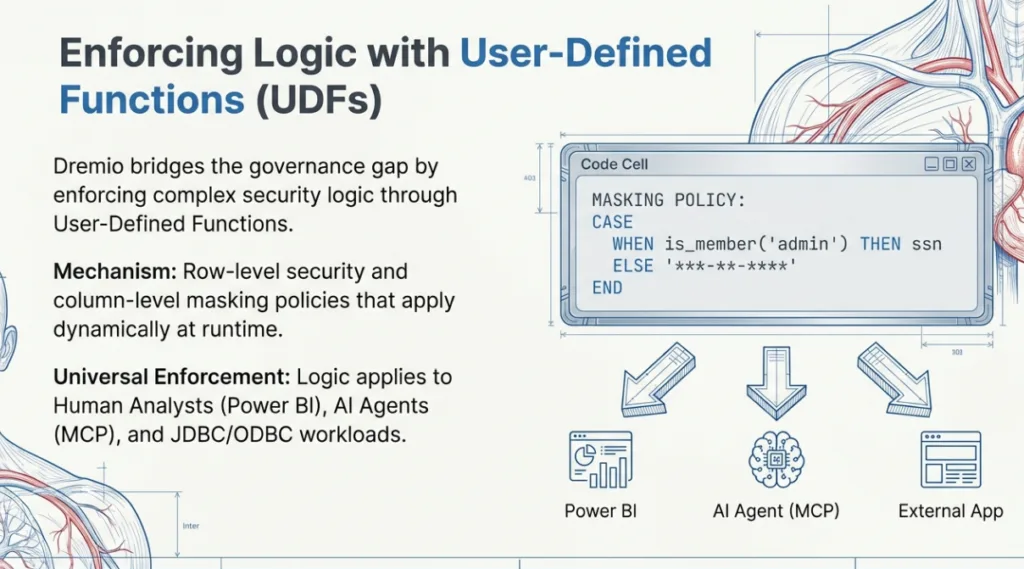
Dremio bridges this gap by enabling Dremio-run queries using Dremio Catalogs Fine-Grained Access Control (FGAC). This is achieved through User-Defined Functions (UDFs) that define sophisticated row-level security and column-level masking. For example, a masking policy might use CASE WHEN is_member('admin') THEN ssn ELSE '***-**-****' END to obscure sensitive data dynamically.
While Polaris vends temporary storage credentials for direct file access, it cannot enforce this logic-heavy filtering. Dremio extends this governance to all consumers, whether they are human analysts using Power BI via Arrow Flight (ADBC), AI agents interacting through the Model Context Protocol (MCP), or any other workload that leverages Dremio’s JDBC/ODBC/REST API interfaces.
Takeaway 3: Turning Metadata into "AI Context" with Semantics
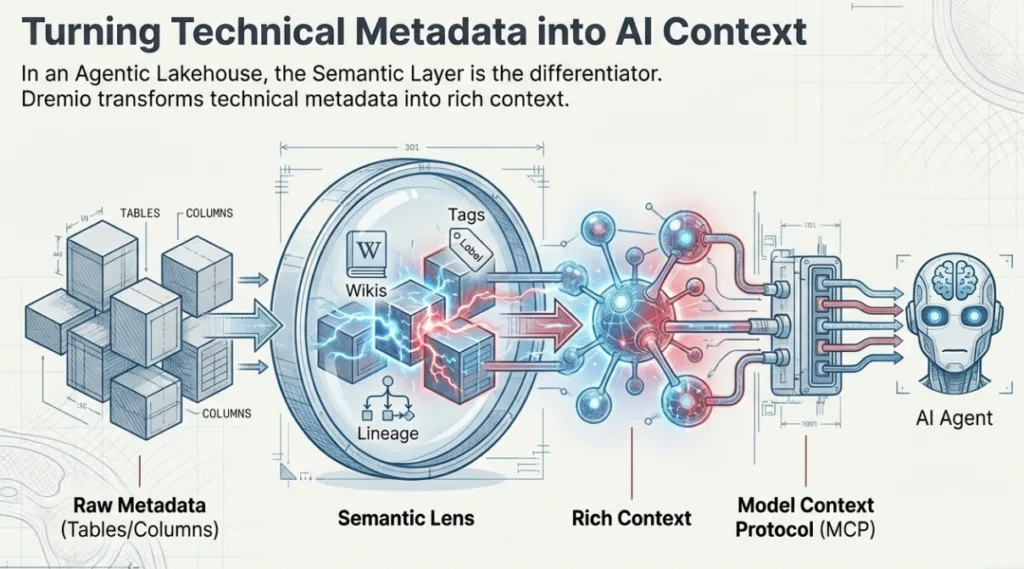
In an Agentic Lakehouse, the "Semantic Layer" is the primary differentiator. Dremio transforms technical metadata into "rich context" by tracking Wikis, tags, and lineage. But the true power lies in how this context integrates with Dremio’s AI Agent, enabling better responses to natural language analytics whether from Dremio’s AI agent or using external agents with Dremio’s MCP Server.
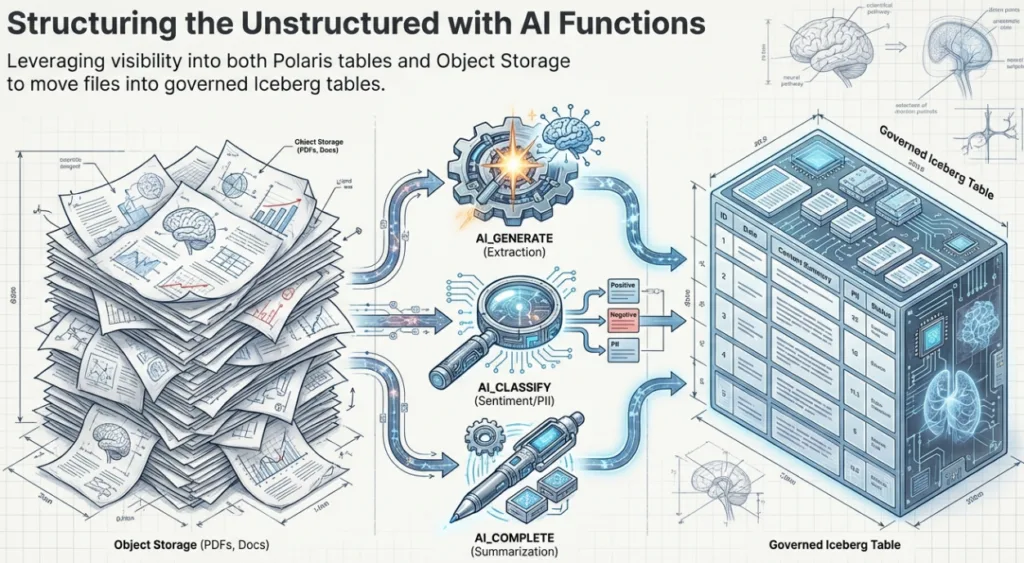
Since Dremio’s open catalog can see your iceberg tables alongside data on your object storage, you can even leverage unstructured data in your object storage to create structured data using Dremio AI Functions:
AI_GENERATE: The "Swiss Army Knife" for extracting structured data from unstructured sources (PDFs, docs) based on the schema and context defined in the catalog.
AI_CLASSIFY: Automatically categorizes text data (e.g., sentiment analysis or PII detection) directly via SQL.
AI_COMPLETE: Summarizes complex data patterns or documents into narrative insights.
By using the Catalog's visibility into its embedded Polaris catalog and Federated sources, Dremio enables you to easily move PDFs from your object storage into governed Iceberg tables and views.
Dremio is the first data platform built for AI agents and managed by AI agents.
Takeaway 4: The "Ingest Anywhere, Consume Here" Best Practice
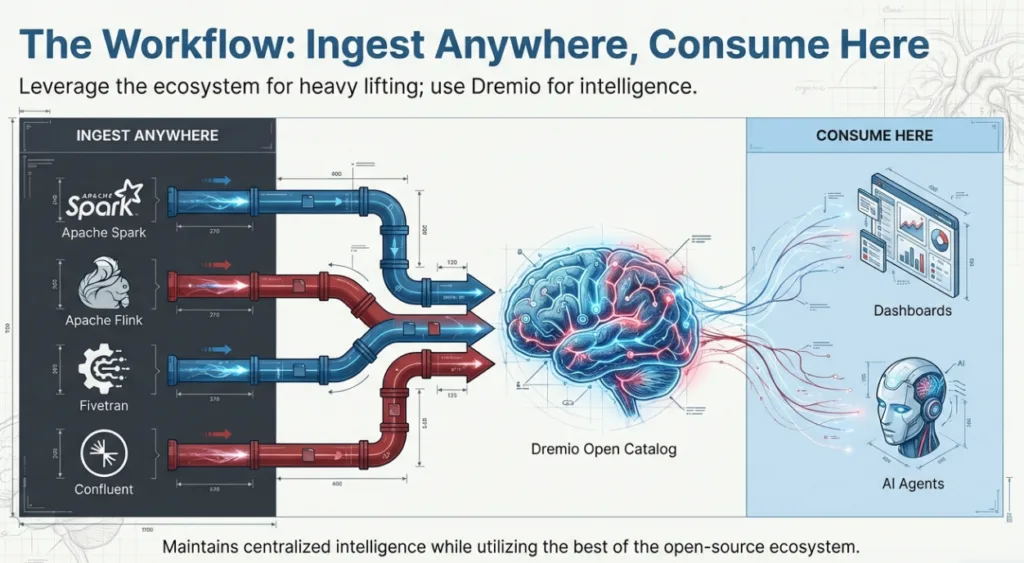
To achieve an optimized, AI-ready architecture, we recommend the "Ingest Anywhere, Consume Here" workflow. This strategy leverages the best of the open-source and vendor ecosystem while maintaining centralized intelligence.
Ingest Anywhere: Use Apache Spark or Flink's high-performance Iceberg interoperability, or vendor options such as Fivetran or Confluent, for heavy-duty data ingestion and batch/stream processing.
Consume Here: Use Dremio as the primary point of consumption and autonomous optimization.
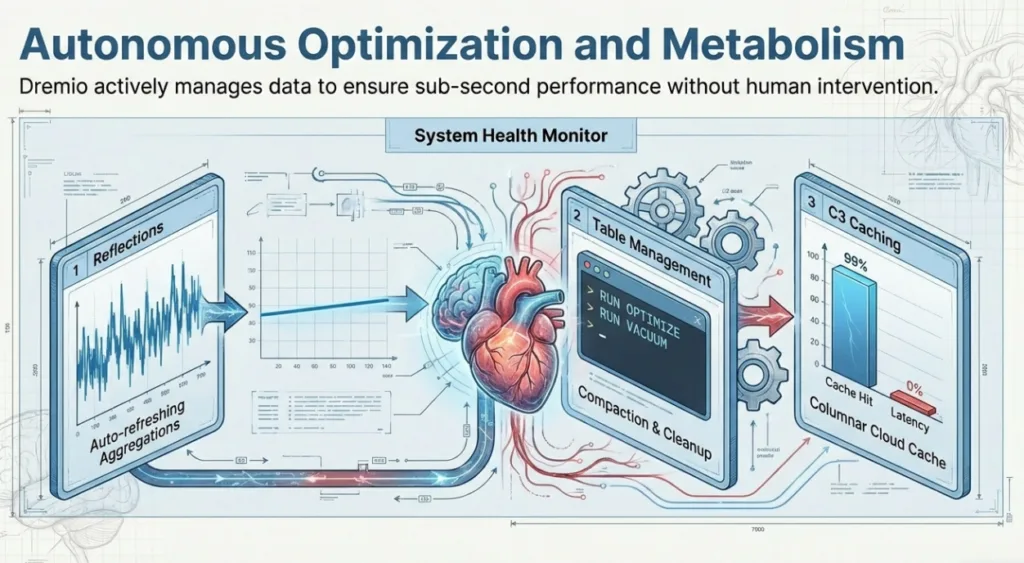
This approach is superior because it unlocks Autonomous Optimization. Dremio doesn't just store data; it manages it through:
Reflections: Dremio automatically designs, creates, and refreshes Raw, Aggregation, and Starflake reflections to provide sub-second performance.
Iceberg Table Management: Native OPTIMIZE and VACUUM commands handle file compaction and snapshot expiration to keep the lakehouse healthy.
C3 Caching: The Columnar Cloud Cache ensures frequently accessed data stays close to compute, eliminating the latency of remote storage.
Conclusion: The Future of Federated Governance
The Dremio Open Catalog is the vital bridge between open-source flexibility and enterprise-grade AI readiness. By moving from a "static mirror" of Iceberg files to a semantic, agent-ready architecture, Dremio allows organizations to finally realize the promise of a self-managing data lakehouse.
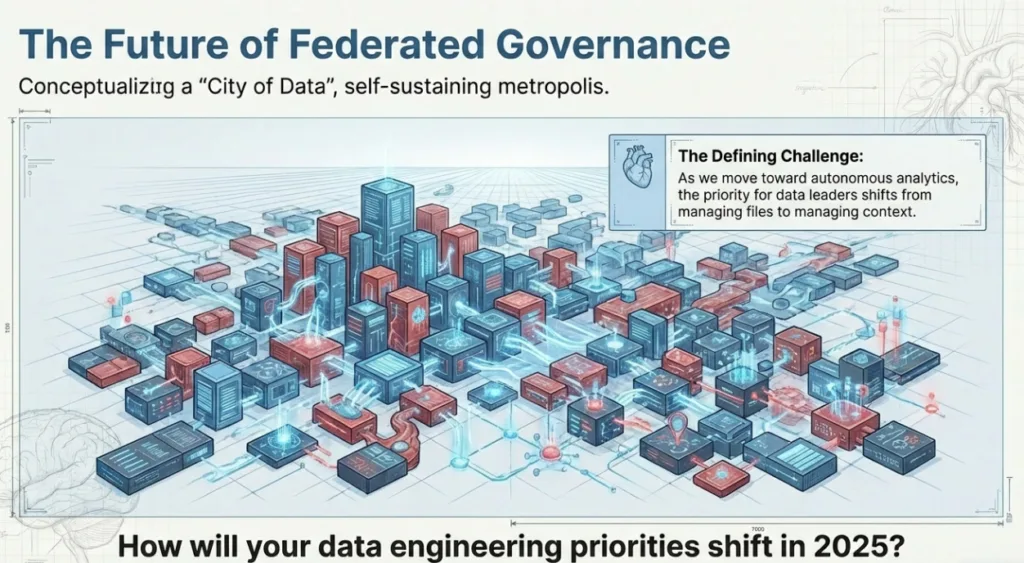
As we move toward a future of autonomous analytics, the defining challenge for data leaders will be the shift from managing files to managing context. How will the transition from "passive metadata" to "agentic context" change your data engineering priorities in 2025?
For a deeper treatment of the topics in this post, download Apache Polaris: The Definitive Guide by Alex Merced, Andrew Madson, and Tomer Shiran, free from Dremio.
Ingesting Data Into Apache Iceberg Tables with Dremio: A Unified Path to Iceberg
By unifying data from diverse sources, simplifying data operations, and providing powerful tools for data management, Dremio stands out as a comprehensive solution for modern data needs. Whether you are a data engineer, business analyst, or data scientist, harnessing the combined power of Dremio and Apache Iceberg will undoubtedly be a valuable asset in your data management toolkit.
Oct 12, 2023·Product Insights from the Dremio Blog
Table-Driven Access Policies Using Subqueries
This blog helps you learn about table-driven access policies in Dremio Cloud and Dremio Software v24.1+.
Aug 31, 2023·Dremio Blog: News Highlights
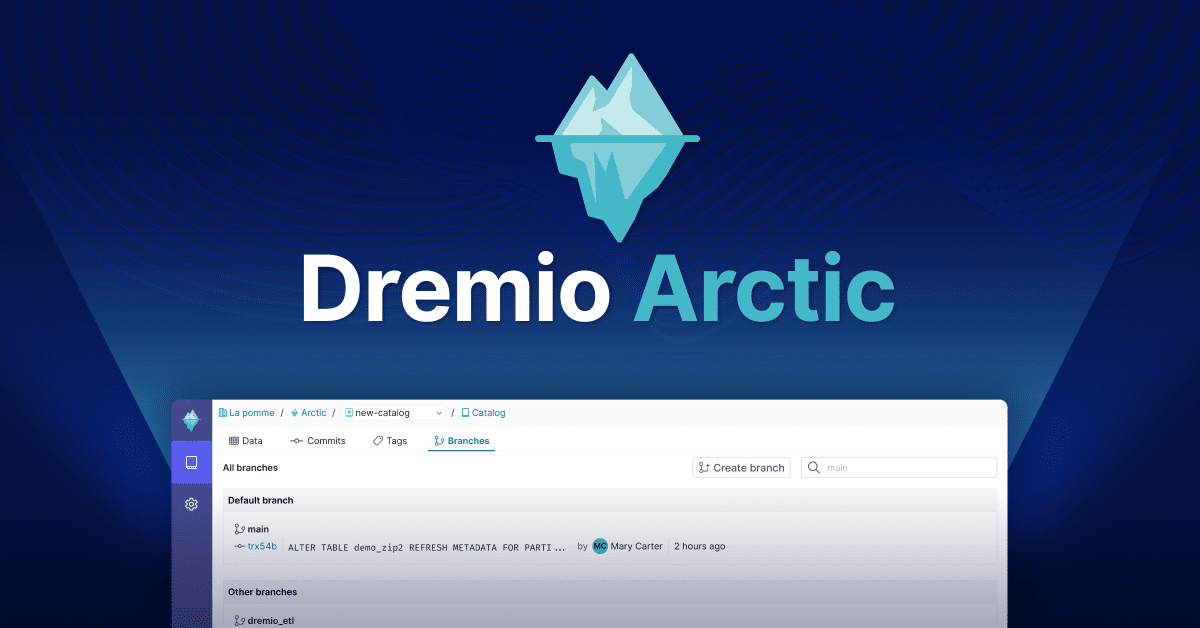
Dremio Arctic is Now Your Data Lakehouse Catalog in Dremio Cloud
Dremio Arctic bring new features to Dremio Cloud, including Apache Iceberg table optimization and Data as Code.