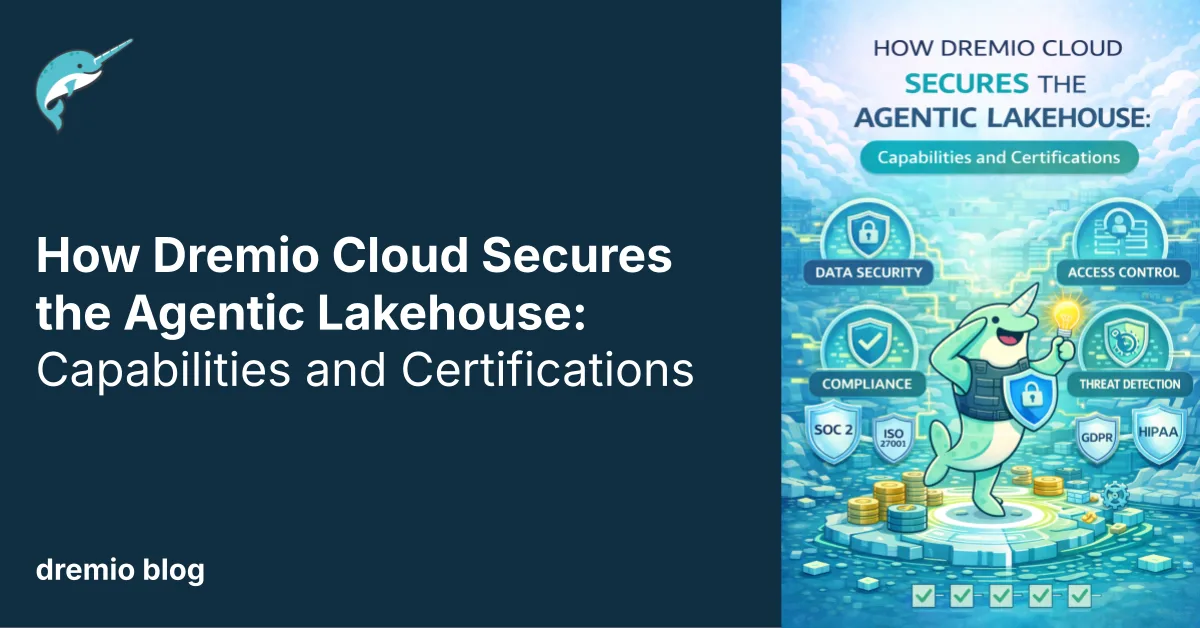
Dremio Cloud uses the agentic lakehouse pattern, enabling high-speed analytics while minimizing data movement for enhanced security.
Query Federation allows querying across data sources without duplicating data, thus reducing security risks.
Dremio ensures end-to-end data protection with TLS 1.2 encryption in transit and AES-256 encryption at rest.
Granular access control through Role-Based Access Control (RBAC) and Fine-Grained Access Control (FGAC) protects sensitive data effectively.
Dremio holds leading security certifications, including SOC 2 Type II and ISO/IEC 27001, validating its commitment to security compliance.
Every time you move data between a lake, a warehouse, and a downstream application, you multiply your security risk. Leaving data in place is the safest approach, but historically, accessing it directly meant sacrificing performance and governance. The agentic lakehouse pattern changes that by allowing high-speed, governed analytics directly on your storage.
Dremio Cloud is the first data platform built for and managed by AI agents. Beyond enabling agentic analytics, Dremio was architected with a security-first mindset. Ensuring robust Dremio Cloud security capabilities means your data foundation is protected, compliant, and strictly governed, all without requiring centralized data copies.
Let's explore the core security architecture, access controls, and industry certifications that make Dremio a trusted platform for enterprise analytics.
Try Dremio’s Interactive Demo
Explore this interactive demo and see how Dremio's Intelligent Lakehouse enables Agentic AI
Security Starts with Zero Data Movement
Traditional architectures rely on complex ELT pipelines to copy data from object storage into a cloud data warehouse. This creates duplicate data silos, inherently expanding the attack surface and complicating compliance efforts. If data exists in three different systems, you have to secure, audit, and mask it in three different systems.
Dremio's Query Federation allows you to query data across dozens of sources in place without the risk and cost of data movement. When you connect Dremio to your S3 buckets, Azure Data Lake Storage, PostgreSQL databases, or other sources, the data remains safely in its original location. The query optimizer pushes filtering work to the source system, returning only the requested results back to the user or AI agent.
The Tradeoff: Querying federated data across a network can incur higher latency than querying data stored locally in the lakehouse. Dremio mitigates this through Reflections—physically optimized, pre-computed Iceberg tables that act as transparent acceleration structures. Reflections give you local query performance while maintaining the centralized security and governance of the lakehouse.
End-to-End Data Protection and Encryption
When sensitive data is queried, it must be protected at every stage of its lifecycle. Dremio Cloud provides comprehensive encryption to secure your workloads, whether the data is moving across the network or resting in storage.
All data transmitted between Dremio Cloud and your client applications—including BI tools connected via Arrow Flight or external AI agents connecting via the MCP Server—is encrypted in transit using TLS 1.2 or higher.
For data stored at rest within the Dremio environment, such as reflections and locally cached data (C3 caching), Dremio employs AES-256 encryption.
For organizations with strict compliance mandates, Dremio also supports customer-managed encryption keys, giving your security team complete control over the cryptographic keys used to protect your data. This ensures that even if the underlying infrastructure is compromised, your data remains unreadable.
Granular Access Control and FGAC
A governed semantic layer is essential for both humans and AI agents. The semantic layer teaches the AI your business language so it generates the right SQL, but it also tightly enforces exactly who or what is allowed to see specific information. Without context and strict boundaries, AI models hallucinate or expose restricted data.
Dremio provides rigorous Role-Based Access Control (RBAC) that integrates directly with enterprise identity providers. Dremio Cloud supports a wide array of Identity and Access Management (IAM) capabilities to ensure secure and seamless authentication:
Identity Providers: Integration with external LDAP or OpenID providers (e.g., Okta, Microsoft Entra ID, Google Workspace) via OAuth 2.0 and OpenID Connect. Dremio Cloud also supports Social Identity Providers for flexible access.
Access Tokens & Apps: Support for Personal Access Tokens, External Token Providers, and OAuth Apps for secure programmatic access via the MCP server or APIs.
Custom Roles: Beyond standard RBAC, administrators can configure Custom Roles to map privileges exactly to their organizational structure. Service Users support is also on the roadmap.
You can assign these permissions down to the most granular level, including the organization, project, source, folder, or individual table.
Fine-Grained Access Control (FGAC) in Action
For highly sensitive datasets, Dremio's catalog supports Fine-Grained Access Control (FGAC). Through the use of User-Defined Functions (UDFs), data teams can dynamically enforce restrictions at query time.
Here is an example of implementing column-level masking in Dremio. Suppose you have a table containing customer phone numbers, but you only want users with the HR_Role to see the unmasked digits.
-- Create a masking function

CREATE OR REPLACE FUNCTION mask_phone(phone_num VARCHAR)

RETURNS VARCHAR

RETURN

  CASE

    WHEN is_member('HR_Role') THEN phone_num

    ELSE '***-***-' || RIGHT(phone_num, 4)

  END;

-- Apply the masking policy to the phone_number column

ALTER TABLE customers.contact_info

MODIFY COLUMN phone_number

SET MASKING POLICY mask_phone(phone_number);
You can use a similar approach for row-level security, ensuring users only see the specific rows relevant to their region or department. This means a single virtual dataset can safely serve multiple departments without risking unauthorized access.
The Open Catalog: A Governed Namespace
The brain of the agentic lakehouse is the Dremio Open Catalog, built on Apache Polaris, the open Iceberg REST catalog standard. It extends the open standard by adding federated sources into a single, governed namespace.
Formulaically, the Dremio Open Catalog = 1 Apache Polaris Catalog + Dremio Federated Sources.
This means you have a unified place to define access policies across both open table formats and your operational databases. Instead of configuring security roles in PostgreSQL, Snowflake, and S3 independently, you configure them once in Dremio's semantic layer.
Furthermore, Dremio's architecture supports integration with external policy engines like Apache Ranger and Privacera. This enables large enterprises to use their existing access control infrastructure without rebuilding their security rules from scratch.
Leading Security Certifications
Building for the enterprise means adhering to the strictest regulatory standards. Dremio maintains independent verification of its security posture through several globally recognized security certifications and compliance frameworks.
These certifications demonstrate that Dremio's internal operations and cloud architecture follow rigorous, continuously monitored security protocols.
SOC 2 Type II: An in-depth, ongoing audit verifying that Dremio's information security practices, policies, and operations meet the AICPA trust services criteria for security, availability, and confidentiality.
ISO/IEC 27001: Certification of Dremio's comprehensive Information Security Management System (ISMS), proving a systematic approach to managing sensitive company information and minimizing cyber risks.
HIPAA Compliance: Readiness to handle Protected Health Information (PHI), enabling healthcare organizations and their business associates to build their lakehouses securely.
GDPR and CCPA: Full adherence to major global data privacy regulations regarding the storage, processing, and protection of user data.
Dremio embeds security into its development lifecycle, performing automated vulnerability scanning, static application security testing (SAST), and strict 3rd-party dependency checking on a continuous basis.
Start Building Secure Agentic Analytics
The safest data architecture is one where data doesn't move, policies are unified in a central catalog, and every query is authenticated, authorized, and encrypted. By abstracting the complexity of data access and enforcing fine-grained controls at the catalog level, Dremio secures the data foundation so your teams—and your AI agents—can explore insights freely.
Your data stays in your storage, in an open format, accessible by any engine. No lock-in, and no compromised security.
Try Dremio Cloud free for 30 days
Deploy agentic analytics directly on Apache Iceberg data with no pipelines and no added overhead.
Ingesting Data Into Apache Iceberg Tables with Dremio: A Unified Path to Iceberg
By unifying data from diverse sources, simplifying data operations, and providing powerful tools for data management, Dremio stands out as a comprehensive solution for modern data needs. Whether you are a data engineer, business analyst, or data scientist, harnessing the combined power of Dremio and Apache Iceberg will undoubtedly be a valuable asset in your data management toolkit.
Oct 12, 2023·Product Insights from the Dremio Blog
Table-Driven Access Policies Using Subqueries
This blog helps you learn about table-driven access policies in Dremio Cloud and Dremio Software v24.1+.
Aug 31, 2023·Dremio Blog: News Highlights
Dremio Arctic is Now Your Data Lakehouse Catalog in Dremio Cloud
Dremio Arctic bring new features to Dremio Cloud, including Apache Iceberg table optimization and Data as Code.