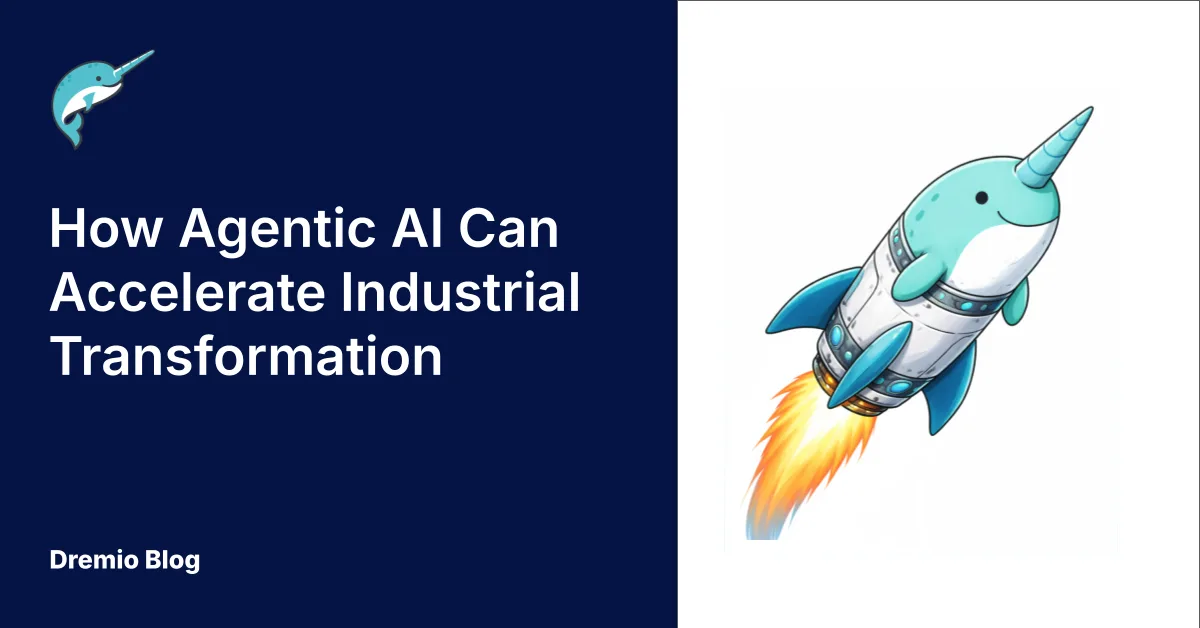
Agentic AI enhances autonomous problem solving by executing complex tasks with minimal supervision.
It reduces cognitive load, allowing users to focus on strategic and creative work while handling routine tasks.
Agentic AI improves decision making by rapidly processing information and identifying patterns across industries.
The technology adapts and learns from feedback, making it effective in dynamic environments.
Agentic AI offers scalability and cost efficiency, automating workflows while significantly reducing operational expenses.
Last week I published a blog about some of the risks to consider when implementing Agentic AI in your workflows or organisation. But what about the other side of that coin, the benefits this revolutionary technology can bring about? Read on to learn several of the ways that Agentic AI is transforming how we work and solve problems across industries.
Try Dremio’s Interactive Demo
Explore this interactive demo and see how Dremio's Intelligent Lakehouse enables Agentic AI
Autonomous problem solving:
Agentic AI really delivers on the “intelligence" of Artificial Intelligence. Agents are able to take a goal, comprehend the request, then devise and execute a plan to answer it. AI agents can even handle complex tasks by breaking them down into smaller steps, and making decisions at each stage about their progress and how to proceed. Instead of just answering discrete questions, AI agents can accomplish multi-step objectives all with minimal human supervision.
Reduced cognitive load:
AI agents work great as productivity tools, able to handle time-consuming tasks like information gathering, document processing, and data analysis. AI agents not only handle the execution of these tasks but can also mostly self-manage, so users only have to delegate the task or goal, without constant intervention. By autonomously handling these kinds of routine tasks, AI agents free users to focus on strategic thinking or creative work.
Enhanced decision making:
Agentic AI’s capabilities to rapidly process large amounts of information, consider multiple scenarios, and identify patterns makes them capable of supporting decision making. Industries that require manual approvals, such as healthcare, finance, and operations management, can use AI agents to make better-informed and thus more confident decisions.
Adaptability and learning:
Agentic AI can adjust its approach based on feedback and changing circumstances, both from users and the systems that they integrate with. If one strategy doesn't work, it can try alternatives, learn from errors, and refine its methods over time. For example, if a requested resource does not contain the information needed or attempts to call a tool fails, it will try other options rather than give up or error out.
This allows AI agents to respond to changing conditions, detect issues early, and raise problems before users become aware of them. As a result, they are highly effective in fast-paced environments, customer-facing industries, or applications where data updates very frequently. Relevant industries include customer services, logistics, and operations management.
Availability and scalability:
Unlike human workers, agentic AI can operate continuously, at high speed, and handle multiple tasks simultaneously. With one agent able to run multiple tasks in parallel and coordinate with sub-agents, workflows can be scaled up without scaling staff. This makes it well-suited for monitoring systems, responding to time-sensitive situations, or managing workflows across different time zones.
Cost efficiency:
Agentic AI can greatly reduce operational expenses by automating complex workflows that otherwise require multiple human hours or specialised expertise. Not only can AI agents handle complex, multi-system operations but they are also capable of completing them far faster than humans using manual methods. And time saved, means decisions made faster, work completed quicker, and ultimately money being saved.
Summary
By taking initiative, planning actions, and adapting to changing conditions without constant human oversight, agentic AI enhances efficiency, reduces operational costs, and accelerates innovation. Beyond productivity gains, agentic AI also enables businesses to scale complex processes more effectively, freeing human employees to focus on strategic and creative work while the AI handles routine or dynamic tasks.
Try Dremio Cloud free for 30 days
Deploy agentic analytics directly on Apache Iceberg data with no pipelines and no added overhead.
Ingesting Data Into Apache Iceberg Tables with Dremio: A Unified Path to Iceberg
By unifying data from diverse sources, simplifying data operations, and providing powerful tools for data management, Dremio stands out as a comprehensive solution for modern data needs. Whether you are a data engineer, business analyst, or data scientist, harnessing the combined power of Dremio and Apache Iceberg will undoubtedly be a valuable asset in your data management toolkit.
Sep 22, 2023·Dremio Blog: Open Data Insights
Intro to Dremio, Nessie, and Apache Iceberg on Your Laptop
We're always looking for ways to better handle and save money on our data. That's why the "data lakehouse" is becoming so popular. It offers a mix of the flexibility of data lakes and the ease of use and performance of data warehouses. The goal? Make data handling easier and cheaper. So, how do we […]
Oct 12, 2023·Product Insights from the Dremio Blog
Table-Driven Access Policies Using Subqueries
This blog helps you learn about table-driven access policies in Dremio Cloud and Dremio Software v24.1+.