Key Takeaways
- Traditional cloud data warehouses like Amazon Redshift can't adapt to modern needs, resulting in hidden costs and inefficiencies.
- Dremio's Agentic Lakehouse optimizes data access by querying directly from low-cost object storage, eliminating redundancy.
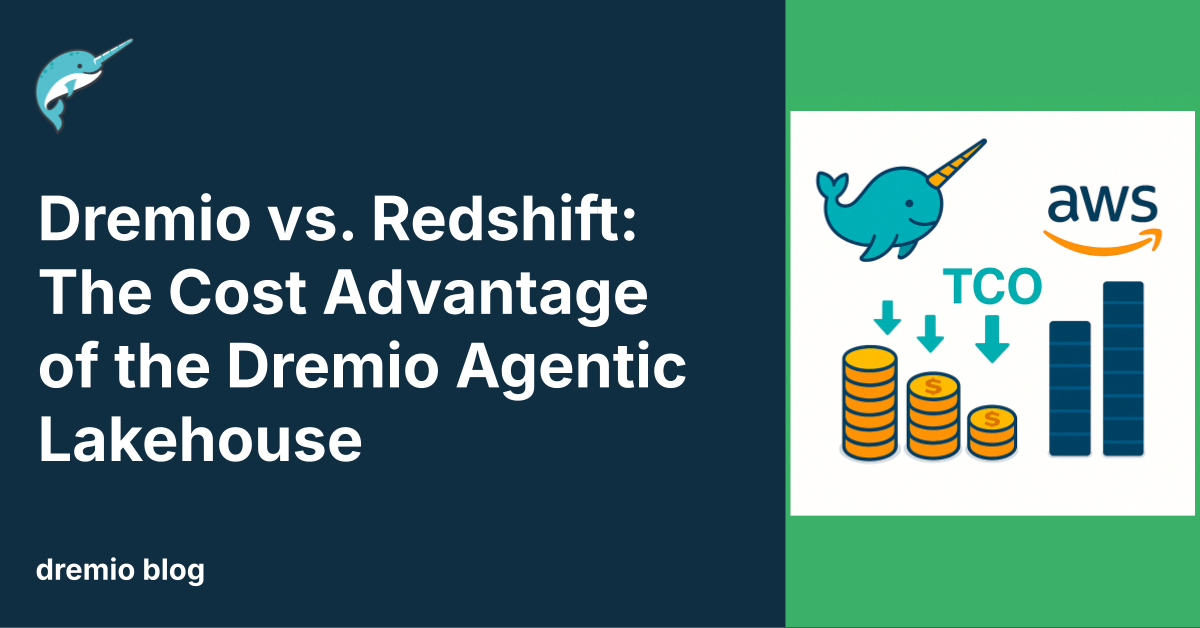
- Dremio demonstrates significant cost savings, with reported total cost of ownership reductions of 50–75% compared to Redshift.
- The platform enhances efficiency with a 1.3× to 2.0× greater compute efficiency and 80–90% lower storage costs.
- Dremio positions organizations for future AI-driven analytics by unifying data access and automating maintenance tasks.
The New Economics of Data
Cloud data warehouses like Amazon Redshift were built for a world that no longer exists. In that earlier era, organizations focused primarily on structured business intelligence, static dashboards, and predictable workloads. Data was tightly controlled, compute resources were fixed, and dynamic scalability for rapidly changing workloads was not a concern.
Today, everything has changed. Modern enterprises need to support not only traditional BI workloads, but AI-driven analytics, large-scale data exploration, and agentic workloads that demand dynamic access to data across multiple clouds and sources. These emerging use cases require elasticity, openness, and automation—capabilities that legacy data warehouses simply weren’t designed to deliver.
As a result, the economics of data management have shifted. Maintaining a traditional data warehouse architecture is no longer just a technical limitation—it’s a financial one.
The Redshift Reality: Complexity That Costs
While Redshift remains a familiar choice for many AWS customers, its underlying architecture introduces hidden costs that escalate over time. These costs span compute, storage, data movement, management and maintenance.
The platform’s per-node pricing model encourages over-provisioning, leaving clusters running idle during off-peak periods. At the same time, concurrency scaling adds unpredictable surcharges when workloads spike, creating cost volatility that’s difficult to plan for.
Storage costs are another challenge. Redshift’s proprietary storage is significantly more expensive than open object storage services like Amazon S3. To make matters worse, most Redshift environments rely heavily on ETL pipelines and data duplication—replicating the same data across environments just to make it queryable. Each duplicate not only increases storage spend but also adds complexity and delay.
Then there’s the human cost. Routine maintenance tasks like vacuuming, tuning, and managing clusters require specialized skills and ongoing attention. Over time, these operational inefficiencies compound, inflating both infrastructure and labor costs.
For organizations pursuing AI and agentic analytics, as well as supporting their traditional BI workloads, these constraints are more than a nuisance—they’re a roadblock.
The Dremio Difference: An Agentic Lakehouse Built for Efficiency
Dremio takes a fundamentally different approach, combining the scalability of the data lake with the performance and governance of a warehouse. Instead of forcing data into proprietary storage, Dremio queries data directly where it lives—on object storage on Amazon S3, —eliminating data duplication and the costs that come with it.
This architecture is the foundation of Dremio’s Agentic Lakehouse, an intelligent, AI-ready platform that unifies analytics and AI under one roof. Built on open standards such as Apache Iceberg and Apache Arrow, Dremio brings together elastic compute, autonomous optimization, and a governed semantic layer to deliver warehouse-grade performance at a fraction of the cost.
By removing the need for over-provisioned clusters, Dremio scales compute dynamically with workload demand. Its autonomous reflections and intelligent caching capabilities minimize redundant compute, while its unified semantic layer ensures every query—whether from a human or an AI agent—operates with the right security, governance, and context.
The result is a system that’s both faster and dramatically more efficient, redefining what modern analytics infrastructure can achieve.
Efficiency in Action: Quantifiable Advantages
The efficiency gains from Dremio’s architecture aren’t just theoretical—they’re measurable. Across a range of workloads, organizations see between 1.3× and 2.0× greater compute efficiency compared to Redshift, thanks to Dremio’s query engine and autonomous optimizations.
Caching and Reflections deliver additional savings, reducing redundant query workloads and lowering overall compute consumption by 50%. These optimizations allow teams to handle more queries and users without scaling infrastructure costs linearly.
Concurrency—one of Redshift’s costliest pain points—is also a clear differentiator. Dremio delivers 40%+ greater concurrency uplift without the unpredictable expense of concurrency scaling. And because data lives in low-cost object storage instead of proprietary warehouse nodes, organizations can reduce storage costs by as much as 80–90%.
Together, these improvements create a compounding effect: every component of the stack becomes more efficient, and total cost of ownership drops dramatically.
Real-World TCO: 50–75% Lower Costs
Customers migrating from Redshift to Dremio consistently report 50–75% total cost of ownership (TCO) savings—a figure driven by both architectural and operational advantages.
Elastic compute eliminates the need for idle clusters, ensuring resources are only used when needed. Because Dremio queries data directly in the lake, the need for numerous complex ETL pipelines, duplicate data stores disappears—saving both time and infrastructure cost.
Operational efficiency is another key factor. Dremio’s autonomous data management automates maintenance tasks such as vacuuming, compaction, and clustering. This reduces administrative overhead and eliminates manual tuning, allowing data teams to focus on delivering insights rather than maintaining infrastructure.
The result is a modern data platform that costs less to run, requires less hands-on management, and scales seamlessly as workloads grow.
Why the Agentic Lakehouse Wins
Dremio’s cost advantage extends beyond efficiency—it’s about readiness for the next generation of AI-driven analytics. The Agentic Lakehouse enables both users and AI agents to access governed, high-performance data directly through Dremio’s semantic layer, ensuring consistency and control.
With Dremio, the lakehouse becomes part of the broader AI ecosystem. Models like Claude, ChatGPT, or custom enterprise agents can query governed data directly, gaining real-time access to the context and structure they need to generate accurate results.
In essence, Dremio bridges the gap between analytics and AI—providing a single, open, and cost-efficient foundation for both. By unifying data access and simplifying operations, Dremio allows organizations to innovate faster, cut costs, and prepare their data landscape for the agentic future.
The Smarter, Lower-Cost Future
The economics of the Agentic Lakehouse are clear. By eliminating the hidden costs of Redshift, Dremio delivers faster insights, greater flexibility, and dramatically lower total cost of ownership.
For organizations looking to modernize their data architecture and prepare for the agentic AI era, the choice is simple: adopt Dremio, a platform built for the future.
Keep learning
For a deeper treatment of the topics in this post, download Apache Iceberg: The Definitive Guide by Tomer Shiran, Jason Hughes, and Alex Merced, free from Dremio.
If you are weighing this for your own stack, talk to the Dremio team.
Try Dremio Cloud free for 30 days
Deploy agentic analytics directly on Apache Iceberg data with no pipelines and no added overhead.