With the release of Dremio Next Generation Cloud, the Dremio Model Context Protocol (MCP) Server is now hosted for Dremio Cloud customers. This means you can immediately connect your own custom AI agent—or use models like Claude—to your Dremio lakehouse. Just configure the endpoint and OAuth client, and you're ready to start chatting with your data through natural language.
For Dremio customers, this extensibility is transformative: with enhanced MCP server data exploration, your Agentic Lakehouse becomes a first-class citizen in any AI workflow, whether powered by Claude, ChatGPT, or your own AI applications. Dremio's MCP Server exposes your entire AI Semantic Layer—with all its governance, security, and performance optimizations—to the AI ecosystem, enabling agents to deliver fast, accurate insights without pipelines or vendor lock-in.
Key highlights:
Dremio is the Agentic Lakehouse—the only data platform built for agents and managed by agents, providing agent choice through open MCP integration.
The MCP Server enables AI agents to interact securely with unified, governed enterprise data through natural-language interfaces backed by the AI Semantic Layer.
MCP server data exploration accelerates insight generation by eliminating technical barriers between AI agents and your lakehouse data.
Built on open standards including Apache Iceberg, Polaris, and Arrow, Dremio delivers agent extensibility without proprietary formats or vendor lock-in.
What is an MCP server in AI?
An MCP server in AI is a standardized interface that enables AI agents to securely access and interact with enterprise data systems through the Model Context Protocol. MCP servers act as intelligent bridges between AI models and data sources, translating natural language queries into secure, governed data operations while maintaining context about business logic, relationships, and access controls.
MCP data flows through these servers with full governance and security intact, meaning AI agents can explore datasets, generate insights, and perform complex analytics without bypassing organizational policies or compromising data integrity. For enterprise organizations, MCP servers represent the foundation for scalable, trustworthy agentic analytics—enabling AI agents to operate autonomously while respecting the same access controls and business context that govern human users.
Try Dremio’s Interactive Demo
Explore this interactive demo and see how Dremio's Intelligent Lakehouse enables Agentic AI
How does an MCP server work?
Understanding how an MCP server operates reveals why it's essential for enterprise agentic analytics. The MCP architecture creates a secure, governed pathway for AI agents to access unified data while maintaining the business context needed for accurate insights.
1. Establish a secure connection
The MCP server begins by authenticating the AI agent using enterprise-grade security protocols, typically OAuth 2.0. This ensures that every interaction respects organizational security boundaries and that the agent operates within the same access controls as human users. The connection maintains session state and tracks all queries for audit and compliance purposes.
Once authenticated, the MCP server establishes a persistent connection that enables real-time interaction between the AI agent and the lakehouse. This secure channel ensures that sensitive data never leaves the governed environment, addressing one of the primary concerns organizations have about AI adoption—maintaining control over where data flows and who can access it.
2. Discover available resources
After establishing a secure connection, the MCP server provides the AI agent with a catalog of available resources—tables, views, metrics, and semantic definitions from the AI Semantic Layer. This discovery process is filtered by the user's access permissions, ensuring agents only see resources they're authorized to access. The MCP server data analysis capabilities begin with this contextual awareness.
The discovery phase is critical because it gives AI agents the business context they need to generate accurate queries. Rather than presenting raw table names and columns, the MCP server exposes semantic definitions, business metrics, and relationships between datasets. This means agents understand not just what data exists, but what it means in business terms—enabling more accurate analysis without manual interpretation.
3. Load tools for interaction
MCP servers expose specific tools that AI agents can invoke to perform actions on data. These tools include functions for executing queries, generating SQL, analyzing patterns, and retrieving metadata. Each tool comes with clear specifications about its inputs, outputs, and intended use cases, enabling agents to select the right tool for each analytical task.
This tool-based architecture provides an MCP server solution that's both flexible and secure. AI agents gain the capabilities they need to deliver insights, while organizations maintain control over what actions agents can perform. Tools can be customized to align with specific business workflows, ensuring that agentic analytics supports rather than disrupts established processes.
4. Use prompts to drive queries
Prompts serve as templates that guide AI agents toward optimal interactions with the lakehouse. These pre-defined patterns help agents structure their queries more effectively, leveraging best practices encoded by data teams. Prompts can suggest specific analytical approaches, recommend relevant metrics, or guide agents through complex multi-step workflows.
By providing prompt templates, the MCP server accelerates the learning curve for AI agents. New agents can quickly understand how to query specific datasets, apply business logic correctly, and generate insights that align with organizational standards. This guided approach ensures consistency across different AI implementations while maintaining flexibility for custom use cases.
5. Generate and execute natural-language SQL
When a user asks a question in natural language, the MCP server translates that intent into optimized SQL queries. This translation leverages the AI Semantic Layer to understand business terminology, apply appropriate filters, and join relevant tables—all while respecting governance policies. The generated SQL benefits from Dremio's query optimization capabilities, including Autonomous Reflections that accelerate performance automatically.
The MCP server data analysis process goes beyond simple query generation. It understands context from previous queries, applies business logic from semantic definitions, and generates queries that leverage lakehouse performance optimizations. This means AI agents deliver not just accurate results, but fast results—without requiring manual query tuning or performance optimization by platform teams.
6. Return contextualized results
Results from MCP server queries return with full context intact. Rather than raw numbers, AI agents receive data formatted with semantic meaning, business definitions, and metadata that explains what the results represent. This contextualization enables agents to provide meaningful interpretations and actionable insights rather than requiring users to interpret data manually.
The contextualized responses maintain lineage information, showing which sources contributed to each result and how governance policies were applied. This transparency ensures that users can trust AI-generated insights, understanding exactly where data came from and what transformations were applied. For enterprise organizations, this auditability is essential for compliance and decision-making confidence.
7. Continuous learning loop
MCP servers enable a continuous learning loop where AI agents improve their understanding of your data over time. As agents interact with the semantic layer, execute queries, and receive feedback, they build increasingly sophisticated mental models of your data landscape. This learning happens within the secure, governed environment—agents never need to export data or operate outside enterprise boundaries.
The learning loop also benefits data teams. By observing which queries agents generate, which semantic definitions they reference most frequently, and where they encounter challenges, platform teams gain insights into how to optimize the semantic layer for agentic analytics. This creates a virtuous cycle where both AI capabilities and data architecture improve together, accelerating the organization's path to AI-powered insights.
What is data exploration in an MCP server?
MCP server data exploration is the process of using AI agents to examine, query, and analyze enterprise data through natural language interfaces, uncovering insights and patterns that guide decision-making without requiring manual SQL authoring or complex pipeline development. This approach transforms how organizations discover value in their data by eliminating technical barriers between business questions and analytical answers.
Through the Model Context Protocol, data exploration becomes conversational rather than technical. Business professionals can ask complex analytical questions in plain language, and AI agents—guided by the AI Semantic Layer—navigate the lakehouse to find relevant data, join across sources, apply business logic, and deliver accurate insights. Unlike traditional BI tools that require users to know what they're looking for, MCP server data exploration enables discovery-driven analytics where patterns and insights emerge through intelligent conversation with your data.
How an enterprise MCP server facilitates extensibility
What makes MCP particularly powerful for the Agentic Lakehouse is its three-pronged approach to connectivity that enables true agent choice:
Tools (model-controlled): These are functions that AI models can call to perform specific actions. Think of them as the "hands" of the AI—they can execute queries, analyze patterns, or trigger analytical workflows. Tools provide agents with capabilities while maintaining governance boundaries.
Resources (application-controlled): These provide read-only access to data sources, semantic definitions, and business context. They're like GET endpoints in a REST API, giving AI models the context they need to interpret data correctly without allowing modifications. Resources expose the AI Semantic Layer to agents, ensuring consistent interpretations across all analytics.
Prompts (user-controlled): Pre-defined templates that help users and agents interact with tools and resources most effectively. They're like having an expert data analyst sitting next to you, guiding you through best practices for exploring specific datasets or answering particular types of business questions.
This architecture means that enterprise MCP servers aren't just simple connectors—they're intelligent bridges that understand both the capabilities of the Agentic Lakehouse and the needs of AI agents accessing it. By supporting open standards rather than proprietary protocols, Dremio enables organizations to choose any AI agent that supports MCP, avoiding vendor lock-in while maintaining full governance and security across all agentic analytics workflows.
How do MCP servers handle data privacy and security?
The Dremio MCP Server integrates seamlessly with Dremio's existing security infrastructure, ensuring that AI agents operate within the same governance boundaries as human users. Users authenticate using OAuth, and every query respects the same role-based access controls (RBAC) and fine-grained access controls (FGAC) you've already configured in Dremio. If a user can't see certain columns or rows in the Dremio UI, they won't see them through the MCP Server either.
This unified governance approach means organizations can confidently enable agentic analytics without creating security gaps or compliance risks. All MCP server interactions maintain full lineage tracking, showing exactly which data sources were accessed, what transformations were applied, and which policies governed each query. This auditability is essential for regulated industries and enterprises with strict data governance requirements, enabling AI adoption without compromising security or compliance standards.
Leveraging the Dremio MCP Server solution for natural language SQL
The Dremio MCP Server isn't just another connector—it's a natural language query interface to your entire Agentic Lakehouse. Behind the scenes, the Dremio MCP Server delivers the fastest path to AI-powered insights by:
Understanding business context: It leverages your AI Semantic Layer, including table relationships, business definitions, and metric calculations, ensuring AI agents interpret data correctly without manual validation.
Generating optimized SQL queries: Using Dremio's understanding of your data model, it creates efficient queries that leverage Autonomous Reflections and other performance optimizations—delivering sub-second results at the lowest cost.
Respectingdata governance: All queries run through Dremio's security layer with fine-grained access controls, ensuring users only see data they're authorized to access while maintaining full lineage for audit and compliance.
Returning meaningful results: Data comes back formatted and contextualized, ready for AI agents to provide insights—not just raw numbers that require manual interpretation.
But it goes beyond simple queries. The MCP Server enables complex analytical workflows that would traditionally require data engineering resources:
Anomaly detection: "Are there any outliers in today's transaction volumes?"
Predictive analytics: "Based on current trends, what's our projected inventory needs for next month?"
Cross-functional analysis: "How do marketing campaigns correlate with support ticket volumes?"
AI agents can navigate your entire data landscape, federating queries across multiple sources with zero ETL, applying business logic from your semantic layer, and delivering insights that would typically require hours of manual analysis—all within minutes and without data duplication or pipeline development.
Top use cases for Dremio’s Model Context Protocol (MCP) Server
The enterprise MCP server unlocks powerful use cases across industries by enabling AI agents to access unified, governed data through natural language interfaces. Here are the top scenarios where organizations are accelerating insights and reducing operational complexity:
Accelerating business intelligence for executives
Executive teams need fast, accurate answers to strategic questions without waiting for data analysts to run reports. With Dremio's MCP Server, executives can ask questions in natural language—"What were our top-performing products by region last quarter?" or "How do customer acquisition costs compare to lifetime value across segments?"—and receive immediate insights backed by governed, unified data.
The enterprise MCP server eliminates the weeks-long cycle of requesting reports, waiting for data preparation, and scheduling review meetings. AI agents leverage the AI Semantic Layer to understand business terminology, find relevant data across sources, and deliver insights with the same accuracy as analyst-prepared reports. This acceleration enables more agile decision-making while freeing analysts to focus on strategic work rather than repetitive report generation.
Enabling self-service analytics for business teams
Sales, marketing, and operations teams have deep domain knowledge but often lack SQL expertise or data engineering resources. The MCP Server democratizes data access by letting these teams explore data conversationally, asking business questions without learning technical query languages or understanding table schemas.
Through natural language interaction, business professionals can discover trends, analyze campaign performance, investigate operational metrics, and generate visualizations—all while Dremio's governance ensures they only access data within their authorization boundaries. This self-service capability reduces bottlenecks on data teams, accelerates insight generation, and empowers business teams to make data-driven decisions independently, scaling analytics adoption across the organization without increasing platform team workload.
Automating regulatory compliance and audit workflows
Regulated industries face continuous pressure to demonstrate data lineage, access controls, and compliance with policies like GDPR, HIPAA, and SOX. The enterprise MCP server maintains full lineage tracking across all AI-generated queries, documenting which users accessed what data, when, and for what purpose—essential for audit trails and regulatory reporting.
AI agents can also assist compliance teams by answering questions about data policies, identifying datasets that contain sensitive information, and generating reports showing how governance rules are applied across the lakehouse. This automation reduces manual compliance work while improving accuracy and consistency, enabling organizations to scale AI adoption confidently in regulated environments where governance cannot be compromised.
Streamlining data discovery for new initiatives
When launching new products, entering new markets, or investigating emerging trends, teams need to quickly discover relevant data across the organization. The MCP Server accelerates this discovery process by enabling AI agents to explore your data landscape conversationally, identifying relevant datasets, understanding their contents, and surfacing connections between sources that might not be obvious.
Rather than spending weeks cataloging data sources, understanding schemas, and mapping relationships, teams can ask exploratory questions like "What customer data do we have related to subscription renewals?" or "Which datasets contain information about supply chain delays?" The AI Semantic Layer ensures agents understand business context, making recommendations about relevant data sources while respecting access controls and maintaining governance throughout the discovery process.
Optimizing data platform operations and cost management
Platform teams face constant pressure to optimize performance, reduce costs, and maintain reliable operations across growing data estates. The enterprise MCP server enables teams to monitor lakehouse operations conversationally, asking questions about query performance, resource consumption, and optimization opportunities without writing complex monitoring queries or navigating dashboards.
AI agents can identify queries that would benefit from Autonomous Reflections, detect patterns in resource usage that suggest cost optimization opportunities, and provide recommendations for Automatic Iceberg Clustering configurations. This conversational approach to platform operations reduces the time platform teams spend on routine monitoring and tuning, enabling them to focus on strategic priorities while the autonomous lakehouse continuously optimizes itself—delivering better performance at lower cost without manual intervention.
Experience advanced MCP data exploration with the Agentic Lakehouse
The Dremio MCP Server in Next Generation Cloud represents more than just another feature—it's a fundamental enabler of the Agentic Lakehouse vision. It bridges the structured world of governed enterprise data with the intuitive world of natural language AI, maintaining all the governance, performance, and security you expect from Dremio while opening up entirely new ways of working with data.
By providing agent choice through open MCP standards, Dremio ensures you're never locked into a single AI vendor or proprietary protocol. Whether you choose to use integrated agents or bring your own, your AI workflows benefit from unified data, consistent governance, and business context provided by the AI Semantic Layer—all while Autonomous Reflections and Automatic Iceberg Clustering deliver 20× performance at the lowest cost.
Book a demo today and see how Dremio's Agentic Lakehouse and MCP Server can transform your organization's path to AI-powered insights—without pipelines, lock-in, or operational burden.
Try Dremio Cloud free for 30 days
Deploy agentic analytics directly on Apache Iceberg data with no pipelines and no added overhead.
Ingesting Data Into Apache Iceberg Tables with Dremio: A Unified Path to Iceberg
By unifying data from diverse sources, simplifying data operations, and providing powerful tools for data management, Dremio stands out as a comprehensive solution for modern data needs. Whether you are a data engineer, business analyst, or data scientist, harnessing the combined power of Dremio and Apache Iceberg will undoubtedly be a valuable asset in your data management toolkit.
Oct 12, 2023·Product Insights from the Dremio Blog
Table-Driven Access Policies Using Subqueries
This blog helps you learn about table-driven access policies in Dremio Cloud and Dremio Software v24.1+.
Aug 31, 2023·Dremio Blog: News Highlights
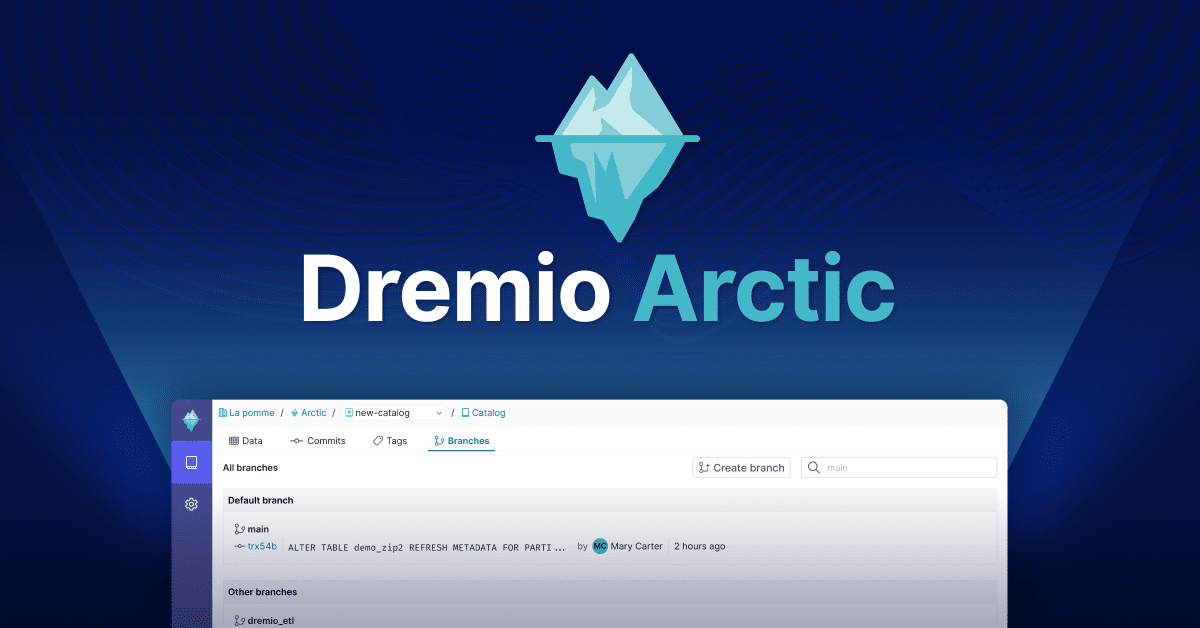
Dremio Arctic is Now Your Data Lakehouse Catalog in Dremio Cloud
Dremio Arctic bring new features to Dremio Cloud, including Apache Iceberg table optimization and Data as Code.