The data lakehouse integrates generative AI to simplify data access and analytics, yet many organizations face complexities in its implementation.
Dremio enables AI to take actionable steps within a data lakehouse using its Integrated AI Agent and Model Context Protocol.
True openness in a lakehouse means avoiding lock-in at the compute engine level, allowing interoperability with other data engines.
The semantic layer in Dremio transforms raw data into defined, reusable products, enhancing analytical capabilities with AI support.
The evolution of data platforms encompasses challenges from traditional warehouses to intelligent lakehouses, focusing on automation and integration.
The data lakehouse, supercharged by generative AI, has become the centerpiece of the modern data stack. The promise is alluring: a single, unified platform for all data and analytics, simplified access, and AI that can answer any business question you can articulate in plain English.
Yet, many organizations find themselves facing a paradox. The goal was simplicity, but the reality is often a tangle of manual performance tuning, complex integrations with other tools, and AI features that feel more like novelties than core operational assets. While the architecture has evolved, the day-to-day burden on data teams remains stubbornly high.
This article cuts through the hype to reveal four surprising truths about what a brilliant and open data lakehouse platform can achieve. Drawing from a deep dive into the architecture of the Dremio platform, we'll explore capabilities that move beyond simple Text-to-SQL and set a new baseline for what data platforms should deliver.
Try Dremio’s Interactive Demo
Explore this interactive demo and see how Dremio's Intelligent Lakehouse enables Agentic AI
1. Your AI Can Do More Than Answer Questions, It Can Take Action
The current generation of Text-to-SQL tools typically stops at generating a query. You ask a question, and the AI gives you the code to find the answer. This is helpful, but it's a passive interaction. A more advanced paradigm exists where AI moves from being an analyst to an active participant in data operations.
Dremio's architecture enables this shift through its Integrated AI Agent and Model Context Protocol (MCP) Server, which provides a powerful, three-pronged approach to connect with the lakehouse:
Tools (model-controlled): These are functions the AI model can call to perform specific actions. Think of them as the AI's "hands", they can execute queries, modify data, or trigger processes.
Resources (application-controlled): These provide read-only access points to data sources, giving the AI model the context it needs to understand the environment without allowing modifications.
Prompts (user-controlled): These are pre-defined templates that guide users toward asking effective, well-structured questions.
The most impactful takeaway is the result of combining the AI Agent and MCP Server's "Tools" with Dremio's comprehensive REST API. The API allows for programmatic management of the entire lakehouse, sources, tables, folders, user-defined functions (UDFs), and more. By configuring an AI agent with tools that call these API endpoints, you can empower it to not just answer questions but to take action.
This represents a fundamental shift. Imagine an AI agent that not only identifies a sudden spike in query latency but is empowered to take immediate, autonomous action. It could use Dremio's API not just to run queries but to analyze jobs, generate visualizations, generate documentation and more. This functionality can then become portable not just in Dremio but also in any agent/client with Dremio's MCP Server. This moves AI from a passive dashboard component to an active, operational co-pilot for your entire data estate.
2. An 'Open' Lakehouse Doesn't Just Use Open Formats, It Embraces Other Engines
Apache Iceberg has become the de facto open standard for data lakehouse table formats, and for good reason. It provides the transactional consistency and schema evolution needed for enterprise workloads. However, true openness is about more than just the format your data is stored in; it's also about avoiding lock-in at the compute engine level.
Dremio extends this concept of openness through its Open Catalog, which provides direct REST API endpoints (https://catalog.dremio.cloud/api/iceberg). These endpoints allow other popular data processing engines to connect directly to Dremio's catalog, using it as a central, shared source of metadata truth for the same Iceberg tables.
The engines that can connect to and work with Dremio's catalog include:
Apache Spark
Apache Flink
Dremio’s Query Engine
Any Apache Iceberg REST supporting Engine
This is a counter-intuitive and powerful feature. Instead of forcing users into its own query engine for all workloads, Dremio positions its catalog as a unifying layer for a multi-engine environment. This architecture ensures that data isn't locked in at the engine level, giving organizations the flexibility to use the best tool for the job, whether it's Dremio for interactive BI, Spark for large-scale ETL, or Flink for real-time stream processing, all while operating on a single, consistent version of the data.
3. The Semantic Layer Isn't a Buzzword, It's a Programmable Data Product
"Semantic layer" is an industry term often shrouded in ambiguity. In Dremio, it's not an abstract concept but a concrete, multi-layered architecture of views designed to bridge the gap between complex physical data and business-friendly consumption. This structure turns raw data into well-defined, reusable data products. In this context, a 'data product' is a reusable, curated dataset (like a view) that is documented, governed, and designed for a specific business purpose, treating data as a product that teams can reliably consume.
The architecture is organized using a three-layer approach:
Preparation Layer: This layer maps one-to-one with physical tables from a source. Its purpose is to organize and expose only the necessary datasets, providing a clean entry point without altering the underlying data.
Business Layer: This is where logical joins occur. Views in this layer create a holistic picture of core business entities, such as "customer" or "product," by combining data from multiple preparation-layer views.
Application Layer: This final layer contains consumption-ready datasets tailored for specific use cases, such as a departmental BI dashboard or a machine learning model. It filters, aggregates, and arranges data from the business layer for a targeted audience.
This structured layer is further enhanced with AI-powered features. Users can leverage Generative AI to generate wikis (detailed descriptions) automatically and labels (for categorization and search) for datasets. This enriched metadata serves as a guide for both human users navigating the data and for Dremio's AI Agent, enabling it to generate far more accurate, context-aware natural language queries. By building this programmable layer of knowledge, organizations can dramatically accelerate their analytical maturity.
Each cycle teaches something new, and when cycles happen quickly, learning compounds. You and your teams develop sharper intuition about what questions to ask, what patterns matter, and which actions drive results.
4. The Evolution of Data Platforms: From Warehouse to Intelligent Lakehouse
The architecture of data platforms has evolved to solve a series of compounding challenges. Understanding this journey clarifies the value proposition of a modern, intelligent lakehouse.
Stage 1: The Traditional Data Warehouse
Rigid, predefined schemas and significant data movement defined this era. Data was extracted from operational systems, transformed, and loaded (ETL) into a central warehouse. The primary challenges were data lock-in within proprietary storage formats and a heavy reliance on complex, often brittle, inter-departmental ETL pipelines that slowed down access to new insights.
Stage 2: The First-Generation Data Lakehouse
The first-generation lakehouse addressed the ETL problem by bringing compute directly to the data, which lived on open cloud object storage. This reduced data movement and broke down proprietary silos. However, new challenges emerged. Data teams were now burdened with the heavy manual work of table optimization (e.g., compacting small files) and performance management. Building a semantic layer or integrating AI capabilities required separate, often long-running, development projects bolted on top of the core platform.
Stage 3: The Dremio Intelligent Data Lakehouse
The modern intelligent lakehouse solves the operational challenges of the first generation by delivering a complete, integrated platform that provides value on day one. Dremio achieves this by seamlessly integrating key capabilities that were previously separate concerns:
Autonomous Table Management: First-generation lakehouses offloaded table optimization (like compacting small files) onto data teams, creating significant manual toil. The intelligent lakehouse automates this maintenance for Iceberg tables, directly addressing this operational burden to improve performance and reduce costs without manual intervention.
A Natively Integrated Semantic Layer: Where previous platforms required bolting on a separate metrics store or semantic tool, the intelligent lakehouse integrates this as a core, multi-layered view architecture. This eliminates a complex integration project and ensures business logic is consistently applied from day one.
An AI-Native Foundation: Instead of treating AI as an add-on, an intelligent lakehouse is built with an extensible AI agent and SQL functions at its core. This provides immediate value for natural language exploration while offering the extensibility (via the AI Agent, MCP Server and AI functions) to evolve into a true operational assistant.
Conclusion: A New Baseline for Data Platforms
A truly modern data lakehouse is defined by more than just its use of open formats. Its value is measured by its intelligence and completeness. It is a platform where AI can take action, where openness extends to other compute engines, where the semantic layer is a structured and programmable asset, and where performance management is autonomous.
These integrated capabilities are shifting the baseline for what organizations should expect from a data platform. The focus is no longer just on storing and querying data, but on creating a self-managing, intelligent, and truly unified ecosystem. As you evaluate your data strategy, ask yourself a forward-looking question: As AI becomes a more active participant in our data ecosystems, how will you leverage it to not just analyze your business, but to help run it?
Ingesting Data Into Apache Iceberg Tables with Dremio: A Unified Path to Iceberg
By unifying data from diverse sources, simplifying data operations, and providing powerful tools for data management, Dremio stands out as a comprehensive solution for modern data needs. Whether you are a data engineer, business analyst, or data scientist, harnessing the combined power of Dremio and Apache Iceberg will undoubtedly be a valuable asset in your data management toolkit.
Oct 12, 2023·Product Insights from the Dremio Blog
Table-Driven Access Policies Using Subqueries
This blog helps you learn about table-driven access policies in Dremio Cloud and Dremio Software v24.1+.
Aug 31, 2023·Dremio Blog: News Highlights
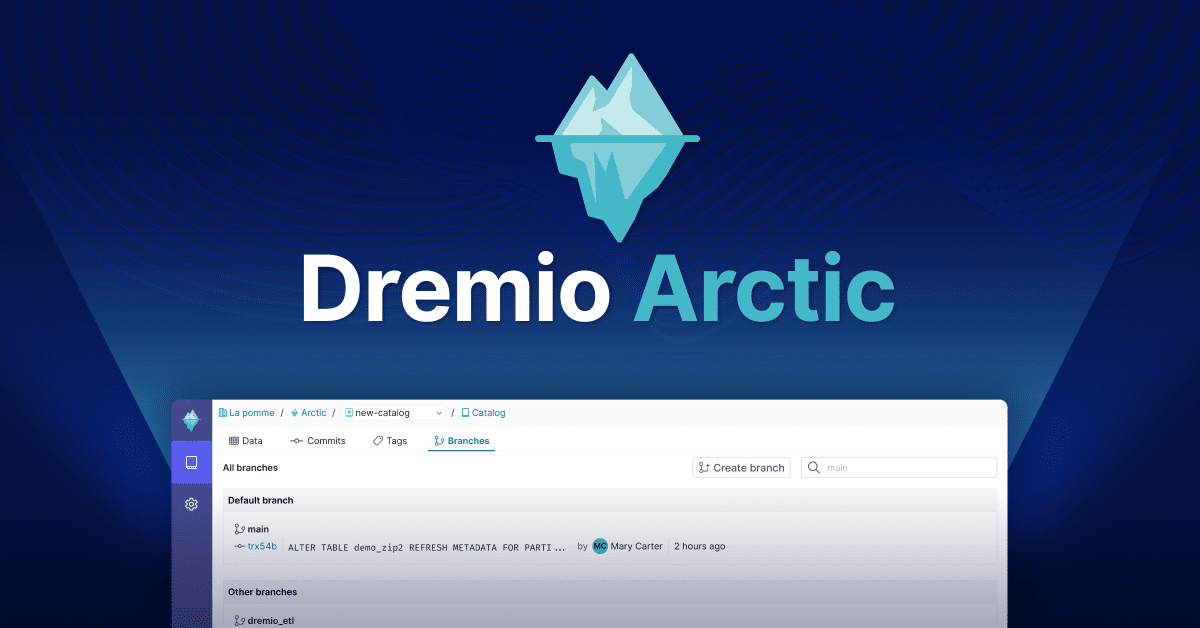
Dremio Arctic is Now Your Data Lakehouse Catalog in Dremio Cloud
Dremio Arctic bring new features to Dremio Cloud, including Apache Iceberg table optimization and Data as Code.