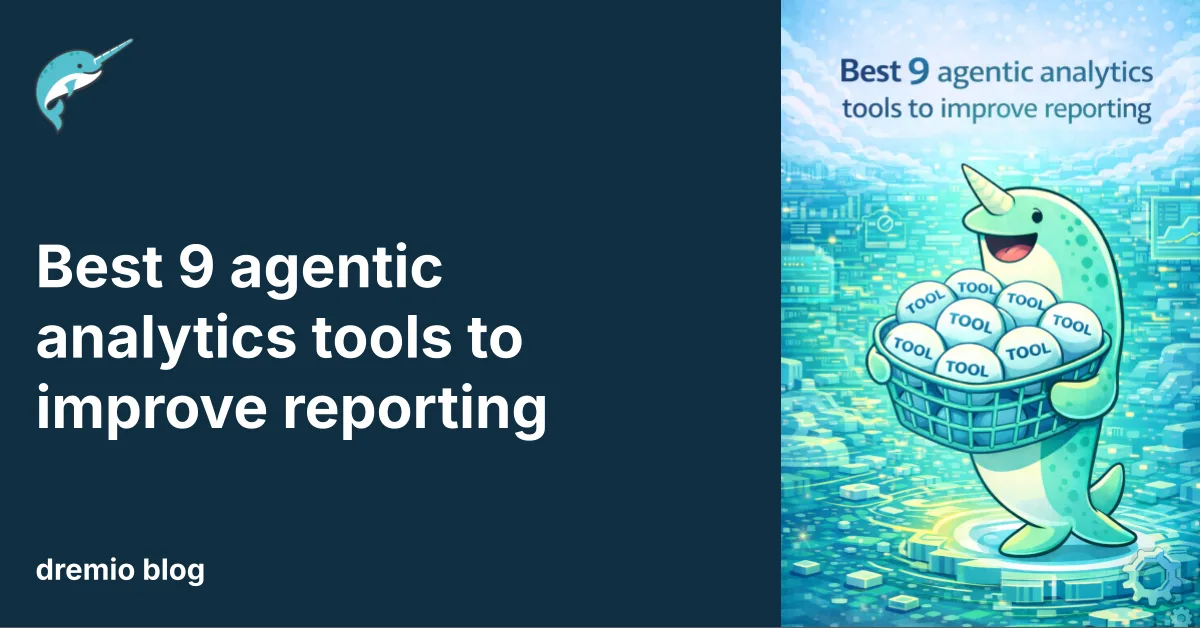
Agentic analytics tools utilize AI agents to automate data workflows, rapidly delivering insights to stakeholders.
The market for agentic analytics is on the rise, with 40% of enterprise applications expected to integrate AI agents by 2026.
Key agentic analytics tools include Dremio, Databricks, and ThoughtSpot, each offering unique features for data analysis.
Benefits of agentic analytics include faster insights, reduced manual tasks, improved reporting accuracy, and proactive anomaly detection.
Selecting the right agentic analytics platform involves evaluating data architecture, autonomy, security, and scalability.
Agentic analytics tools are changing how enterprises build reports and extract value from data. These platforms use AI agents that plan, execute, and adapt analytical workflows autonomously. Instead of waiting for analysts to write queries or build dashboards, agentic analytics tools continuously monitor data, detect patterns, and deliver insights directly to stakeholders.
The market for agentic analytics tools is growing rapidly. According to Gartner, 40% of enterprise applications will integrate task-specific AI agents by the end of 2026. A Dremio-commissioned survey found that 65% of data leaders name agentic analytics as a top priority this year. The tools below represent the best agentic analytics for data-driven insights across enterprise, lakehouse, and modern data environments.
Spotter AI agents, Agentic Data Prep, natural language search, SpotCache for fixed AI costs
Tableau
Tableau Agent, Ask Data, Explain Data, Tableau Pulse proactive insights, Einstein AI predictions
Microsoft Fabric
Copilot across all workloads, Power BI AI visuals, Azure OpenAI integration
Google Cloud (BigQuery)
Gemini AI in BigQuery, BQML (ML in SQL), Vertex AI agents, DataCanvas no-code analytics
Snowflake (Cortex AI)
Cortex AI suite, Snowflake Intelligence, Cortex Analyst, Semantic View Autopilot
Qlik (Sense + AutoML)
Associative analytics engine, AutoML, augmented analytics, natural language interaction
Tellius
AI-native analytics, Kaiya AI assistant, automated insights, workflow orchestration
Try Dremio’s Interactive Demo
Explore this interactive demo and see how Dremio's Intelligent Lakehouse enables Agentic AI
What is an agentic analytics tool for reporting?
An agentic analytics tool is a platform where AI agents autonomously plan, execute, and refine analytical tasks to generate reports, detect anomalies, and surface insights. These agents go beyond simple text-to-SQL by maintaining context over multiple interactions, chaining tasks together, and adapting their approach based on what they find in the data.
The practical advantage over manual analysis is speed and scale. A single analytics agent can monitor hundreds of metrics, compile executive reports, and flag anomalies across business units — all without a human writing a query. Traditional reporting requires analysts to define questions, build queries, format results, and distribute findings. An agentic analytics tool compresses this workflow from days to seconds.
Best agentic analytics tools for data analysis in 2026
The platforms below are widely recognized agentic analytics tools used across enterprise, lakehouse, and modern data environments. Each takes a different approach to embedding AI agents into the analytics workflow. The best agentic analytics platform for your organization depends on your existing data architecture, governance requirements, and the depth of agent autonomy you need.
1. Dremio
Dremio is the agentic lakehouse platform purpose-built to support AI agents across enterprise data. Its AI Semantic Layer provides agents with consistent metric definitions and natural-language data discovery. Dremio's native MCP (Model Context Protocol) server allows any AI agent framework to connect to the lakehouse through open protocols, avoiding proprietary lock-in.
What sets Dremio apart as an analytics agent platform is its combination of semantic intelligence with autonomous performance. Dremio's query engine self-tunes through intelligent caching, query rewriting, and Iceberg clustering, so agents get fast, governed answers without manual optimization. Zero-ETL federation means agents query data across clouds and on-premises systems without data movement. Dremio was recognized in Forrester's Q1 2026 Data Lakehouses Landscape report.
Pros of Dremio:
AI Semantic Layer provides agents with consistent metric definitions, semantic search, and natural language data discovery
Native MCP server enables any AI agent framework to connect using open protocols, avoiding vendor lock-in
Autonomous optimization delivers sub-second query performance without manual tuning, ideal for high-volume agent workloads
2. Databricks
Databricks launched Genie Code in March 2026, an autonomous AI agent that automates data engineering tasks like pipeline building, debugging, and dashboard creation. The platform combines Unity Catalog governance with Mosaic AI for building agentic systems and AI/BI Genie for natural language interaction with data.
Unified platform for data engineering, ML training, and analytics with strong governance through Unity Catalog
Cons of Databricks:
High complexity for business analysts and non-technical users
Costs scale rapidly with compute-intensive ML and analytics workloads
Steep learning curve for teams not already using notebook-based development
3. ThoughtSpot
ThoughtSpot positions itself as the agentic analytics platform company. Its Spotter agents automate data exploration through conversational analytics, and the next-generation Analyst Studio (February 2026) introduced Agentic Data Prep for natural language data profiling and preparation.
Pros of ThoughtSpot:
Purpose-built for natural language search and self-service agentic analytics
Agentic Data Prep lets analysts profile datasets and generate queries using natural language
Cons of ThoughtSpot:
Works best with Snowflake, creating a platform dependency for full feature access
Limited data engineering and transformation capabilities compared to full-stack platforms
Premium pricing that can be significant for large enterprise deployments
4. Tableau (Salesforce)
Tableau is adding agentic analytics capabilities through its Salesforce integration. Tableau Agent delivers autonomous reporting within the Salesforce ecosystem, while Ask Data provides natural language querying, Explain Data offers automated explanations, and Tableau Pulse delivers proactive AI-generated insights.
Pros of Tableau:
Industry-leading data visualization with a massive community and training ecosystem
Tableau Pulse delivers proactive, personalized AI-powered insights based on user interests
Cons of Tableau:
Data preparation capabilities are limited, requiring external tools for complex workflows
Agentic features are maturing more slowly than purpose-built agentic analytics software
Einstein AI features and advanced Salesforce integration require additional licensing
5. Microsoft Fabric
Microsoft Fabric embeds Copilot AI across every workload: data engineering, data science, real-time analytics, and Power BI. Copilot generates DAX formulas, writes SQL, explains data visualizations, and builds reports from natural-language prompts, making it a broad agentic analytics tool for Microsoft-centric organizations.
Pros of Microsoft Fabric:
Copilot embedded across every Fabric workload, from data engineering to BI reporting
Deep Microsoft 365 and Power BI integration extends AI analytics to the largest BI user base
Cons of Microsoft Fabric:
Still maturing as a unified platform, with some workloads more polished than others
Licensing complexity across Microsoft 365, Azure, and Fabric tiers can be difficult to plan
Best suited for organizations already deep in the Microsoft ecosystem
6. Google Cloud (BigQuery + Gemini)
Google BigQuery integrates Gemini AI for natural language querying, BQML for running machine learning directly in SQL, and Vertex AI for building autonomous analytics agents. DataCanvas provides a no-code analytics interface for business users.
Pros of Google Cloud:
Gemini-powered natural language querying with strong AI/ML integration through Vertex AI
BQML lets data teams train and deploy ML models using familiar SQL without Python
Cons of Google Cloud:
Tight Google ecosystem coupling limits portability for multi-cloud organizations
Complex IAM configuration adds overhead for large teams
Less suited for organizations with heavy on-premises or hybrid deployments
7. Snowflake (Cortex AI)
Snowflake has built a comprehensive agentic analytics suite called Cortex AI, which includes LLM capabilities, Copilot, Document AI, Cortex Analyst, and Search. Snowflake Intelligence is a conversational application layer, and Semantic View Autopilot automates the creation of semantic models for consistent agent access.
Pros of Snowflake:
Broad suite of native AI features integrated directly into the data platform
Cortex Analyst and Semantic View Autopilot provide consistent metrics for AI-driven reporting
Cons of Snowflake:
Consumption-based pricing makes agentic workload costs unpredictable for large deployments
AI features deliver their best performance within the Snowflake ecosystem
Limited support for unstructured data compared to lakehouse-native platforms
8. Qlik (Sense + AutoML)
Qlik Sense uses a patented associative analytics engine that lets users explore data relationships without predefined queries. Qlik's AI capabilities include AutoML for automated model building, augmented analytics for automated insight generation, and natural language interaction for agent-style analytics.
Pros of Qlik Sense:
Patented associative engine discovers data relationships that predefined dashboards miss
AutoML enables non-data-scientists to build and deploy ML models
Cons of Qlik Sense:
Talend integration following the Qlik acquisition is still evolving
Visualization learning curve can be steep for new users
Premium pricing, especially for enterprise-wide deployments
9. Tellius
Tellius is an AI-native analytics platform built from the ground up for automated insight generation. Its Kaiya AI assistant provides conversational analytics, automated anomaly detection, and natural language search. The platform supports agentic workflow orchestration where AI agents chain analyses together.
Pros of Tellius:
Purpose-built for AI-driven analytics with strong automated insight generation
Kaiya AI assistant offers deep conversational analytics and natural language search
Cons of Tellius:
Smaller market presence compared to platform incumbents like Databricks and Snowflake
Limited data engineering capabilities for complex pipeline workflows
Newer platform with fewer enterprise reference deployments
Benefits of leveraging agentic analytics software
Agentic analytics software delivers measurable advantages across reporting speed, accuracy, and accessibility. The benefits below describe why enterprises are prioritizing these tools in their 2026 data strategies.
Faster time to insight and decision-making
Agentic analytics compresses the path from question to answer. Instead of waiting for an analyst to receive a request, write a query, build a report, and present findings, an AI agent handles the full cycle in seconds. This speed matters most in fast-moving environments where delayed answers mean missed opportunities. AI-driven decision making is a top priority for a reason: the organizations that act on data fastest gain a structural advantage.
The impact compounds across the organization. When every department gets answers in seconds rather than days, decisions across sales, marketing, finance, and operations happen in parallel rather than sequentially. The backlog of ad-hoc requests on data teams shrinks, and analysts shift from report builders to strategic advisors.
Agent-generated insights arrive in seconds, reducing decision cycles from days to minutes
Parallel insight delivery across departments accelerates organization-wide execution
Reduced manual analysis and operational overhead
Manual reporting requires analysts to write SQL, format results, build charts, and distribute findings. This work is repetitive and time-consuming. A core capability of agentic analytics software is to automate these steps, so analysts can focus on interpretation and strategy. Agents work with live data to generate reports, update dashboards, and monitor metrics without human involvement.
The operational overhead reduction is measurable. Teams that deploy agentic analytics tools report spending less time on report building and more time on complex analysis that requires human judgment. This shift frees capacity without adding headcount.
Agents automate SQL writing, chart building, and report distribution
Analysts reclaim time for strategic work that requires live data interpretation and domain expertise
Improved accuracy across reporting
Manual reporting is prone to copy-paste errors, inconsistent metric definitions, and stale data. AI agents that query a governed semantic layer produce consistent results every time. The same metric returns the same number regardless of which agent, tool, or user runs the query.
Accuracy also improves through self-validation. Agentic analytics tools check results against quality rules, historical baselines, and confidence thresholds before surfacing insights. This catches errors that manual review often misses.
Semantic layer-backed queries produce consistent metrics across all reports and agents
Self-validation catches data quality issues before they reach stakeholders
Proactive anomaly detection and risk mitigation
Traditional analytics is reactive: teams discover problems when they check dashboards. Agentic analytics is proactive: agents monitor metrics continuously and surface anomalies in real time. This shift from reactive to proactive detection reduces the time between problem and response.
Federation and virtualization enable agents to scan data across multiple systems without moving data, expanding the scope of anomaly detection beyond a single data warehouse. Agents can correlate signals across CRM, ERP, and operational databases to detect patterns that single-system monitoring would miss.
Real-time anomaly detection surfaces issues before they affect business outcomes
Cross-system monitoring through federation catches patterns invisible to single-source analysis
Greater accessibility for business users and data teams
Agentic analytics tools make data accessible to users who do not write SQL. Natural language interfaces let business users ask questions and get answers directly. Context-aware agents remember previous interactions and adapt their responses based on user history and role.
This accessibility has long-term benefits beyond individual productivity. When more people across the organization can access trusted data, decision quality improves at every level. Data teams shift from gatekeepers to enablers, and the culture becomes more data-driven.
Natural language access removes the SQL barrier for business users
Context-aware agents personalize responses based on user role and history
How to choose the right analytics agent platform for your enterprise
Selecting an analytics agent platform requires evaluating architecture, autonomy depth, governance, and scalability. The criteria below help enterprises make a structured comparison. Agentic analytics for data analysts starts with choosing a platform that fits your data stack and governance requirements.
Align with your existing data architecture
The platform must integrate with your current data sources, warehouses, lakes, and cloud environments. Evaluate native connector support, data federation capabilities, and whether the platform requires data movement into a proprietary format. The best agentic analytics platform for data analytics teams is one that integrates with their existing stack.
Migration costs and timeline matter. A platform that requires copying all data into its own storage adds cost and complexity. Tools with federation capabilities query data in place, reducing infrastructure overhead.
Check native connector support for your data sources (cloud storage, databases, SaaS)
Evaluate whether the platform can query data in place or requires data movement
Evaluate the depth of agent autonomy and orchestration
Not all "agentic" features are equal. Some platforms add a chat interface on top of basic SQL generation. Others support multi-step planning, adaptive execution, and autonomous performance tuning. Evaluate how many steps the agent can chain together, whether it can adapt its plan mid-execution, and how it handles failures.
True autonomy means the agent can detect an issue, investigate the cause, and surface findings without any human prompt. Surface-level autonomy means the agent only responds when asked.
Test whether agents chain multi-step analyses autonomously or require human prompts at each step
Check adaptive capabilities: can the agent adjust its plan if a data source is unavailable or a query fails?
Assess governance, security and compliance controls
Agentic tools operate at machine speed, amplifying the impact of governance gaps. Data governance must include row-level and column-level security, audit logging, and compliance controls that apply to every agent-initiated query. Without these controls, agents risk accessing restricted data or producing non-compliant outputs.
Governance also means controlling what actions agents can take. If an agent can trigger workflows or write to databases, those actions need authorization gates and audit trails.
Verify that security controls apply to agent queries identically to human queries
Check audit logging granularity: does it track every agent action, including tool use and data access?
Examine semantic consistency and standardization
Agents need consistent metric definitions to produce reliable results. Evaluate whether the platform includes an AI semantic layer or requires you to build one separately. Without a semantic layer, agents must infer metric definitions, which leads to inconsistent and incorrect results.
The semantic layer should support dimension mapping, join path resolution, and aggregation rules. It should also expose metadata through APIs that agents can consume programmatically.
Check whether the platform includes a built-in semantic layer or requires a third-party solution
Evaluate API access to semantic definitions for agent consumption
Ensure scalability, performance and interoperability
AI agents generate high query volumes. The platform must handle concurrent agent workloads without degradation. Evaluate query performance under load, elastic compute scaling, and support for multiple query engines. Interoperability with existing BI tools, notebooks, and AI frameworks is equally important.
Check open-protocol support (MCP, REST APIs) so agents built on different frameworks can interact with the platform. Avoid platforms that lock agents into proprietary connectors.
Test query performance under high concurrent agent workloads
Verify open-protocol support (MCP, REST APIs) for agent framework flexibility
Power smarter analytics agent tools with Dremio
Dremio is the best agentic analytics platform for enterprises that need governed, high-performance AI agent access to data at scale. Dremio's AI Agent connects to the agentic lakehouse through a native MCP server, providing any AI framework with standardized access to enterprise data.
AI Semantic Layer: Consistent metric definitions and natural language discovery for agents and human users
Native MCP server: Open-protocol connectivity that supports any AI agent framework without vendor lock-in
Autonomous optimization: Self-tuning query engine with intelligent caching, Iceberg clustering, and query rewriting
Zero-ETL federation: Query all data sources in place across clouds and on-premises without data movement
Enterprise governance: Row-level and column-level security, audit logging, and compliance controls on every query
Book a demo today and see how Dremio powers the best agentic analytics tools for enterprises.
Frequently asked questions
How does an agentic analytics tool improve reporting consistency?
Agentic analytics tools improve reporting consistency by querying a governed semantic layer that standardizes metric definitions across all reports. When every agent uses the same calculation for "revenue" or "churn rate," reports across departments align automatically. Data quality checks run at query time, and agents validate results against historical baselines. Conversational analytics interfaces let users ask follow-up questions, and the agent maintains context to deliver consistent answers across the conversation.
What does autonomy actually mean in enterprise agentic analytics?
In enterprise agentic analytics, autonomy means agents can detect issues, investigate root causes, and surface findings without human intervention. An autonomous agent monitors KPIs, fires when metrics deviate from expectations, runs diagnostic queries, and routes findings to the right team. Human oversight remains critical: organizations should configure approval gates for high-stakes actions and review agent outputs regularly. Autonomy does not mean unsupervised — it means the agent handles routine analytical steps independently while humans supervise outcomes.
How do agentic analytics tools maintain metric consistency across departments?
Agentic analytics tools maintain metric consistency by connecting every query to a centralized semantic model. This model defines how metrics are calculated, which data sources they use, and what business rules apply. When sales, marketing, and finance all query through the same semantic layer, "pipeline value" means the same thing in every report. Agents capable of resolving ambiguous questions refer to this model rather than guessing, so different departments always see the same numbers.
How does agentic analytics software operate securely in regulated environments?
In regulated industries, agentic analytics software must enforce row-level and column-level security on every query, log every agent action for audit trails, and comply with frameworks like GDPR, HIPAA, and SOX. Security controls must apply at the platform level so agents cannot circumvent access rules. Complex workflows involving sensitive data should include human approval gates. Audit logs must capture the full chain from agent request to data access to result delivery.
Can an analytics agent platform integrate with existing BI tools and data stacks?
Yes. The best analytics agent platforms support open protocols like MCP and REST APIs, allowing agents to connect to existing BI tools (Tableau, Power BI, Looker), notebooks (Jupyter), and data infrastructure (Spark, Trino, dbt). Deploying AI agents does not require replacing your current stack — it means adding an intelligent layer on top. Multi-agent orchestration, where specialized agents handle different parts of the analytics workflow, is possible when the platform provides standardized API access. Dremio's agentic platform supports this open integration model.
Try Dremio Cloud free for 30 days
Deploy agentic analytics directly on Apache Iceberg data with no pipelines and no added overhead.
Ingesting Data Into Apache Iceberg Tables with Dremio: A Unified Path to Iceberg
By unifying data from diverse sources, simplifying data operations, and providing powerful tools for data management, Dremio stands out as a comprehensive solution for modern data needs. Whether you are a data engineer, business analyst, or data scientist, harnessing the combined power of Dremio and Apache Iceberg will undoubtedly be a valuable asset in your data management toolkit.
Oct 12, 2023·Product Insights from the Dremio Blog
Table-Driven Access Policies Using Subqueries
This blog helps you learn about table-driven access policies in Dremio Cloud and Dremio Software v24.1+.
Aug 31, 2023·Dremio Blog: News Highlights
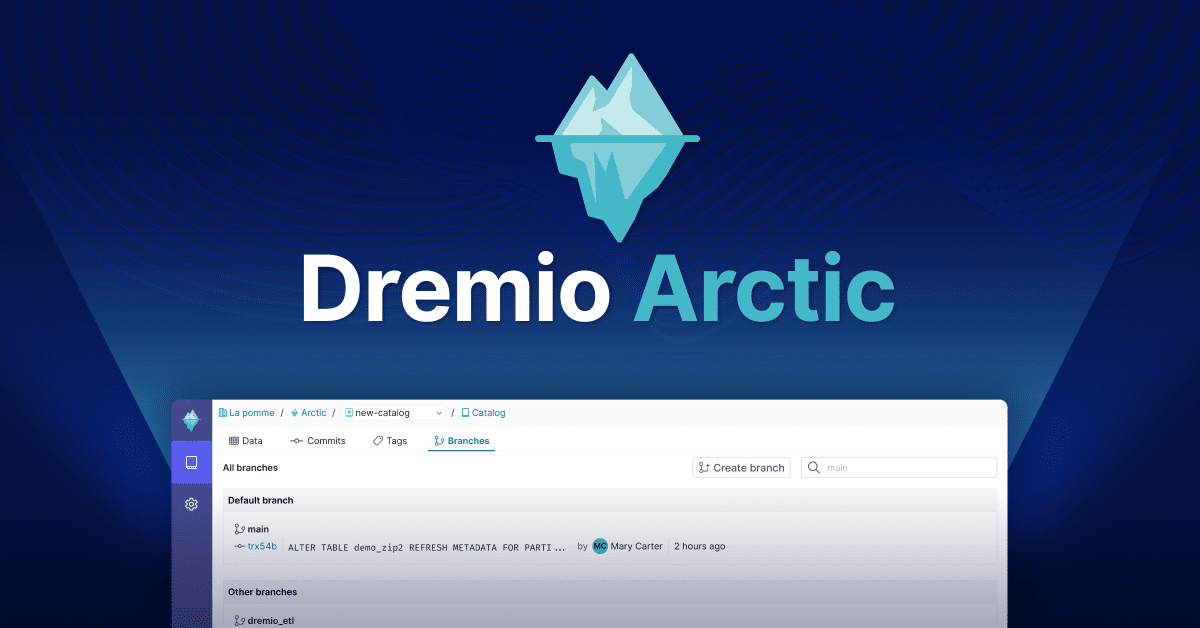
Dremio Arctic is Now Your Data Lakehouse Catalog in Dremio Cloud
Dremio Arctic bring new features to Dremio Cloud, including Apache Iceberg table optimization and Data as Code.