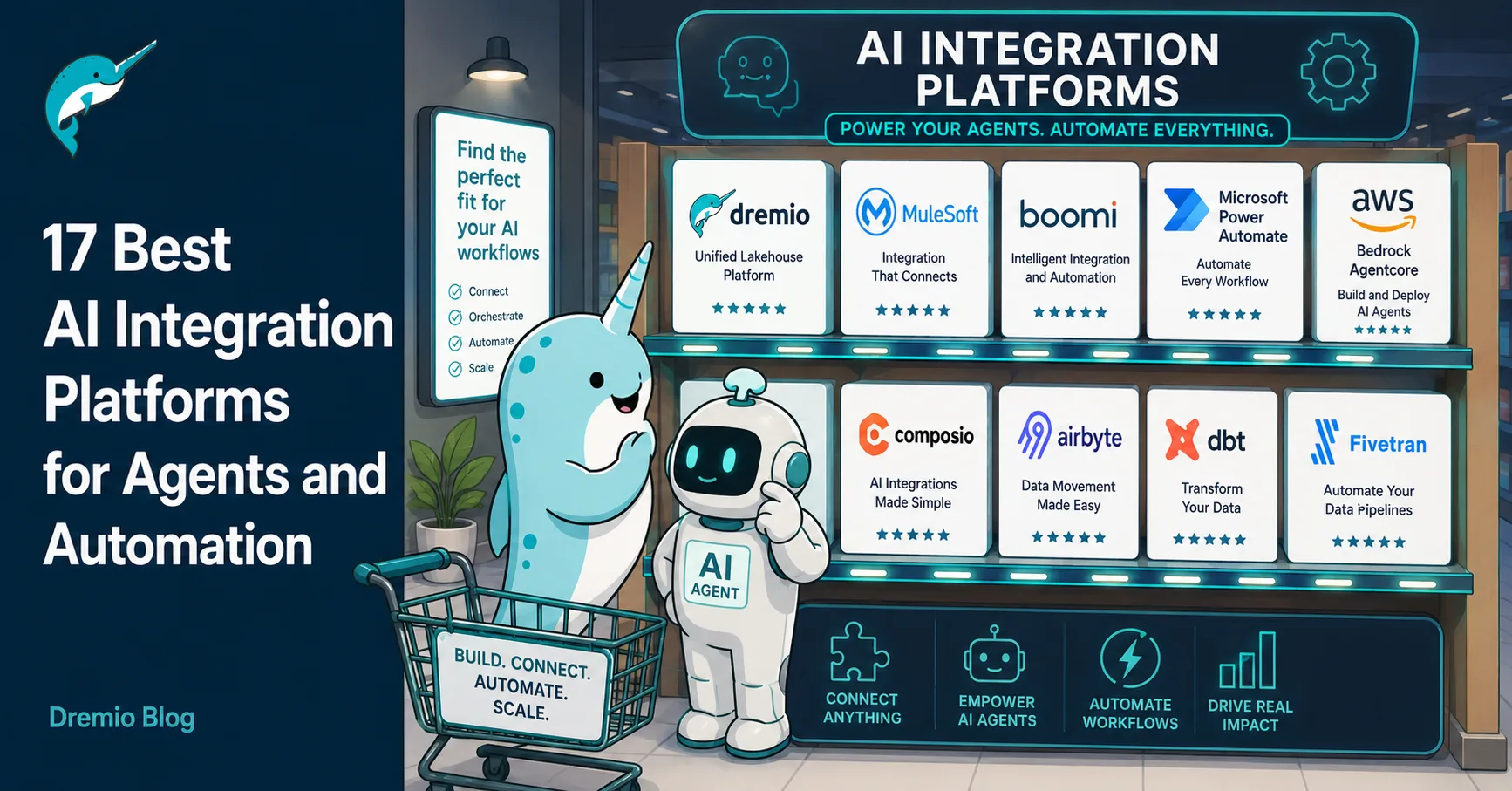
AI integration platforms have become a critical piece of enterprise architecture. Organizations building AI agents, automation workflows, and AI-ready data pipelines need platforms that connect data sources, enforce governance, and support the high-throughput, low-latency access patterns that AI systems demand. This guide covers 17 of the best AI integration platforms available in 2026, selection criteria for evaluating them, and how a data lakehouse foundation strengthens every AI integration strategy.
Top AI integration platforms in 2026
Key features
Dremio
Agentic Lakehouse, Zero-ETL federation, AI semantic layer, MCP for agents, autonomous optimization, Apache Iceberg native
Enterprise data integration and governance, hybrid/multi-cloud support
Apache Kafka
Distributed event streaming, real-time data pipelines, foundation for AI data feeds
Confluent
Enterprise Kafka platform, managed event streaming, data contracts and stream catalog
Matillion
Cloud-native ELT, no-code/low-code transformation for cloud warehouses and lakehouses
Prefect
Python-native workflow orchestration, AI pipeline scheduling and observability
n8n
Open-source workflow automation, 350+ integrations, AI tool-calling and API connectivity
What is an AI integration platform?
An AI integration platform is a system that connects AI models, agents, and automation workflows to the data sources, APIs, and external services they need to function. It handles the infrastructure of AI connectivity — authentication, data format translation, governance enforcement, error handling, and performance management — so that AI systems can focus on reasoning and decision-making rather than low-level integration mechanics.
Enterprise AI integration platforms work by providing a layer between AI models and the data or services those models consume. They expose connectors, APIs, and semantic interfaces that standardize how AI systems access information across a heterogeneous enterprise environment. Without an integration platform, connecting an AI agent to enterprise data requires custom development for each data source — a fragile and expensive approach that does not scale across a large organization.
The benefits of a dedicated AI integration platform are concrete: faster AI deployment, more consistent data quality for AI inputs, centralized governance over AI data access, and reduced engineering overhead for connecting new AI use cases to existing data infrastructure.
What are the best AI integration platforms for 2026?
The best AI integration platforms in 2026 are those that can handle both the data preparation requirements of AI model training and the real-time data access requirements of AI agents in production. Below are the 17 platforms that meet the demands of enterprise AI integration today.
1. Dremio
Dremio is the Intelligent Lakehouse Platform for the Agentic AI Era, built by the original co-creators of Apache Polaris and Apache Arrow. It serves as the AI data foundation for enterprise organizations — providing Zero-ETL federation across all data sources, a unified semantic layer that gives AI agents consistent business context, and native support for the Model Context Protocol (MCP) so AI agents can query data autonomously with proper governance enforced automatically.
Unlike platforms that focus on data movement, Dremio queries data where it lives. AI agents connect to Dremio through MCP and receive governed access to all enterprise data — structured tables in cloud object storage, relational databases, SaaS sources, and streaming feeds — through a single interface. The autonomous optimization engine keeps query performance high without manual tuning, so AI agents receive fast responses even under concurrent load from multiple agents and human analysts. Trusted by Shell, TD Bank, Michelin, and Farmer's Insurance, Dremio is the AI integration platform built for organizations that need data speed, governance, and semantic clarity at enterprise scale.
Pros of Dremio:
Zero-ETL federation means AI agents access current data without waiting for ETL pipelines
AI semantic layer provides business context that allows agents to interpret data correctly
MCP support enables native, governed AI agent connectivity
Autonomous optimization delivers fast query response times without manual performance work
Apache Iceberg native — open format support prevents vendor lock-in
Trusted by global enterprises for mission-critical AI and analytics workloads
Dremio cons:
Best suited for organizations adopting a lakehouse architecture — less focused on pure workflow automation use cases
2. MuleSoft
MuleSoft is Salesforce's enterprise integration platform, built on the Anypoint Platform and an API-led connectivity model. It connects applications, data sources, and AI systems through reusable APIs that are designed, published, and managed through a central platform portal. MuleSoft has the broadest enterprise adoption among integration platforms, particularly for organizations with complex Salesforce ecosystems or multi-system integration requirements.
MuleSoft's Anypoint AI features add AI-generated integration code, intelligent error detection, and AI-powered connector recommendations that reduce the development effort required for complex integration projects.
Pros of MuleSoft:
API-led connectivity model creates reusable integration assets across the enterprise
500+ pre-built connectors for enterprise applications, databases, and cloud services
Deep integration with Salesforce CRM and the broader Salesforce ecosystem
MuleSoft cons:
Licensing cost is high, particularly for smaller organizations or simpler use cases
Complexity of Anypoint Platform requires meaningful investment in training and expertise
Not optimized for high-throughput data processing or analytical workloads
3. Boomi
Boomi is a cloud-native integration Platform-as-a-Service (iPaaS) focused on hybrid connectivity — connecting on-premises systems with cloud applications and data services through low-code visual builders. It is widely used for connecting ERP systems, HR platforms, and CRM tools across organizations that have a mix of legacy on-premises software and modern cloud applications.
Boomi's AI-powered integration suggestions — Boomi AI — recommend integration flows based on the data structures being connected, reducing the time required to build new integrations.
Pros of Boomi:
Low-code visual interface accessible to integration developers without deep programming expertise
Strong hybrid connectivity for organizations with on-premises infrastructure
Boomi AI reduces development time with intelligent integration suggestions
Boomi cons:
Less suited for complex data transformation workloads than purpose-built data integration tools
Performance at high throughput can be limiting for enterprise-scale data pipelines
Governance and lineage capabilities less mature than dedicated data governance platforms
4. Microsoft Power Automate
Microsoft Power Automate is a low-code/no-code workflow automation platform that integrates across Microsoft 365, Azure, Dynamics 365, and hundreds of third-party services. It is the primary automation tool for organizations within the Microsoft ecosystem, enabling business users to build automated workflows without writing code. Power Automate AI Builder adds AI processing capabilities — form recognition, sentiment analysis, object detection — directly into automation workflows.
For enterprises building AI-powered workflows on Microsoft infrastructure, Power Automate provides a tightly integrated automation layer that connects Azure AI services, Copilot Studio, and Microsoft 365 data in a single, governed environment.
Pros of Microsoft Power Automate:
Deep native integration with Microsoft 365, Teams, Azure AI, and Dynamics 365
Low-code/no-code builder accessible to business users without engineering support
AI Builder adds AI processing directly into automation workflows
Microsoft Power Automate cons:
Primarily suited for the Microsoft ecosystem — less effective for non-Microsoft tool stacks
Complex or high-volume workflows may hit performance and scalability limits
Data governance is dependent on Microsoft Purview, adding complexity for organizations outside the Microsoft stack
5. AWS Bedrock AgentCore
AWS Bedrock AgentCore is Amazon's fully managed infrastructure for deploying production-grade AI agents on AWS. It provides the runtime, memory management, tool connectivity, and security infrastructure that AI agents need to operate reliably at scale. Agents built on Bedrock AgentCore can connect to AWS data services, external APIs, and third-party tools through AWS's managed connector library.
AgentCore simplifies the operational complexity of running AI agents in production — handling authentication, session management, and scaling automatically — while integrating with AWS's security and compliance infrastructure through IAM, VPC, and AWS CloudTrail.
Pros of AWS Bedrock AgentCore:
Fully managed AI agent runtime reduces operational complexity for AWS-native organizations
Deep integration with AWS data services, security controls, and monitoring
Scales automatically to handle concurrent agent requests
AWS Bedrock AgentCore cons:
Deeply tied to the AWS ecosystem — limited portability to other cloud providers
Less suited for organizations with on-premises or multi-cloud data estates
Best used for agent execution rather than data preparation or semantic layer management
6. Composio
Composio is a developer-first platform specifically designed for building production-grade AI agents that connect to external tools and services. It provides 850+ pre-built tool integrations with managed authentication (OAuth, API keys, token storage) handled automatically, so developers focus on agent logic rather than authentication infrastructure. Composio's standardized tool definition format works across multiple LLM providers.
Composio is built for engineering teams building AI agents that take actions — creating calendar events, sending emails, querying databases, updating CRM records — rather than teams primarily focused on data pipeline orchestration.
Pros of Composio:
850+ pre-built connectors with managed authentication for every integration
Standardized tool definitions work across major LLM providers
Purpose-built for production agentic AI workflows
Composio cons:
Focus on action-oriented agent integrations — not suited for heavy data transformation workloads
Less enterprise governance maturity compared to established integration platforms
Primarily developer-focused — limited low-code interface for business users
7. Nango
Nango is an AI agent infrastructure platform focused on keeping AI agent data contexts current. Its primary use case is retrieval-augmented generation (RAG) synchronization — maintaining vector databases with up-to-date content from connected sources through real-time sync and event-triggered updates. This ensures AI models receive accurate, current information from enterprise sources without manual data refresh processes.
Nango handles the complexity of OAuth flows, API pagination, rate limiting, and incremental sync across hundreds of SaaS sources, making it far easier to build agents that depend on current external data.
Pros of Nango:
Specialized for real-time data sync to AI agent knowledge bases and vector stores
Handles OAuth and authentication complexity for hundreds of SaaS integrations
Strong for RAG-based AI applications that require continuously updated context
Nango cons:
Narrowly focused on data sync for AI agents — not a general-purpose integration platform
Less suited for structured SQL data workloads or enterprise analytics use cases
Enterprise governance features still maturing relative to established platforms
8. Informatica
Informatica is one of the most established enterprise data management and integration platforms, providing a comprehensive suite of tools for data integration, data quality, data governance, and master data management (MDM) through its Intelligent Data Management Cloud (IDMC). Informatica's AI-powered automation (CLAIRE) handles data discovery, quality scoring, and lineage tracking automatically, reducing the manual effort of data preparation at enterprise scale.
For organizations building AI systems that require high-quality, certified data, Informatica's data quality and governance capabilities make it a foundational platform — particularly for regulated industries where data accuracy is a compliance requirement.
Pros of Informatica:
Comprehensive data governance, quality, and lineage management at enterprise scale
AI-powered CLAIRE engine automates metadata management and quality scoring
Strong regulatory compliance capabilities for healthcare, financial services, and government
Informatica cons:
High licensing cost, particularly for smaller organizations or specific use cases
Platform complexity requires deep implementation expertise
Not suited for fast, interactive SQL analytics — primarily a data management and preparation tool
9. Airbyte
Airbyte is an open-source ELT (Extract, Load, Transform) platform with 350+ pre-built connectors for databases, SaaS applications, cloud storage, and APIs. It is the most widely adopted open-source data pipeline tool in the modern data stack, used to move data from source systems into data warehouses and lakehouses for analytics and AI workloads. Airbyte Cloud offers a fully managed version with reduced operational overhead.
Airbyte's primary strength is flexibility — the connector framework allows teams to build custom connectors for sources not covered by the pre-built library, and the open-source model means there are no licensing constraints on the number of pipelines or data volume.
Pros of Airbyte:
Open-source model with no per-pipeline or volume-based pricing
350+ pre-built connectors with active community-maintained additions
Connector Development Kit (CDK) makes building custom connectors straightforward
Less enterprise governance and security maturity than commercial alternatives
Airbyte Cloud pricing can be high at large data volumes
10. dbt (data build tool)
dbt is a SQL-based transformation framework that runs inside data warehouses and lakehouses, transforming raw data into clean, tested, and documented datasets ready for analytics and AI. It defines transformation logic in SQL and Jinja templates, runs tests to validate data quality, and generates documentation and lineage automatically. dbt is the most widely used semantic and transformation layer in the modern data stack.
dbt works downstream of data ingestion tools like Airbyte or Fivetran — it does not move data, but transforms data that has already been loaded into a warehouse or lakehouse. dbt models define the business logic that makes raw data consistent and interpretable for analysts and AI models.
Pros of dbt:
SQL-based transformation makes data modeling accessible to analysts with SQL skills
Built-in testing framework catches data quality issues before they reach downstream consumers
Automatic lineage documentation maps the full dependency graph of all data models
dbt cons:
Does not handle data ingestion — requires a separate ELT tool for source-to-warehouse movement
Limited to transformations inside a single warehouse or lakehouse environment
Not suited for real-time streaming transformations (designed for batch-oriented workloads)
11. Fivetran
Fivetran is a fully managed ELT platform that automates data pipelines from 600+ sources to data warehouses and lakehouses. It prioritizes reliability and low operational overhead — Fivetran handles schema evolution, connector maintenance, and incremental data loading automatically, with strong SLA guarantees for pipeline uptime. It is the commercial alternative to self-hosted Airbyte for organizations that prioritize managed reliability over open-source flexibility.
Pros of Fivetran:
Fully managed pipeline operations with strong reliability SLAs
600+ pre-built connectors with automatic schema drift handling
Low maintenance — Fivetran handles connector updates when APIs change
Fivetran cons:
Pricing based on monthly active rows can become expensive at high data volumes
Less flexibility than open-source alternatives for custom connector development
Locked into Fivetran's connector library — custom connectors are limited in scope
12. Talend (Qlik)
Talend, now part of Qlik, is an enterprise data integration and governance platform covering ETL, data quality, API integration, and master data management. It supports hybrid and multi-cloud deployment models and provides strong data quality certification capabilities that make it a fit for organizations in regulated industries. Talend's integration with Qlik's analytics platform creates a combined data integration and BI stack for organizations that use both products.
Pros of Talend:
Comprehensive data integration covering ETL, API integration, and data quality
Strong support for hybrid and multi-cloud deployment models
Governance and data quality capabilities well-suited for regulated industries
Talend cons:
Complex platform with a steep learning curve for new teams
Integration between Talend and Qlik analytics is still maturing post-acquisition
Higher cost compared to modern open-source alternatives for similar use cases
13. Apache Kafka
Apache Kafka is the dominant open-source distributed event streaming platform, used to build real-time data pipelines and streaming applications. It stores data as an ordered, immutable log of events and allows multiple consumers to read from the same streams independently. Kafka is the foundation of real-time data feeds for AI systems — providing the continuous stream of current data that AI models and agents need for real-time decision-making.
Pros of Apache Kafka:
High-throughput, low-latency event streaming at massive scale
Durable event log allows multiple consumers to replay historical events
Massive ecosystem of connectors (Kafka Connect) for databases, cloud services, and applications
Kafka cons:
Complex to operate at production scale — requires deep infrastructure and operations expertise
Does not provide governance, catalog, or semantic layer capabilities on its own
Managed Kafka services (Confluent, Amazon MSK) reduce but do not eliminate operational complexity
14. Confluent
Confluent is the enterprise platform built on Apache Kafka, adding governance, a stream catalog, data contracts, and fully managed infrastructure on top of the open-source Kafka core. Confluent Cloud removes the operational burden of managing Kafka clusters, while Confluent's Stream Governance adds schema registry, data contracts, and stream lineage tracking — capabilities that are critical for production AI data feeds.
Pros of Confluent:
Fully managed Kafka reduces the operational complexity of running event streaming at scale
Stream Governance adds data contracts and schema validation critical for AI data reliability
Strong global ecosystem of connectors and integrations built on the Kafka standard
Confluent cons:
High cost at scale compared to self-managed Kafka
Primarily a streaming platform — not suited for batch analytics or semantic layer management
Vendor dependency on Confluent's Cloud platform for managed features
15. Matillion
Matillion is a cloud-native ELT platform designed specifically for transforming data in cloud data warehouses and lakehouses. It provides a visual, low-code transformation interface that makes data modeling accessible to data analysts without deep engineering expertise. Matillion supports Snowflake, Databricks, Amazon Redshift, Google BigQuery, and Microsoft Azure Synapse as execution targets.
Pros of Matillion:
Low-code visual interface accessible to data analysts without programming backgrounds
Purpose-built for cloud data warehouse and lakehouse transformations
Strong native integrations with major cloud platforms
Matillion cons:
Primarily a transformation tool — does not handle data ingestion or orchestration independently
Less suited for organizations with on-premises or hybrid data environments
Performance and cost scaling can be unpredictable for very high-volume transformation workloads
16. Prefect
Prefect is a Python-native workflow orchestration platform for data pipelines and AI workflows. It provides scheduling, observability, error handling, and retry logic for Python-based data workflows, making it a popular choice for data engineering teams that write their pipelines in Python. Prefect's managed cloud offering reduces infrastructure management while keeping full control over pipeline logic in code.
Pros of Prefect:
Python-native — pipelines are defined in standard Python code, no DSL required
Strong observability with real-time pipeline monitoring and alerting
Flexible deployment options — run locally, on cloud VMs, or on Prefect Cloud
Prefect cons:
Python-only — not suited for teams using non-Python pipeline languages
Less integrated with enterprise governance and security platforms than commercial alternatives
Orchestration-focused — does not handle data storage, transformation, or semantic layer management
17. n8n
n8n is an open-source workflow automation platform that combines visual, low-code workflow building with code execution nodes for developers who need custom logic. It provides 350+ integrations covering SaaS applications, databases, APIs, and AI tools, making it suitable for building hybrid workflows that combine data operations with AI tool-calling and external API interactions. n8n's self-hosted model gives organizations full control over their automation infrastructure.
Pros of n8n:
Open-source with full source code access and self-hosted deployment option
350+ integrations with strong AI tool-calling support for agentic workflows
Combines visual workflow building with code execution nodes for complex custom logic
n8n cons:
Self-hosted deployment requires infrastructure management and maintenance
Less enterprise governance maturity than commercial integration platforms
Performance at very high automation volume can require substantial infrastructure tuning
What should I look for in an AI integration platform?
When selecting an AI integration platform, the right choice depends on your primary use case — data preparation for AI training, real-time data access for AI agents, or workflow automation for enterprise AI systems. Evaluate the following criteria across all candidates.
Scalability for AI workloads and agents
AI workloads generate data access patterns that differ fundamentally from human analytics workloads: higher concurrency, lower latency requirements, and often unpredictable query volumes driven by agent activity. The platform must scale to handle these patterns without requiring constant manual capacity planning. Data management for AI at scale requires platforms that scale compute automatically and maintain performance under concurrent agent load.
Evaluate how the platform performs under concurrent AI agent query load
Check whether scaling is automatic or requires manual infrastructure adjustment
Verify that the platform can meet the sub-second latency requirements of real-time AI agents
Support for diverse data sources and systems
AI systems need access to data wherever it lives — cloud object storage, relational databases, SaaS platforms, streaming systems, and unstructured content stores. A platform that supports only a narrow set of source types forces teams to build additional integrations for each uncovered source. Look for platforms that handle complex data types including structured tables, semi-structured JSON, unstructured files, and vector embeddings alongside standard SQL data.
Verify the platform's connector library covers your current and planned data sources
Check support for semi-structured, unstructured, and vector data alongside structured SQL
Evaluate whether the platform can handle both batch and streaming data sources from a single interface
AI integration platforms built on open standards allow organizations to swap tools, add new AI models, and share data across teams without rebuilding integrations. Proprietary APIs and formats create dependencies that are expensive to unwind. Look for platforms that support open query protocols, open table formats, and standard sharing interfaces that work across the ecosystem.
Prioritize platforms built on open formats and open APIs
Verify data sharing capabilities — can the platform share governed data with external AI systems and partners?
Check compatibility with the AI tools and models you plan to use today and in the future
Workflow orchestration and automation capabilities
AI integration does not end at data access. The platform must support the workflow orchestration and scheduling that keeps AI pipelines running reliably — triggering data refreshes, managing dependencies between pipeline steps, handling errors, and alerting teams when pipelines fail. Evaluate whether orchestration is built into the platform or requires a separate tool.
Check whether the platform provides built-in scheduling and dependency management
Evaluate error handling and retry logic — what happens when an integration step fails?
Verify observability capabilities — can you monitor pipeline health, data freshness, and query performance from a single view?
Security, governance, and compliance
AI systems that access enterprise data must do so under the same governance controls that apply to human access — and often stricter ones, given the autonomous nature of agent access. Data governance for AI integration must cover access controls, audit logging, purpose-based access policies, and lineage tracking for all data consumed by AI systems.
Verify support for role-based and attribute-based access controls
Check whether AI agent access is audited and logged separately from human access
Evaluate compliance certification coverage for your industry (SOC 2, HIPAA, GDPR, etc.)
How leading AI and ML data integration services use data lakehouses
Modern AI integration platforms increasingly rely on data lakehouse architectures as the data foundation for AI systems. A data lakehouse combines the low-cost, scalable storage of a data lake with the governance, ACID transactions, and query performance of a data warehouse — making it the most practical foundation for enterprise AI integration.
Unified data access across systems
Unified data access is the foundational requirement for AI integration. When an AI agent needs to answer a question that spans customer records in Salesforce, transaction data in a data warehouse, and product data in a cloud data lake, it needs a platform that can execute that query across all three sources without requiring three separate API calls and manual data joining. A lakehouse with federated query capabilities provides this unified access layer.
Connect all enterprise data sources to a federated query layer for unified AI agent access
Eliminate point-to-point integrations between AI agents and individual data systems
Apply consistent governance across all data sources from a single policy layer
AI systems require both historical data for training and current data for inference. A lakehouse that supports both batch and streaming data processing eliminates the need to run separate systems for each workload type. Historical training data is processed in batch. Real-time inference data is processed as it arrives. Both workloads access the same governed lakehouse storage layer.
Run batch processing for model training and real-time processing for inference from the same platform
Maintain a single storage layer that serves both workload types without data duplication
Apply governance and quality controls to both batch and streaming data through a unified policy layer
AI models interpret data based on the labels, descriptions, and relationships associated with it. Without a semantic layer, models receive raw column names and technical schemas that carry no business meaning. A lakehouse semantic layer translates raw data into business metrics, entity relationships, and natural language-readable descriptions that AI models can interpret correctly — reducing errors and improving output quality.
Define all business metrics and KPIs centrally in the semantic layer for AI model consumption
Expose entity relationships and business context through semantic APIs that AI agents can traverse
Reduce AI hallucinations caused by incorrect data interpretation through consistent semantic definitions
AI integration platforms must work with the diverse collection of AI tools, models, and frameworks that enterprises use. A lakehouse built on open standards — Apache Iceberg, Apache Arrow, JDBC, ODBC, and the Model Context Protocol — provides an interoperable data foundation that any AI tool can connect to. This prevents the need to rebuild integrations every time a new AI model or framework is adopted.
Build the data foundation on open formats and protocols that work across AI tool ecosystems
Use standard query interfaces (Arrow Flight, JDBC, ODBC) so AI tools connect without custom development
Adopt MCP as the standard for AI agent connectivity to maximize compatibility across agent frameworks
Strengthen AI integration with Dremio's Agentic Lakehouse
Dremio is the Intelligent Lakehouse Platform for the Agentic AI Era, providing the data foundation that enterprise AI integration depends on. The Dremio Agentic Lakehouse connects AI agents to all enterprise data through a governed, semantically enriched, high-performance access layer — built by the original co-creators of Apache Polaris and Apache Arrow.
What makes Dremio the strongest AI integration data foundation:
Zero-ETL Federation: AI agents access data across all enterprise sources — cloud, on-premises, hybrid — without waiting for ETL pipelines to complete.
AI Semantic Layer: Exposes business context, metric definitions, and entity relationships to AI models and agents through a governed interface, ensuring correct data interpretation.
MCP Native Support: AI agents connect to Dremio through the Model Context Protocol for governed, programmatic data access across the entire enterprise data estate.
Autonomous Optimization: Self-managing query engine delivers fast, consistent performance under the high-concurrency access patterns that AI agent workloads generate.
Apache Iceberg Native: Open table format support ensures AI integration is not locked into any single vendor's proprietary storage format.
Enterprise Trust: Shell, TD Bank, Michelin, and Farmer's Insurance rely on Dremio for mission-critical AI and analytics at scale.
Book a demo today and see how Dremio can help your organization strengthen and scale its AI integration.
Frequently asked questions
What AI integration platform is best for combining multiple data sources?
The best platform for combining multiple data sources depends on the type of combination required. For federated querying across sources without data movement — allowing AI agents to query structured data, cloud storage, and databases through a single interface — Dremio is the leading choice. For moving data from many sources into a central warehouse or lakehouse, Fivetran and Airbyte are the top options. For connecting AI agents to SaaS tool APIs for action-taking, Composio and MuleSoft serve different levels of complexity.
Why is selecting the right AI integration solution so critical for enterprises?
The data an AI system accesses determines the quality of its outputs. An AI integration solution that delivers stale, inconsistent, or ungoverned data produces unreliable AI behavior — incorrect recommendations, hallucinated facts, and decisions based on outdated information. Selecting the right platform ensures AI systems receive current, accurate, and appropriately governed data, which is the prerequisite for reliable AI output at enterprise scale.
What are the main challenges of enterprise AI integration?
The primary challenges include fragmented data integration across heterogeneous source systems, inconsistent governance of AI agent data access, latency mismatches between AI agent requirements and pipeline-based data delivery, and the difficulty of maintaining semantic consistency across a large collection of AI tools and models. Organizations also struggle with the pace at which AI tooling evolves — integration approaches that worked for last year's AI stack may not support next year's agent frameworks.
How does Dremio complement and empower AI integration platforms?
Dremio provides the AI-ready data foundation that AI integration platforms build on. While workflow automation platforms like MuleSoft and Boomi handle the orchestration and API connectivity layer of AI integration, and agent platforms like Composio handle tool-calling, Dremio handles the data layer — ensuring that AI systems have fast, governed, semantically enriched access to all enterprise data. The combination of Dremio's federated query engine, semantic layer, and MCP support makes it a natural data backbone for any enterprise AI integration architecture.
Try Dremio Cloud free for 30 days
Deploy agentic analytics directly on Apache Iceberg data with no pipelines and no added overhead.
Ingesting Data Into Apache Iceberg Tables with Dremio: A Unified Path to Iceberg
By unifying data from diverse sources, simplifying data operations, and providing powerful tools for data management, Dremio stands out as a comprehensive solution for modern data needs. Whether you are a data engineer, business analyst, or data scientist, harnessing the combined power of Dremio and Apache Iceberg will undoubtedly be a valuable asset in your data management toolkit.
Sep 22, 2023·Dremio Blog: Open Data Insights
Intro to Dremio, Nessie, and Apache Iceberg on Your Laptop
Editor’s note, September 2026. This post was published in September 2023 and some product details have changed since. Nessie is still available and self-deployable under the Apache-2.0 licence, and it remains the clearest implementation of catalog-level branching. It is not an Apache Software Foundation project, and its development has slowed considerably. For how the current […]
Oct 12, 2023·Product Insights from the Dremio Blog
Table-Driven Access Policies Using Subqueries
This blog helps you learn about table-driven access policies in Dremio Cloud and Dremio Software v24.1+.