Data lakes often turn into inefficient data swamps due to slow queries and complex management. Dremio transforms this with advanced capabilities.
Dremio eliminates the need for a separate performance layer by optimizing data queries and managing autonomous reflections directly on data lake storage.
With managed query engines, Dremio automatically scales compute resources, freeing teams from resource management, and saving costs.
Dremio simplifies data ingestion with a single SQL command, making it easier for analysts to load data without complex scripts.
Now, users can query unstructured data like PDFs directly with SQL in Dremio, expanding analytics capabilities significantly.
Too often, promising data lakes degrade into data swamps of inefficiency, plagued by slow queries, constant tuning, and complex management. This architectural friction creates data silos and requires specialized teams just to keep the lights on, slowing down the very analytics they were meant to enable.
But what if your data lakehouse could manage itself? What if it were not only powerful but also autonomous, open, and intelligent? A modern platform should eliminate this operational drag, allowing data teams to focus on generating insights, not managing infrastructure. The goal is to shrink the cycle time between a question and its answer, because as the speed of learning increases, its value compounds.
Each cycle teaches something new, and when cycles happen quickly, learning compounds. You and your teams develop sharper intuition about what questions to ask, what patterns matter, and which actions drive results.
This article reveals five surprisingly powerful capabilities in Dremio that directly address these challenges. These features transform the data lake from a passive repository into a true self-service analytics platform that is faster, simpler, and more open than you ever thought possible.
1. Your Data Lake Doesn't Need a Separate Performance Layer
A common architectural pattern involves moving or copying data from the lake into a separate, proprietary performance layer just to satisfy BI and dashboarding workloads. Dremio makes this entire layer obsolete by delivering high-performance analytics directly on your data lake storage.
This is achieved through two key autonomous capabilities:
Automatic Optimization: Dremio automatically performs critical maintenance on Apache Iceberg tables. It intelligently compacts small files into larger ones, rewrites manifest files, and clusters data in the background. This is crucial because it reduces metadata overhead and minimizes file open/close operations, significant performance killers in object storage, to improve query speed and reduce costs without any manual intervention.
Autonomous Reflections: Dremio’s query acceleration technology automatically learns from user query patterns. Based on this learning, it creates and manages intelligent materializations (an advanced form of materialized views) called Reflections for Iceberg and Parquet datasets. Dremio’s query planner can then transparently rewrite incoming queries to use these Reflections, dramatically accelerating performance without the user ever knowing they exist.
The Impact: This represents a fundamental rethinking of data architecture that reclaims the data lake from architectural complexity. By eliminating the need for a separate performance layer, you simplify your data stack, reduce data duplication, and slash costs associated with complex ETL pipelines built solely for performance. This approach delivers on the original, unfulfilled promise of the data lake: a single, high-performance source of truth, managed autonomously.
2. You Can Stop Manually Managing Compute for Analytics
One of the biggest operational headaches and cost centers in data analytics is managing compute clusters. Teams often over-provision resources to handle peak query loads, meaning they pay for expensive compute that sits idle most of the time.
Dremio solves this with managed query engines that are completely elastic and auto-scaling. When a query is submitted, an engine automatically starts. As concurrent workloads increase, the engine scales up by adding replicas, groups of executors that process queries in parallel, to handle the demand. Most importantly, when the engine is idle, it automatically stops. You can configure the minimum number of replicas to 0, ensuring that you consume zero resources when no queries are running.
The Impact: This compute model frees your data team from the "capacity planning guessing game." You no longer pay for idle resources, and the platform can seamlessly handle unpredictable, spiky query workloads without any manual intervention. This transforms the data team from a cost center focused on resource management to an innovation enabler, free to say "yes" to new analytics projects without worrying about compute constraints.
3. Your Lakehouse Catalog Can Speak to Any Engine (Spark, Flink, etc.)
Vendor lock-in is a major concern in the data world, especially at the catalog level. If your metadata and governance are trapped in a proprietary system, your ability to use a diverse set of processing engines is severely limited.
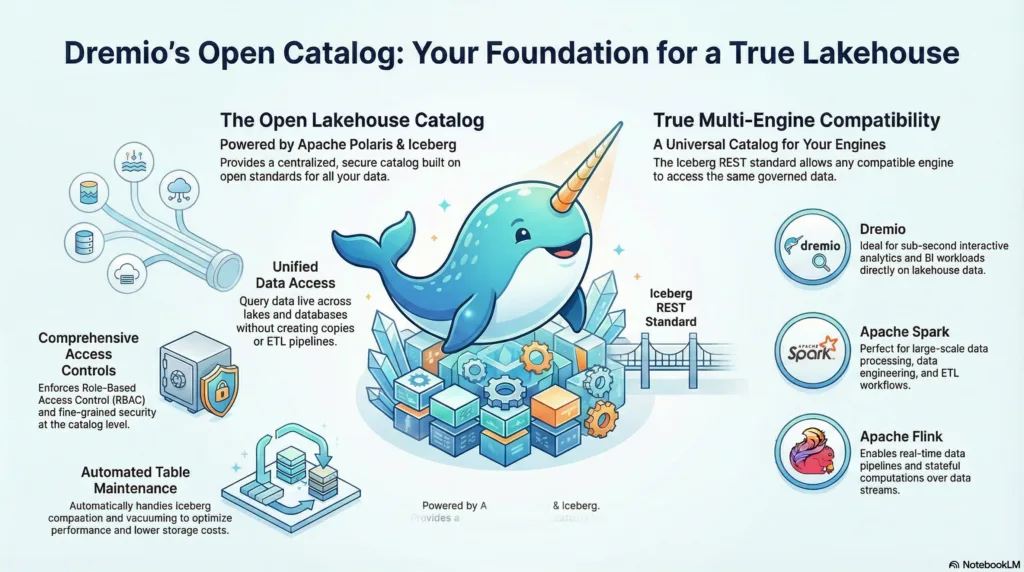
Dremio’s built-in Open Catalog for Apache Iceberg is designed to be completely open, powered by an open implementation of the Iceberg REST API based on the Apache Polaris specification. This ensures a standard, non-proprietary interface. It exposes a standard endpoint (https://catalog.dremio.cloud/api/iceberg) that allows other popular data engines like Apache Spark, Trino, and Apache Flink to connect to it directly. This isn't a simple API stub; Dremio provides robust, documented configurations, proving that multi-engine interoperability is a first-class design principle, not a marketing checkbox.
The Impact: This openness is a game-changer. It prevents vendor lock-in and positions Dremio as the central semantic and governance layer for a flexible, multi-engine data ecosystem. Your data engineering teams can use Spark for large-scale ETL, data scientists can use Flink for real-time processing, and analysts can use Dremio for interactive BI, all while sharing a single, consistent, and governed view of the data. It empowers teams to use the best tool for the job without creating new data silos.
4. Loading Data is Now a Single, Simple SQL Command
Ingesting new data into the lakehouse has traditionally required complex, code-heavy ETL scripts or reliance on external tools. This complexity creates a bottleneck, slowing down the process of making new datasets available for analysis.
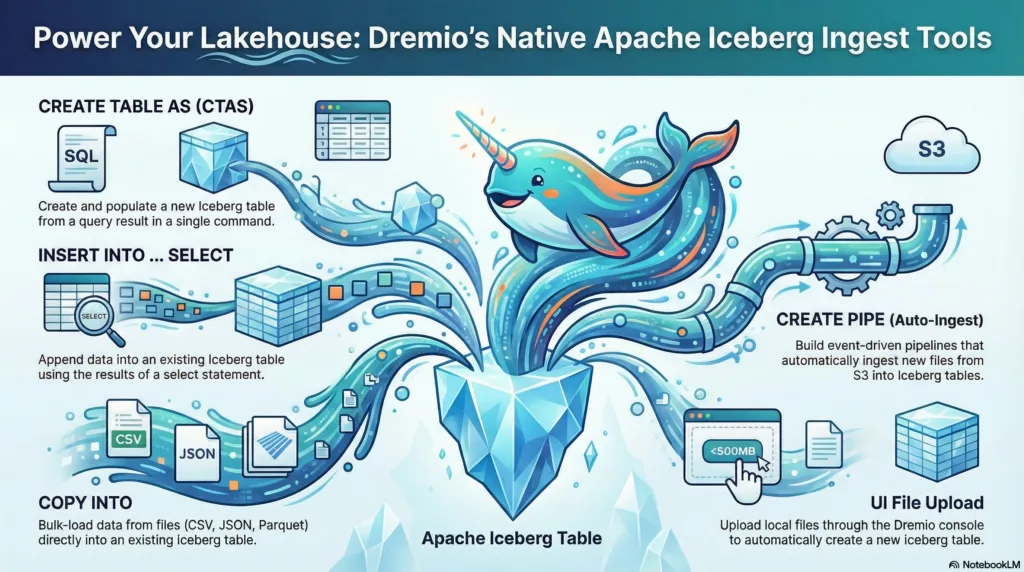
Dremio radically simplifies this with the COPY INTO SQL command. This single command allows any user to perform a one-time, bulk load of data from common file formats like CSV, JSON, and Parquet directly from object storage (like S3) into a high-performance Apache Iceberg table.
The Impact: COPY INTO democratizes data ingestion. It empowers analysts and engineers to onboard new datasets with a single, familiar SQL command, drastically reducing the time and effort required. For many common use cases, this eliminates the need for external tools or writing complex data pipelines, making the process of introducing new data into the lakehouse faster and more accessible to a broader audience.
5. You Can Now Query Your Unstructured Data (Yes, even PDFs) with SQL
Vast amounts of valuable information are locked away in unstructured files like PDFs, documents, and reports, traditionally inaccessible to standard data analytics tools. Unlocking this "dark data" often requires specialized AI platforms and complex processing pipelines.
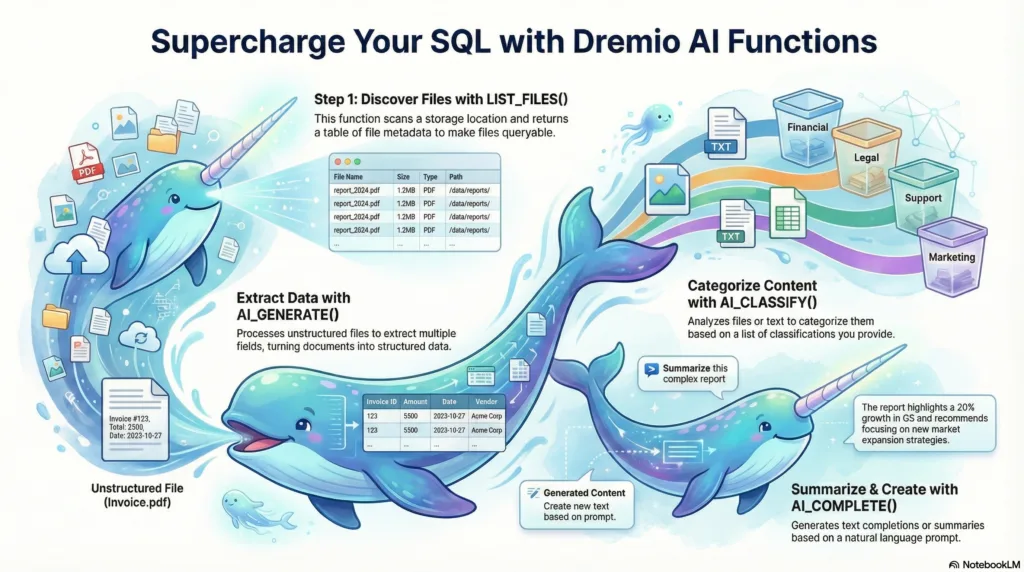
Dremio brings this capability directly into the lakehouse with native AI functions. Using the AI_GENERATE function in combination with the LIST_FILES table function, you can process unstructured files directly in object storage with SQL. Imagine running a query like the one below, which scans a folder of PDF recipes and extracts structured data into a queryable table, all with a single SQL statement.
SELECT

  recipe_info['recipe_name'] AS recipe,

  recipe_info['cuisine_type'] AS cuisine

FROM (

  SELECT

    AI_GENERATE(

      ('Extract recipe details', file)

      WITH SCHEMA ROW(recipe_name VARCHAR, cuisine_type VARCHAR)

    ) AS recipe_info

  FROM

    TABLE(LIST_FILES('@Cookbooks/recipes'))

  WHERE

    file['path'] LIKE '%.pdf'

)
The Impact: This capability fundamentally redefines the boundaries of the data lakehouse, blurring the line between the data lakehouse and AI/ML platforms. It brings sophisticated Retrieval-Augmented Generation (RAG) capabilities, which often require separate vector databases and complex Python pipelines, directly into the familiar world of SQL. This makes them accessible to a much broader audience of data analysts, allowing the universal language of data to be used for analyzing massive collections of documents, reports, and other text-based files.
Conclusion
The data lakehouse is evolving beyond just being a repository for data. With Dremio, it's becoming an autonomous, open, and intelligent platform that actively works to simplify your architecture, accelerate your queries, and expand the very definition of what data can be analyzed.
From self-managing performance and serverless compute to an open catalog, simplified ingestion, and the ability to query unstructured text, these five capabilities represent a fundamental shift in how data teams can operate. They remove friction, automate complexity, and put powerful new tools directly into the hands of users. This frees up valuable time and resources, allowing you to focus on what truly matters.
When your data platform can manage itself and query anything, what new business questions will you finally be able to ask?
Keep learning
For a deeper treatment of the topics in this post, download Apache Iceberg: The Definitive Guide by Tomer Shiran, Jason Hughes, and Alex Merced, free from Dremio.
Ingesting Data Into Apache Iceberg Tables with Dremio: A Unified Path to Iceberg
By unifying data from diverse sources, simplifying data operations, and providing powerful tools for data management, Dremio stands out as a comprehensive solution for modern data needs. Whether you are a data engineer, business analyst, or data scientist, harnessing the combined power of Dremio and Apache Iceberg will undoubtedly be a valuable asset in your data management toolkit.
Oct 12, 2023·Product Insights from the Dremio Blog
Table-Driven Access Policies Using Subqueries
This blog helps you learn about table-driven access policies in Dremio Cloud and Dremio Software v24.1+.
Aug 31, 2023·Dremio Blog: News Highlights
Dremio Arctic is Now Your Data Lakehouse Catalog in Dremio Cloud
Dremio Arctic bring new features to Dremio Cloud, including Apache Iceberg table optimization and Data as Code.